

Overview of the Conference
This report analyzes Ethiopia’s participation in the 2024 World without Hunger Conference in Addis Ababa. Facing significant food insecurity challenges (high vulnerability, limited technology access, post-harvest losses), Ethiopia sought funding for agricultural investments, technology partnerships, policy changes (climate finance, fair trade), and capacity building. The conference has also focused on sharing best practices, fostering collaboration, and attracting investment in sustainable food systems through plenary sessions, technical showcases and a field visit.
The Addis Ababa World without Hunger Conference (held November 5 to 7, 2024) served as a pivotal platform for sharing best practices and innovative solutions to global food insecurity. Organized by UNIDO, in partnership with the Federal Democratic Republic of Ethiopia, the African Union, and the FAO, the conference underscored a unified global commitment to ending hunger. Discussions emphasized actionable strategies and the importance of collaboration across sectors to create sustainable food systems. The high-level attendance, including UNIDO Director-General Gerd Müller and the Crown Prince of Abu Dhabi, further highlighted the international priority placed on achieving food security.
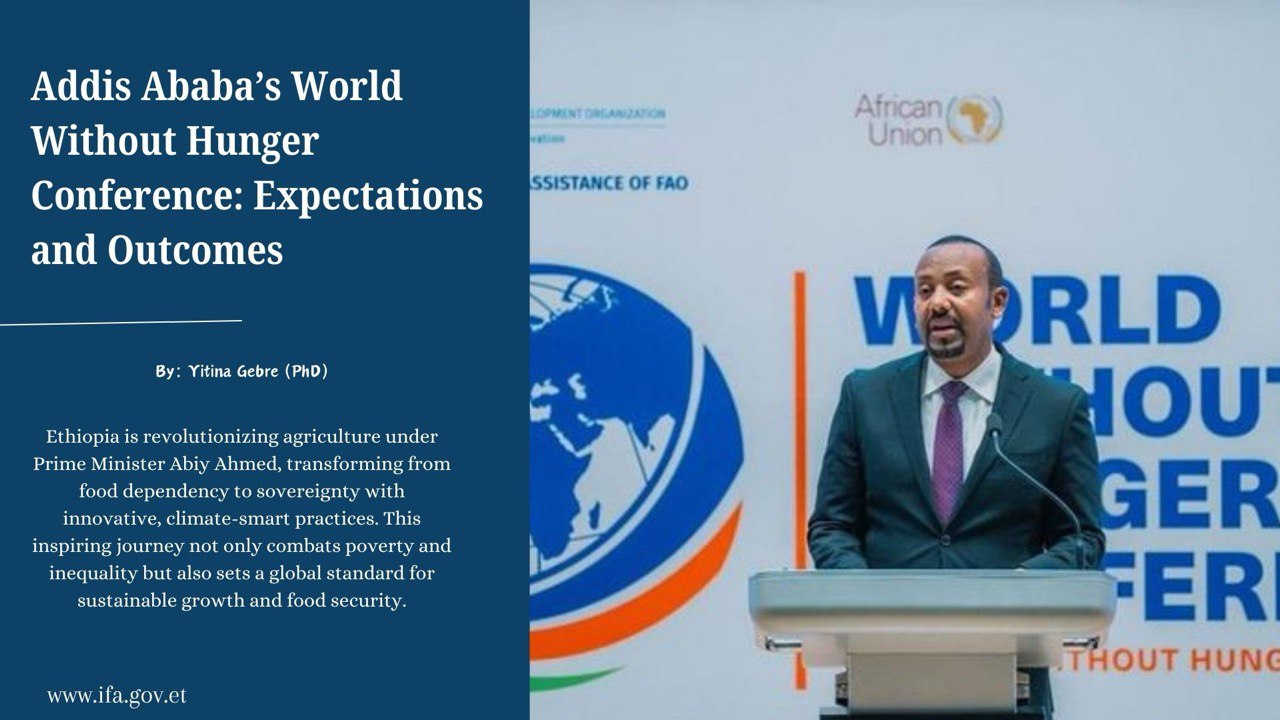
Prime Minister Abiy Ahmed officially inaugurated the event, emphasizing the transformative impact of UNIDO’s initiatives in the fight against hunger. The opening day featured a plenary session that delved into key topics, including agribusiness development, innovation, climate change, and fair trade. This was followed by technical sessions, showcasing various local food security initiatives, and culminated in a field visit that provided participants with firsthand insights into these efforts in practice.
The second day was dedicated to the investment forum, which aimed to attract funding for strategic areas such as agribusiness infrastructure, technology, and renewable energy. This forum served as a dynamic platform for connecting governments, startups, and investors, fostering partnerships to stimulate economic growth while enhancing food security.
The final day of the conference featured high-level statements from global leaders and experts, a government-business dialogue, and a political forum that concluded with the adoption of the “Addis Ababa Call to Action.” This political declaration, accompanied by a comprehensive final report, summarized the conference’s key discussions and outcomes, establishing a roadmap for future collaborative efforts.
One of the most notable highlights was UNIDO’s call for urgent investment, with an estimated $50 billion required over the next decade to eradicate hunger globally. This ambitious goal underscores the scale of resources and commitment needed to achieve lasting food security. The agreements and insights forged during the conference are expected to significantly influence future policies and initiatives, particularly in Africa, while fostering international collaboration to advance food security and sustainable development. The conference concluded on November 7, 2024, with optimism that its outcomes will catalyze meaningful progress in the global fight against hunger.
In alignment with the 2013 Lima Declaration, the World Without Hunger Conference underscored the critical role of inclusive and sustainable industrial development (ISID) in combating hunger. The United Nations Industrial Development Organization (UNIDO) has been instrumental in promoting ISID among its member states, advocating for an integrated approach that balances social equity, economic growth, and environmental sustainability. Recognizing the interconnected nature of these pillars is essential for crafting long-term solutions to global food insecurity.
The UNIDO, through a range of programs including technical cooperation, research, and policy advice, works to build resilient food systems globally. Its ISID model emphasizes equitable participation in industrial growth, promoting social inclusion and sustainable development alongside economic progress.
A key achievement was the February 19, 2024, agreement between UNIDO, CIDCA, and the Ethiopian government, solidifying a partnership to advance the UN’s 2030 Agenda through development projects in agriculture, renewable energy, digital technology, and trade. This includes establishing a center of excellence and expertise exchange, and formally integrates UNIDO into the Global Development Promotion Center Network, leveraging the UNIDO’s Program for Country Partnership (PCP) model for attracting investment and aligning with national development priorities. This South-South cooperation model, highlighted by UNIDO Director-General Gerd Müller, shows potential for scalability.
Field visits to Ethiopian agricultural projects showcased successful strategies, inspiring attendees to replicate these models in their own countries, establishing Ethiopia as a potential model for Africa and beyond. The conference, therefore, serves as a powerful example of international collaboration towards achieving sustainable development goals and ending hunger.
Ethiopia’s Context, Pre-Conference Initiatives
Ethiopia faced significant food insecurity challenges, including high vulnerability, limited access to modern agricultural technologies, and significant post-harvest losses (among others) further constrained food production and availability. These factors disproportionately affected smallholder farmers, exacerbating existing inequalities. Ethiopia has already implemented various national programs aimed at improving food security. These included initiatives to expand irrigation infrastructure, strengthen agricultural extension services, and provide support to smallholder farmers through input subsidies and credit schemes. While some progress was made, limitations remained in terms of scaling up successful initiatives, ensuring equitable access to resources, and adapting to the escalating impacts of climate change. Prior to the conference, Ethiopia engaged in several international collaborations focused on food security. These provided technical assistance, funding, and capacity-building support, but often faced coordination challenges and limitations in translating global commitments into effective and efficient action that brings justifiable and sound impact on the country.
Ethiopia’s Expectations at the Conference
Ethiopia’s participation in the 2024 World without Hunger Conference in Addis Ababa reflected its commitment to eradicating hunger. Key expectations included securing substantial funding for agricultural investments (irrigation, farmer support, climate-resilient technologies); establishing partnerships for technology transfer and research (drought-resistant crops, improved post-harvest practices), and influencing global policy to improve climate finance, fair trade, and market access; and strengthening national capacity through training, farmer support networks, and robust monitoring systems. These priorities guided Ethiopia’s engagement and shaped its assessment of the conference’s success.
Conference Outcomes for Ethiopia
Ethiopia significantly benefited from the World Without Hunger Conference. Its successful sustainable agriculture practices, including climate-resilient crops and community farming, served as a valuable model. The conference facilitated new partnerships focused on seed distribution and technology transfer, leading to policy recommendations concerning rural infrastructure and fair trade. Specific actions were agreed upon to empower youth and women in agriculture.
Concrete strategies for hunger eradication, such as climate-smart agriculture and improved food storage, emerged from the conference. Increased global awareness resulted in new funding pledges and significant media attention, strengthening commitments to sustainable agriculture, including reduced fertilizer use. The conference also expanded Ethiopia’s professional networks, paving the way for future collaboration.
Call to Action
The long-term success of the initiatives launched at the World without Hunger Conference in Addis Ababa, Ethiopia depends on several key factors: sustainability, effective implementation, and robust monitoring. To maintain and expand these programs, consistent funding, strong institutional capacity, and adaptability to evolving challenges such as climate change and political instability are essential.
Key Remarks from Leaders
Prime Minister Abiy Ahmed of Ethiopia emphasized the urgent need for innovative and sustainable agricultural practices. He highlighted the importance of improved access to agricultural inputs and effective climate change mitigation. Advocating for a holistic approach, he noted that it is crucial to address underlying issues of poverty and inequality. Citing Ethiopia’s agricultural transformation as a successful model, he remarked that the country has doubled its cultivated land and achieved significant results with high-value crops.
UNIDO Director-General Gerd Müller stressed the feasibility of achieving a hunger-free world, emphasizing that political will and substantial investment are critical. He called for an additional $50 billion annually for the next ten years to be directed toward infrastructure, innovation, and agribusiness. Müller also announced the opening of the China–Africa–UNIDO Centre of Excellence in Addis Ababa, aimed at fostering collaboration and knowledge exchange.
African Union Commission Chairperson Moussa Faki highlighted the urgent need to combat food insecurity in Africa, where over 280 million people are food insecure and 850 million lack access to a healthy diet. He acknowledged the continent’s vast potential despite current challenges and called for improved implementation of the AU’s 10-year Action Plan for resilient and sustainable agri-food systems. Faki urged development partners to align their resources with these objectives.
The remarks from these leaders underscore a unified commitment to addressing food security through innovative solutions and collaborative efforts. By focusing on sustainable practices and mobilizing the necessary investments, the initiatives from the conference can pave the way toward a hunger-free future for Ethiopia and the broader African continent.
About Authors
Dr.Yitina Gebre Multilateral Affairs Research Director General at the Institute of Foreign Affairs (IFA).
Declaimer: The opinions stated in this article solely belong to the author and do not reflect the views or positions of the IFA