

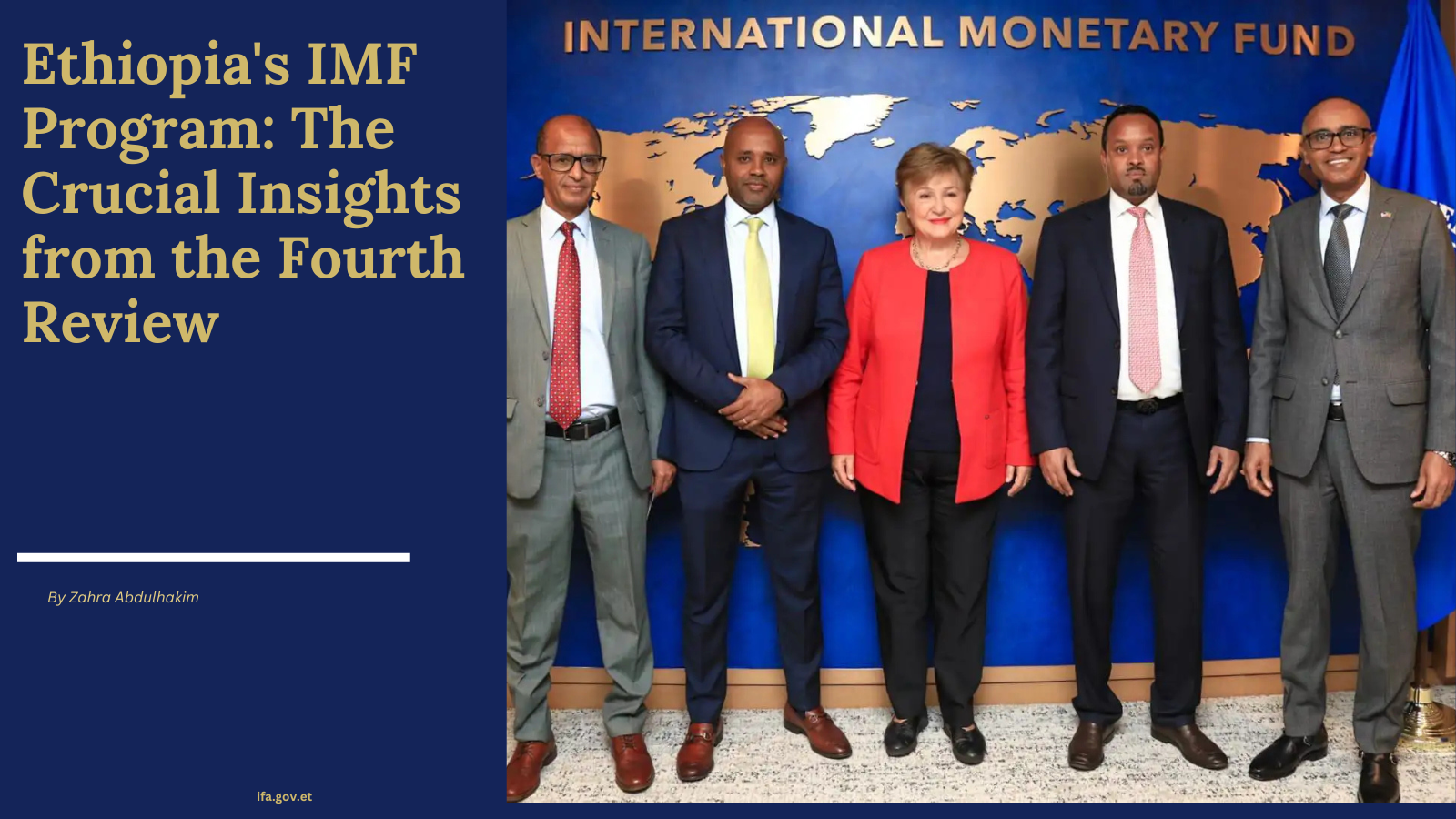
Ethiopia has reached a notable milestone in its ongoing economic reform agenda following a staff-level agreement between the International Monetary Fund (IMF) and Ethiopian authorities on the fourth review of the country’s Extended Credit Facility (ECF) arrangement. Subject to approval by IMF management and the Executive Board in the coming weeks, the agreement is expected to unlock approximately USD 261 million in new financing. This would bring total IMF disbursements under the program to about USD 2.13 billion, out of the USD 3.4 billion facility approved in July 2024 to support Ethiopia’s Homegrown Economic Reform (HGER) agenda. While the immediate financial injection offers short-term relief, the broader significance of the review lies in Ethiopia’s ability to sustain one of Africa’s most determined economic reform programs amid debt restructuring pressures, post-conflict recovery, and far-reaching monetary and fiscal adjustments.
According to the IMF staff team, led by Alvaro Piris, implementation of the ECF-supported program has delivered favorable macroeconomic outcomes. Economic growth has accelerated, inflation has declined, and the value of goods exports has more than doubled within a year. These outcomes reflect a relatively strong reform momentum, with the program’s disbursement rate now standing at roughly 62.5 percent. A central driver has been the liberalization of the foreign exchange regime in July 2024, which effectively eliminated the parallel market premium and improved price discovery and transparency. This shift, combined with tighter monetary policy, has helped stabilize expectations despite an initial depreciation of the birr.
Export performance has been further strengthened by increased gold production, partly due to the formalization of previously informal supply channels, as well as a rebound in agricultural exports. These gains have improved external balances and enhanced Ethiopia’s capacity to finance essential imports and meet external obligations. At the same time, the export base remains concentrated in a limited range of commodities, leaving the economy exposed to price volatility and external shocks. Inflation dynamics nonetheless suggest growing policy credibility, as price pressures have moderated in spite of currency adjustment, reflecting improved supply conditions and disciplined macroeconomic management. The IMF has underscored the importance of continuing efforts to deepen foreign exchange market liquidity and develop risk-hedging instruments to support private sector activity and investor confidence.
Debt restructuring remains a pivotal, yet unresolved, component of Ethiopia’s stabilization strategy. The program is anchored in the G20 Common Framework, under which Ethiopia reached a memorandum of understanding with its Official Creditor Committee in July 2025. This step represents meaningful procedural progress, but the process is incomplete, as bilateral agreements—particularly with major creditors such as China—have yet to be finalized. Until these negotiations are concluded, a portion of IMF financing will continue to be absorbed by debt servicing rather than redirected toward growth-enhancing public investment. Restoring full debt sustainability is therefore essential, not only to regain fiscal space but also to rebuild market confidence and attract private capital.
Economic growth has gathered pace since mid-2024, driven by sector-specific developments. Gold exports have emerged as a major contributor to foreign exchange earnings, although part of this increase may reflect statistical reclassification rather than purely organic expansion. Energy generation from the Grand Ethiopian Renaissance Dam (GERD) has strengthened domestic power supply and enhanced Ethiopia’s potential as a regional electricity exporter, even as the project remains entangled in sensitive geopolitical dynamics with downstream riparian states, notably Egypt. Agriculture has also shown signs of recovery, supported by favorable weather conditions and targeted policy incentives, though productivity gains remain vulnerable to climate variability and logistical constraints.
These positive trends should be interpreted with caution. Much of the observed acceleration reflects recovery from a low base following years of conflict, pandemic disruptions, and macroeconomic imbalances. Sustaining growth at higher levels will require deeper structural transformation, including diversification away from primary commodities, expanded infrastructure investment, and sustained improvements in human capital. Without these shifts, current gains may prove difficult to maintain over the medium term.
The reform agenda also carries significant political and institutional implications. Currency depreciation, subsidy rationalization, and fiscal tightening have imposed tangible costs on urban households and the middle class, raising concerns about social tolerance for continued adjustment. Ethiopia’s federal structure, combined with regional disparities and post-conflict sensitivities, complicates the consistent implementation of reforms across the country. While the IMF has emphasized inclusive consultations with financial institutions, the private sector, and development partners, maintaining a broad domestic consensus remains a delicate task.
Prime Minister Abiy Ahmed’s administration has thus far managed to balance reform ambition with political realities, but more demanding phases lie ahead. Planned measures such as civil service reform, state-owned enterprise restructuring, and deeper financial sector reforms could test institutional capacity and political cohesion. Experience from other reform episodes suggests that reform fatigue can emerge once distributional effects become more pronounced, making sustained political commitment a critical variable in the program’s success.
Looking ahead, Ethiopia has already implemented several high-impact reforms, including exchange rate liberalization and initial fiscal consolidation. Future reviews will focus on more entrenched and politically sensitive measures, such as subsidy phase-outs and banking sector recapitalization, which may expose underlying vulnerabilities and provoke resistance from vested interests. External risks—including global commodity price swings, regional instability, and tighter international financial conditions—could further complicate the adjustment path. Domestically, deepening foreign exchange markets and completing debt restructuring will be essential benchmarks for long-term macroeconomic viability.
Beyond its national implications, Ethiopia’s experience under the ECF carries broader relevance for the African continent. As Africa’s second-most populous country and host of the African Union, Ethiopia’s reform trajectory serves as a test case for the effectiveness of the G20 Common Framework in delivering timely and meaningful debt relief. Its approach to exchange rate liberalization offers lessons on managing currency transitions without triggering runaway inflation, while its gradual shift from a state-led to a more market-oriented development model may inform similar efforts elsewhere, provided political contexts allow for adaptation.
In conclusion, the fourth review of Ethiopia’s IMF program affirms tangible progress in stabilizing the economy, with notable gains in exports, inflation control, and growth. Yet the durability of these achievements will depend on resolving outstanding debt negotiations, deepening structural reforms, and cushioning the economy against external shocks. The outcome of this program will not only shape Ethiopia’s economic destiny but also influence debt-distressed peers across the continent, highlighting the interplay of policy resolve and global cooperation in fostering sustainable development.
By Zahra Abdulhakim, an independent researcher
Disclaimer:
The content disseminated by the Institute of Foreign Affairs (IFA) – including, but not limited to, publications, public statements, events, media appearances, and digital communications – reflects the views of individual contributors and does not necessarily represent the official positions or policies of the Institute, its partners, or any affiliated governmental or non-governmental entities.
While the IFA endeavors to ensure the accuracy, integrity, and timeliness of the information presented, it makes no representations or warranties, express or implied, regarding the completeness, reliability, or suitability of such content for any purpose. The Institute expressly disclaims any liability for errors or omissions, as well as for any actions taken or decisions made based on the information provided.
The inclusion of external links, references, or third-party resources does not constitute an endorsement by the Institute. Additionally, engagement on social media platforms – including, but not limited to, likes, shares, retweets (RTs), or reposts – shall not be interpreted as an endorsement or validation of the views expressed therein.
Readers and audiences are encouraged to exercise critical judgment and seek independent verification when interpreting or relying upon any information disseminated through publications and posts on the Institute’s platforms or representatives.