

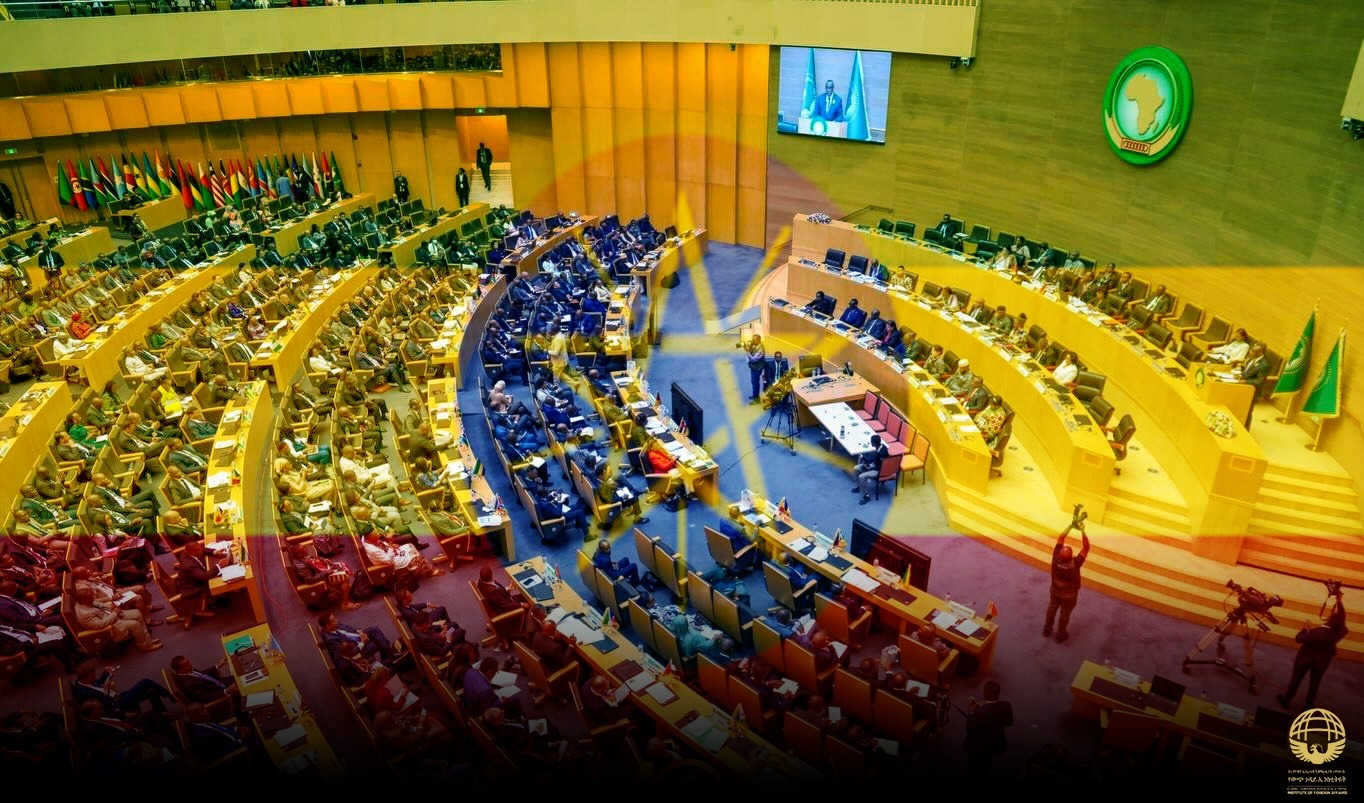
The African Union’s 39th Ordinary Summit convenes in Addis Ababa this week under the theme “Assuring Sustainable Water Availability and Safe Sanitation Systems,” bringing together 55 heads of state at a moment of heightened geopolitical significance for Ethiopia. While the water theme dominates official proceedings, the summit’s political agenda encompasses peace and security coordination in Somalia and Sudan, institutional elections, climate diplomacy preparations for COP32, and the persistent challenge of AU financing reform. For Ethiopia, this convergence of continental priorities presents a rare strategic opportunity to advance core national interests through institutional influence, normative agenda-setting, and bilateral diplomacy on the margins of multilateral engagement.
The Water Governance Framework: Aligning Continental Priorities with Ethiopian Development
The 2026 AU theme directly intersects with Ethiopia’s most visible infrastructure project: the Grand Ethiopian Renaissance Dam (GERD). Africa faces a substantial water and sanitation deficit, with 411 million Africans lacking safe water access and 779 million without adequate sanitation, according to AU estimates. Closing this gap requires an additional $30 billion annually beyond current continental investment levels of $10-19 billion. Against this backdrop, Ethiopia’s completion and inauguration of the 5,150-megawatt GERD in September 2025 positions the country as a practical demonstration of development-oriented water infrastructure.
The strategic framing matters. The AU’s established water governance architecture through Agenda 2063, the Africa Water Vision, and the Continental Africa Water Investment Programme emphasizes equitable and reasonable utilization, development-oriented infrastructure, and technical cooperation over securitization. These principles align precisely with Ethiopia’s approach to Nile development. By centering the summit on water governance while operating Africa’s largest hydropower dam, Ethiopia can position the GERD within AU normative frameworks rather than as the “existential threat” framed by Cairo.
Research from the MIT Joint Program on the Science and Policy of Global Change, including the 2025 J-WAFS report on the GERD, confirms that coordinated operation between upstream and downstream dams reduces basin-wide evaporation and maximizes energy efficiency. The High Aswan Dam loses an estimated 10-12 billion cubic meters annually to evaporation in the Saharan heat, while the GERD, located in cooler highland gorges, loses approximately 1.5-1.7 billion cubic meters. This differential represents not water diversion but system optimization, a technical reality that supports Ethiopia’s development rights under international water law principles of equitable utilization.
Ethiopia should ensure that AU documentation and ministerial statements emerging from the summit explicitly reference non-consumptive hydropower as compatible with equitable utilization principles. This establishes normative precedent that undermines securitization narratives while reinforcing Ethiopia’s position that development and cooperation are complementary rather than contradictory.
Peace and Security: Somalia File and Regional Burden-Sharing
Despite the water theme, the International Crisis Group confirms that peace and security will be the summit’s political gravity center. The agenda includes Somalia/Al-Shabaab threat assessments, Sudan crisis coordination, ATMIS future operations, and regional peacekeeping financing. Ethiopia maintains thousands of troops in Somalia under both bilateral arrangements and AU mandates, while simultaneously navigating diplomatic tensions with Mogadishu over Somaliland, subsequently deferred through the December 2024 Ankara Declaration.
The financial context is critical. Kenya’s President Ruto continues pushing for $1 billion in contributions to the AU Peace Fund, but only 17 of 55 AU states currently charge the 0.2% levy designated for AU operations. International partners still finance 64% of the AU’s $700 million budget, and U.S. skepticism toward long-term African mission funding persists across both Biden and Trump administrations.
For Ethiopia, this creates negotiating leverage. As a major troop contributor facing both peacekeeping obligations and unresolved development constraints including maritime access, Ethiopia can emphasize that continental security muscle requires reciprocal AU institutional support for legitimate development concerns. The message should be clear: states that provide regional stabilization cannot simultaneously have their economic development aspirations treated as security threats.
Maritime Access and Landlocked State Equity
Multiple African analysts and Ethiopian commentators now argue that the AU must develop a framework for maritime access equity for landlocked states. Ethiopia, with a population exceeding 130 million, is the world’s most populous landlocked nation, with over 90% of its trade flowing through a single corridor to Djibouti. The country lost Red Sea access in 1993 with Eritrean independence, creating a structural development constraint that affects continental integration.
As the African Union convenes its current Summit, it should confront maritime access not as a bilateral dispute, but as a continental structural challenge affecting all landlocked states, including Ethiopia. Recently the Reporter stated that, “maritime access is not only an economic question; it also carries security dimensions,” particularly for a country that is one of Africa’s largest economies and a leading contributor to AU and UN peace operations, with legitimate interests in the safety of the sea-lanes that sustain its trade, energy, and food security. The Summit should therefore elevate the issue into a structured AU framework—mandating a high-level panel on maritime access for landlocked states, developing principles on transit equity and cooperative port arrangements, and aligning maritime solutions with the implementation of the AfCFTA—so that access is governed by rules, sovereignty is safeguarded, and African ownership of maritime security in the Red Sea and beyond becomes a stabilizing force rather than a source of friction. By choosing foresight over delay, the AU can transform Ethiopia’s maritime question into a test case for continental agency, fairness, and long-term strategic coherence.
Ethiopia should push for AU institutional recognition that landlocked status constitutes a structural development constraint requiring collective solutions, not merely bilateral negotiations that trigger sovereignty disputes. The framing shift matters: from “Ethiopia threatening Somalia’s sovereignty” to “AU addressing systemic infrastructure deficits that limit continental integration and trade.”
Institutional Elections and Long-Term Influence
The Executive Council handles elections for Peace and Security Council seats, the African Commission on Human and Peoples’ Rights, and the African Committee of Experts on the Rights and Welfare of the Child. Ethiopia should secure or actively support candidates who understand Horn of Africa security complexities and will not reflexively adopt Cairo’s framing on Nile issues. These institutional positions shape continental policy discourse and conflict mediation approaches for multi-year terms.
Climate Diplomacy and COP32 Preparation
Ethiopia secured COP32 hosting rights for 2027 in Addis Ababa. The 2026 AU theme builds on outcomes from the September 2025 African Climate Summit and positions Ethiopia ahead of COP30 in Brazil. The UAE is co-hosting the 2026 UN Water Conference later this year and has deepened bilateral ties with Ethiopia, including Prime Minister Abiy’s recent UAE visit and a joint statement on Sudan humanitarian coordination.
Ethiopia should use the AU Summit to preview COP32 priorities, positioning the water-energy nexus as a climate adaptation strategy. The GERD becomes climate infrastructure in this framing: reliable renewable energy that moderates hydrological variability through regulated flow management. This connects Ethiopia’s development to continental climate resilience, a narrative that strengthens both AU support and international climate finance eligibility.
The 2026 AU theme chose water for substantive reasons. Africa has 64 transboundary river basins, climate change is intensifying scarcity, and colonial-era agreements privilege downstream states across the continent. The GERD dispute serves as a test case for whether Africa can build governance systems based on equitable development or whether it defaults to externally imposed frameworks that freeze historical inequities.
Ethiopia’s position is fundamentally about African agency: the right to develop resources, negotiate as equals, and reject frameworks that subordinate upstream states to colonial arrangements. If Ethiopia succeeds in securing AU institutional endorsement of principles aligning with equitable utilization and development rights, it establishes precedent applicable to the Congo Basin, Niger Basin, and other transboundary systems where upstream states face similar constraints.
Conclusion: From Hosting to Agenda-Setting
Ethiopia enters this summit with structural advantages: host nation status, AU headquarters permanence, COP32 hosting responsibilities, and thematic alignment between continental water priorities and national infrastructure. The challenges are evident: Egypt’s diplomatic campaign, Trump administration mediation offers, Somalia tensions, and peacekeeping leverage dynamics.
The winning strategy does not seek confrontation but normative victories. Ethiopia should convert hosting advantage into AU institutional endorsement of principles that align with Ethiopian interests. The summit should be about Africa’s water governance future, not Ethiopia versus Egypt. Maritime access should be framed as a continental development imperative, not a bilateral sovereignty dispute.
Ethiopia does not need to dominate summit proceedings. It needs to shape the frameworks that will govern continental policy for the next decade. Addis Ababa, as both host city and continental capital, is precisely where those frameworks are written. The question is whether Ethiopia capitalizes on this moment to advance both national interests and continental principles of equitable development, or whether it allows external powers and regional rivals to set the terms of engagement. The evidence suggests Ethiopia has both the opportunity and the strategic positioning to succeed, provided it executes with precision on institutional engagement, bilateral diplomacy, and communications strategy throughout the summit proceedings.
By Getahun Tsegaye, Assistant researcher @IFA
Disclaimer:
The content disseminated by the Institute of Foreign Affairs (IFA) – including, but not limited to, publications, public statements, events, media appearances, and digital communications – reflects the views of individual contributors and does not necessarily represent the official positions or policies of the Institute, its partners, or any affiliated governmental or non-governmental entities.
While the IFA endeavors to ensure the accuracy, integrity, and timeliness of the information presented, it makes no representations or warranties, express or implied, regarding the completeness, reliability, or suitability of such content for any purpose. The Institute expressly disclaims any liability for errors or omissions, as well as for any actions taken or decisions made based on the information provided.
The inclusion of external links, references, or third-party resources does not constitute an endorsement by the Institute. Additionally, engagement on social media platforms – including, but not limited to, likes, shares, retweets (RTs), or reposts – shall not be interpreted as an endorsement or validation of the views expressed therein.
Readers and audiences are encouraged to exercise critical judgment and seek independent verification when interpreting or relying upon any information disseminated through publications and posts on the Institute’s platforms or representatives.