

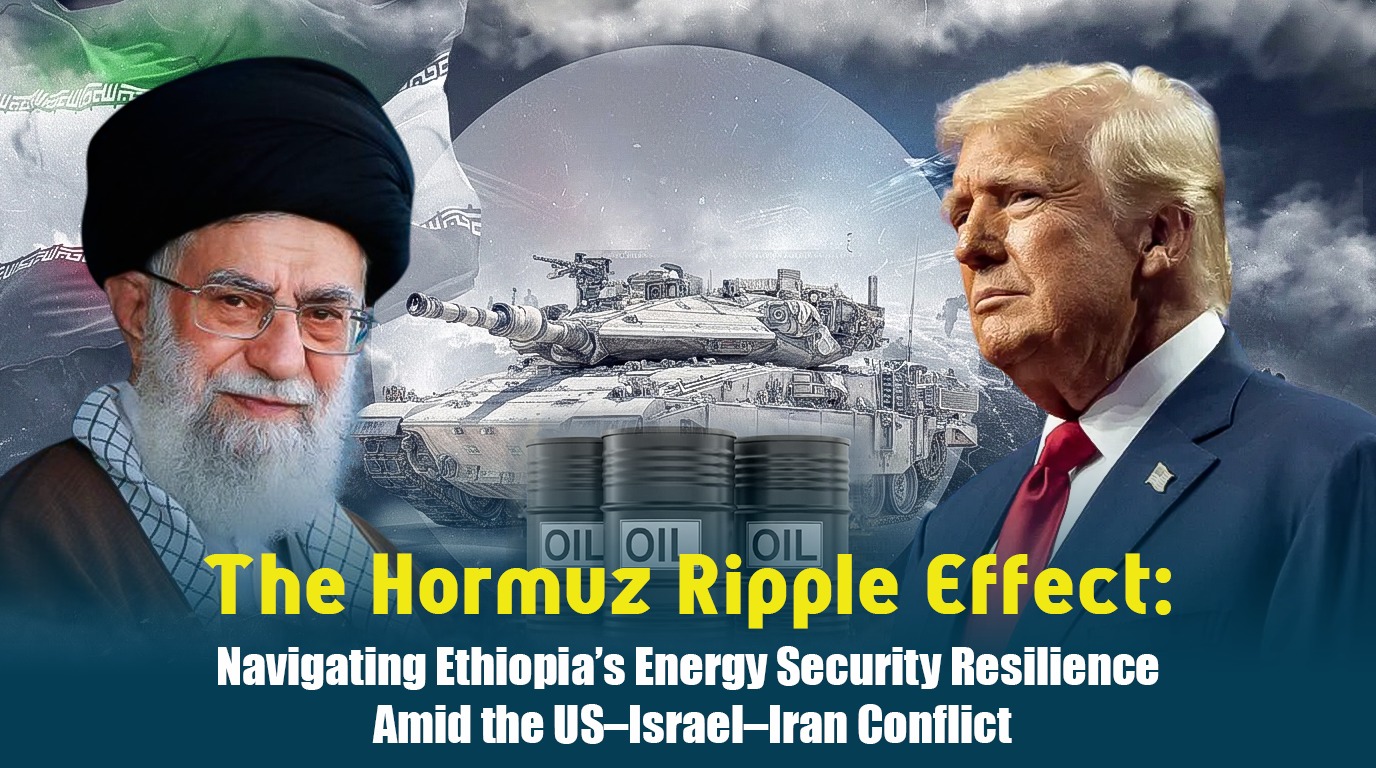
As of 2 March 2026, three days have passed since coordinated military strikes by the United States and Israel targeted strategic assets inside Iran on 28 February 2026, marking a consequential escalation in Middle Eastern geopolitics. Tehran’s subsequent missile and drone responses across the Gulf have widened the confrontation beyond a contained military exchange into a systemic regional crisis affecting energy infrastructure, maritime corridors, and global commodity markets. While the immediate theatre of conflict lies far from the Horn of Africa, the economic reverberations are neither distant nor abstract for Ethiopia.
At the centre of this unfolding volatility is the Strait of Hormuz, the narrow maritime passage linking the Persian Gulf to global markets. Approximately one-fifth of the world’s traded crude oil and a significant share of liquefied natural gas transit daily through this corridor. According to the U.S. Energy Information Administration (EIA), nearly 20 million barrels per day passed through the Strait in 2024, representing close to $500 billion in annual energy trade. Even partial disruption injects substantial risk premiums into oil futures markets, elevates insurance costs for tankers, and reduces shipping volumes. The economic consequences cascade rapidly across import-dependent economies, irrespective of geographical proximity to the Gulf.
Public statements by senior advisers within Iran’s Islamic Revolutionary Guard Corps (IRGC) declaring the Strait closed and warning against vessel passage have intensified market anxieties. Whether or not such declarations translate into sustained enforcement, the perception of risk alone is sufficient to drive volatility. In highly financialized global energy markets, expectations matter as much as physical supply. For Ethiopia—an economy that does not produce crude oil at commercial scale and relies heavily on imported refined petroleum products—the implications are direct and immediate.
Ethiopia’s structural exposure stems from its energy import profile. The country sources diesel, gasoline, jet fuel, and heavy fuel oil primarily from Gulf suppliers, including the United Arab Emirates, Saudi Arabia, and Kuwait. These same states have reportedly faced retaliatory missile and drone incidents targeting strategic facilities. The vulnerability of energy infrastructure in the Gulf is not theoretical.
The attacks on Ras Tanura, Saudi Arabia’s largest oil refinery on the Persian Gulf coast, led to a complete halt of Aramco operations on Monday, March 3rd. This disruption removed 550,000 barrels per day from the global supply, sending benchmark prices sharply upward within hours. Should refinery operations in Saudi Arabia or elsewhere in the Gulf face renewed or sustained bombardment, supply tightness could compound the effects of maritime disruption, amplifying global price shocks.
Ethiopia’s exposure, however, is not limited to the Strait itself. Approximately 90–95 percent of its petroleum imports enter through the Port of Djibouti in Djibouti. This logistical concentration, while efficient under stable conditions, represents a structural chokepoint during periods of regional turbulence. Beyond Hormuz lies a second vulnerability: the Red Sea–Mediterranean corridor via the Suez Canal. According to the United Nations Conference on Trade and Development (UNCTAD), the Canal accounts for between 12 and 15 percent of global trade and nearly 30 percent of global container traffic. Heightened hostilities in the region, including renewed Houthi attacks on commercial shipping in the Red Sea, could elevate freight costs, extend delivery timelines, and disrupt insurance frameworks. In the latest development of Tehran war, Houthi rebels in Yemen have threatened to escalate attacks against international shipping in the Red Sea.
For Ethiopia, therefore, the risk emanating from the US–Israel–Iran confrontation is not primarily one of physical blockade but of price transmission and systemic vulnerability.
If the disruption at Hormuz proves to continue-be it for the coming few weeks or so, energy security should be reframed as a central pillar of national resilience. Ethiopia’s response should at least rest on a three-pillar strategy integrating infrastructure resilience, structural transition, and proactive diplomacy.
First, strengthening strategic petroleum reserves—either through expanded domestic storage capacity or through bilateral buffering agreements—would enhance short-term shock absorption. Investments in storage facilities along the Djibouti–Addis Ababa corridor would mitigate temporary shipping disruptions and reduce vulnerability to logistical bottlenecks.
Second, diversification of supply contracts beyond a narrow concentration in the Gulf would incrementally reduce exposure to maritime chokepoints. While global energy markets are inherently interconnected, even marginal diversification enhances bargaining leverage and resilience. Parallel to diversification, Ethiopia should accelerate its structural transition toward renewable energy. The country already generates approximately 95 percent of its electricity from renewable sources, primarily hydropower. Leveraging flagship infrastructure such as the Grand Ethiopian Renaissance Dam (GERD) to expand electrification and electric mobility can gradually reduce petroleum demand in the transport sector. Scaling geothermal, wind, and solar investments will further consolidate Ethiopia’s ambition to achieve 100 percent renewable electricity by 2030, anchoring long-term energy sovereignty.
Third, diplomatic engagement remains indispensable. Ethiopia can leverage its standing within continental and multilateral forums to advocate for maritime stability and regional de-escalation, while simultaneously engaging Gulf producers to secure supply continuity assurances during periods of heightened uncertainty. Energy diplomacy must become a proactive component of foreign policy, integrating economic security considerations into bilateral and multilateral dialogue.
The evolving confrontation between Iran, the United States, and Israel highlights the deep interconnectedness of global energy markets and serves as a critical stress test for Ethiopia’s macroeconomic preparedness. By strengthening reserves, diversifying suppliers, and accelerating its renewable energy transformation, Ethiopia can proactively turn geopolitical vulnerability into strategic resilience.
By Getahun Tsegaye, at IFA
Disclaimer:
The content disseminated by the Institute of Foreign Affairs (IFA) – including, but not limited to, publications, public statements, events, media appearances, and digital communications – reflects the views of individual contributors and does not necessarily represent the official positions or policies of the Institute, its partners, or any affiliated governmental or non-governmental entities.
While the IFA endeavors to ensure the accuracy, integrity, and timeliness of the information presented, it makes no representations or warranties, express or implied, regarding the completeness, reliability, or suitability of such content for any purpose. The Institute expressly disclaims any liability for errors or omissions, as well as for any actions taken or decisions made based on the information provided.
The inclusion of external links, references, or third-party resources does not constitute an endorsement by the Institute. Additionally, engagement on social media platforms – including, but not limited to, likes, shares, retweets (RTs), or reposts – shall not be interpreted as an endorsement or validation of the views expressed therein.Readers and audiences are encouraged to exercise critical judgment and seek independent verification when interpreting or relying upon any information disseminated through publications and posts on the Institute’s platforms or representatives.