

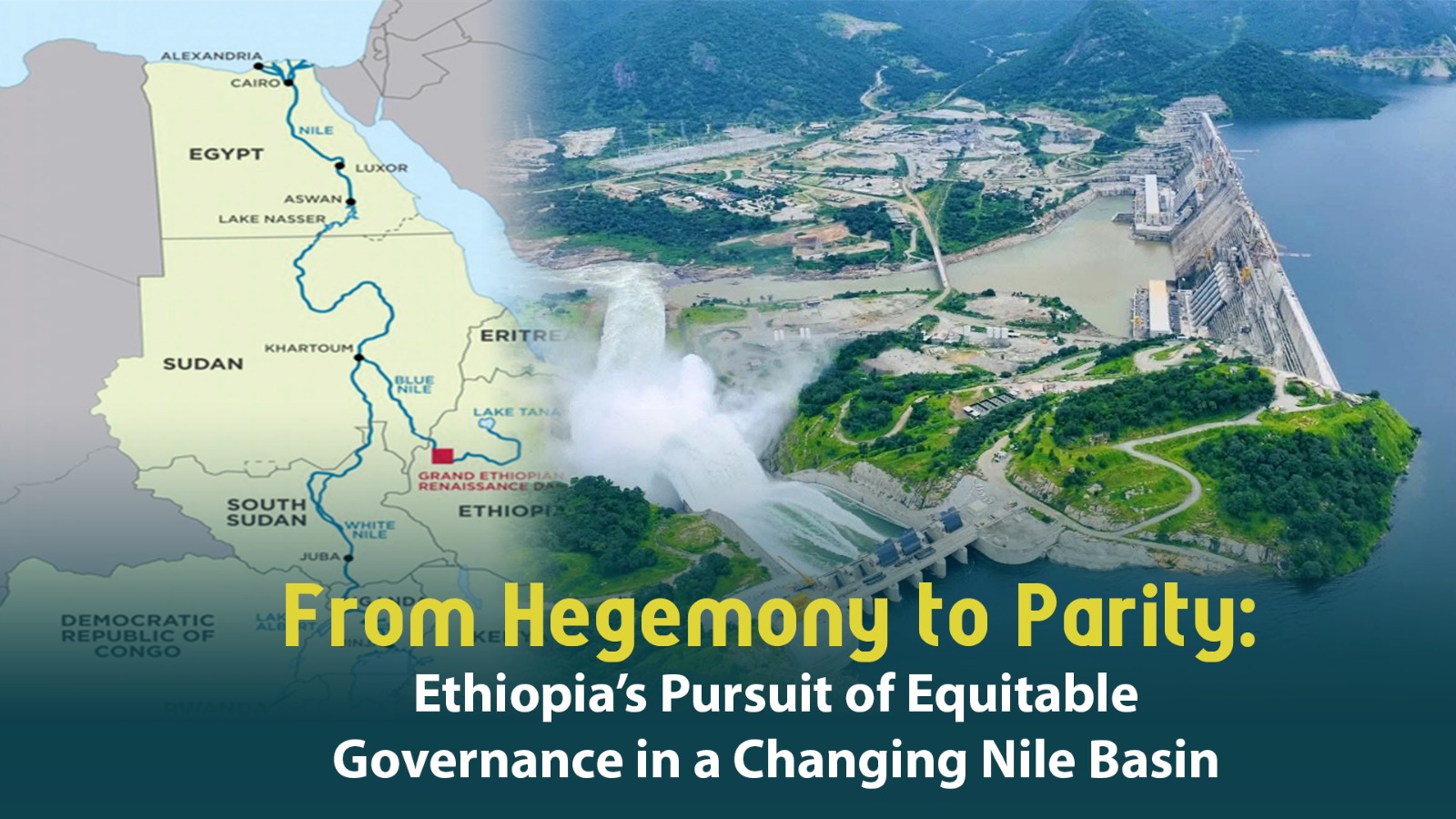
The hydro-political landscape of the Nile Basin continues to be defined by a fundamental divergence in diplomatic strategies. Ethiopia remains steadfast in its commitment to the principle of Limited Territorial Sovereignty, advocating for the equitable and reasonable utilization of the Abbay (Nile) to ensure mutual benefits for all riparian states. This principled approach, rooted in multilateral legal frameworks, stands in contrast to Egypt’s recent funding of Kenyan hydropower projects. Rather than a shift toward genuine economic cooperation, such maneuvers represent a continuation of Cairo’s traditional water securitization agenda. These efforts are strategically aimed at preserving a hydro-hegemonic status quo in a region undergoing structural changes following Ethiopia’s successful completion of the Grand Ethiopian Renaissance Dam (GERD).
The recent visit of Egyptian Foreign Minister Badr Abdelatty to Nairobi, accompanied by announcements of a 100 million dollar Dam Construction Fund and proposals for expanded maritime cooperation, has been framed as a partnership initiative. Yet within the historical context of Nile politics, the initiative reflects what may be described as Iceberg Diplomacy, visible cooperation above the surface and strategic leverage beneath it. The objective is not simply infrastructure financing. It is an influence over the future trajectory of Nile governance.
For decades, Egypt’s Nile strategy was predicated on the presumed inheritance of allocation rights from the 1929 and 1959 accords. This framework established Cairo as the basin’s primary hydro-hegemon, granting it disproportionate influence over downstream narratives and upstream limitations. The Grand Ethiopian Renaissance Dam (GERD) fundamentally altered this equation; the anticipated hydraulic crisis failed to materialize, and Ethiopia’s advocacy for equitable utilization gained institutional weight following the entry into force of the Cooperative Framework Agreement (CFA).
Cairo’s strategy appears to have transitioned from overt pressure to financial inducements as its capacity for unilateral action diminishes. Infrastructure pledges and development funding have emerged as primary instruments of economic statecraft. In the delicate political landscape of the Nile Basin, such projects are increasingly viewed through the lens of “Poisoned Honey”—offering immediate utility while potentially creating long-term asymmetric dependencies. By intertwining high-finance with water governance, these investments may incrementally translate into structural alignment and enduring policy influence.
Kenya occupies a pivotal position in this evolving dynamic. As a Lake Victoria state and CFA signatory, Nairobi has historically aligned with upstream calls for equitable and reasonable utilization. Egyptian financing of dam infrastructure at hydrological source points therefore carries implications that extend beyond bilateral cooperation. Technical engagement may expand data access, monitoring capacity, and influence over flow interpretation at the origin of the White Nile. In strategic terms, this reflects the enduring instinct of a hydro-hegemon seeking to shape the system from its source.
This development must also be understood within a broader regional pattern. Egypt’s recent military actions in the Horn and increased diplomatic efforts in East Africa point to a coordinated change in direction. These movements together seem like what some people call the “Paranoiac Shadow”. This is a strategic position that makes sure that no major change in how the Nile is run happens without Cairo’s involvement or permission. A multi-directional alignment strategy is taking shape via financial outreach in the south, security involvement in the east, and ongoing diplomatic action in the north.
Such alignment risks creating what analysts describe as a “Geopolitical Cage”—achieved not through overt coercion, but through a layering of influence that incrementally constricts Ethiopia’s strategic maneuverability. Should upstream cohesion erode, the institutional consolidation of the Cooperative Framework Agreement (CFA) may be impeded, ultimately fragmenting the basin’s transition toward a unified system of multilateral governance.
The financial aspect of this outreach also has to be looked at closely. Egypt’s foreign debt, which is more than $160 billion, makes it reasonable to wonder if it can keep its promises to build infrastructure abroad. In geopolitically sensitive basins, large-scale finance seldom happens without outside strategic interests being involved. Where funding flows are underwritten by broader geopolitical actors, infrastructure diplomacy can evolve into long-term policy alignment, what some characterize as forms of debt-trapping through structural dependency rather than overt imposition.
Meanwhile, the GERD continues to operate within hydrological parameters consistent with historical seasonal variability. Ethiopia contributes approximately 85 percent of Nile waters through the Blue Nile and has consistently grounded its position in three principles: equitable and reasonable utilization, the obligation not to cause significant harm, and sustained cooperation. These norms are codified in the 1997 UN Watercourses framework and reflected in the CFA, which represents a structural maturation of basin governance from bilateral allocation toward legal parity.
Egypt’s unwillingness to fully support the CFA shows the larger geopolitical dilemma. The basin is moving away from traditionally centralized authority and toward agreed international equality. For a long-standing hydro-hegemon, such parity represents a profound recalibration of influence.
Taken together, these dynamics reveal a widening divergence in basin vision. Ethiopia is moving toward integration by making energy interdependency, legal institutionalization, and regionally funded infrastructure more common. Egypt, by contrast, appears to be pursuing influence through selective bilateral alignment and financial penetration. The contest is therefore not solely about water volume. It is about governance architecture.
Ethiopia’s regional integration is not rhetorical. It is operational. By mid-2025, Ethiopia supplied 83 percent of Kenya’s total electricity imports, delivering over 1,274 GWh annually through the Sodo–Moyale–Suswa interconnector. According to Kenya’s Energy and Petroleum Regulatory Authority, these imports save Nairobi approximately 10 million dollars per year while strengthening grid stability and helping avert blackouts during peak demand. In contrast to infrastructure diplomacy premised on financial leverage, Ethiopia’s energy exports create functional interdependence grounded in mutual economic benefit and shared energy security.
The political dimension of this energy interdependence was underscored during the inauguration of the Grand Ethiopian Renaissance Dam, where Kenyan President William Ruto framed the project as a continental milestone. Emphasizing that the five-billion-dollar dam was financed entirely through Ethiopia’s domestic resources, the Kenyan president described it as proof that “Africa can take charge of its own destiny.” He confirmed ongoing discussions to expand Kenya’s power purchase agreement with Ethiopia beyond the existing 200 megawatts, noting that the clean energy supply is critical for supporting Kenya’s economic zones and mitigating drought-related shortages. By linking the GERD to Kenya’s own debt-free development initiatives, the head of state situated the project within a broader narrative of African self-financed infrastructure and regional cooperation.
Understanding the Real Impact of GERD
Since construction began in 2011, Ethiopia has maintained consistent diplomatic engagement with both Egypt and Sudan. It has participated in numerous negotiations facilitated by the African Union, the United States, and the European Union. Despite these efforts, talks have frequently stalled over Egypt’s demand for a binding framework that would extend downstream approval authority over upstream water development.
Ethiopia contributes more than 85 percent of the Nile’s annual flow through the Blue Nile system and was never party to colonial-era allocation treaties. Its position has consistently emphasized equitable and reasonable utilization within a cooperative framework. Claims that GERD would severely reduce Egypt’s water supply have not been substantiated by observed hydrological data. Independent modeling and seasonal flow monitoring indicate that the dam’s hydroelectric design regulates flow but does not entail consumptive diversion.
The contrast in strategic framing between the two states is pronounced. Ethiopia built GERD to help with energy poverty at home and to connect electricity throughout the region. Egypt, by contrast, has framed the dam primarily as a national security concern, elevating the issue to international platforms including the United Nations Security Council and the Arab League.
GERD therefore represents more than infrastructure. It symbolizes a structural transition in Nile governance, from historically centralized allocation toward negotiated multilateral engagement grounded in contemporary international water law principles.
Charting a Path Forward
Ethiopia continues to advocate dialogue, regional partnership, and peaceful resolution. Its position remains grounded in mutual respect, equitable utilization, and the obligation not to cause significant harm, principles reflected in the 1997 United Nations Watercourses framework and embedded within the CFA.
For Ethiopia, the path forward remains unchanged. Pan-African hydro-solidarity anchored in law, transparency, and regional integration continues to define Addis Ababa’s strategic posture. By advancing energy interdependence through the GERD and consolidating the legal framework of the Cooperative Framework Agreement, Ethiopia reinforces a basin order grounded in shared prosperity rather than inherited monopoly.
The Nile should bring people together, not tear them apart. Millions of people in East Africa still depend on its waters. The CFA is now in effect, and the GERD is getting closer to being fully operational. It is time to move beyond zero-sum narratives and transition toward a model of basin governance defined by equitable utilization under international law. Replacing the “winner-take-all” perspective with a framework of shared benefits is essential for long-term regional stability. Its longevity will rely on institutional unity, evidence-based discourse, and continuous political sophistication among all riparian nations.
The durability of the Nile Basin’s future will depend on whether governance is anchored in equitable law or influenced by layered strategic realignment. The question now is whether it will be consolidated through institutional cohesion or contested through recalibrated forms of influence.
“Ethiopia’s sovereign right to harness the Nile waters is essential for Africa’s shared development, regional cooperation, and lasting peace.”
Adapted from African Union Bureau Communiqué on GERD (2020)
By Beminet Alemayehu at IFA
Disclaimer:
The content disseminated by the Institute of Foreign Affairs (IFA) – including, but not limited to, publications, public statements, events, media appearances, and digital communications – reflects the views of individual contributors and does not necessarily represent the official positions or policies of the Institute, its partners, or any affiliated governmental or non-governmental entities.
While the IFA endeavors to ensure the accuracy, integrity, and timeliness of the information presented, it makes no representations or warranties, express or implied, regarding the completeness, reliability, or suitability of such content for any purpose. The Institute expressly disclaims any liability for errors or omissions, as well as for any actions taken or decisions made based on the information provided.
The inclusion of external links, references, or third-party resources does not constitute an endorsement by the Institute. Additionally, engagement on social media platforms – including, but not limited to, likes, shares, retweets (RTs), or reposts – shall not be interpreted as an endorsement or validation of the views expressed therein.
Readers and audiences are encouraged to exercise critical judgment and seek independent verification when interpreting or relying upon any information disseminated through publications and posts on the Institute’s platforms or representatives.