

Military institutions are often imagined as the final bastion of state authority—the disciplined core that sustains sovereignty when political systems fracture. Yet Sudan presents a paradox.
At the very moment when the Sudanese state most urgently requires a cohesive military backbone, the Sudanese Armed Forces (SAF) are undergoing a transformation that may gradually undermine the very institutional coherence upon which the state depends. Public displays of unity—such as military parades in Khartoum where Islamist fighters march alongside professional units—project an image of consolidated authority. Behind the optics, however, a subtler and potentially more consequential process is unfolding: the incremental ideological embedding of Islamist networks within Sudan’s military structure.
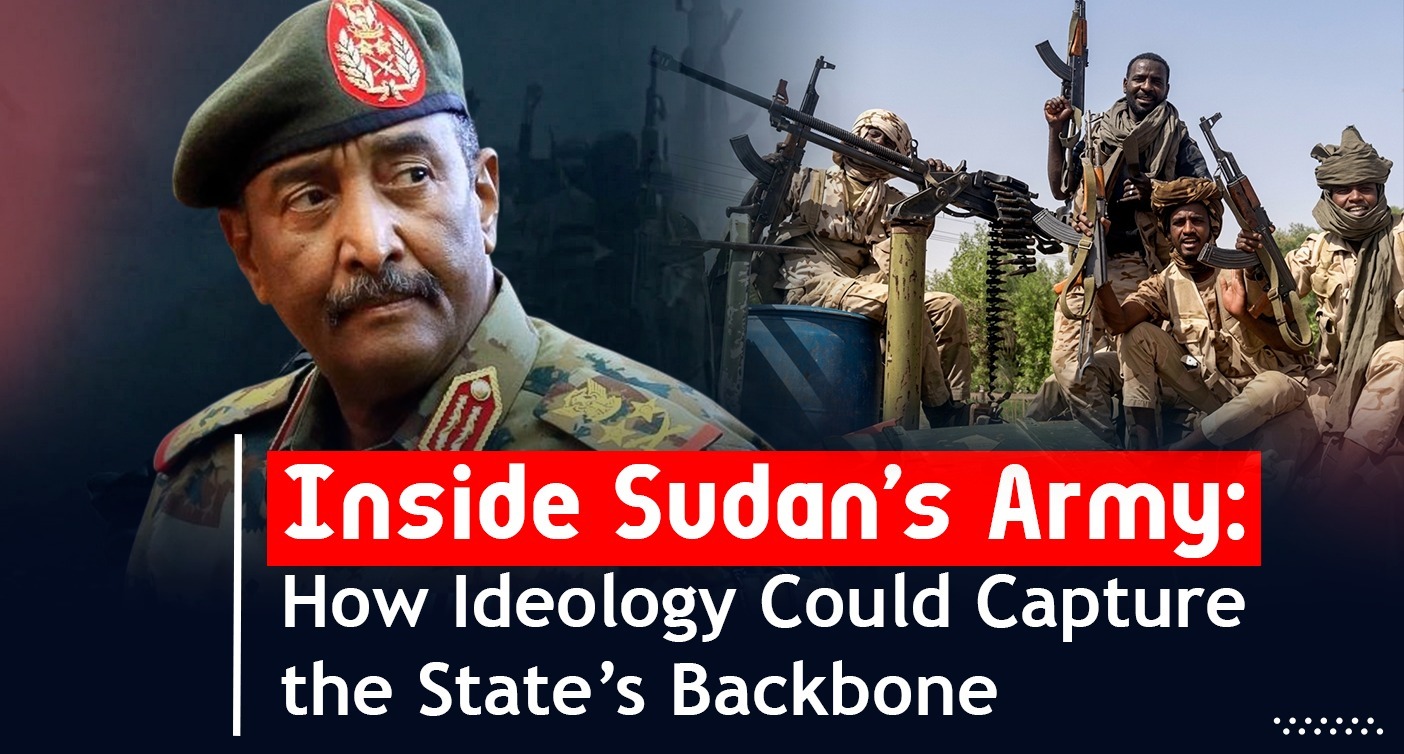
Since the consolidation of power by General Abdel Fattah al-Burhan following the eruption of Sudan’s civil war in 2023, the SAF has reportedly incorporated approximately 15,000 Islamist militia fighters into its ranks. At first glance, this integration appears to be a pragmatic wartime adjustment—an attempt to compensate for battlefield attrition and to expand manpower during a protracted conflict against the Rapid Support Forces (RSF). Yet beneath this tactical rationale lies a deeper structural question: can a national army preserve institutional integrity while integrating actors whose ideological loyalties extend beyond the formal chain of command?
Conventional analyses of Sudan’s conflict tend to focus on battlefield dynamics between the SAF and the RSF. Such frameworks, while important, risk overlooking a quieter transformation occurring within the SAF itself. The Sudanese military has historically functioned not merely as an instrument of coercion but as the strategic spine of the Sudanese state, controlling borders, enforcing policy, and serving as the ultimate arbiter of political order. If that spine becomes ideologically fragmented, the consequences could extend far beyond the immediate battlefield, reshaping Sudan’s governance structure, economic networks, and regional posture.
Fractured Foundations: Where SAF Loyalty Splits
The internal hierarchy of the SAF simultaneously creates resilience and vulnerability. Senior officers maintain formal authority over promotions, deployments, and resource distribution. Operational cohesion relies on a professional ethos that prioritizes obedience to centralized command. Yet the integration of Islamist fighters has not occurred evenly across the military. Certain units remain largely insulated, while others contain dense concentrations of ideologically motivated fighters operating alongside regular personnel.
This uneven integration generates structural vulnerabilities that are rarely visible in official narratives. First, co-optation of officers becomes easier when ideological networks offer career incentives or financial patronage. Second, unit-level indoctrination can occur informally during joint training exercises and combat operations, gradually normalizing ideological alignment as a factor in decision-making. Third, the emergence of parallel command structures—informal channels linking fighters and officers to external Islamist networks—can create competing sources of authority.
Historical precedent suggests these dynamics are not theoretical. During the Darfur conflict between 2003 and 2010, Sudan’s reliance on irregular militias—most notably the Janjaweed—produced fragmented chains of command and blurred accountability for violence. Similar patterns emerged following South Sudan’s independence in 2011, where the partial integration of militia forces into the national army generated persistent factionalism and periodic defections.
In Sudan’s current context, however, the stakes are considerably higher. Unlike regional militias operating on the periphery, the SAF remains the central institution underpinning Sudanese statehood. If ideological penetration alters the military’s internal cohesion, the entire architecture of governance may be affected.
Silent Currents: How Ideology Creeps Into the Ranks
Ideological embedding rarely occurs through overt institutional transformation. Instead, it unfolds gradually through structural incentives and informal networks. Evidence emerging from internal monitoring reports suggests that between 2023 and 2025, nearly 30 percent of mid-level officer promotions occurred in units that had integrated Islamist contingents. While correlation does not necessarily imply causation, the clustering of promotions within these units raises questions about evolving patronage structures.
Junior officers represent a particularly important vector for ideological influence. Early-career officers frequently participate in joint exercises and operational deployments where professional norms are shaped. When these environments reward ideological cohesion—through trust networks, battlefield solidarity, or material incentives—officers may gradually internalize loyalties that extend beyond formal command.
External actors further complicate this dynamic. Networks associated with the Sudanese Islamic Movement have historically maintained deep connections within Sudan’s security sector. These networks often provide financial assistance, career opportunities, and ideological guidance through informal channels such as religious endowments and private donors. Over time, such support structures can create what political economists describe as dual loyalty equilibria, where officers balance obligations to the state with commitments to ideological patrons.
This phenomenon closely resembles the principal–agent dilemma commonly observed in fragile security institutions. Military leadership (the principal) cannot fully monitor the actions or motivations of subordinate officers (the agents). When external networks offer alternative sources of patronage, officers may rationally diversify their loyalties in pursuit of career security.
Importantly, ideological penetration does not require universal adherence to succeed. Even limited clusters of aligned officers can reshape institutional dynamics by influencing promotions, procurement decisions, and operational doctrine. In this sense, the transformation of the SAF could occur incrementally rather than through a dramatic takeover.
Shifting Command: When Doctrine Follows Loyalty
If ideological alignment increasingly shapes career incentives within the SAF, the military’s operational logic may gradually evolve. Promotions could favor officers connected to Islamist networks, while resource allocation and deployment decisions might increasingly reflect ideological considerations.
Such shifts would have significant strategic implications. Sudan’s military doctrine—historically oriented toward regime stability and territorial defense—could begin to prioritize network-driven objectives. Units stationed in politically sensitive regions such as Darfur or eastern Sudan might selectively enforce orders depending on the interests of aligned factions.
External actors also have the capacity to amplify these dynamics. Regional powers including Egypt, United Arab Emirates, and Qatar maintain varying degrees of influence within Sudan’s security landscape. Financial assistance, training programs, and intelligence cooperation—whether intended to stabilize Sudan or advance strategic interests—could inadvertently strengthen factional alignments within the SAF.
The economic dimension is equally consequential. Sudan’s military historically controls significant revenue streams, including access to gold mining concessions and strategic infrastructure linked to the Red Sea trade corridor. If ideological factions consolidate control over these assets, state revenues could be diverted into patronage networks, reducing fiscal transparency and discouraging foreign investment.
For neighboring states in the Horn of Africa—including Ethiopia—such uncertainty carries tangible security implications. Sudan has traditionally functioned as a critical buffer in the region’s geopolitical landscape. A partially ideologized SAF could complicate border management, conflict mediation efforts, and regional counterterrorism cooperation.
Forked Paths: Three Futures for Sudan’s Army
The trajectory of Sudan’s military transformation remains uncertain, but three plausible scenarios illustrate the potential outcomes.
The first scenario involves full institutional infiltration, where Islamist-aligned officers gradually dominate key command positions. In this case, the SAF could evolve into a hybrid institution serving both national defense and ideological agendas. Such a transformation would effectively produce a “state within a state,” blurring the boundaries between military authority and ideological networks.
The second scenario envisions partial entrenchment. Here, professional officers retain nominal control of the military hierarchy, but ideological factions remain embedded within certain units. While the army might continue functioning operationally, latent factionalism would weaken cohesion and increase the risk of defections or selective obedience during political crises.
The third scenario involves institutional resistance. Professional elements within the SAF might attempt to purge ideological networks or reassert centralized command. Yet such efforts could provoke the emergence of parallel Islamist armed groups operating outside the formal military structure, potentially generating cycles of confrontation that further destabilize Sudan’s political landscape.
In each scenario, the transformation of the SAF unfolds gradually rather than through dramatic coups or sudden political shifts. This incremental process makes it particularly difficult for policymakers and international observers to detect early warning signs.
Lessons from Afar: Turkey and Pakistan in Perspective
Comparative experience offers useful insights into how ideological networks interact with military institutions. During the 1990s, the military of Turkey faced internal ideological divisions even as it pursued modernization and professionalization. Although political tensions persisted, institutional reforms ultimately reinforced state-first control over the armed forces.
The trajectory of Pakistan presents a more cautionary example. Since the 1980s, the integration of Islamist proxy networks within Pakistan’s security establishment has shaped strategic decision-making, particularly along the Afghan frontier. These relationships did not emerge through abrupt institutional capture but rather through gradual alignment between ideological actors and military structures.
Sudan’s current trajectory appears to exhibit elements of both cases. Like Turkey in the 1990s, segments of the SAF remain committed to professional military norms. Yet the gradual embedding of Islamist networks also resembles the Pakistani model, where ideological alignment has subtly influenced procurement strategies, operational priorities, and regional engagement.
The key lesson is that institutional transformation rarely occurs overnight. It unfolds through cumulative shifts in incentives, promotions, and resource allocation.
Safeguarding the Spine: Incentives, Oversight, and Reform
Preventing institutional capture requires more than rhetorical commitments to professionalism. It demands concrete mechanisms that reshape incentives within the SAF.
First, monitoring promotion patterns and unit composition can provide early warning indicators of ideological clustering. Transparent personnel management systems reduce the likelihood that informal patronage networks will dominate career advancement.
Second, international partners should prioritize professional military education and training programs that reinforce norms of civilian oversight and institutional neutrality. Such programs have historically played a crucial role in strengthening military professionalism in fragile states.
Third, economic governance reforms are essential. Separating military units from direct control over commercial assets—including mining concessions and trade infrastructure—would reduce the financial incentives that encourage factional competition within the armed forces.
Finally, regional organizations such as the African Union and Intergovernmental Authority on Development could play a more active role in supporting security-sector reform initiatives that prioritize institutional cohesion.
A Crossroads for Sudan
Sudan’s military stands at a critical juncture. The integration of Islamist fighters into the SAF may provide short-term operational advantages, but it simultaneously introduces structural risks that could reshape the institution from within. What appears today as pragmatic wartime adaptation may tomorrow become an entrenched system of dual loyalties.
For policymakers across the Horn of Africa, the lesson is clear: monitoring Sudan’s conflict requires more than tracking battlefield developments. The deeper question concerns the institutional evolution of the SAF itself. If ideological networks continue to embed within the military’s command structure, Sudan’s armed forces may gradually transform from guarantor of sovereignty into a conduit for competing political agendas.
Such a transformation would not occur through a dramatic coup or sudden collapse. It would unfold quietly—through promotions, patronage networks, and shifting incentives—until the state’s strategic backbone no longer serves a single master.
Recognizing these dynamics early may be the only opportunity to prevent Sudan’s most critical institution from becoming the very mechanism through which the state is ultimately captured.
By Hawi Wondimu at IFA
Disclaimer:
The content disseminated by the Institute of Foreign Affairs (IFA) – including, but not limited to, publications, public statements, events, media appearances, and digital communications – reflects the views of individual contributors and does not necessarily represent the official positions or policies of the Institute, its partners, or any affiliated governmental or non-governmental entities.
While the IFA endeavors to ensure the accuracy, integrity, and timeliness of the information presented, it makes no representations or warranties, express or implied, regarding the completeness, reliability, or suitability of such content for any purpose. The Institute expressly disclaims any liability for errors or omissions, as well as for any actions taken or decisions made based on the information provided.
The inclusion of external links, references, or third-party resources does not constitute an endorsement by the Institute. Additionally, engagement on social media platforms – including, but not limited to, likes, shares, retweets (RTs), or reposts – shall not be interpreted as an endorsement or validation of the views expressed therein.Readers and audiences are encouraged to exercise critical judgment and seek independent verification when interpreting or relying upon any information disseminated through publications and posts on the Institute’s platforms or representatives.