

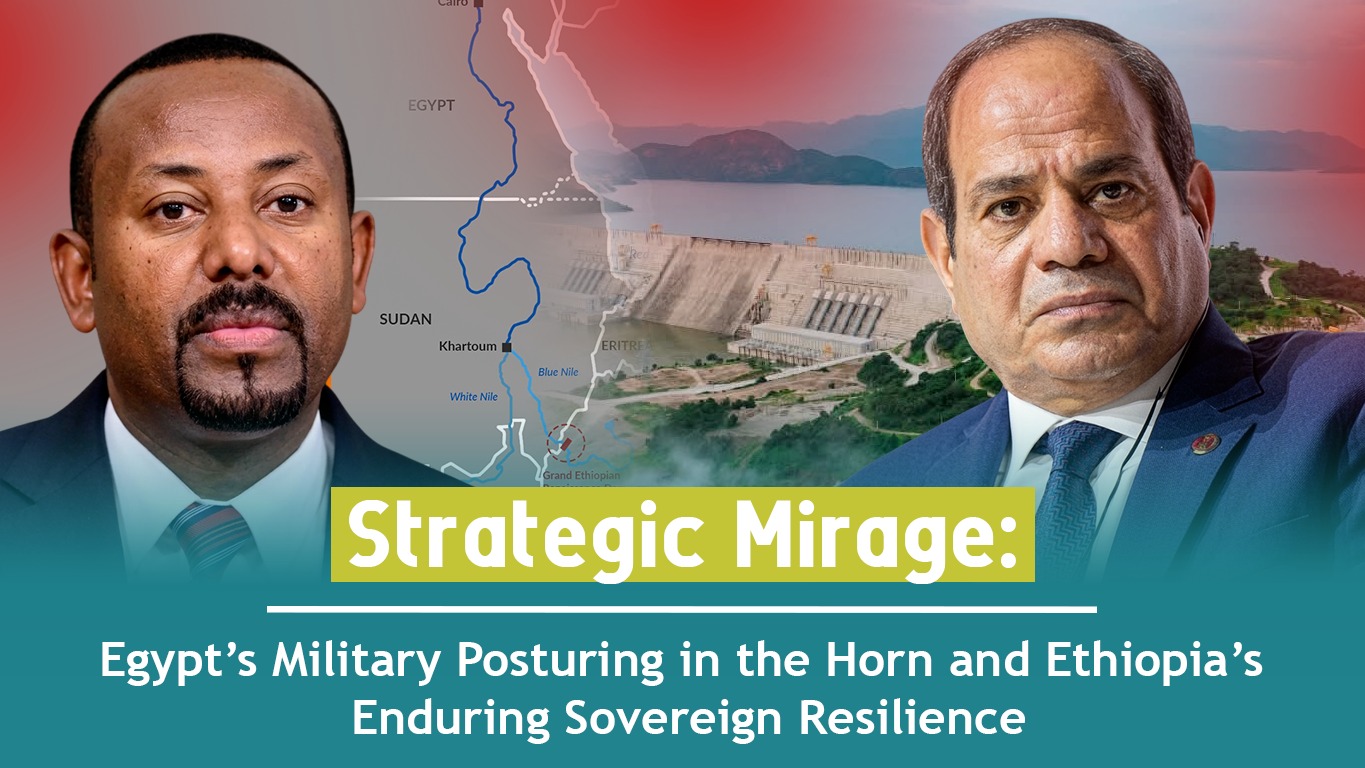
Geopolitical competition in the Horn of Africa rarely unfolds through direct confrontation. Instead, it is often expressed through strategic signaling, diplomatic maneuvering, and the cultivation of influence across peripheral theatres. Egypt’s recent military and diplomatic engagements in the region—particularly its security cooperation with Somalia and expanding ties across the Red Sea corridor—must therefore be understood within this broader logic of indirect competition.
At first glance, Cairo’s posture appears to represent an attempt to project deterrence toward Ethiopia amid the protracted dispute over the Grand Ethiopian Renaissance Dam (GERD). Yet a closer examination reveals a more nuanced reality. Rather than fundamentally altering the regional balance of power, Egypt’s activities in the Horn largely reflect a familiar pattern within Nile Basin geopolitics: the use of diplomatic alliances and strategic signaling to compensate for structural constraints in confronting upstream states.
From the perspective of international relations theory, such behavior can be interpreted through the lens of hydro-hegemony theory, which explains how dominant downstream states attempt to maintain control over shared water resources through a combination of material power, bargaining leverage, and ideational narratives. Historically, Egypt has been the principal hydro-hegemon of the Nile Basin, shaping regional water governance through colonial treaties, diplomatic pressure, and international advocacy.
However, the construction of the GERD has significantly disrupted this historical equilibrium. As upstream states increasingly assert developmental rights over transboundary waters, the basin is experiencing what scholars describe as a transition from hydro-hegemony toward a more contested and multipolar hydropolitical order.
Within this evolving context, Egypt’s growing visibility in the Horn of Africa appears less a decisive strategic breakthrough than a symbolic attempt to regain influence within a shifting regional landscape.
The Nile Question and the Historical Foundations of Rivalry
The rivalry between Ethiopia and Egypt is deeply rooted in the geopolitics of the Nile Basin. For more than a century, the management of the river has been shaped by colonial-era agreements that allocated the overwhelming majority of Nile waters to downstream states, particularly Egypt and Sudan, while excluding upstream countries from meaningful participation.
These arrangements were institutionalized through treaties negotiated during the British colonial period, including the 1929 Nile Waters Agreement and the 1959 bilateral treaty between Egypt and Sudan. While these agreements entrenched Egypt’s privileged access to the river, they also laid the foundations for long-term tensions by marginalizing upstream states whose territories generate the majority of the Nile’s flow.
Ethiopia occupies a particularly central position within this hydrological system. The Ethiopian highlands supply roughly 85 percent of the water that eventually reaches Egypt through the Blue Nile [Abbay River]. Yet for much of the twentieth century, Ethiopia lacked the financial and technological capacity to fully utilize these resources.
The GERD fundamentally altered this dynamic. Initiated in 2011, the project represents the largest hydropower facility in Africa and a cornerstone of Ethiopia’s national development strategy. For Ethiopia, the dam is not merely an infrastructure project but a symbol of economic sovereignty—an effort to transform the country into a regional energy hub. Kenya, Sudan, and Djibouti are already benefiting from the electricity supply, while Tanzania and other countries in the region are in the pipeline to finalize deals, illustrating how the dam ensures regional integration and fosters connectivity.
Egypt, however, has interpreted the project through a markedly different strategic lens. With more than 90 percent of its freshwater supply dependent on the Nile, Cairo perceives any upstream regulation of the river as a potential threat to its national water security.
The dispute surrounding the GERD has therefore evolved beyond technical negotiations over water management. It has become a broader geopolitical contest over development rights, regional influence, and the future governance of the Nile Basin.
Egypt’s Regional Strategy: Securitization and Strategic Signaling
Faced with the erosion of its traditional hydro-hegemonic position, Egypt has increasingly sought to securitize the Nile issue within its foreign policy discourse. Securitization theory, developed by scholars of the Copenhagen School, suggests that political actors often frame certain issues as existential threats in order to justify extraordinary policy measures.
In Egypt’s case, the Nile has long been framed as a matter of “national survival.” Egyptian leaders frequently describe the river as the country’s “lifeline,” reinforcing a narrative in which upstream infrastructure projects are portrayed as potential threats to national security.
This discourse has important geopolitical implications. By framing the Nile dispute in security terms, Cairo has expanded its strategic toolkit beyond diplomatic negotiations to include military signaling and regional alliance-building.
Egypt’s growing engagement in the Horn of Africa—particularly in Somalia—should be viewed within this context. Through defense agreements, military training programs, and participation in stabilization initiatives, Cairo has sought to establish a modest security footprint in a region historically shaped by Ethiopian influence.
Egypt’s Military Engagement in Somalia
Egypt’s involvement in Somalia has been presented publicly as a contribution to international efforts aimed at combating the extremist group Al-Shabaab and supporting the country’s stabilization. These objectives align with the broader security agenda of the African Union (AU) under the African Union Support and Stabilization Mission in Somalia (AUSSOM).
Yet the geopolitical context suggests that Egypt’s engagement also carries strategic signaling value. Ethiopia has been one of the most significant contributors to Somalia’s security architecture for nearly two decades, maintaining troops and operational networks across several regions.
Cairo’s entry into this security landscape therefore introduces a new dimension of geopolitical rivalry. Some analysts interpret the move as an attempt to counterbalance Ethiopia’s influence and signal Cairo’s capacity to operate within Ethiopia’s immediate strategic neighborhood.
However, the practical impact of Egypt’s presence remains limited. Ethiopia’s geographic proximity to Somalia, its long-standing security partnerships with Somali authorities, and its extensive operational experience in the country provide structural advantages that external actors are unlikely to replicate in the near term.
Consequently, Egypt’s military engagement functions less as a transformative shift in the regional security balance than as a symbolic assertion of strategic relevance.
Peripheral Pressure and Proxy Geopolitics
Egypt’s approach toward Ethiopia reflects a broader historical pattern within Nile Basin politics: the use of indirect pressure mechanisms designed to shape the strategic environment of upstream states without engaging in open confrontation. Rather than relying primarily on direct military coercion, Cairo has historically pursued influence through diplomatic alliances, regional partnerships, and the cultivation of leverage across Ethiopia’s geopolitical periphery.
This strategy aligns closely with realist interpretations of international relations, particularly balance-of-power dynamics in asymmetric conflicts. When direct confrontation with a large and historically resilient state is costly or impractical, rival powers often seek to constrain their opponent’s strategic autonomy through indirect means—leveraging neighboring states, insurgent movements, or diplomatic coalitions to create persistent pressure points.
Within the Horn of Africa, such strategies have unfolded over decades. Egypt has historically supported forces that challenged Ethiopia’s territorial integrity during the late twentieth century. Specifically, Addis Ababa has long maintained that Cairo quietly welcomed—and at times diplomatically facilitated—Eritrea’s secession from Ethiopia in 1993, following the collapse of the Derg regime. For Ethiopia, the emergence of a new state along its Red Sea corridor significantly altered the regional strategic balance and weakened its access to maritime routes.
Beyond this historical episode, Egypt has, over the years, supported armed actors operating along Ethiopia’s peripheries as part of a broader effort to constrain the country’s rise as an upstream hydro-political power. Within this narrative, Eritrea has frequently been not merely as a neighboring rival but as a strategic intermediary through which external actors—including Cairo—exert pressure on Ethiopia’s internal stability.
Indeed, in periods of heightened regional tension, arms trafficking networks operating across the Red Sea corridor and the Eritrean frontier have played a role in fueling insurgencies and internal unrest within Ethiopia. From this vantage point, Eritrea is serving—intentionally or structurally—as a conduit through which rival powers seek to project influence into Ethiopia’s domestic security environment.
The Horn of Africa’s conflicts are driven by a wide range of domestic, historical, and socio-political factors that cannot be reduced solely to external manipulation. Yet the persistence of these perceptions highlights an important reality: within Ethiopian strategic thinking, competition over the Nile has long been understood not only as a diplomatic dispute over water resources but also as a broader geopolitical contest unfolding across multiple arenas of regional politics.
Consequently, Egypt’s contemporary engagements in the Horn—particularly its security cooperation with states surrounding Ethiopia—are often a continuation of a long-standing strategy of peripheral pressure. In this reading, the Nile dispute is not confined to negotiations over water management but is embedded within a wider struggle over regional influence, strategic autonomy, and the evolving balance of power in Northeast Africa.
The Expanding Geopolitical Theatre: Sudan, Eritrea, and the Red Sea
Egypt’s strategic calculations in the Horn are further shaped by its relationships with neighboring states, particularly Sudan and Eritrea.
Historically, Cairo has maintained close ties with Sudanese military elites, conducting joint military exercises and coordinating diplomatic positions regarding Nile negotiations. These partnerships have provided Egypt with leverage along Ethiopia’s western frontier.
Meanwhile, the evolving geopolitics of the Red Sea corridor has drawn Eritrea into broader regional security alignments. The strategic significance of the Red Sea—one of the world’s most important maritime trade routes—has attracted growing attention from global and regional powers alike.
Within this multi-layered geopolitical arena, Nile politics intersects with maritime competition, regional alliances, and shifting power balances across the Horn of Africa.
Yet even amid these dynamics, Ethiopia retains substantial structural advantages rooted in geography, demographics, and economic potential.
Ethiopia’s Strategic Depth and Structural Resilience
The limitations of Egypt’s strategic signaling become clearer when viewed against Ethiopia’s broader structural strengths.
With a population exceeding 120 million and one of the largest economies in Africa, Ethiopia occupies a central geopolitical position in the Horn. Its geographic location places it at the intersection of key regional corridors linking the Red Sea, the Nile Basin, and the broader East African economic zone.
Equally consequential is Ethiopia’s emerging role in regional energy networks. Once fully operational, the GERD is expected to generate more than 5,000 megawatts of electricity, enabling Ethiopia to export power to neighboring states and strengthen economic interdependence across East Africa.
Energy connectivity of this kind has important geopolitical implications. By supplying electricity to neighboring countries, Ethiopia can deepen regional economic integration and expand its diplomatic influence through what some analysts describe as “infrastructure diplomacy.”
Symbolism versus Strategic Reality
Egypt’s expanding visibility in the Horn of Africa reflects the intensifying geopolitical competition surrounding the Nile Basin. Military cooperation agreements, diplomatic alliances, and regional engagement initiatives all form part of Cairo’s effort to regain leverage amid a changing hydropolitical environment.
Yet these initiatives ultimately confront a structural reality: Ethiopia’s geopolitical position, demographic scale, and developmental trajectory make it difficult for external actors to significantly constrain its strategic autonomy.
In this sense, Egypt’s military posturing may be better understood as a form of strategic signaling rather than a credible instrument of coercion. The transformation of the Nile Basin—driven by the emergence of upstream infrastructure projects and new regional alliances—has reduced Cairo’s capacity to dictate the terms of regional water governance.
Conclusion: From Hydro-Hegemony to Cooperative Hydropolitics
The dispute between Ethiopia and Egypt reflects a deeper transformation underway in the governance of the Nile Basin. For decades, the river system was shaped by a hydro-hegemonic order rooted in colonial-era treaties that privileged downstream states while excluding upstream nations from meaningful participation in the management of shared waters. Ethiopia’s development of the Grand Ethiopian Renaissance Dam (GERD) has fundamentally challenged this historical arrangement, marking a turning point in the basin’s hydropolitics.
The GERD embodies the core principle of equitable and reasonable utilization, a standard long articulated in international water law regarding transboundary resources. The project is not as an instrument of coercion but as a foundation for regional energy integration and shared development. By contrast, Egypt’s strategic posture has remained largely anchored in a colonial treaty mentality that seeks to preserve the historical status quo of Nile water allocation. This divergence lies at the core of the contemporary dispute.
Equally consequential is Cairo’s continued securitization of the Nile question. By framing the river primarily through the lens of existential security, Egypt has expanded the dispute beyond technical negotiations into the domain of geopolitical rivalry. Its growing military signaling and diplomatic maneuvering across the Horn of Africa appear aimed at exerting pressure on Ethiopia’s strategic environment. Yet such actions offer little constructive value either to regional stability or to Egypt’s own long-term interests.
Indeed, attempts to externalize the Nile dispute through regional military posturing risk reinforcing perceptions of confrontation without addressing the structural realities of the basin. Ethiopia today is not a peripheral actor that can be easily coerced. With its demographic scale, geographic centrality, and expanding infrastructure networks, it functions as a pivotal and anchoring state within the Horn of Africa’s political and economic architecture. Efforts to intimidate or destabilize such a state through indirect pressure are unlikely to produce strategic dividends.
In this sense, Egypt’s recent military signaling in the region increasingly resembles a geopolitical performance rather than a credible instrument of coercion. The structural transformation of the Nile Basin—driven by upstream development and shifting regional power balances—cannot be reversed through symbolic displays of force.
For the region to move beyond recurring cycles of suspicion and rivalry, Cairo may ultimately need to recognize the changing hydropolitical landscape and engage constructively with Ethiopia’s longstanding call for equity and cooperation. The Nile’s future cannot be secured through attempts to preserve an outdated hydro-hegemonic order. Instead, it will depend on the emergence of cooperative basin governance grounded in mutual recognition of shared rights and responsibilities.
Only through such an approach can the Nile evolve from a source of geopolitical contention into a foundation for regional integration and collective prosperity.
References
Abdelhady, Dalia. 2021. “Hydropolitics and the Nile Basin Dispute.” Middle East Policy 28 (3): 42–57.
Abiy Ahmed. 2024. “Speech at the Inauguration of the Grand Ethiopian Renaissance Dam.” Addis Ababa.
Cascão, Ana Elisa, and Alan Nicol. 2016. “GERD: New Norms of Cooperation in the Nile Basin?” Water International 41 (4): 550–573.
De Waal, Alex. 2015. The Real Politics of the Horn of Africa: Money, War and the Business of Power. Cambridge: Polity Press.
International Crisis Group. 2020. Bridging the Gap in the Nile Waters Dispute. Brussels: International Crisis Group.
Kendie, Daniel. 1999. Egypt and the Politics of the Nile Basin. Lanham: University Press of America.
Lefebvre, Jeffrey A. 2012. “Egypt’s Foreign Policy in the Twenty-First Century.” Middle East Journal 66 (2): 195–215.
Lieberman, Evan. 2020. “The Politics of Water Security in the Nile Basin.” African Affairs 119 (476): 415–437.
Nicol, Alan, and Ana Elisa Cascão. 2011. “Against the Flow – New Power Dynamics and Upstream Mobilisation in the Nile Basin.” Review of African Political Economy 38 (128): 317–325.
Patey, Luke. 2021. “The Horn of Africa’s New Geopolitics.” African Affairs 120 (480): 601–617.
Plaut, Martin. 2016. Understanding Eritrea: Inside Africa’s Most Repressive State. Oxford: Oxford University Press.
Salman, Salman M. A. 2013. “The Grand Ethiopian Renaissance Dam: The Road to the Declaration of Principles and the Khartoum Document.” Water International 38 (5).
Verhoeven, Harry. 2015. Water, Civilisation and Power in Sudan: The Political Economy of Military-Islamist State Building. Cambridge: Cambridge University Press.
Verhoeven, Harry. 2016. Environmental Politics in the Middle East: Local Struggles, Global Connections. Oxford: Oxford University Press.
Yihdego, Zeray, and Alistair Rieu-Clarke. 2016. “The Grand Ethiopian Renaissance Dam and the Nile Basin: Implications for Transboundary Water Cooperation.” International Journal of Water Resources Development 32 (4): 595–608.
Walsh, Declan. 2020. “Battle for the Nile: Ethiopia, Egypt and the Politics of Water.” The New York Times.
Kingsley, Patrick. 2023. “Tensions Rise over Ethiopia’s Giant Nile Dam.” The Guardian.
Al Jazeera. 2024. “Why Egypt and Ethiopia Remain Locked in Dispute over the GERD.”
International Crisis Group. 2023. “Nile Dam Talks Stall as Regional Tensions Rise.”
Atlantic Council. 2024. “Egypt’s Strategic Calculations in the Horn of Africa.”
By Getahun Tsegaye, IFA
Disclaimer:
The content disseminated by the Institute of Foreign Affairs (IFA) – including, but not limited to, publications, public statements, events, media appearances, and digital communications – reflects the views of individual contributors and does not necessarily represent the official positions or policies of the Institute, its partners, or any affiliated governmental or non-governmental entities.
While the IFA endeavors to ensure the accuracy, integrity, and timeliness of the information presented, it makes no representations or warranties, express or implied, regarding the completeness, reliability, or suitability of such content for any purpose. The Institute expressly disclaims any liability for errors or omissions, as well as for any actions taken or decisions made based on the information provided.
The inclusion of external links, references, or third-party resources does not constitute an endorsement by the Institute. Additionally, engagement on social media platforms – including, but not limited to, likes, shares, retweets (RTs), or reposts – shall not be interpreted as an endorsement or validation of the views expressed therein.
Readers and audiences are encouraged to exercise critical judgment and seek independent verification when interpreting or relying upon any information disseminated through publications and posts on the Institute’s platforms or representatives.