

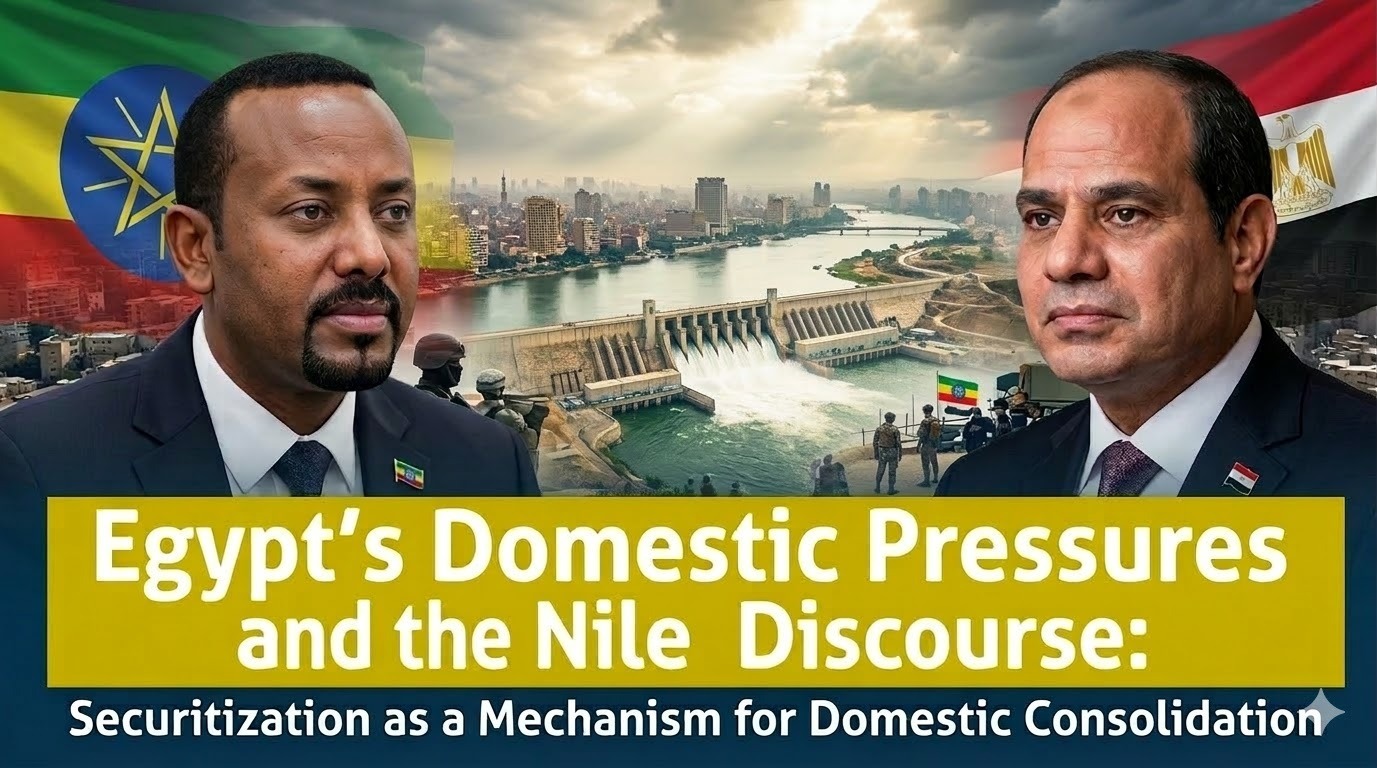
Political narratives rarely emerge in isolation. They often reflect deeper structural anxieties within states confronting economic uncertainty, demographic pressure, and geopolitical recalibration. In the case of Egypt, the increasingly confrontational rhetoric surrounding the Nile and the Grand Ethiopian Renaissance Dam (GERD) cannot be fully understood without first examining the domestic pressures shaping Cairo’s political calculus.
While the Nile has historically occupied a central place in Egyptian national identity, the contemporary securitization of the river is also intertwined with mounting economic challenges, demographic strain, and evolving regional power dynamics. In this sense, Egypt’s Nile discourse is not merely a foreign policy position but part of a broader political strategy aimed at managing internal vulnerabilities while preserving external influence.
Domestic Economic Strains and Political Messaging
Egypt currently faces a complex set of domestic challenges that significantly shape its governance priorities and external policy posture. High inflation, a depreciating currency, and persistent youth unemployment have placed considerable pressure on the country’s economic stability. According to the International Monetary Fund (IMF), Egypt has struggled with rising debt and fiscal constraints, with external debt surpassing $160 billion in recent years.
Egypt’s domestic economic pressures have intensified in recent years. Reporting by The New York Times highlights that the country has faced repeated economic shocks since 2022, including high inflation, currency devaluations, and rising poverty levels. Inflation reached a peak of 38 percent in 2023, severely eroding purchasing power for many Egyptian households and deepening social hardship. The report also notes that informal practices such as tipping have expanded across a wide range of services, from parking attendants and delivery workers to government clerks and hospital staff, reflecting broader economic strain and declining real wages.
At the same time, critics and economic observers have questioned the government’s spending priorities. Despite growing economic pressure on ordinary citizens, the government has continued to invest heavily in large-scale prestige projects, including cultural and infrastructure developments that are often presented as symbols of national progress. Some analysts argue that these projects serve political and symbolic purposes, projecting an image of modernization while diverting public attention from worsening economic conditions and rising poverty.
In this context, strong national security narratives, particularly surrounding the Nile and the GERD dispute, can also function as powerful political tools that mobilize public sentiment and reinforce national unity during periods of economic stress. Some analysts suggest that during periods of economic hardship, governments may rely more heavily on external security narratives to consolidate domestic political support.
Equally consequential is Egypt’s demographic reality. With a population exceeding 110 million, the country must continuously expand employment opportunities, infrastructure, and social services for a rapidly growing youth population. Managing these pressures requires not only economic reforms but also strong political narratives capable of maintaining social cohesion.
In such contexts, governments often turn to issues that resonate deeply with national identity. In Egypt, the Nile occupies precisely this symbolic space. The river has long been portrayed as the country’s existential lifeline, a narrative deeply embedded in public discourse, educational materials, and political rhetoric. Consequently, framing developments along the Nile as threats to national survival can serve as a powerful tool for mobilizing domestic unity.
Security concerns further complicate Egypt’s internal environment. Persistent instability in the Sinai Peninsula and broader regional turbulence add layers of political sensitivity to national security discourse. Together, these economic, demographic, and security pressures form the backdrop against which Egypt’s Nile policy operates.
Media Narratives and the Construction of Crisis
Perhaps most revealing is the role of media narratives in shaping public perception of the Nile dispute. Egypt’s media ecosystem—characterized by strong state influence—has devoted extensive coverage to the GERD and the broader Nile Basin debate.
Through television broadcasts, newspapers, and digital platforms, discussions of the dam frequently emphasize worst-case scenarios, presenting the project as an existential threat to Egypt’s water security. Government ministries regularly issue statements warning that unregulated water releases from Ethiopia could endanger downstream states, particularly Egypt and Sudan.
Academic analyses of Egyptian media coverage suggest that this framing often highlights potential threats while giving limited attention to Ethiopia’s developmental rationale or the technical characteristics of the project. Research published in journals examining Middle Eastern media discourse has noted a recurring narrative in which Egypt is portrayed as a vulnerable downstream victim confronting upstream unilateralism.
High-level officials have at times amplified these narratives through dramatic rhetoric, referring to the GERD as a potential “dam of ruin and destruction.” Such language circulates widely across both state-aligned and private media outlets, reinforcing a sense of national urgency.
Repeated exposure to these narratives inevitably shapes public perception. Stories frequently emphasize the possibility that Ethiopia could dramatically reduce Egypt’s water supply or that millions of Egyptians might face severe shortages. Even when such scenarios remain uncertain, their persistent repetition generates public concern and strengthens support for assertive government policies.
In this way, the Nile dispute becomes embedded within Egypt’s domestic political landscape, serving as both a policy challenge and a narrative instrument.
Strategic Signaling Beyond Egypt’s Borders
Domestic narratives, however, represent only one dimension of Egypt’s Nile diplomacy. Cairo has also invested significant effort in shaping international perceptions of the dispute.
Egyptian diplomacy has actively engaged multilateral institutions such as the African Union, the United Nations, the United States, and the European Union, portraying the GERD dispute as a matter of international water governance and regional stability. Through diplomatic outreach and public relations campaigns, Egypt has sought to position itself as a defender of established water norms and cooperative river management.
At the same time, Egypt has expanded its political and security engagement across parts of the Horn of Africa and East Africa. Increased diplomatic outreach, economic cooperation initiatives, and security partnerships reflect a broader strategic effort to maintain influence within the Nile Basin.
Some analysts describe this posture as an attempt to prevent major transformations in Nile governance from occurring without Cairo’s participation. In practical terms, this approach involves cultivating alliances with downstream and certain upstream states while maintaining strong diplomatic visibility in global forums.
This multidirectional strategy—combining diplomacy, economic engagement, and security partnerships—aims to ensure that Egypt remains a central actor in any future Nile governance architecture.
The GERD and the Hydropolitics of the Nile
Only against this broader domestic and geopolitical context does the GERD dispute fully emerge into view.
The Grand Ethiopian Renaissance Dam (GERD), launched in 2011 on the Blue Nile, represents the largest hydroelectric project in Africa. For Ethiopia, the dam symbolizes a transformative step toward energy security, industrialization, and regional power connectivity. With an expected generating capacity exceeding 6,000 megawatts, the project is designed primarily for electricity production rather than irrigation.
Hydrologically, Ethiopia contributes more than 85 percent of the Nile’s annual flow through the Blue Nile system. Yet historically, it was excluded from colonial-era water allocation agreements such as the 1929 Anglo-Egyptian Treaty and the 1959 Nile Waters Agreement between Egypt and Sudan. These treaties effectively allocated the majority of Nile waters to downstream states while granting Egypt significant veto power over upstream projects.
Ethiopia has long rejected the legitimacy of these colonial arrangements, arguing that they fail to reflect modern principles of international water law, particularly the doctrine of equitable and reasonable utilization embodied in the 1997 UN Convention on the Law of the Non-Navigational Uses of International Watercourses.
From Addis Ababa’s perspective, the GERD represents a sovereign development initiative that corrects historical imbalances in Nile governance.
Egypt, however, views the dam through a different lens. Given its near-total dependence on the Nile for freshwater—over 95 percent of its water supply—the country fears that upstream regulation could reduce water flows during drought periods or alter long-standing allocation patterns.
These divergent perspectives lie at the heart of the current hydropolitical standoff.
Negotiation Cycles and Persistent Deadlock
Since construction began in 2011, Ethiopia, Egypt, and Sudan have engaged in numerous negotiation rounds facilitated by various actors, including the African Union, the United States, and the European Union.
Despite these efforts, talks have repeatedly stalled over fundamental disagreements. Egypt has sought a legally binding framework governing the dam’s filling and operation, including mechanisms that could constrain upstream water development. Ethiopia, by contrast, argues that such provisions would effectively grant downstream states veto power over future projects.
Independent hydrological studies have suggested that the GERD’s hydroelectric design allows water to pass through the system without significant consumptive loss. Unlike irrigation dams, which retain water for agricultural use, hydroelectric dams typically release water downstream after electricity generation.
Seasonal flow monitoring during recent filling phases has not produced evidence of major long-term reductions in downstream water volumes. Nonetheless, distrust between the parties continues to complicate cooperative management.
Competing Visions for the Nile Basin
The GERD dispute ultimately reflects competing visions for the future of Nile governance.
Ethiopia has increasingly framed the dam within a benefit-sharing paradigm, proposing regional electricity trade and integrated development. Addis Ababa has repeatedly offered to export surplus electricity to neighboring states—including Egypt and Sudan—at preferential rates, arguing that shared energy infrastructure could transform the Nile into a platform for economic integration.
Egypt, however, has tended to prioritize water volume guarantees over broader economic cooperation. From Cairo’s perspective, safeguarding water security remains the overriding strategic objective.
This divergence highlights the tension between two governance models: one focused on allocating water volumes, the other emphasizing shared economic benefits.
Toward Cooperative Basin Governance
Ultimately, the future of the Nile Basin will depend on whether its riparian states can move beyond zero-sum narratives toward a more cooperative framework. The Cooperative Framework Agreement (CFA)—signed by several upstream countries—represents one attempt to establish a more inclusive governance architecture, although Egypt and Sudan have yet to join the agreement. If successfully implemented, such multilateral mechanisms could provide institutional pathways for managing disputes, coordinating infrastructure development, and sharing hydrological data.
Yet achieving this transition will require political flexibility from all parties. Downstream states must recognize the developmental aspirations of upstream countries, while upstream actors must continue demonstrating transparency and cooperation.
Conclusion
The Nile has long been both a source of life and a site of geopolitical contestation. Today’s dispute over the GERD reflects not only competing national interests but also deeper structural shifts in regional power dynamics.
Egypt’s increasingly securitized Nile narrative is partly shaped by domestic economic pressures and the political need for national cohesion. Ethiopia’s dam, meanwhile, symbolizes a broader transformation in the political geography of the Nile Basin—one in which upstream states are asserting greater agency over their natural resources.
For lasting stability, the basin must evolve beyond historical hierarchies and confrontational rhetoric. Instead of framing the Nile as a battleground over water volumes, riparian states could treat it as a foundation for shared prosperity through energy trade, coordinated water management, and regional infrastructure integration.
If managed wisely, the Nile could shift from a hydropolitical fault line into one of Africa’s most powerful engines of cooperative development.
References
Ahram Online. “Egypt Has ‘No Problem’ with Ethiopia, Only Seeks Legally Binding Deal on GERD.” December 20, 2025. https://english.ahram.org.eg/NewsContent/1/1234/558994/Egypt/Foreign-Affairs/Egypt-has-no-problem-with-Ethiopia-only-seeks-leg.aspx.
Anadolu Agency. “Egypt: Countries Must Reach Binding Deal on Nile Dam.” 2020. https://www.aa.com.tr/en/energy/energy-security/egypt-countries-must-reach-binding-deal-on-nile-dam/31177.
Associated Press. “Egypt Says Ethiopia’s Completed Power-Generating Dam Lacks a Legally Binding Agreement.” 2025. https://apnews.com/article/edd7ec2a31960750baae45b99f1e3d9b.
Associated Press. “IMF Releases $2.3 Billion to Egypt after Reforms Stabilize Economy.” 2026. https://apnews.com/article/3bf4c186b3b4a344480fb3884f9e246e.
Associated Press. “Nile Basin Nations Say Water-Sharing Accord Has Come into Force without Egypt’s Backing.” 2024. https://apnews.com/article/e245661a016bb75d9337d3e45a7753f7.
Egypt Today. “Egypt’s External Debt Reaches $161.2 Billion in 2025.” December 7, 2025. https://www.egypttoday.com/Article/3/143907/Egypt-s-external-debt-reaches-161-2B-in-2025.
Ethiopian News Agency. “CFA Significant Shift in Water Resource Utilization.” 2024. https://www.ena.et/web/eng/w/eng_5291295.
Nile Basin Initiative. “Cooperative Framework Agreement.” Accessed March 10, 2026. https://nilebasin.org/about-us/cooperative-framework-agreement.
Reuters. “Ethiopia Launches Massive Hydropower Dam against Bitter Egyptian Opposition.” September 9, 2025. https://www.reuters.com/sustainability/boards-policy-regulation/ethiopia-launches-massive-hydropower-dam-against-bitter-egyptian-opposition-2025-09-09.
Reuters. “IMF Approves Funding for Egypt after Reform Programme Review.” March 11, 2025. https://www.reuters.com/world/africa/imf-approves-12-billion-egypt-after-reform-programmes-fourth-review-2025-03-11.
The Guardian. “Ethiopia Inaugurates Africa’s Largest Hydroelectric Dam as Egypt Rift Deepens.” September 9, 2025. https://www.theguardian.com/world/2025/sep/09/ethiopia-inaugurates-africa-largest-hydroelectric-dam-egypt-rift-deepens.
By Bemnet Alemayehu, IFA
Disclaimer:
The content disseminated by the Institute of Foreign Affairs (IFA) – including, but not limited to, publications, public statements, events, media appearances, and digital communications – reflects the views of individual contributors and does not necessarily represent the official positions or policies of the Institute, its partners, or any affiliated governmental or non-governmental entities.
While the IFA endeavors to ensure the accuracy, integrity, and timeliness of the information presented, it makes no representations or warranties, express or implied, regarding the completeness, reliability, or suitability of such content for any purpose. The Institute expressly disclaims any liability for errors or omissions, as well as for any actions taken or decisions made based on the information provided.
The inclusion of external links, references, or third-party resources does not constitute an endorsement by the Institute. Additionally, engagement on social media platforms – including, but not limited to, likes, shares, retweets (RTs), or reposts – shall not be interpreted as an endorsement or validation of the views expressed therein.Readers and audiences are encouraged to exercise critical judgment and seek independent verification when interpreting or relying upon any information disseminated through publications and posts on the Institute’s platforms or representatives.