

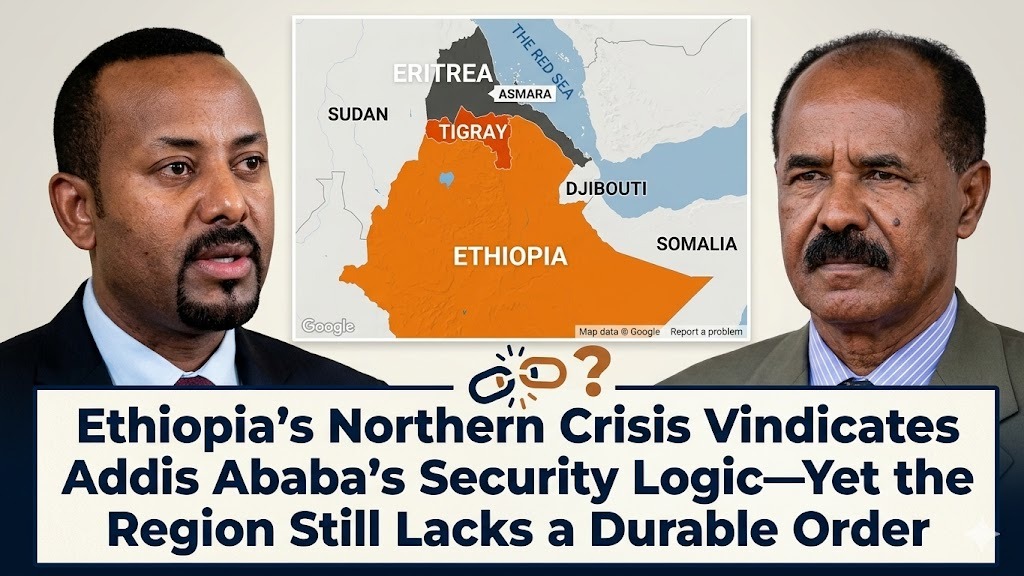
Geopolitical crises in the Horn of Africa rarely emerge suddenly; more often, they represent the delayed exposure of structural tensions long embedded in the region’s fragile political architecture. The renewed strain in relations between Ethiopia and Eritrea illustrates precisely such a dynamic. Much of the external commentary surrounding the latest escalation begins from a convenient but incomplete premise: that Addis Ababa’s strategic posture—particularly its renewed emphasis on sea access and security autonomy—has destabilized the regional balance. Yet this interpretation overlooks a more uncomfortable possibility. Rather than creating instability, Ethiopia may have identified a deeper structural insecurity long before the region—and its observers—were prepared to acknowledge it.
At the center of this misreading lies an overly optimistic interpretation of the Pretoria Peace Agreement. Widely celebrated for ending the devastating two-year war between the Ethiopian federal government and the Tigray People’s Liberation Front (TPLF), the agreement undoubtedly marked a historic diplomatic achievement. Yet ending a war and constructing a durable regional order are fundamentally different undertakings. The Pretoria settlement halted large-scale hostilities, but it did not resolve the deeper security dilemmas that had made northern Ethiopia such a volatile geopolitical space in the first place.
The Limits of the Post-Pretoria Order
Peace agreements often succeed in freezing violence while leaving the strategic environment largely intact. The Pretoria arrangement demonstrated precisely this limitation. It established mechanisms for ceasefire monitoring and humanitarian access, yet it left unresolved several critical questions: the long-term political status of Tigray within the Ethiopian federation, the role and presence of Eritrean forces in contested areas, and the broader architecture of security along Ethiopia’s northern frontier.
These omissions matter profoundly. Northern Ethiopia remains one of the most militarized political spaces in the Horn of Africa, where unresolved political authority and contested security arrangements coexist uneasily. The TPLF’s demobilization, though significant, has not eliminated the complex network of armed actors, local militias, and political factions that shape security dynamics across the region. Nor has the agreement established a robust framework for interstate security cooperation between Addis Ababa and Asmara.
Perhaps most revealing is the fact that Eritrea continues to occupy a pivotal position in Ethiopia’s strategic calculus. Under the leadership of Isaias Afwerki, Eritrea retains the capacity to influence developments in northern Ethiopia through a range of instruments—direct military pressure, diplomatic maneuvering, or tacit alignment with actors dissatisfied with the post-war order. In such an environment, the absence of open warfare does not necessarily imply the existence of a stable equilibrium.
In other words, Pretoria lowered the temperature without dismantling the circuitry of escalation. What the region is witnessing today may therefore be less a sudden deterioration than the delayed exposure of a settlement that never fully secured the northern theater.
Ethiopia’s Structural Security Dilemma
Understanding Ethiopia’s current strategic posture requires situating it within the country’s unique geopolitical predicament. With more than 120 million citizens and one of Africa’s largest economies, Ethiopia remains simultaneously a continental heavyweight and a geographically constrained power. Since losing direct access to the Red Sea following Eritrea’s independence in 1993, Ethiopia has been the world’s most populous landlocked state.
This condition is not merely an economic inconvenience; it is a structural security dilemma. Access to maritime trade routes determines the resilience of national supply chains, military logistics, and long-term economic sovereignty. Ethiopia currently relies overwhelmingly on the ports of Djibouti—a dependence that illustrates the vulnerability inherent in its geography.
For Ethiopian policymakers, therefore, the discourse surrounding maritime access cannot be reduced to rhetorical nationalism or expansionist ambition. Rather, it reflects a strategic reassessment of how a large inland power manages vulnerability in a region characterized by fluid alliances and persistent geopolitical competition.
Prime Minister Abiy Ahmed has repeatedly framed the question of sea access as a matter of long-term national security. Critics often interpret this language as evidence of revisionist ambitions toward neighboring states such as Somalia or Eritrea. Yet such interpretations overlook the broader structural context. Ethiopia’s leadership is grappling with a fundamental mismatch between the country’s demographic and economic weight and the narrow geographic constraints imposed by its unjust landlocked status.
From this perspective, Ethiopia’s strategic narrative—centered on access, autonomy, and sovereign resilience—appears less like opportunistic rhetoric and more like an attempt to articulate a persistent national vulnerability.
Tigray, Eritrea, and the Unfinished Security Equation
If Ethiopia’s maritime discourse reflects long-term structural concerns, the immediate volatility in the north arises from a more complex triangular relationship among Addis Ababa, Asmara, and Tigray.
The war between the Ethiopian government and the TPLF fundamentally altered regional alignments. During the conflict, Eritrea entered Tigray and became the most consequential actor. With the signing of the Pretoria Agreement—negotiated largely without Eritrea’s direct participation—the deal sealed the cessation of hostilities, exposing Eritrea’s forceful incursions into Tigray.
The result is a precarious triangular equilibrium: Ethiopia seeks reintegration and stabilization, Eritrea seeks permanent neutralization of Tigrayan power, and Tigray itself remains politically and militarily uncertain. In such a configuration, even minor shifts in alignment or perception can rapidly escalate into interstate tension.
The Horn’s Expanding Strategic Theater
The northern crisis cannot be analyzed in isolation from the broader geopolitical transformations unfolding across the Horn of Africa and the Red Sea corridor. Regional conflicts increasingly intersect with external power competition, transforming local disputes into nodes within a wider strategic network.
For example, Egypt views developments in Ethiopia through the lens of Nile Basin geopolitics, particularly the dispute surrounding the Grand Ethiopian Renaissance Dam (GERD). From Cairo’s perspective, any regional configuration that constrains Ethiopia’s strategic flexibility may indirectly strengthen Egypt’s bargaining position in the long-running hydropolitical standoff.
Meanwhile, actors such as Turkey and several Gulf states have expanded their diplomatic and commercial presence throughout the Red Sea region. Their engagement often focuses on port infrastructure, logistics corridors, and security partnerships—sectors where economic opportunity and geopolitical influence intersect.
These external actors did not create Ethiopia’s security dilemmas. Yet their presence magnifies the strategic consequences of regional instability. Ports, corridors, and maritime routes increasingly function as instruments of geopolitical leverage, reinforcing Ethiopia’s perception that geographic constraints translate directly into strategic vulnerability.
When Thin Settlements Collapse
Across the Horn, the recurring pattern is clear: political settlements that pause violence without constructing durable institutions tend to unravel under pressure.
The ongoing war in Sudan demonstrates how quickly fragile political arrangements can collapse when competing armed actors retain independent power bases. Similarly, persistent constitutional tensions in Somalia reveal the risks of attempting ambitious state-building projects without sufficient consensus on security sequencing.
The Ethiopia–Eritrea relationship reflects a parallel dynamic. The Pretoria agreement succeeded in halting an active war but did not establish the comprehensive political-security architecture necessary to stabilize the entire northern frontier. In the absence of such an architecture, political rhetoric—whether concerning sovereignty, recognition, or maritime access—easily becomes a vehicle for geopolitical signaling.
Ethiopia’s Strategic Narrative: Insight Without Doctrine
Acknowledging the legitimacy of Ethiopia’s security concerns does not imply that its diplomatic strategy has been flawless. Real insecurity does not automatically produce optimal policy. Addis Ababa has often articulated its grievances in language that resonates domestically but raises alarm among its neighbors.
In regional diplomacy, perception can be as consequential as capability. Statements emphasizing historical entitlement or strategic correction risk reinforcing fears of Ethiopian predominance, particularly among smaller states that already view the region’s demographic giant with caution.
Thus, Ethiopia faces a second-order challenge. Having correctly diagnosed the structural insecurity embedded in its geopolitical position, it must now translate that diagnosis into a doctrine capable of reassuring its neighbors while safeguarding its national interests.
Toward a More Durable Northern Settlement
The Horn of Africa appears to be entering a period of competitive geopolitical reordering. In such an environment, thin settlements will likely fail quickly, while symbolic disputes may escalate into strategic confrontations. Avoiding this trajectory requires a more deliberate effort to construct durable regional architecture.
For Ethiopia, three policy priorities appear particularly urgent.
First, Addis Ababa should continue articulating the legitimacy of its security and access concerns, but it must do so in a language that minimizes avoidable alarm. Strategic communication is not merely diplomatic etiquette; in the Horn, it shapes alliance behavior and regional perceptions.
Second, the northern settlement should incorporate Tigray as a central variable rather than treating it as a residual administrative issue. The interface between interstate conflict and internal fragmentation runs directly through Tigray. Any sustainable security arrangement between Ethiopia and Eritrea will ultimately require a political framework that addresses this triangular dynamic.
Third, Ethiopia’s pursuit of maritime access should be embedded within a broader regional bargain rather than framed solely as a national demand. Multilateral approaches involving Red Sea and Horn states—potentially under the auspices of regional organizations such as Intergovernmental Authority on Development (IGAD) or the African Union (AU)—could help transform what currently appears as a zero-sum geopolitical contest into a cooperative economic project.
Conclusion
The renewed tensions in northern Ethiopia should not be interpreted simply as the result of ambition or miscalculation. They reflect the deeper structural reality that the Horn of Africa has yet to develop a stable regional order capable of accommodating the security concerns of its largest state while reassuring its smaller neighbors.
In this sense, Ethiopia’s strategic anxiety is not irrational. Its leadership has recognized earlier than many observers that the post-Pretoria environment was insufficient to guarantee long-term stability. Yet recognizing a structural problem is only the first step toward solving it.
The real challenge now lies in transforming Ethiopia’s security narrative into a credible architecture of regional cooperation—one that addresses legitimate concerns about access, sovereignty, and stability without convincing the region that Ethiopia’s security can only come at others’ expense.
The Horn’s history offers a sobering lesson: when diplomacy fails to construct durable order, war often becomes the brutal mechanism through which unresolved contradictions are eventually settled. Ethiopia has correctly identified the fragility of the current arrangement. The question that remains is whether Addis Ababa—and the region around it—can design a more sustainable equilibrium before the next crisis forces the issue once again.
By Saron Tadesse, IFA
Disclaimer:
The content disseminated by the Institute of Foreign Affairs (IFA) – including, but not limited to, publications, public statements, events, media appearances, and digital communications – reflects the views of individual contributors and does not necessarily represent the official positions or policies of the Institute, its partners, or any affiliated governmental or non-governmental entities.
While the IFA endeavors to ensure the accuracy, integrity, and timeliness of the information presented, it makes no representations or warranties, express or implied, regarding the completeness, reliability, or suitability of such content for any purpose. The Institute expressly disclaims any liability for errors or omissions, as well as for any actions taken or decisions made based on the information provided.
The inclusion of external links, references, or third-party resources does not constitute an endorsement by the Institute. Additionally, engagement on social media platforms – including, but not limited to, likes, shares, retweets (RTs), or reposts – shall not be interpreted as an endorsement or validation of the views expressed therein.Readers and audiences are encouraged to exercise critical judgment and seek independent verification when interpreting or relying upon any information disseminated through publications and posts on the Institute’s platforms or representatives.