

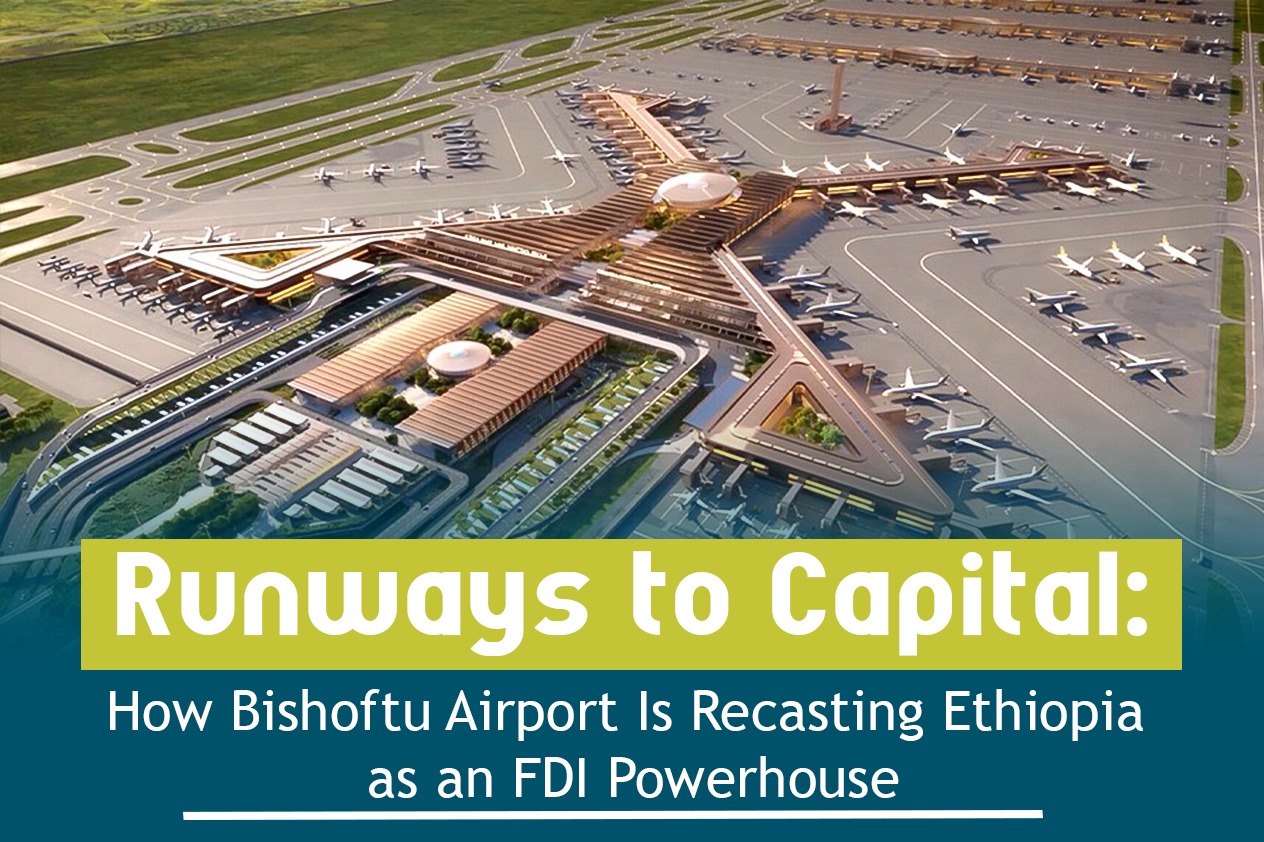
The construction of the Bishoftu International Airport (BIA) in Bishoftu, Ethiopia, is often viewed as a necessary response to the increasing congestion at Addis Ababa Bole International Airport. However, the significance of this project goes beyond expanding aviation capacity. It is a flagship project poised to become a continental hub serving Ethiopia and the broader African region. Furthermore, it represents a strategic effort to position Ethiopia as an attractive destination for foreign direct investment (FDI) in today’s competitive global economy.
Recent discussions with Italy regarding financing for the US $12.5 billion mega-project have injected new energy into the initiative. These talks indicate that European countries are steadily building confidence in the project, potentially paving the way for a broader influx of investors in similar ventures. While a binding agreement has not yet been reached, this engagement signifies a shift in perception—viewing the project not merely as infrastructure development, but as a premier long-term investment opportunity.
Infrastructure as Strategic Signaling
Mega-projects like Bishoftu Airport serve multiple purposes. In Ethiopia’s case, the airport not only addresses aviation needs but also signals the country’s policy intentions and execution capabilities.
With construction already in progress since the groundbreaking in January 2026, the project has reached a significant milestone. For international investors, visible progress reduces uncertainties and distinguishes credible ventures from mere aspirations.
With support from the African Development Bank (AfDB), the Ethiopian Airlines Group (EAG)—a leading carrier in Africa—is steering the initiative. Its role as the sponsor of this landmark project ensures institutional credibility.
The project, which is planned for completion by 2030 with a projected annual capacity of over 100 million passengers, will be Africa’s largest airport. However, its true value lies in its comprehensive design. The inclusion of logistics hubs, cargo terminals, maintenance facilities, and commercial zones reflects a larger “airport city” model aimed at generating sustainable economic activity.
Boosting Momentum and Investor Confidence
Italy’s participation in financing discussions introduces a crucial element into the project’s evolving structure. Although negotiations are ongoing, the potential involvement of Italian financial institutions signals growing confidence from Europe in Ethiopia’s infrastructure plans.
This development aligns with Ethiopia’s broader strategy to diversify its economic partnerships. Engagements with Italy extend beyond aviation to encompass cooperation on debt restructuring under the G20 Common Framework, as well as support for other major infrastructure projects.
In Mid-March 2026, Ethiopia and Italy signed a bilateral debt restructuring agreement as part of the Official Creditor Committee (OCC) process under the G20 Common Framework.
Diversified financing enhances the project’s appeal from an FDI perspective. In addition to the African Development Bank—which initially financed $500 million and led efforts to raise $8.7 billion—reports indicate that countries from the Middle East, Europe, and China have shown strong interest in financing this mega-project.
The United States also previously announced its support for the Bishoftu International Airport project. During his September 2025 state visit to Ethiopia, US Senior Advisor for Africa Massad Boulos met with Prime Minister Abiy Ahmed (PhD), Ethiopian Airlines CEO Mesfin Tasew, and other officials. Boulos emphasized the historic ties between the U.S. and Ethiopian Airlines—anchored by the long-standing Boeing partnership—and signaled that the U.S. International Development Finance Corporation (DFC) is mobilizing to support the new airport, with specific financial terms still under deliberation.
Involvement from various stakeholders helps spread risk and enhances overall bankability. For investors, such arrangements provide assurance that the project is backed by a broad coalition rather than a single funding source.
Logistics as the New Investment Frontier
The Bishoftu project emerges at a time when logistics infrastructure plays a crucial role in global investment decisions. As supply chains adapt to geopolitical changes and post-pandemic realities, countries offering efficient transit and distribution networks are gaining strategic importance.
Ethiopia’s strategic geographic location naturally positions it as a link between Africa, Europe, the Middle East, and Asia. By integrating cargo infrastructure into the core of the project, Bishoftu International Airport is poised to facilitate new trade routes, particularly for time-sensitive goods.
This shift has direct implications for FDI. Investors in manufacturing, agriculture, and high-value exports are more inclined to invest where logistics systems are reliable and cost-effective. In this context, the airport not only serves as a transportation hub but also as a foundation for broader industrial growth.
The Airport City Effect
A key feature of the Bishoftu development is its focus on economic clustering. The planned “airport city” is expected to host industrial zones, logistics parks, service providers, and commercial enterprises within an integrated ecosystem.
Such clustering effects can stimulate self-reinforcing growth. Initial investments attract complementary industries, creating networks of suppliers and service providers that lower operational costs and enhance efficiency. Over time, this clustering dynamic can transform infrastructure into a sustained driver of investment.
However, realizing this potential will depend on the strength of the regulatory environment. Efficient customs procedures, transparent investment rules, and streamlined administrative processes will be crucial in translating infrastructure into tangible economic benefits.
Constraints in a Competitive Landscape
Some observers may still express skepticism. The project undoubtedly offers significant potential, but its implementation will hinge on a range of structural and competitive considerations. Debt sustainability, in particular, will be central to the financing strategy, given the scale of investment involved and persistent questions about feasibility. At the same time, standard infrastructure metrics—such as adherence to timelines and budget discipline—will serve as critical indicators of overall performance.
Yet, while these concerns are legitimate, Ethiopia has, in recent years, developed a track record of delivering large-scale national projects under the leadership of Abiy Ahmed. The completion of the Grand Ethiopian Renaissance Dam (GERD)—a flagship project valued at around $5 billion and the largest hydroelectric dam in Africa, with a projected capacity exceeding 5,000 MW—stands as a defining example. The dam has already begun generating electricity, with neighboring countries such as Kenya, Djibouti, and Sudan benefiting from power exports, while others, including Somalia and Tanzania, are expected to follow.
Beyond GERD, a range of ongoing mega-projects further reinforces this track record. These include the nationwide corridor development initiatives centered in Addis Ababa, the Digital Ethiopia strategy aimed at accelerating technological transformation, the expansion of industrial parks, and major transport and logistics investments such as rail and road networks. Collectively, these projects provide tangible evidence of Ethiopia’s growing institutional and executional capacity to deliver complex, capital-intensive infrastructure. In this context, there is a strong basis to expect that the Bishoftu International Airport project will be completed as planned by 2030.
Regionally, Ethiopia is not alone in pursuing logistics-driven growth. Kenya and Rwanda are actively positioning themselves as investment and logistics hubs, while established global centers in the Middle East continue to offer advanced infrastructure and mature regulatory ecosystems.
To effectively compete, Bishoftu should differentiate itself not just through scale but also through efficiency, cost competitiveness, and policy coherence.
Moving from Infrastructure to Investment Strategy
Maximizing the project’s impact on FDI will require a coordinated policy approach:
– Establishing a dedicated investment regime tailored to the airport city
– Securing anchor investors to attract broader capital inflows
– Enhancing transparency in financing and project implementation
– Integrating the airport with national industrial and export strategies
– Leveraging economic diplomacy to position Ethiopia as a gateway economy
The project is a crucial test for Ethiopia’s Economic Trajectory. Bishoftu epitomizes far beyond a simple infrastructure achievement—it stands as a trial of excellence.
By Bruktawit Abayneh, Research communication head, IFA
Disclaimer:
The content disseminated by the Institute of Foreign Affairs (IFA) – including, but not limited to, publications, public statements, events, media appearances, and digital communications – reflects the views of individual contributors and does not necessarily represent the official positions or policies of the Institute, its partners, or any affiliated governmental or non-governmental entities.
While the IFA endeavors to ensure the accuracy, integrity, and timeliness of the information presented, it makes no representations or warranties, express or implied, regarding the completeness, reliability, or suitability of such content for any purpose. The Institute expressly disclaims any liability for errors or omissions, as well as for any actions taken or decisions made based on the information provided.
The inclusion of external links, references, or third-party resources does not constitute an endorsement by the Institute. Additionally, engagement on social media platforms – including, but not limited to, likes, shares, retweets (RTs), or reposts – shall not be interpreted as an endorsement or validation of the views expressed therein.Readers and audiences are encouraged to exercise critical judgment and seek independent verification when interpreting or relying upon any information disseminated through publications and posts on the Institute’s platforms or representatives.