

For Ethiopia, the question is no longer whether military modernization is necessary. It is whether modernization will strengthen sovereign capacity or merely replace one form of vulnerability with another. In defence, the danger does not end with the purchase price. It begins after delivery: in the spare parts chain, in software dependence, in maintenance regimes, in upgrade permissions, in munitions resupply, and in the quiet political leverage that foreign suppliers retain over the systems they sell. A country may formally own its platforms yet still lack full control over their combat availability. That is why the real strategic issue is not import versus local production in the abstract. It is whether procurement is structured to reproduce dependency or to create capability.[1][2]
This distinction matters with particular force for Ethiopia. A state that seeks stronger strategic autonomy cannot build its armed forces on a model of permanent external permission. Modern military technology is too complex, too capital-intensive, and too embedded in global supply chains for any late-industrializing country to localize everything at once. The relevant lesson from successful states is therefore not self-sufficiency in the maximalist sense. It is sequencing: importing what is urgently needed for deterrence and readiness, while using every acquisition to widen domestic maintenance capacity, subsystem production, engineering absorption, and, over time, selective design authority.[3][4]
Defence technology is unlike ordinary industrial imports because dependency extends across the full life cycle of the system. An army can buy an air-defence battery, a drone fleet, or an armored vehicle, but if it cannot overhaul that equipment at home, secure the software environment, integrate new payloads, or guarantee wartime resupply, it has purchased only conditional capability. In peacetime this weakness may remain hidden. In crisis it becomes decisive. The supplier’s power often appears not at the point of sale but at the point of sustainment. Real sovereignty in defence therefore means more than possession. It means the ability to use, repair, adapt, and replenish systems under pressure without crippling foreign constraint.[5]
Many developing states misread this problem because they frame the debate too crudely. One camp treats modernization as a procurement exercise and assumes that rapid imports are enough. Another speaks of indigenous production as though political will alone can substitute for industrial depth. Both approaches fail. Pure import strategies can create sharp operational gains, but they also lock militaries into foreign logistics, training, and upgrade pathways. Pure self-reliance rhetoric, by contrast, often degenerates into symbolic factories, low-value assembly, and unrealistic claims of autonomy. The stronger path lies between those errors. The aim should be capability-producing acquisition: imports that are chosen, negotiated, and sequenced so that each round of modernization leaves behind more national competence than before.[1][3]
India offers one of the clearest illustrations of this logic. Its latest acquisition reforms explicitly describe a move beyond an earlier phase of indigenisation that was largely understood as manufacturing foreign technology. The policy direction now stresses indigenous design, development, and manufacturing, while seeking to reduce import dependency through procurement preference, higher indigenous-content requirements, and new acquisition categories.[1][6] This is a significant distinction. Manufacturing a foreign design under license may create industrial activity, but it does not automatically create design control. India’s experience shows that indigenisation becomes strategically meaningful only when the state uses procurement demand to push domestic industry beyond fabrication and toward engineering authority. For Ethiopia, the lesson is not to imitate India’s scale. It is to understand that demand policy matters. Local production becomes strategic only when the state deliberately rewards movement from assembly to subsystems, and from subsystems to adaptation and design.[1][6]
Turkey’s rise provides a second, and in some ways more relevant, lesson. Ankara did not begin by rejecting foreign cooperation. It used licensed production, joint ventures, offsets, and local-content requirements as stepping stones, while building a central defence-industrial authority capable of linking procurement, finance, R&D, and export promotion. That sequencing helped Turkey move from dependency toward a far broader industrial base. Yet the Turkish case is also a warning against undisciplined ambition: the same high-quality study that documents Turkey’s ascent notes criticism over poor prioritisation and a lack of coherent procedure, as well as the sector’s growing dependence on exports to offset costs.[3] The implication for Ethiopia is exacting but useful. Co-production can work, but only if it is governed by a clear learning roadmap. Without strong institutional discipline, it risks becoming a prestige exercise rather than a capability ladder.[3]
Brazil underscores a third principle: autonomy should be selective, not universal. Its national defence strategy tied military modernization to the restructuring of the defence industry and explicitly aimed to ensure that the armed forces’ equipment needs would rest on technologies “domestically mastered.” At the same time, Brazil concentrated special emphasis on decisive sectors such as cyber, space, and nuclear capabilities rather than pretending that every domain could be equally localized.[4] That is the right logic for a resource-constrained state. A poorer country does not need sovereignty in everything. It needs sovereignty in the capabilities where control matters most, where adaptation to local terrain and doctrine is crucial, and where industrial learning can realistically accumulate. Ethiopia’s strategic problem is therefore not how to produce an entire arsenal domestically. It is how to identify the few domains in which domestic mastery would generate the highest security return.[4]
Indonesia shows both the promise and the limits of legally mandated technology transfer. Its recent regulations require foreign defence procurement to pass through countertrade, local-content, and offset mechanisms, with significant obligations tied to contract value. The same framework specifies that these arrangements can include design, engineering, education and training, after-sales service, overhaul, modification, licensed production, joint production, joint development, and technology transfer, all under a coordinated state mechanism.[7] That architecture is sophisticated because it recognizes that procurement should return part of the contract value as technological control and national added value. But the Indonesian lesson is also sobering: transfer clauses do not absorb technology by themselves. Contracts can compel cooperation; they cannot manufacture competent engineers, disciplined factories, or effective audit systems. For Ethiopia, this means co-production and offsets are useful only in sectors where real absorptive capacity can be built.[7]
South Africa’s experience adds an essential caution. Its defence-industry white paper placed unusual emphasis not only on critical technologies and acquisition structures, but also on economic viability and governance. That concern was well placed. Defence industries can become politically protected but strategically underperforming sectors if governments confuse industrial symbolism with sustainable capability. The South African case reminds late-modernizing states that defence industrial policy requires tough choices about what is worth sustaining, what can be converted, and how to govern acquisition and technology management without opening large spaces for rent-seeking or prestige procurement.[8] Ethiopia should absorb that warning early. A domestic defence industry is valuable only if it is disciplined by performance, sustained demand, and strategic clarity.[8]
What, then, should Ethiopia do? It should adopt a doctrine of sequenced defence autonomy. That begins by abandoning the false prestige of trying to localize everything. Some capabilities are too urgent or too technologically demanding to wait for local production. Air-defence layers, resilient communications, electronic warfare tools, selected intelligence and surveillance systems, and certain high-end munitions may have to be acquired abroad for the foreseeable future. But even here, deals should be judged not only by what they deliver now, but by what they allow Ethiopia to control later: training rights, local maintenance, overhaul capacity, software access where possible, munitions continuity, and the freedom to integrate or modify subsystems over time.[5][6]
The second layer should focus on co-production where learning is realistic and strategically meaningful. Ammunition, tactical drones, vehicle refurbishment and upgrade kits, communications equipment, support electronics, and maintenance depots are more plausible sectors for rapid Ethiopian gains than the pursuit of costly prestige platforms. In these areas, the purpose of co-production must be clearly understood. It is not to attach the Ethiopian flag to foreign hardware. It is to move technical control inward: into tooling, quality assurance, repair competence, component substitution, testing, and skilled labor formation. Local assembly without those gains is not autonomy. It is supervised dependence with domestic packaging.[3][7]
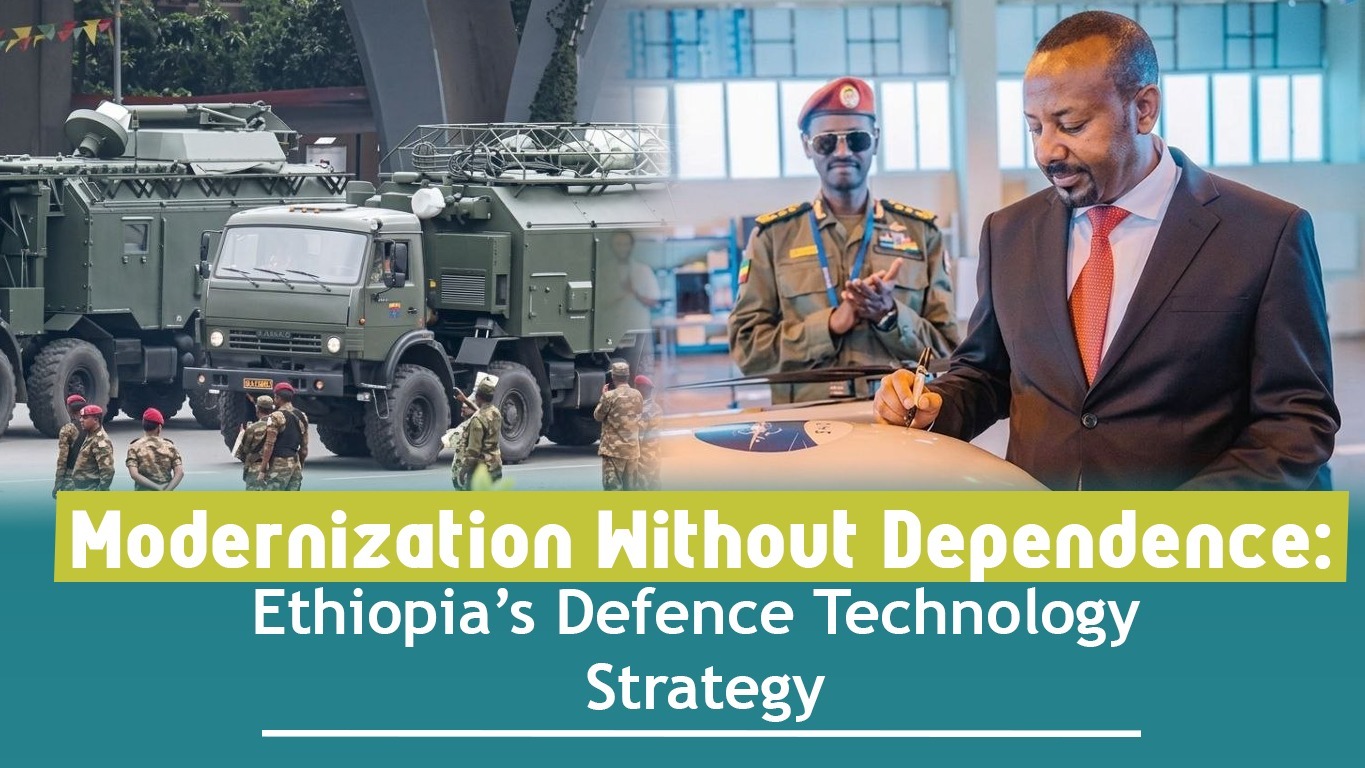
The third layer should be genuinely indigenous and highly selective. Ethiopia’s visible movement in unmanned systems suggests where this logic can start. In March 2025, Prime Minister Abiy Ahmed inaugurated SkyWin Aeronautics Industries, which manufactures unmanned aerial vehicles for civilian and military use.[9] That fact alone does not prove deep technological independence. But it does indicate an emerging institutional base in a sector where entry barriers are lower than in combat aircraft, where iteration cycles are faster, and where local adaptation can generate immediate operational relevance. Drones, counter-drone systems, tactical communications, battlefield software, ruggedized electronics integration, and selected loitering systems are exactly the types of domains in which a late-industrializing state can move from assembly to adaptation more quickly than in heavier and more capital-intensive categories.[9]
The broader international market reinforces the case for this approach. SIPRI’s latest data show that the global arms trade is being reshaped by concentration among the largest exporters, the sharp decline in Russian exports, and a wider search by importers for diversified supply options. In the 2021–25 period, the United States alone accounted for 42 percent of global arms exports, while the top five suppliers together made up 70 percent of the total.[5] For importers, that means two things. First, dependence on a narrow supplier base has become riskier. Second, diversification is necessary but not sufficient. A country can diversify its suppliers and still remain dependent if it has not built domestic sustainment and adaptation capacity. Ethiopia should therefore treat the global market not as a stable source of guaranteed access, but as an increasingly competitive and politically conditioned space that makes selective autonomy more valuable, not less.[5]
In the end, the strongest Ethiopian strategy is neither romantic self-reliance nor passive import dependence. It is a disciplined progression from buyer to builder in carefully chosen domains. That requires a central state mechanism able to connect military demand, industrial policy, workforce development, R&D, and acquisition oversight. It requires rigorous triage about what must be sovereign, what can be co-produced, and what will remain imported. And it requires judging every major defence deal by a simple question: five years after the contract is signed, what element of capability will be more firmly under Ethiopian control? That is the metric that separates modernization from mere accumulation. Ethiopia’s long-term military strength will not be decided only by what it buys abroad. It will be decided by whether those purchases are converted, patiently and deliberately, into sovereign national capability.[3][4][7][8]
Notes
[1] Government of India, Defence Acquisition Procedure 2026 draft materials and Press Information Bureau release on DAP 2026, 2026.
[2] SIPRI, Trends in International Arms Transfers, 2025, March 2026.
[3] International Institute for Strategic Studies, From Client to Competitor: The Rise of Türkiye’s Defence Industry, 2024.
[4] Federative Republic of Brazil, National Strategy of Defense, 2008.
[5] SIPRI, Trends in International Arms Transfers, 2025, March 2026.
[6] Press Information Bureau, Government of India, “DAP 2026 proposes transformative leap in India’s defence acquisition framework,” February 2026.
[7] Ministry of Defence of the Republic of Indonesia, regulation on countertrade, local content, and offset in foreign defence procurement, 2024.
[8] Government of South Africa, White Paper on the South African Defence Related Industries, 1999.
[9] Ethiopian News Agency, “Prime Minister Abiy Inaugurates Sky Win Aeronautics Industries,” March 8, 2025.
By Sifan Tadesse, IFA
Disclaimer:
The content disseminated by the Institute of Foreign Affairs (IFA) – including, but not limited to, publications, public statements, events, media appearances, and digital communications – reflects the views of individual contributors and does not necessarily represent the official positions or policies of the Institute, its partners, or any affiliated governmental or non-governmental entities.
While the IFA endeavors to ensure the accuracy, integrity, and timeliness of the information presented, it makes no representations or warranties, express or implied, regarding the completeness, reliability, or suitability of such content for any purpose. The Institute expressly disclaims any liability for errors or omissions, as well as for any actions taken or decisions made based on the information provided.
The inclusion of external links, references, or third-party resources does not constitute an endorsement by the Institute. Additionally, engagement on social media platforms – including, but not limited to, likes, shares, retweets (RTs), or reposts – shall not be interpreted as an endorsement or validation of the views expressed therein.
Readers and audiences are encouraged to exercise critical judgment and seek independent verification when interpreting or relying upon any information disseminated through publications and posts on the Institute’s platforms or representatives.