

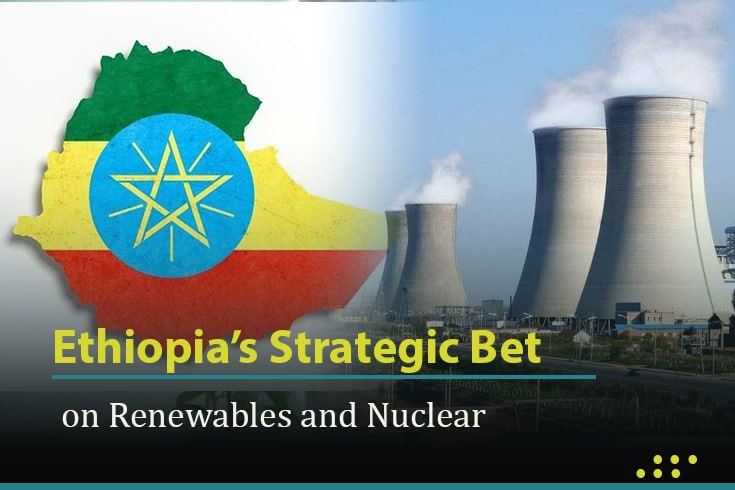
The old assumption behind energy planning in import-dependent states was that oil shocks, however painful, would eventually pass. Prices would spike, shipping routes would tighten, wars would unsettle markets, and then the system would normalize. That assumption now looks increasingly outdated. Imported hydrocarbons no longer carry only a commercial cost. They carry a recurring geopolitical premium. For countries without oil wealth, energy security has returned to the center of state strategy. In that setting, Ethiopia’s turn toward diversified renewables, grid expansion, and peaceful nuclear preparation looks less like ambition for its own sake than a notably forward-looking effort to build resilience before crisis dictates the terms.[1][2][3]
Energy insecurity is no longer episodic
The significance of today’s oil insecurity lies not only in price volatility but in structural exposure. The Strait of Hormuz remains the world’s most important oil transit chokepoint: the U.S. Energy Information Administration estimates that oil flows through the strait averaged 23.2 million barrels per day in the first half of 2025, about 29 percent of total global seaborne oil trade. EIA also notes that very few alternatives exist to move oil out of the Gulf if the strait is disrupted.[1] That matters because it shows how much of the global economy still depends on narrow corridors vulnerable to war, coercion, or strategic panic.
For non-oil developing economies, that vulnerability spills well beyond the fuel pump. Imported petroleum shapes transport costs, food logistics, industrial production, inflation, and foreign-exchange stability. A government can survive one episode of disruption through subsidies or emergency adjustment. It cannot build durable growth on the assumption that such shocks will remain rare. This is why energy policy has moved back into the realm of national security. States that can anchor more of their energy system domestically now hold a meaningful strategic advantage over those that remain exposed to imported volatility.[1]
Ethiopia’s advantage is substantial
Ethiopia already possesses one of the most important starting advantages in Africa: a highly renewable electricity base. IRENA’s Ethiopia profile shows that the country’s installed power capacity remains overwhelmingly renewable, led by hydropower with additional wind, bioenergy, solar, and a smaller geothermal component.[2] That is not a symbolic achievement. It means Ethiopia has already established a domestic platform for power generation that many import-dependent states still lack.
Still, electricity strength is not the same thing as full energy sovereignty. Transport, freight, and many industrial activities remain exposed to imported fuel costs. Ethiopia is therefore not yet insulated from global hydrocarbon risk. But this is precisely why its current direction deserves a positive reading. The country is not beginning its transition in the middle of an emergency. It is building from an existing base of renewable strength. That alone places it ahead of many peers that are only now confronting the strategic implications of fossil-fuel dependence.[2][3]
Hydropower’s dominance also sharpens the logic of diversification. Hydro has given Ethiopia a major comparative advantage, but concentration in any single source brings risk, especially in an era of climate variability and hydrological uncertainty. The strategic answer is not to retreat from hydro. It is to widen the system around it. Ethiopia’s policy direction increasingly reflects that understanding.[2][3]
Diversified Renewables
The clearest expression of that strategy appears in Ethiopia’s National Energy Compact. The compact sets a target of expanding installed capacity from 9,761 MW to 14,000 MW by 2030, raising the share of non-hydro renewables to at least 15 percent, scaling up transmission and distribution infrastructure, and creating conditions to mobilize larger volumes of private investment.[3] Taken together, these are not merely development goals. They form the outline of a resilience strategy.
Each part of that mix addresses a different vulnerability. Wind can complement seasonal hydrological fluctuations. Solar can strengthen distributed supply and reduce pressure on centralized systems. Geothermal offers the prospect of reliable domestic baseload. Storage improves flexibility and makes variable generation more dependable. Transmission matters just as much as generation, because energy security is not created only where power is produced; it is created when power can be moved reliably to industrial centers, households, and export markets.[2][3]
This is what makes Ethiopia’s strategy notably prescient. It is not treating renewable energy as branding. It is using renewable diversification to reduce structural exposure. In a world where imported hydrocarbons increasingly come with geopolitical risk attached, that is a sophisticated policy instinct. Ethiopia is not waiting for external pressure to force a reset. It is attempting to build optionality in advance.[1][3]
The Nuclear long-horizon
The same logic applies to nuclear. Nuclear power is expensive, slow, and governance-intensive. All of that is true. Ethiopia’s most immediate gains will still come from diversified renewables, storage, transmission expansion, and electrification. But that does not make peaceful nuclear preparation a distraction. It makes it a long-range hedge.
Ethiopia’s September 2025 statement to the IAEA presents nuclear development in precisely those institutional terms: strengthening cooperation with the Agency, developing human capacity, and advancing peaceful nuclear applications under international safeguards.[4] That is the right sequence. Serious nuclear capability begins not with a reactor announcement but with regulation, training, safety culture, and institutional patience.
Seen that way, nuclear is not a break from Ethiopia’s renewable path. It is a disciplined effort to preserve future choices. As industrial demand rises and the value of steady baseload grows, Ethiopia may benefit from having prepared the legal, technical, and human infrastructure needed to evaluate nuclear energy from a position of competence rather than urgency. A state that starts building those foundations early expands its room for maneuver later.[3][4]
Energy policy is also becoming regional strategy
The strategic payoff of Ethiopia’s energy choices will not stop at its borders. In the Horn and East Africa, infrastructure is never purely technical. It shapes interdependence, bargaining power, and the regional balance of influence. Energy, in that sense, can become both an economic asset and a geopolitical instrument.[3][5][6]
The Ethiopia–Kenya interconnector offers the clearest example. KETRACO describes it as a 1,045-kilometre, 500 kV HVDC transmission line running from Wolayta/Sodo in Ethiopia to Suswa in Kenya, with 2,000 MW converter substations at both ends. The Eastern Africa Power Pool identifies the line as one of the major achievements of regional integration, enabling electricity exchange among member states.[5][6] This is more than an engineering fact. It shows how Ethiopia’s domestic generation base can be translated into regional influence.
That matters economically as well as politically. A reliable exportable electricity surplus can support foreign-exchange earnings, improve manufacturing competitiveness through more dependable supply at home, and strengthen the wider architecture of regional power trade. It can also deepen the kind of interdependence that raises the cost of regional instability. None of this is automatic. Exporting power creates obligations of reliability and pricing credibility. But those are the obligations that come with strategic weight. They do not diminish the opportunity. They confirm it.[3][5][6]
Conclusion
Ethiopia’s energy direction now looks notably well judged. In a world where imported oil carries a harder strategic edge, the country’s investment in diversified renewables, stronger grids, and peaceful nuclear preparation appears not merely prudent but prescient. It reflects a state trying to reduce vulnerability before vulnerability becomes overwhelming.
The next task is disciplined acceleration: diversify beyond hydro, build transmission as seriously as generation, link energy planning to industrial competitiveness and foreign-exchange resilience, and continue nuclear preparation with institutional care rather than spectacle. If Ethiopia stays on that course, it will do more than reduce exposure to oil shocks. It will show that a non-oil state can convert infrastructure into sovereignty and sovereignty into constructive regional influence.[2][3][4][6]
References
[1] U.S. Energy Information Administration. World Oil Transit Chokepoints. 2025.
U.S. Energy Information Administration. Amid Regional Conflict, the Strait of Hormuz Remains Critical for Oil Trade. Today in Energy, June 16, 2025.
[2] International Renewable Energy Agency. Ethiopia: Statistical Profile (Africa Renewable Energy Statistics Profile). 2025 edition.
[3] World Bank. National Energy Compact for the Federal Democratic Republic of Ethiopia (Mission 300). 2025.
[4] International Atomic Energy Agency. Statement of the Federal Democratic Republic of Ethiopia to the 69th Ordinary Session of the General Conference. September 2025.
[5] Kenya Electricity Transmission Company. Eastern Electricity Highway Project (EEHP) (Kenya–Ethiopia Interconnector) Transmission Line. Project documentation.
[6] Eastern Africa Power Pool. Infrastructure Development. Project overview.
African Development Bank. Project Completion Report for Public Sector Operations: Multinational Ethiopia–Kenya Electricity Highway Project.
By Kena Seyife, IFA
Disclaimer:
The content disseminated by the Institute of Foreign Affairs (IFA) – including, but not limited to, publications, public statements, events, media appearances, and digital communications – reflects the views of individual contributors and does not necessarily represent the official positions or policies of the Institute, its partners, or any affiliated governmental or non-governmental entities.
While the IFA endeavors to ensure the accuracy, integrity, and timeliness of the information presented, it makes no representations or warranties, express or implied, regarding the completeness, reliability, or suitability of such content for any purpose. The Institute expressly disclaims any liability for errors or omissions, as well as for any actions taken or decisions made based on the information provided.
The inclusion of external links, references, or third-party resources does not constitute an endorsement by the Institute. Additionally, engagement on social media platforms – including, but not limited to, likes, shares, retweets (RTs), or reposts – shall not be interpreted as an endorsement or validation of the views expressed therein.
Readers and audiences are encouraged to exercise critical judgment and seek independent verification when interpreting or relying upon any information disseminated through publications and posts on the Institute’s platforms or representatives.