

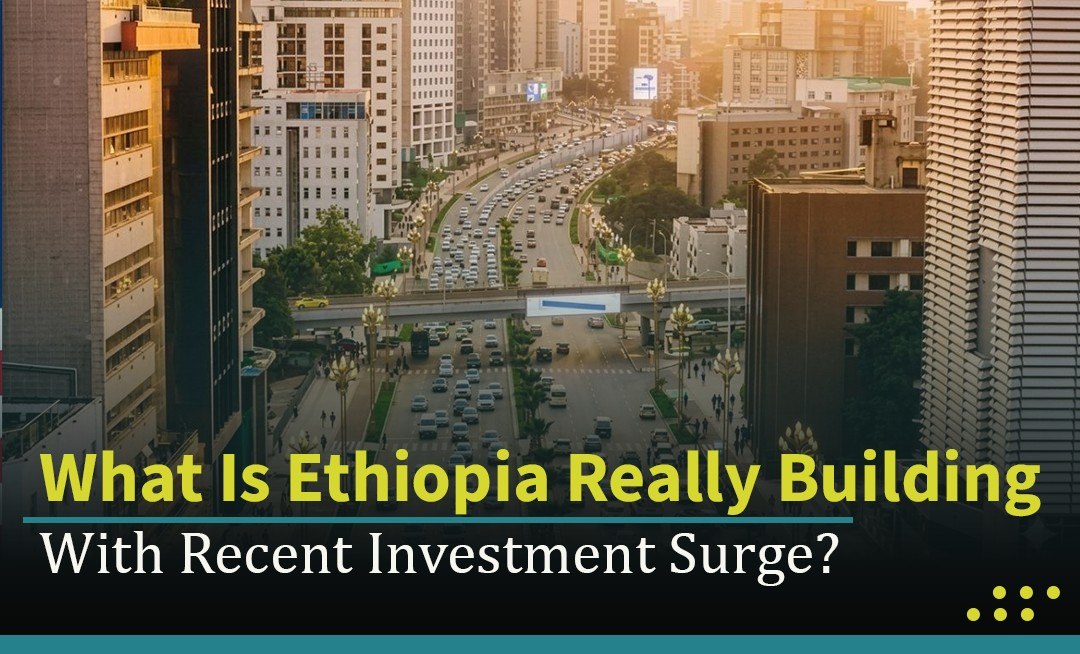
The headline from Ethiopia’s 2026 investment forum might seem a design for easy consumption: $13.1 billion in signed agreements. The harder question is what kind of economy those agreements imply. Read superficially, the forum looks like a familiar foreign direct investment story—one more contest among East African economies to attract scarce capital. Read strategically, it suggests something more consequential. Ethiopia is not merely competing for a larger share of investment. It is trying to shift regional competition toward sectors where scale, energy, and production capacity matter more than intermediation alone.[1][2]
That distinction matters since the composition of the commitments is unusually revealing. Reporting on the forum shows the agreements concentrated in manufacturing, agriculture and agro-processing, energy, construction, and other strategic sectors.[1][2] Official summaries of the event say the largest block sat in energy and green development, with more than $10.3 billion of commitments, while industrialization and manufacturing accounted for roughly $2.5 billion more.[2] Reuters also reported that the single biggest commitment came from China’s Ming Yang Smart Energy Group, whose projects in renewable energy, hydrogen, and green ammonia were valued at more than $10 billion.[1] This is not what an investment profile looks like when investors are mostly chasing short-cycle consumer demand or speculative paper returns. It is what it looks like when a state is trying to assemble a production system.[1][2]
Why the sector mix matters
The most important analytical mistake is to treat all inward capital as strategically equivalent. It is not. Capital aimed at real estate, finance, or shallow services can boost activity, but it does not necessarily deepen productive capability. Capital aimed at energy, manufacturing, processing, and logistics infrastructure can. It can create tradables, reduce import dependence, and produce linkages across the wider economy.
This matters especially in Ethiopia’s case because the country’s long-running weakness has not been a lack of ambition but a narrow export base relative to its size. A World Bank economic update argued that a more competitive external position would be necessary for manufacturing-led structural transformation, stronger growth, and a better external balance.[3] The implication is straightforward: an economy as large as Ethiopia’s cannot rely indefinitely on consumption, protected domestic activity, or headline reform alone. It must produce more of what it sells abroad.[3]
That is why the forum’s sector mix is more significant than the $13.1 billion headline. Ethiopia appears to be signaling that the next phase of its growth model is not simply about attracting more investors, but about attracting them into activities that harden economic structure. Manufacturing and agro-processing matter because they keep more value inside the country. Construction and logistics matter because they reduce the frictions that make inland production expensive. Energy matters because without reliable power, the rest remains an announcement rather than a strategy.[1][2][3]
Renewable energy as the real center of gravity
The clearest evidence that Ethiopia is attempting something larger than an FDI publicity cycle is the sheer weight of the energy package. More than $10.3 billion of the forum’s commitments were directed to energy and green development, and the anchor deal—Ming Yang’s planned investment of over $10 billion—focuses on renewable energy, hydrogen, and green ammonia.[1][2] That concentration is analytically decisive. It suggests that the forum was not built around a miscellany of unrelated deals. It was organized around the infrastructure of industrial possibility.[1][2]
For Ethiopia, renewable energy is not a side bet. It is the enabling condition for a different economic role. The International Energy Agency describes Ethiopia as a net electricity exporter and notes its efforts to diversify beyond hydropower through additional renewable investment.[4] That matters because power is the central input constraint for manufacturing, processing, cooling chains, and modern logistics. An inland economy with abundant renewable electricity can lower one of the structural cost disadvantages that often trap such states in narrower commercial roles.[4]
Green hydrogen and green ammonia sharpen this point. These are not just energy projects. They sit at the intersection of export strategy, industrial chemistry, and future trade positioning. Even if such projects globally face financing and execution risk, their strategic logic is clear: they offer a route by which abundant renewable power can be converted into exportable industrial value.[1] Ethiopia’s bet, in effect, is that energy should not simply support domestic demand. It should underpin a heavier production platform.[1][4]
The forum sits on top of a reform cycle
The forum’s significance is greater because it coincides with a real, if still fragile, reform cycle. In July 2024, the National Bank of Ethiopia announced a market-based exchange-rate reform, eased several foreign-exchange restrictions, and changed retention rules in ways designed to increase foreign-exchange availability to the private sector.[5][6] A year later, the Bank said the reform package had introduced market-based exchange-rate determination and formed part of wider macroeconomic liberalization.[6] The World Bank has also publicly backed Ethiopia’s reform program, saying it had helped reduce distortions and support trade and investment conditions.[7]
These reforms do not solve Ethiopia’s investment climate on their own. But they do suggest that the government is trying to align macro policy with a private-sector-led production push. That matters because execution—not announcement—is the real test. Ethiopia has a long record of ambitious industrial policy colliding with foreign-exchange shortages, implementation gaps, and uneven institutional coordination. The problem has rarely been the absence of a developmental thesis. It has been the state’s difficulty in turning that thesis into a functioning ecosystem.[3][5][7]
Infrastructure is being treated as an enabler, not a trophy
The same logic is visible in parallel infrastructure plays. Ethiopian Airlines says the planned Bishoftu International Airport is a major greenfield hub project, with the first phase valued at about $12.5 billion and long-term capacity of 60 million passengers annually by 2030.[8] U.S. trade officials describe the project as including major cargo facilities and intended to handle most of Ethiopia’s international traffic once complete.[9] For a country trying to become an inland production platform, such infrastructure is not cosmetic. It is part of the logistics architecture needed to move higher-value goods, integrate supply chains, and reduce the penalties of geography.[8][9]
Strategic implication: a bid for structural power
This is the deeper significance of the forum. Ethiopia is not simply trying to prove that it can attract more capital than other economies in East Africa. It is trying to make itself economically harder to route around. That is a bid for structural power: the kind that comes not from diplomatic posture alone, but from becoming a necessary site of production, processing, energy supply, and market scale.
The broader data point in the same direction. UNCTAD reported that Ethiopia’s FDI inflows rose in 2024 to about $4 billion, even as global FDI declined overall.[10] That does not prove that Ethiopia has already secured a new regional role. It does show that capital is arriving at a moment when the state is openly trying to convert market size, renewable energy, and infrastructure into industrial depth.[10]
The policy implication is straightforward. Ethiopia should resist the temptation to judge success by pledge volume alone. The true measure is whether these commitments produce a tradables ecosystem: bankable power, functioning customs, logistics that reduce inland penalties, and industrial rules firms can actually operate under. If Addis Ababa can do that, the 2026 forum will matter not because it won an FDI race, but because it marked a deliberate shift in the terms of economic competition in East Africa.[1][2][5][7]
References
[1] Reuters, “Ethiopia seals $13 billion worth of deals at investment conference,” March 29, 2026. (Reuters)
[2] Ministry of Finance of Ethiopia, “Invest in Ethiopia 2026 Forum Wraps Up with Over $13 Billion in Investment Commitments,” March 27, 2026. (Ministry of Finance of Ethiopia)
[3] World Bank, Ethiopia Economic Update: The Inescapable Manufacturing-Services Nexus. (UN Trade and Development (UNCTAD))
[4] International Energy Agency, Country Profile: Ethiopia. (UN Trade and Development (UNCTAD))
[5] National Bank of Ethiopia, “Press Release: Reform of the Foreign Exchange Regime,” July 29, 2024. (National Bank of Ethiopia)
[6] National Bank of Ethiopia, “NBE marks the one-year anniversary of Ethiopia’s historic macro reforms,” July 29, 2025. (National Bank of Ethiopia)
[7] World Bank, “World Bank Steps up Support for Ethiopia’s Economic Reforms with $1 Billion Development Policy Operation,” July 3, 2025. (National Bank of Ethiopia)
[8] Ethiopian Airlines Group, “Shaping Africa’s New Aviation Gateway: The Bishoftu International Airport.” (Reuters)
[9] U.S. International Trade Administration, “Ethiopia Design and Construction Launch of $12.5 Billion Airport City Project.” (Reuters)
[10] UNCTAD, World Investment Report 2025. (UN Trade and Development (UNCTAD))
By Fitsum Abayineh
Disclaimer:
The content disseminated by the Institute of Foreign Affairs (IFA) – including, but not limited to, publications, public statements, events, media appearances, and digital communications – reflects the views of individual contributors and does not necessarily represent the official positions or policies of the Institute, its partners, or any affiliated governmental or non-governmental entities.
While the IFA endeavors to ensure the accuracy, integrity, and timeliness of the information presented, it makes no representations or warranties, express or implied, regarding the completeness, reliability, or suitability of such content for any purpose. The Institute expressly disclaims any liability for errors or omissions, as well as for any actions taken or decisions made based on the information provided.
The inclusion of external links, references, or third-party resources does not constitute an endorsement by the Institute. Additionally, engagement on social media platforms – including, but not limited to, likes, shares, retweets (RTs), or reposts – shall not be interpreted as an endorsement or validation of the views expressed therein.
Readers and audiences are encouraged to exercise critical judgment and seek independent verification when interpreting or relying upon any information disseminated through publications and posts on the Institute’s platforms or representatives.