

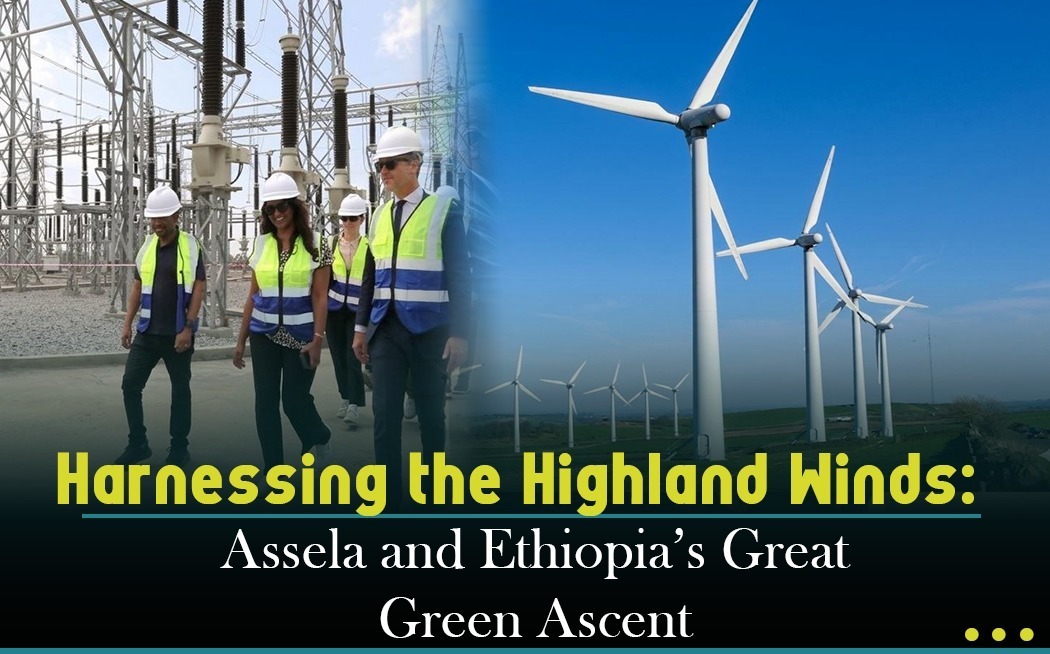
The Ethiopian energy sector has witnessed a structural reconfiguration with the commissioning of the Assela Wind Farm Project. Set against the Ethiopian Highlands, Prime Minister Abiy Ahmed officially launched the 100-megawatt project, which is much more than a mere array of wind turbines. It is indicative of a paradigm change in the way Ethiopia perceives its energy security, development, and position within international climate policy negotiations, especially with regard to hosting COP32 in 2027.
The launching ceremony, which saw participation from the EU, Denmark, and UN officials, was not merely diplomatic. Rather, it highlighted the energy policy change in Ethiopia: from depending on one dominant source of energy to an alternative renewable energy source capable of coping with climatic conditions.
From Water to Wind: Engineering Resilience into the Grid
For decades, Ethiopia’s energy narrative has been written in water. Anchored by the Grand Ethiopian Renaissance Dam (GERD), hydropower has functioned as the backbone of national electricity generation. Yet this dependence carries structural risks. Climate variability in the Horn of Africa—particularly recurrent droughts—can lead to seasonal generation deficits, undermining industrial productivity and grid stability.
The Assela Wind Farm introduces a critical layer of resilience. Located approximately 150 km south of Addis Ababa in the Oromia highlands, the project leverages one of Ethiopia’s most viable wind corridors, identified through the Solar and Wind Energy Resource Assessment (SWERA) program.
Comprising 29 Siemens Gamesa SG 3.4-132 turbines, the wind farm has a total installed capacity of 100.5 MW. Under normal operating conditions, it is expected to generate approximately 300 GWh of electricity annually, implying a capacity factor of roughly 34–38%, which is strong by global onshore wind standards.
Crucially, the site benefits from average annual wind speeds of approximately 7–9 m/s, placing it within optimal operating conditions for this class of turbine. Wind generation in this region tends to peak during the dry season—precisely when hydropower output declines due to reduced reservoir inflows. This seasonal complementarity transforms wind energy from a marginal supplement into a system-balancing asset.
Turbine Technology and System Efficiency
Each turbine—manufactured by Siemens Gamesa—is engineered for efficiency under medium-to-high wind regimes:
- Rotor diameter: 132 meters
- Swept area: ~13,685 m²
- Hub height: up to 165 meters
- Generator type: Doubly-fed induction generator (DFIG)
The large rotor diameter maximizes energy capture by expanding the swept area, directly increasing output potential. While the theoretical maximum efficiency of wind conversion (Betz limit) is 59.3%, real-world turbines typically achieve 35–45% aerodynamic efficiency, with overall system efficiency (including electrical and grid losses) in the range of 30–40%.
Advanced features—including pitch control, variable-speed operation, and aerodynamic noise-reduction systems—allow the turbines to maintain high output across varying wind conditions, ensuring stable contribution to the national grid.
From Highland Winds to Urban Demand
The Assela Wind Farm is not an isolated installation but part of a fully integrated energy system that ensures electricity generated in the highlands can be efficiently delivered to end users. At the generation level, the project consists of 29 turbines interconnected through internal medium-voltage cabling, which channel the produced electricity to an on-site substation. There, the voltage is stepped up to enable long-distance transmission with minimal losses. The power is then fed into the national grid operated by Ethiopian Electric Power, allowing it to be transported across regions. Finally, through the distribution network, this electricity reaches industrial zones, urban centers, and residential areas, translating highland wind energy into practical, everyday use across the country.
Like many developing grid systems, Ethiopia faces transmission and distribution losses estimated between 10–20%. However, the country’s hydropower base provides a natural stabilizing mechanism, allowing intermittent wind generation to be absorbed and balanced more effectively than in fossil-fuel-dependent systems.
Fueling the EV Transition: opportunity and constraints
The timing of Assela’s inauguration intersects with one of Ethiopia’s most ambitious policy shifts: its move toward electric mobility. In 2023, the government announced restrictions on the import of internal combustion engine (ICE) vehicles, positioning the country as an early mover in transport electrification.
Estimates suggest that Ethiopia now hosts tens of thousands of electric vehicles, with government targets reaching hundreds of thousands by 2032. While this transition is notable, its success depends fundamentally on the reliability and sustainability of the electricity supply.
Projects like Assela play a critical enabling role by expanding renewable generation capacity. However, structural challenges remain including limited charging infrastructure, uneven electricity access, grid reliability constraints
Thus, while Ethiopia’s EV strategy is forward-looking, its long-term viability will depend on continued investment in both generation and distribution systems.
Blended Finance and the Political Economy of Energy
The Assela project was realized through a €146 million financing package, combining:
- concessional loans (notably from Danish financial institutions)
- grant support from Denmark
- coordination by Ethiopian public institutions
This model reflects a broader European strategy—aligned with the EU’s Global Gateway initiative—to finance infrastructure in emerging markets. While effective in mobilizing capital and technology, such arrangements also raise important considerations of long-term debt sustainability, foreign exchange exposure, and dependence on external technical expertise
Nevertheless, the successful execution of Assela signals Ethiopia’s growing capacity to manage complex, multi-stakeholder infrastructure projects—an important factor as it pursues industrialization and WTO accession.
Denmark’s involvement in Assela is part of a wider pattern of renewable energy engagement across Africa. Through institutions such as Danida Sustainable Infrastructure Finance, Denmark has supported wind projects that combine: European financing, advanced turbine technology, and local capacity-building Companies like Siemens Gamesa have implemented similar projects in countries such as Djibouti, Egypt, and Morocco. These projects export not only hardware, but an entire ecosystem of engineering and procurement systems, maintenance frameworks and technical training for local engineers
Beyond macroeconomics, the project has tangible local impacts. Ethiopian engineers and technicians worked alongside international experts during construction and commissioning, gaining hands-on experience in turbine installation, grid integration, and maintenance.
This knowledge transfer is essential for long-term sustainability. It enables Ethiopia to progressively reduce dependence on foreign expertise while building a domestic “green workforce.”
Additionally, expanded electricity access supports:
- small and medium enterprises
- healthcare delivery
- educational infrastructure
It also contributes to reducing reliance on biomass fuels, with implications for both public health and environmental conservation.
The Road to COP32: Symbolism and Substance
Ethiopia’s selection to host COP32 places it at the center of global climate diplomacy, with the Assela Wind Farm serving as both a practical achievement and a symbolic milestone along this path. The project illustrates the viability of integrating renewable energy within developing economies, highlights the growing importance of blended finance in delivering climate infrastructure, and underscores the connection between energy systems and broader efforts toward transport decarbonization. Yet hosting COP32 will demand more than flagship projects alone. Ethiopia must still confront persistent energy access disparities, strengthen its capacity to adapt to climate impacts, and build the institutional frameworks required for large-scale climate governance. In this context, Assela is best understood not as a culmination of progress, but as an early and meaningful step in a longer, more complex transformation.
In conclusion, The Assela Wind Farm stands at the intersection of ambition and realism. Its 100 MW capacity and 300 GWh annual output make it a meaningful addition to Ethiopia’s grid, while its integration with hydropower enhances system resilience.
Yet its significance lies less in scale than in structure. It represents a shift toward:
- diversified energy systems
- integrated infrastructure planning
- strategic engagement with global climate and financial institutions
As the turbines turn across the highland plateau, they generate not only electricity but a new model of development—one that is greener, more interconnected, and yet still contingent on overcoming persistent structural constraints.
The winds have been harnessed. Whether they can sustain Ethiopia’s ascent will depend on how effectively ambition is matched with institutional and economic capacity.
References
Ethiopian Electric Power. (n.d.). Assela wind farm project.
Ethiopian News Agency. (2026, April 16). PM Abiy inaugurates 100 MW Assela wind farm.
European External Action Service. (n.d.). Assela wind farm: Powering greener Ethiopia.
Ministry of Finance of Ethiopia. (2025). The Assela wind farm delivers first power.
Siemens Gamesa Renewable Energy. (2021). SG 3.4-132 turbine specifications.
The Wind Power. (n.d.). Assela wind farm data.
Energy for Growth Hub. (2025). Ethiopia’s EV transition.
Forbes Africa. (2025). Ethiopia to host COP32.
By Robel Befekadu, IFA
Disclaimer:
The content disseminated by the Institute of Foreign Affairs (IFA) – including, but not limited to, publications, public statements, events, media appearances, and digital communications – reflects the views of individual contributors and does not necessarily represent the official positions or policies of the Institute, its partners, or any affiliated governmental or non-governmental entities.
While the IFA endeavors to ensure the accuracy, integrity, and timeliness of the information presented, it makes no representations or warranties, express or implied, regarding the completeness, reliability, or suitability of such content for any purpose. The Institute expressly disclaims any liability for errors or omissions, as well as for any actions taken or decisions made based on the information provided.
The inclusion of external links, references, or third-party resources does not constitute an endorsement by the Institute. Additionally, engagement on social media platforms – including, but not limited to, likes, shares, retweets (RTs), or reposts – shall not be interpreted as an endorsement or validation of the views expressed therein.
Readers and audiences are encouraged to exercise critical judgment and seek independent verification when interpreting or relying upon any information disseminated through publications and posts on the Institute’s platforms or representatives.