

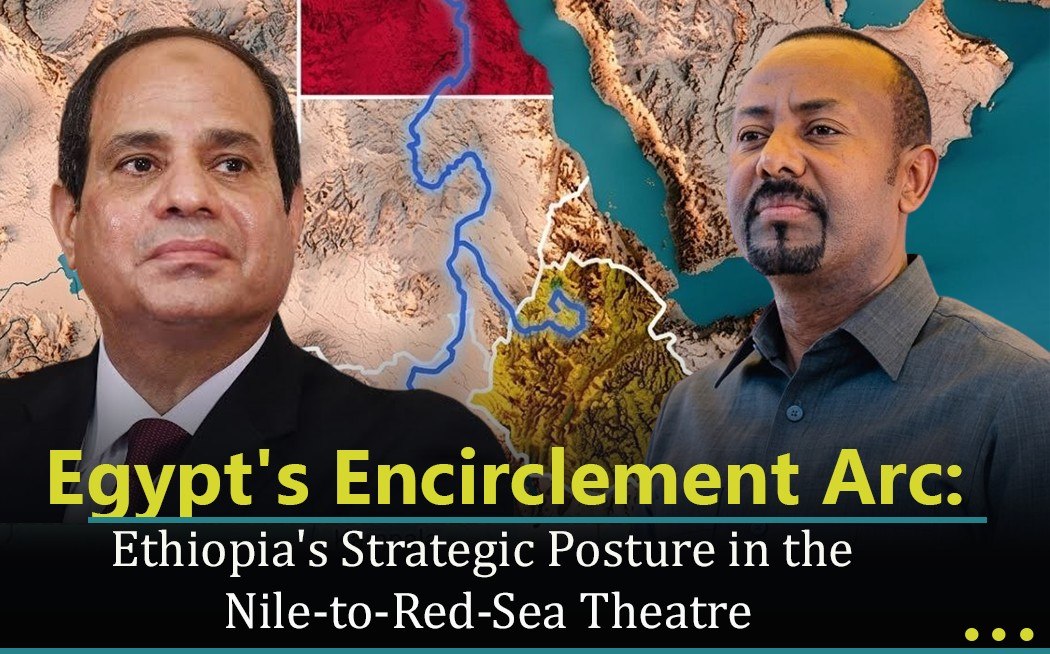
Egypt has stopped fighting Ethiopia at the dam and started fighting it on the perimeter — Ethiopia is now organising its regional posture around that diagnosis.
Addis Ababa is now operating on the working assumption that Cairo has shifted from contesting Ethiopia directly over the Nile to encircling it through a coordinated perimeter strategy anchored on Asmara, Port Sudan, and Mogadishu. This is not the Grand Ethiopian Renaissance Dam dispute of 2011–2020, in which Egyptian pressure was channelled through bilateral water negotiations and tripartite mediation. It is a structurally different posture: an encirclement arc built on three of Ethiopia’s neighbours, underwritten by an Egyptian effort to deny Addis Ababa a seat in the emerging Red Sea security architecture, and operationalised through defence pacts, troop deployments, and Nile Basin diplomacy that routes around the African Union framework. The Ethiopian response is not retaliation. It is geographic counter-design.
The break point was 2023. The collapse of the GERD tripartite track and the outbreak of the Sudan war between the Sudanese Armed Forces and the Rapid Support Forces removed the two institutional containers that had absorbed Cairo–Addis Ababa friction for a decade.¹ With the dam filled and the negotiations exhausted, Cairo had two options: accept hydrological reality, or contest Ethiopia on different ground. It chose different ground. From 2023 onward, Egyptian diplomacy began rebuilding pressure on Ethiopia through every adjacent capital that had a strategic grievance against Addis Ababa — and the Sudan war provided the geopolitical opening that made those rebuilds operational.
Historically, Cairo’s anti-GERD posture was vertical: a direct, bilateral pressure track on the dam itself, mediated through Washington, Khartoum, and the African Union. That posture failed for structural reasons — Ethiopian completion of the dam in 2023 rendered the bilateral leverage obsolete — and Cairo absorbed the failure. What followed was a horizontal reposturing: rather than push harder on the dam, Egypt began arranging itself across Ethiopia’s perimeter. The Nile question did not disappear; it was relocated. It now sits inside a broader Egyptian regional strategy whose operational targets are Ethiopia’s coastal access, its northern frontier, and its eastern security depth, rather than the dam itself.
The factual record across the past two years shows four anchor moves. First, the Egypt–Somalia defence cooperation protocol of August 2024 brought Egyptian troops and equipment into Mogadishu under an ATMIS-replacement framework, positioning Cairo as a security underwriter on Ethiopia’s eastern flank for the first time in modern memory.² Second, Egyptian engagement with Asmara intensified through 2024–2025, with documented high-level diplomatic and military exchanges that signal a Cairo–Asmara understanding aimed, at minimum, at coordinating posture on the Red Sea and on Ethiopian maritime ambition.³ Third, Cairo aligned diplomatically with Port Sudan from early in the SAF–RSF war, providing political cover for the Sudanese Armed Forces and embedding itself in the Sudan settlement track in a way that gives Egypt durable presence on Ethiopia’s western frontier whatever the war’s outcome.⁴ Fourth, Cairo has worked through 2025–2026 to consolidate a Red Sea security framework — discussed primarily through the Jeddah track among Saudi Arabia, Egypt, and select littoral states — that, in Addis Ababa’s reading, is being shaped to exclude Ethiopia from any institutional role on the sea it borders by less than a hundred kilometres.⁵
What Addis Ababa sees, when these four moves are mapped together, is not a sequence of bilateral Egyptian relationships but a single integrated arc — Cairo’s encirclement arc — that stretches from the Nile through the Red Sea littoral and around toward the Indian Ocean coast. The arc has three structural features that distinguish it from the GERD-era dispute. It is multi-vector rather than bilateral, which means it cannot be defused by any single negotiating channel. It is institutionalised through defence agreements and security frameworks rather than expressed through diplomatic protest, which means it has durability beyond any particular Egyptian government. And it routes deliberately around the African Union and IGAD frameworks in which Ethiopia retains weight, which means it has been designed with an eye to Ethiopia’s existing diplomatic strengths and built to neutralise them.
Ethiopia’s strategic posture in response has four operative components, and they are coherent only when read against the encirclement arc rather than against any single Egyptian move. The first is maritime breakout: the January 2024 memorandum of understanding with Somaliland, the parallel exploration of arrangements at Berbera and Assab, and the broader signalling that Ethiopia will accept a degraded multilateral consensus to secure direct coastal access.⁶ The maritime push is not separable from the Egyptian arc; it is the direct counter to it. The second is the deepening of Ethiopian partnerships with the United Arab Emirates, Türkiye, and Israel — partnerships whose common feature is that each provides Addis Ababa with security depth that Cairo cannot easily reach or replicate, particularly in unmanned aerial systems, intelligence sharing, and Red Sea standing.⁷ The third is the operational consolidation of the Tigray settlement, because an unresolved northern frontier converts the encirclement arc from a strategic problem into a survival problem; Addis Ababa cannot answer an Egyptian perimeter strategy while its northern front is still open. The fourth is the steady widening of Ethiopia’s Nile Basin diplomacy beyond the tripartite framework, including continued engagement with the Cooperative Framework Agreement signatories, which denies Cairo the ability to isolate Ethiopia inside an exclusively Egypt–Sudan–Ethiopia frame.⁸
The strategic question is not whether Cairo’s encirclement arc will hold — that depends on variables outside Ethiopian control, including the trajectory of the Sudan war, the durability of Egypt’s Somalia presence, and the internal stability of Eritrea. The strategic question is whether Addis Ababa can complete the geographic counter-design before the arc closes. The maritime file is the load-bearing piece. Without coastal access, Ethiopia faces the encirclement arc with no exit; with it, the arc becomes a containment effort that Ethiopia can absorb and outmanoeuvre. The next twelve months will not be decided at the dam — they will be decided at the coast.
Footnotes
- International Crisis Group, “Stopping Sudan’s Descent into Full-Blown Civil War,” April 2023; coverage of the collapse of the Washington-AU GERD tripartite track, late 2023. [URLs to verify — crisisgroup.org; Reuters and Al-Ahram of December 2023.]
- Egypt–Somalia defence and military cooperation protocol, signed Cairo, 14 August 2024. Reporting in Reuters, Garowe Online, and Hiiraan Online; Egyptian Ministry of Defence statements.
- Reporting on Cairo–Asmara diplomatic and military exchanges, 2024–2025, including the October 2024 trilateral Egypt–Eritrea–Somalia meeting in Asmara. Asharq Al-Awsat, Al-Monitor, and Eritrea Hub.
- Egyptian diplomatic positioning on the SAF–RSF war, 2023–2026, including Cairo’s hosting of Sudanese political tracks and recurring statements in support of the Port Sudan authorities. Sudan Tribune, Egyptian Ministry of Foreign Affairs press releases.
- Reporting on the Jeddah-track Red Sea security discussions among Saudi Arabia, Egypt, and littoral states, 2025–2026. Arab News, The National, Al-Monitor.
- Ethiopia–Somaliland Memorandum of Understanding, signed Addis Ababa, 1 January 2024. Addis Standard, Reuters.
- Reporting on UAE, Türkiye, and Israeli defence and intelligence cooperation with Ethiopia, 2023–2026, including UAV transfers and intelligence-sharing arrangements. Reuters, Daily Sabah, Haaretz.
- Status of the Nile Basin Cooperative Framework Agreement following its entry into force in 2024 and continuing CFA signatory engagement. Nile Basin Initiative; African Union documentation.
By Mihiret Zeleke, IFA
Disclaimer:
The content disseminated by the Institute of Foreign Affairs (IFA) – including, but not limited to, publications, public statements, events, media appearances, and digital communications – reflects the views of individual contributors and does not necessarily represent the official positions or policies of the Institute, its partners, or any affiliated governmental or non-governmental entities.
While the IFA endeavors to ensure the accuracy, integrity, and timeliness of the information presented, it makes no representations or warranties, express or implied, regarding the completeness, reliability, or suitability of such content for any purpose. The Institute expressly disclaims any liability for errors or omissions, as well as for any actions taken or decisions made based on the information provided.
The inclusion of external links, references, or third-party resources does not constitute an endorsement by the Institute. Additionally, engagement on social media platforms – including, but not limited to, likes, shares, retweets (RTs), or reposts – shall not be interpreted as an endorsement or validation of the views expressed therein.
Readers and audiences are encouraged to exercise critical judgment and seek independent verification when interpreting or relying upon any information disseminated through publications and posts on the Institute’s platforms or representatives.