

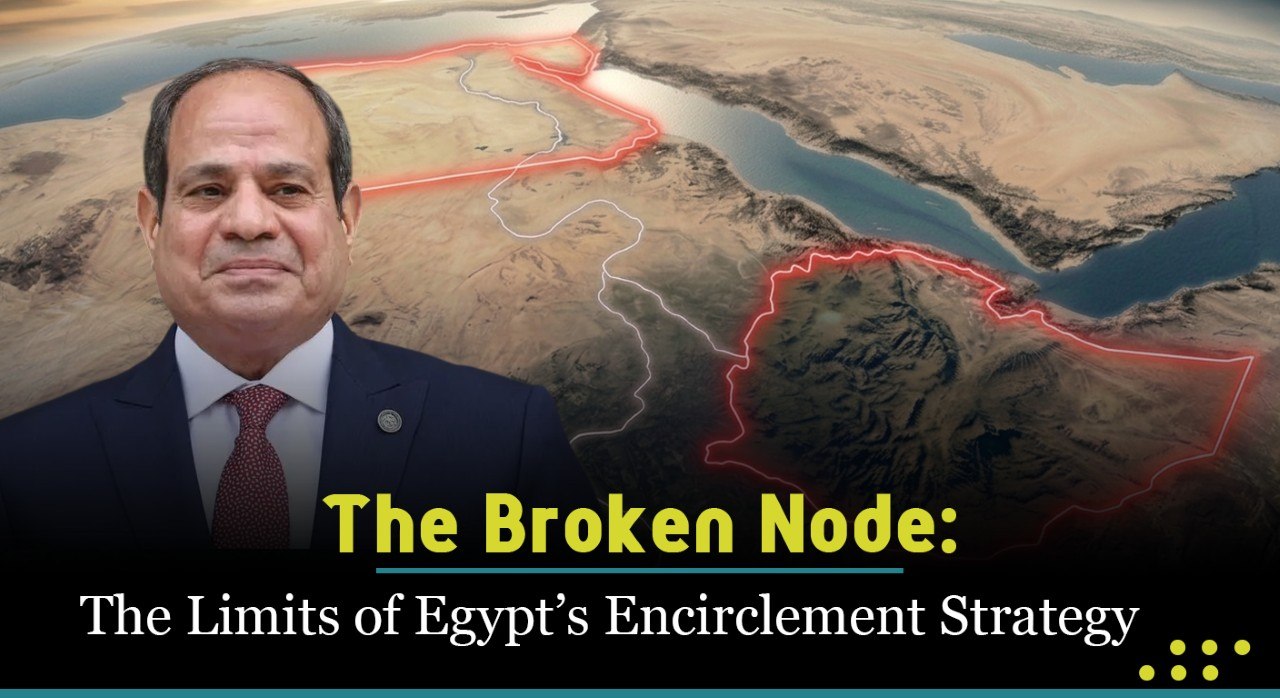
Pagak’s strategic weight came from its location inside the narrow borderland where South Sudan’s oil economy, Ethiopia’s western security exposure, Sudan’s war, and the Nile Basin’s post-GERD order now converge. The reported termination of Egyptian military activity near Pagak in Upper Nile State in May 2026 therefore carried meaning beyond the size of any facility, the number of personnel involved, or the formal language used by South Sudanese authorities. It revealed a deeper shift in the regional order: Egypt’s Ethiopia-facing encirclement and pressure tactic depends on host states whose own strategic calculus is exposed to changing economic pressures, security risks, and geopolitical winds.
The Pagak episode should be read as a stress test of Egypt’s broader pressure architecture. The available reporting indicates that South Sudan moved against the Egyptian presence after growing concern that the Jute-Pagak corridor could become entangled in cross-border escalation linked to Sudan’s war and the sharper Ethiopia-Egypt rivalry. The details remain contested and officially under-explained, which is itself part of the episode’s significance. In the Horn, silence often functions as statecraft. Governments may avoid public rupture while quietly altering the terms on which external actors operate inside their territory.
What emerges is a simple but consequential pattern. Egypt can cultivate positions around Ethiopia, but those positions remain embedded in the political economies of other states. Somalia, Eritrea, Sudan, Djibouti, and South Sudan are not fixed pieces on an Egyptian chessboard. Each has its own anxieties, dependencies, elite bargains, and survival calculations. Once those calculations shift, the encirclement architecture weakens. Pagak became the first visible breach because South Sudan’s own interests began to diverge from the utility of hosting Egyptian leverage near Ethiopia’s border.
The post-GERD order explains the timing. Ethiopia completed the filling of the Grand Ethiopian Renaissance Dam in September 2023, and the project’s subsequent political consolidation made the older Egyptian effort to halt Ethiopia’s hydropower trajectory increasingly ineffective. Once the river itself no longer offered Egypt sufficient leverage, pressure moved outward into surrounding theatres. The contest became less vertical, over the dam alone, and more horizontal, across Ethiopia’s borders, corridors, frontier zones, diplomatic coalitions, and maritime lifelines.
This is visible in the wider regional pattern. Egypt deepened security cooperation with Somalia in 2024, entered the African Union mission framework there, and moved into a more coordinated security posture with Somalia and Eritrea later the same year. These moves were presented through the language of stabilization, military cooperation, and support for Somali security institutions. Yet their functional effect was to increase Egypt’s visibility around Ethiopia’s eastern and northern borders at a time when the Nile dispute had already produced a deeper strategic rivalry.
Pagak belonged to the western side of this same geometry. Its value lay in its position near the South Sudan-Sudan-Ethiopia border triangle, a zone where Sudan’s war, Nile Basin politics, Ethiopian security concerns, and South Sudan’s oil infrastructure intersect. A small foreign footprint in such a location can carry disproportionate significance because it sits within overlapping systems rather than a single bilateral file. It can monitor, signal, reassure one actor, unsettle another, and complicate the calculations of the host state itself.
South Sudan’s economic predicament made that complication harder to absorb. Oil remains the central artery of the South Sudanese state. Export disruption through Sudan repeatedly exposed the fragility of South Sudan’s fiscal base, especially after the war in Sudan damaged or threatened the infrastructure through which South Sudanese crude reaches international markets. For a state whose hard-currency earnings depend overwhelmingly on oil, pipeline insecurity is not an economic inconvenience. It is a sovereignty problem.
That vulnerability made Ethiopia more relevant to South Sudan’s future options. In July 2024, Ethiopia and South Sudan advanced discussions on infrastructure linking Upper Nile through the Gambella-Pagak-Maiwut-Malakal-Maluth-Paloch axis, including the possibility of an alternative route that could eventually connect South Sudanese oil to Djibouti through Ethiopian territory. The route remains ambitious and difficult, but its strategic meaning is already clear. It gives South Sudan a horizon beyond exclusive dependence on Sudan’s war-exposed export corridor.
This is where Ethiopia’s counter-geometry becomes visible. Ethiopia does not need to confront every Egyptian position militarily. It can alter the surrounding incentive structure through roads, energy diplomacy, Nile Basin institutions, commercial corridors, and security reassurance. If South Sudan begins to see Ethiopia as part of its oil survival strategy, then an Egyptian footprint near Ethiopia’s border becomes less useful and more burdensome. The host-state calculus changes before the military balance does.
The Nile Basin layer reinforced this movement. South Sudan’s ratification of the Cooperative Framework Agreement in July 2024 placed it more firmly within the upstream governance camp and contributed to the agreement’s entry into force in October 2024.This did not erase South Sudan’s relations with Egypt, nor did it settle the Nile question. It changed the institutional field in which South Sudan bargains. A state participating in the emerging Nile Basin architecture has less reason to subordinate its long-term water and infrastructure interests to Egypt’s older downstream grammar.
Sudan’s war sharpened the risks. Foreign military footprints in frontier zones now carry heavier political costs because Sudan’s conflict has regionalized the meaning of logistics, border access, armed groups, and external alignment. South Sudan cannot afford to be read as a platform in another state’s confrontation with Ethiopia. The more Sudan’s war transforms nearby infrastructure into strategic targets, the more exposed South Sudan becomes if it hosts facilities that others interpret as part of a pincering pressure campaign.
The domestic dimension also matters. South Sudan’s leadership operates inside a fragile sovereignty environment shaped by oil dependency, armed fragmentation, and external patronage. Moving against a controversial foreign presence near Pagak allowed the state to reassert control without announcing a sweeping foreign-policy rupture. It was a calibrated act: enough to reassure Ethiopia and reduce border risk, but not so loud as to force a total break with Egypt.
For Ethiopia, the lesson is not triumphal. Egypt’s encirclement and pressure tactic remains active, adaptive, and capable of imposing costs through multiple theatres. The more important lesson is strategic discipline. Ethiopia’s most effective answer lies in making the surrounding states’ interests converge with Ethiopian stability. Corridors, electricity interconnection, oil-route alternatives, Nile Basin diplomacy, and Red Sea access bargaining are not auxiliary to security. They are the instruments through which Ethiopia can reshape the setting in which hostile pressure operates.
For South Sudan, Pagak shows the value of keeping strategic autonomy above transactional alignment. The state’s survival will depend on diversifying oil routes, deepening infrastructure options, and avoiding entrapment in rivalries that do not originate from its own national priorities. A foreign footprint may offer immediate diplomatic or military benefit, but it can become a liability when geography, war, and economic dependency change the surrounding equation.
For the wider Horn, the episode exposes the fragility of pressure architectures built through third countries. Egypt may continue to seek leverage around Ethiopia’s borders, but every node in that encirclement architecture rests on a host-state calculation that can be revised. The map around Ethiopia is not static. It is being reordered by pipelines, ports, power lines, Nile institutions, armed conflict, and corridor politics.
Pagak is therefore a signal, not an endpoint. It shows that Ethiopia’s strategic position is no longer shaped only by tensions and negotiations over the Nile. It is being shaped by the quieter contest over whose partnerships become economically indispensable, whose corridors reduce vulnerability, and whose regional vision offers surrounding states a better route through disorder. If that pattern holds, the encirclement architecture around Ethiopia will not collapse in a single moment. It will weaken node by node as host states adjust to shifting geopolitical winds.
References
- Al-Faroug, O., Alnaser, H., Alagra, M., & Idris, M. (2026, May 15). Sudan Nashra: Ethiopia revokes Sudanese ambassador-designate’s credentials; Juba asks Cairo to evacuate military base near Ethiopian border as preemptive move. Mada Masr. https://www.madamasr.com/en/2026/05/15/news/u/sudan-nashra-ethiopia-revokes-sudanese-ambassador-designates-credentials-juba-asks-cairo-to-evacuate-military-base-near-ethiopian-border-as-preemptive-move-another-mahamid-field-commander-defec/
- Ethiopia, South Sudan agree to build alternate oil pipeline route. (2024, July 8). Sudan Tribune. https://sudantribune.com/article/287964
- Ethiopia inaugurates Africa’s largest hydroelectric dam as Egypt rift deepens. (2025,September9).TheGuardian.https://www.theguardian.com/world/2025/sep/09/ethiopia-inaugurates-africa-largest-hydroelectric-dam-egypt-rift-deepens
- Ethiopia says it has completed filling of disputed dam project’s reservoir. (2023, September 10). Reuters. https://www.reuters.com/world/africa/ethiopia-says-it-has-completed-filling-disputed-dam-projects-reservoir-2023-09-10/
- Egypt, Eritrea and Somalia agree to boost security cooperation. (2024, October 10). Reuters. https://www.reuters.com/world/africa/egypt-eritrea-somalia-agree-boost-security-cooperation-2024-10-10/
- Egypt troops to join African Union Somalia mission, foreign minister says. (2024, December 23). Reuters. https://www.reuters.com/world/africa/egypt-troops-join-african-union-somalia-mission-foreign-minister-says-2024-12-23/
- Nile Basin states. (2024, October 13). Announcement of the entry into force of the Nile River Basin Cooperative Framework Agreement. https://nilebasin.org/sites/default/files/2024-10/Announcement%20of%20the%20Entry%20into%20force%20of%20the%20CFA%20%20on%2013%20October%202024.pdf
- South Sudan official says to resume pumping oil through Sudan in a few days. (2024, October 24). Reuters. https://www.reuters.com/world/africa/south-sudan-official-says-resume-pumping-oil-through-sudan-few-days-2024-10-24/
- Tekuya, M. (2024, August 2). Entry into force of the Nile Basin Cooperative Framework Agreement: Challenges and prospects. EJIL: Talk! https://www.ejiltalk.org/entry-into-force-of-the-nile-basin-cooperative-framework-agreement-challenges-and-prospects/
By Sifan Tadesse,IFA
Disclaimer:
The content disseminated by the Institute of Foreign Affairs (IFA) – including, but not limited to, publications, public statements, events, media appearances, and digital communications – reflects the views of individual contributors and does not necessarily represent the official positions or policies of the Institute, its partners, or any affiliated governmental or non-governmental entities.
While the IFA endeavors to ensure the accuracy, integrity, and timeliness of the information presented, it makes no representations or warranties, express or implied, regarding the completeness, reliability, or suitability of such content for any purpose. The Institute expressly disclaims any liability for errors or omissions, as well as for any actions taken or decisions made based on the information provided.
The inclusion of external links, references, or third-party resources does not constitute an endorsement by the Institute. Additionally, engagement on social media platforms – including, but not limited to, likes, shares, retweets (RTs), or reposts – shall not be interpreted as an endorsement or validation of the views expressed therein.
Readers and audiences are encouraged to exercise critical judgment and seek independent verification when interpreting or relying upon any information disseminated through publications and posts on the Institute’s platforms or representative