

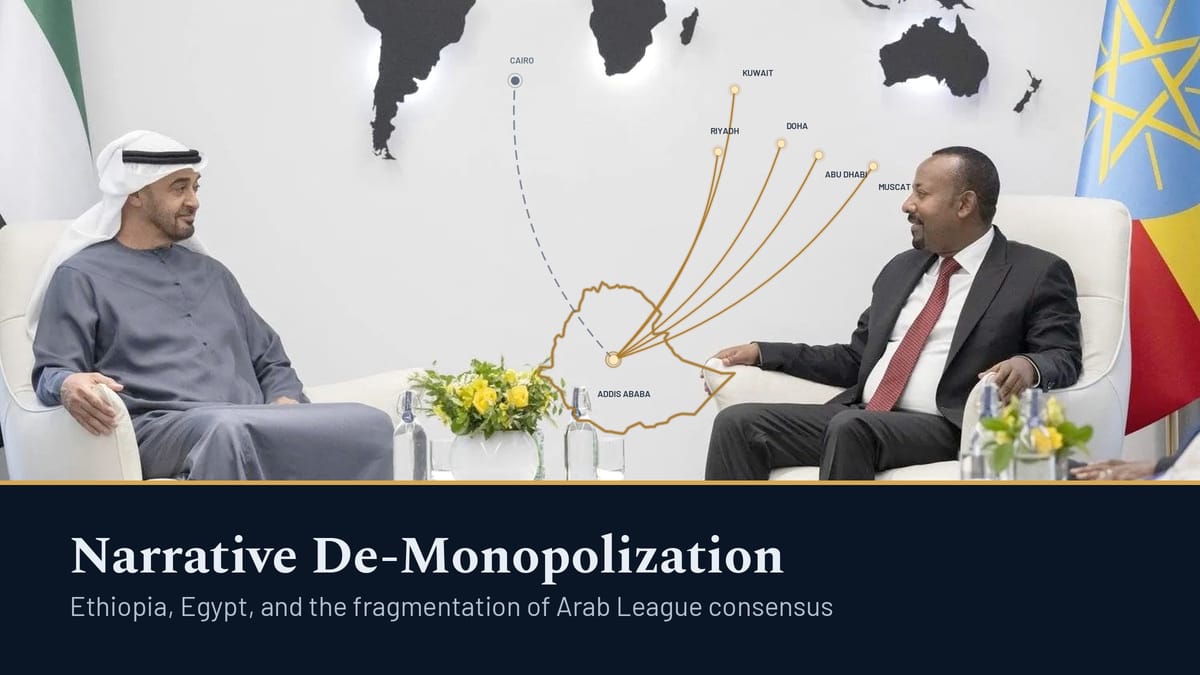
The Arab League clash over Sudan’s accusations against Ethiopia and the United Arab Emirates was not just another procedural quarrel in Cairo. It showed that Egypt can no longer assume Arab institutions will automatically absorb its Ethiopia narrative. For decades, Egypt used Arab diplomatic platforms to frame Ethiopia as an upstream threat, a Red Sea outsider, and a state whose rise needed to be contained. That architecture is now weakening from within.
The immediate dispute centered on Sudan’s attempt to turn a contested battlefield allegation into an Arab League position. Sudanese military authorities accused Ethiopia and the United Arab Emirates of involvement in drone attacks on Khartoum airport and other sites. Ethiopia rejected the allegation, while the United Arab Emirates denied involvement and described the claims as misinformation. The accusation remains unverified. But its diplomatic purpose was clear: Sudan sought to internationalize a war claim by placing it inside an Arab institutional setting.
That move failed to produce the old reflex. According to reports, an extraordinary Arab League session splintered after the United Arab Emirates resisted Sudan’s effort, leading to a sharp exchange and the suspension of discussions. The real significance was not whether one meeting ended badly. It was that Ethiopia was not left alone outside the room while Egypt, Sudan, and the Arab League defined the political meaning of the allegation.
Egypt’s Old Narrative Firewall
For much of the past generation, Egypt’s advantage over Ethiopia was not only geographic, military, or diplomatic. It was narrative. Egypt learned to translate its own Nile insecurities into wider Arab concerns. When Egypt objected to Ethiopian upstream development, especially the Grand Ethiopian Renaissance Dam, it rarely presented the matter as a narrow bilateral dispute. It framed it as an Arab water-security issue. Arab League resolutions repeatedly aligned with Egypt and Sudan, while Ethiopia objected that an African hydro-political dispute was being moved into an Arab forum where Ethiopia was not a member.
That was the old bulwark: not a formal alliance, but a diplomatic habit. Egypt could convert its bilateral disputes with Ethiopia into Arab institutional language. Ethiopia, meanwhile, had to answer from outside the frame. It was treated as external to Arab security despite its proximity to the Red Sea, its historic links with the Arabian Peninsula, its role in the Nile Basin, and its dependence on Red Sea trade routes.
Sudan’s Failed Arabization of the War File
Sudan’s latest move tried to revive that architecture. By accusing Ethiopia and the United Arab Emirates together, Sudan sought to bind two files into one: Ethiopia as a hostile regional actor and the United Arab Emirates as a destabilizing patron in Sudan’s war. It was an attempt to Arabize the accusation — to make Ethiopia’s alleged role part of a broader Arab diplomatic concern while escalating the United Arab Emirates file inside Arab politics.
But Sudan’s war has fractured Arab diplomacy rather than unified it. Egypt has leaned toward Sudan’s army-led authorities. The United Arab Emirates has repeatedly faced accusations of backing the Rapid Support Forces, which it denies. Saudi Arabia, Qatar, and other Arab actors have their own Sudan calculations. The result is no longer a single Arab line but a crowded field of rival interests.
The UAE Breaks the Script
That is why the United Arab Emirates’ pushback matters. It does not mean the United Arab Emirates was defending Ethiopia out of sentiment. It was also defending itself against an accusation that directly implicated its own Sudan policy. Nor does it mean Egypt has lost influence. Egypt still has deep Arab League experience, the Suez Canal, military weight, intelligence ties, and a long institutional memory on the Nile file. It can still mobilize Arab sympathy when the GERD is framed as a downstream water-security issue.
The point is narrower but more important: Egypt can no longer assume automatic Arab institutional alignment whenever Ethiopia is placed on the agenda. The Arab world has become too divided, too transactional, and too invested in the Horn of Africa for Egypt to monopolize the frame.
Ethiopia’s Post-2018 Diplomatic Repositioning
Ethiopia’s own diplomacy helped make this possible. Since 2018, Ethiopia has widened its engagement with Arab states, especially Gulf powers whose interests in the Horn are shaped by ports, food security, logistics, investment, Red Sea stability, and geopolitical competition. The United Arab Emirates became central to this opening through investment, development finance, security cooperation, and high-level diplomacy. It also played a visible role in supporting the 2018 Ethiopia-Eritrea rapprochement, briefly recasting the Horn as a theatre where Gulf diplomacy could shape outcomes rather than merely react to them.
The relationship is strategic on both sides. For the United Arab Emirates, Ethiopia is not a peripheral African file. It is a large market, a demographic heavyweight, a diplomatic center through the African Union, and a state positioned between Africa, the Red Sea, and the Gulf. For Ethiopia, the relationship weakened the old assumption that Arab diplomacy was structurally hostile. It allowed Ethiopia to speak to parts of the Arab world through direct channels rather than through Egypt’s filter.
No Longer Egypt’s Rear Diplomatic Base
The wider Gulf picture is even more important. Gulf states do not have a single Horn policy. The United Arab Emirates sees the region through logistics, ports, food security, investment, and maritime connectivity. Saudi Arabia balances Red Sea leadership, Sudan diplomacy, Islamic diplomacy, and Gulf security. Qatar retains mediation capital. Oman often prefers quiet diplomacy. Kuwait and others bring development, religious, and institutional channels. None of these actors automatically subordinates its Horn policy to Egypt’s Nile strategies.
This fragmentation creates a strategic opening for Ethiopia, but also a risk. Ethiopia should not mistake one Arab League episode for a permanent diplomatic realignment. A durable Arab strategy must be broader: deepening relations with the United Arab Emirates while also building structured ties with Saudi Arabia, Qatar, Oman, Kuwait, and other Arab states through trade, energy, education, religious diplomacy, mediation channels, and Red Sea governance.
Narrative De-Monopolization
The argument is not that the Arab world is hostile to Ethiopia. It is that Egypt historically benefited from a hostile framing of Ethiopia inside Arab platforms, and that framing is now contested by Arab states with independent interests in Ethiopia’s stability and rise.
Ethiopia’s best response is strategic normalization. It should insist that Nile disputes remain grounded in equitable and reasonable utilization. It should prevent Sudan’s war from becoming a platform for anti-Ethiopian alignment. And it should frame Red Sea governance not as a coastal entitlement but as a matter of trade dependence, security interdependence, and Afro-Arab geography.
The End of Automatic Arab Consensus
The Arab League clash was a small event with large meaning. It showed that Ethiopia’s diplomatic environment is changing. Egypt’s old narrative bulwark is cracking — not only because Ethiopia has defeated it, but also Arab politics itself has become more plural. Ethiopia’s task now is to turn that opening into a disciplined regional strategy: one that makes anti-Ethiopian framing harder to universalize, harder to institutionalize, and harder to sell as Arab consensus.
Footnotes
[1] Reuters, “Sudan Army Says UAE and Ethiopia Linked to Khartoum Airport Drone Attack,” May 4, 2026; Reuters, “UAE Denies Involvement in Sudan Airport Attack,” May 6, 2026; Associated Press, “Sudan Recalls Ambassador to Ethiopia over Drone Attack on Khartoum Airport,” May 5, 2026.
[2] Africa Intelligence, “Arab League Splinters over Sudan,” June 8, 2026.
[3] Al Jazeera, “Ethiopia Rejects Arab League Resolution on Renaissance Dam,” June 16, 2021.
[4] Security Council Report, “Sudan: June 2026 Monthly Forecast”; Reuters and Associated Press reporting on Sudan’s accusations against Ethiopia and the United Arab Emirates.
[5] United Arab Emirates Ministry of Foreign Affairs, “Bilateral Relations: UAE and Ethiopia”; Megatrends Afrika / SWP, “UAE Engagement in Ethiopia,” 2025.
By Miheret Zeleke, IFA
Disclaimer:
The content disseminated by the Institute of Foreign Affairs (IFA) – including, but not limited to, publications, public statements, events, media appearances, and digital communications – reflects the views of individual contributors and does not necessarily represent the official positions or policies of the Institute, its partners, or any affiliated governmental or non-governmental entities.
While the IFA endeavors to ensure the accuracy, integrity, and timeliness of the information presented, it makes no representations or warranties, express or implied, regarding the completeness, reliability, or suitability of such content for any purpose. The Institute expressly disclaims any liability for errors or omissions, as well as for any actions taken or decisions made based on the information provided.
The inclusion of external links, references, or third-party resources does not constitute an endorsement by the Institute. Additionally, engagement on social media platforms – including, but not limited to, likes, shares, retweets (RTs), or reposts – shall not be interpreted as an endorsement or validation of the views expressed therein.
Readers and audiences are encouraged to exercise critical judgment and seek independent verification when interpreting or relying upon any information disseminated through publications and posts on the Institute’s platforms or representative