

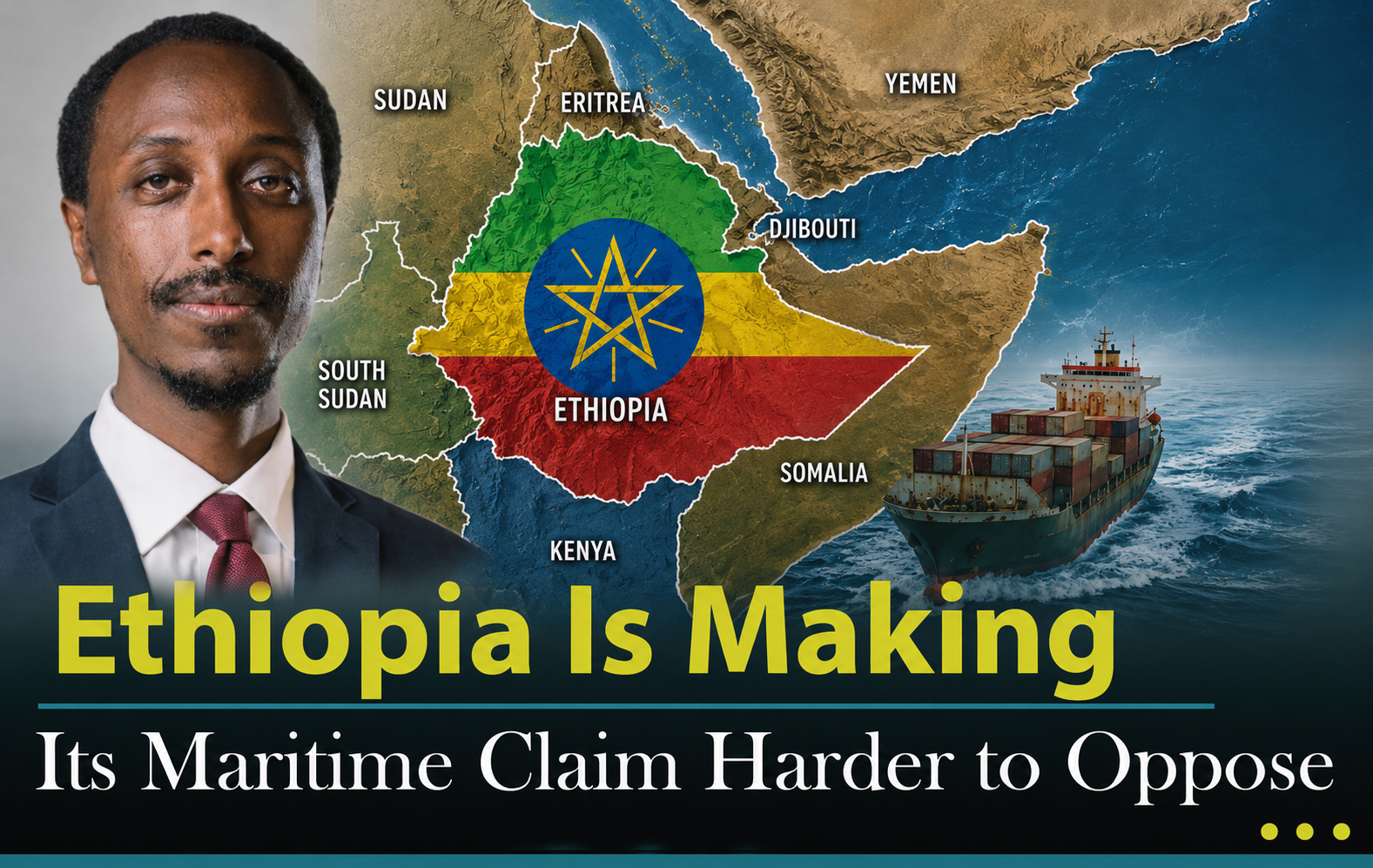
Foreign Minister Gedion Timothewos’s recent statement that access to the Red Sea is a matter of “national development” and a “necessity, not confrontation” should not be interpreted as a softening of Ethiopia’s maritime position. Rather, it reflects a more sophisticated phase in Ethiopia’s maritime diplomacy—one that seeks to reposition sea access from the realm of geopolitical contestation to that of economic transformation and regional integration.
This distinction is more consequential than it first appears. For years, discussions surrounding Ethiopia’s search for maritime access have been dominated by debates over sovereignty, territorial sensitivities, and regional rivalries. Yet Gedion’s intervention suggests that Addis Ababa is increasingly approaching the issue through a different strategic framework. Instead of presenting maritime access primarily as a question of historical grievance or geopolitical necessity, Ethiopia is framing it as a development imperative tied to the country’s economic future and, by extension, the future prosperity of the wider Horn of Africa. What is emerging is not a retreat from Ethiopia’s maritime ambitions, but a strategic maturation of how those ambitions are articulated.
From Access to Development
At the core of Ethiopia’s new diplomatic language lies a simple reality: maritime access is fundamentally an economic issue. Speaking at the Foreign Policy Forum in November 2025, Gedion argued that a country of more than 130 million people pursuing rapid economic transformation requires “durable and secure access to the sea” and should not remain constrained by structural barriers that limit its development potential. The emphasis was notable. The minister was not invoking historical entitlement. He was emphasizing economic viability.
This is important because Ethiopia’s maritime question is often misunderstood as merely a search for a coastline. In reality, the challenge is broader. Ethiopia’s industrialization agenda, export ambitions, food security requirements, energy trade aspirations, and manufacturing competitiveness are all affected by the efficiency, reliability, and cost of maritime connectivity. For a country seeking to become a major African economic hub, logistics are not a secondary concern. They are part of the national development architecture.
This perspective aligns Ethiopia’s position with broader international discussions concerning landlocked developing countries. The issue ceases to be an exceptional Ethiopian demand and becomes a question of how rapidly growing economies can overcome structural disadvantages in order to participate fully in global trade.
Viewed from this angle, Gedion’s formulation represents an attempt to normalize Ethiopia’s maritime agenda. The argument is no longer that Ethiopia deserves access because of history. The argument is that sustainable development requires reliable access to international markets, and that this requirement should be understood as part of the region’s broader economic future.
Strategic Recalibration Through Development Diplomacy
What we are witnessing is a strategic recalibration rather than a strategic retreat.For much of the past decade, discussions surrounding sea access have frequently become trapped within a narrow sovereignty framework. Such a framework inevitably invites defensive reactions because it focuses attention on territory, legal precedent, and perceived geopolitical competition. The development framework changes the conversation.
Under this approach, maritime access becomes connected to infrastructure corridors, logistics networks, industrial zones, energy connectivity, customs integration, and regional trade expansion. The focus shifts from questions of ownership to questions of functionality. This distinction creates greater diplomatic space for Ethiopia. A sovereignty-centered debate tends to produce zero-sum calculations. A development-centered debate creates opportunities for mutual gain.
The significance of this shift is increasingly visible in Ethiopia’s regional diplomacy. At IFA’s RESGA Strategic Dialogue in April 2026, Ethiopian officials repeatedly framed maritime access as a “win-win” proposition linked to regional integration and the shared economic future of the Horn of Africa. Similar themes have emerged across recent diplomatic engagements, where sea access has been discussed alongside investment, connectivity, infrastructure development, and economic cooperation. Such language reflects an evolving strategic doctrine. Ethiopia appears increasingly determined to situate maritime access within a larger vision of regional interdependence rather than bilateral competition.
The Economic Logic Behind the Strategy
The effectiveness of Ethiopia’s new framing depends on whether it rests upon tangible realities. In this regard, the country’s case is strengthened by material economic considerations. A World Bank assessment published in 2026 highlighted both the progress and continuing challenges within Ethiopia’s logistics ecosystem. While reforms have improved efficiency and reduced processing times along key trade corridors, logistics costs and infrastructure constraints continue to affect competitiveness. These findings reinforce Ethiopia’s central argument: maritime access is not merely a symbolic issue. It directly influences economic performance.
For an economy seeking to expand exports, attract investment, strengthen manufacturing, and deepen regional integration, logistics efficiency can determine the success or failure of broader development strategies. Every additional cost imposed by transport bottlenecks ultimately affects producers, exporters, consumers, and investors. This is why Ethiopia increasingly frames maritime access as a developmental necessity rather than a geopolitical aspiration.The objective is not solely access itself. The objective is economic transformation.
Seen from that angle, ports, railways, dry ports, customs modernization, industrial parks, and energy corridors become interconnected components of a single development strategy. Maritime access serves as one element within a wider effort to reduce structural constraints on growth and improve Ethiopia’s position within regional and global markets.
A More Confident Diplomatic Posture
Another important feature of Gedion’s remarks is the confidence they project. States that perceive themselves as strategically isolated often rely on maximalist rhetoric. Ethiopia’s recent diplomatic messaging suggests the opposite. Addis Ababa increasingly appears to believe that its demographic weight, economic potential, and geographic centrality provide a stronger foundation for advancing its maritime interests through negotiation and partnership.
This reflects broader shifts occurring throughout the Horn of Africa. Economic integration is becoming a strategic necessity rather than a policy preference. Regional governments are investing in transport corridors, ports, energy interconnections, and trade facilitation because competitiveness increasingly depends on connectivity. Within this environment, Ethiopia is positioning itself as a central node in the region’s economic future.
The argument is straightforward. A more connected Ethiopia would likely generate benefits extending beyond its borders. Increased trade volumes, expanded infrastructure networks, improved logistics systems, and greater energy connectivity would strengthen economic linkages across the Horn and Red Sea region. From this perspective, maritime access is not solely an Ethiopian issue. It is increasingly becoming a regional economic question.
This logic was also evident in discussions at the IFA Red Sea and Gulf of Aden Conference, where participants emphasized the importance of collaborative approaches to regional security, economic integration, and connectivity. Such discussions reflect a growing recognition that many of the region’s challenges and opportunities are interconnected.
The Counterargument and Ethiopia’s Response
Skeptics will argue that neighboring states may remain unconvinced by Ethiopia’s evolving rhetoric. Some regional actors continue to view discussions of maritime access through the lens of security competition and strategic rivalry.These concerns cannot be dismissed outright. Historical tensions and competing national interests ensure that suspicion will remain part of the regional landscape. Yet Ethiopia’s current approach does not require unanimous acceptance to be strategically effective. Its primary objective is to redefine the terms of engagement.
Rather than debating whether Ethiopia should be permitted to discuss maritime access, Addis Ababa is increasingly encouraging discussions about what forms of access, connectivity, and cooperation can generate mutual benefits for the region. The emphasis shifts from confrontation to architecture—from territorial disputes to economic systems. This does not eliminate disagreement. It changes the arena in which disagreement occurs.
In practical terms, Ethiopia is seeking to build support around principles that are difficult to oppose: regional connectivity, infrastructure development, trade facilitation, economic growth, and shared prosperity. Whether one agrees with every aspect of Ethiopia’s position or not, these objectives possess a broader diplomatic appeal than narratives centered exclusively on sovereignty and power politics.
The Strategic Significance of the Shift
The most important aspect of the foreign minister’s remarks is therefore not the specific wording itself but the strategic logic underpinning it. Ethiopia appears to be developing a maritime doctrine built around three interconnected principles: peaceful engagement, developmental necessity, and regional interdependence.
The first seeks to reassure neighbors that maritime access will be pursued through dialogue and cooperation. The second establishes sea access as a legitimate requirement of national development. The third situates Ethiopia’s aspirations within a broader vision of regional integration and shared prosperity.Together, these principles create a more durable foundation for Ethiopia’s maritime diplomacy.
If sustained, this approach has the potential to transform the conversation surrounding sea access. The debate gradually shifts away from whether Ethiopia’s aspirations are legitimate and toward what forms of regional architecture can best support stability, connectivity, and economic growth across the Horn of Africa.
That is why H.E. Gedion’s intervention matters. It reflects a growing recognition that Ethiopia’s strongest argument is not rooted in historical grievance or geopolitical leverage. It is rooted in the simple proposition that a more connected Ethiopia can contribute to a more integrated and prosperous region. In that sense, Ethiopia is not making a smaller claim. It is making a stronger one—and, increasingly, a harder one to oppose.
References
- Addis Standard, “Maritime routes matter of national development, Red Sea access necessity, not confrontation: FM Gedion,” 20 June 2026.
- Ministry of Foreign Affairs of Ethiopia, “Speech by Foreign Minister Gedion Timothewos at the Foreign Policy Forum on Developments in the Horn of Africa,” 14 November 2025.
- Ethiopian News Agency, “Ethiopia Presses Red Sea Access as ‘Win-Win’ Solution at Strategic Maritime Dialogue,” 7 April 2026.
- World Bank, “Building Ethiopia’s Logistics Future: From Bottlenecks to Flow,” May 2026.
By Eman Ferid, IFA
Disclaimer:
The content disseminated by the Institute of Foreign Affairs (IFA) – including, but not limited to, publications, public statements, events, media appearances, and digital communications – reflects the views of individual contributors and does not necessarily represent the official positions or policies of the Institute, its partners, or any affiliated governmental or non-governmental entities.
While the IFA endeavors to ensure the accuracy, integrity, and timeliness of the information presented, it makes no representations or warranties, express or implied, regarding the completeness, reliability, or suitability of such content for any purpose. The Institute expressly disclaims any liability for errors or omissions, as well as for any actions taken or decisions made based on the information provided.
The inclusion of external links, references, or third-party resources does not constitute an endorsement by the Institute. Additionally, engagement on social media platforms – including, but not limited to, likes, shares, retweets (RTs), or reposts – shall not be interpreted as an endorsement or validation of the views expressed therein.
Readers and audiences are encouraged to exercise critical judgment and seek independent verification when interpreting or relying upon any information disseminated through publications and posts on the Institute’s platforms or representative