

Across the Horn of Africa, the defining political question is no longer who governs but whether states retain the capacity to govern at all. Sudan’s prolonged civil war has fractured authority into competing centers of power. Somalia continues to struggle with the difficult transition from externally supported security arrangements toward self-sustaining national institutions. Across the Red Sea basin, strategic competition, corridor politics, and security realignments are reshaping the regional order. In this environment, the region’s principal fault line is increasingly not ideological or electoral. It is institutional. The emerging divide is between states capable of organizing authority and those struggling to sustain it.
Viewed through this lens, Ethiopia’s 2026 election was less a contest for power than a demonstration of state functionality at scale. While much of the discussion surrounding the vote has focused on electoral competitiveness, opposition participation, and democratic legitimacy, the election’s broader strategic significance lies elsewhere. It served as a geopolitical signal that Ethiopia retains the institutional capacity to translate sovereignty into operational authority at a moment when governability itself has become an increasingly scarce regional commodity.
This distinction matters because sovereignty in the contemporary Horn is no longer primarily challenged by recognition. Most states possess international legitimacy, constitutional frameworks, and formal sovereignty. The more consequential question is whether they possess the administrative machinery necessary to exercise authority, manage political transitions, and project governance across their territories. What increasingly determines regional influence is not sovereignty alone but what may be called governability capital: the accumulated institutional capacity that allows a state to convert formal authority into practical political order.
Governability capital rests on three pillars. The first is administrative reach—the ability to coordinate institutions, manage complex national processes, and project authority across multiple layers of governance. The second is constitutional continuity—the capacity to conduct political succession and competition through established institutional mechanisms rather than through extra-constitutional disruption. The third is strategic predictability—the ability to reduce uncertainty for domestic and external actors by demonstrating institutional endurance over time.
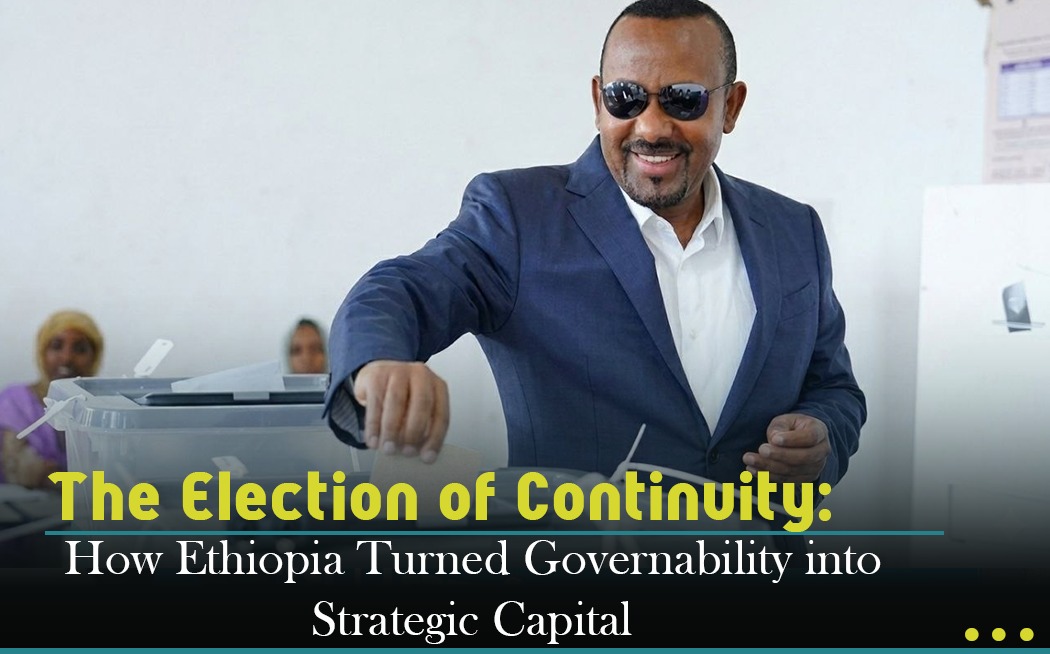
Ethiopia’s 2026 election functioned as a test of all three dimensions. The scale of the exercise itself underscores this point. The National Election Board of Ethiopia coordinated voting across thousands of polling stations, mobilized electoral personnel nationwide, and administered a process that required extensive intergovernmental coordination across federal, regional, and local institutions. While assessments of competitiveness varied among observers, the administrative requirements of conducting a nationwide election remained substantial and offered a visible test of state capacity.
Conducting a nationwide election in one of Africa’s largest and most populous states requires more than political mobilization. It demands extensive logistical coordination, bureaucratic functionality, and institutional coherence. Elections are frequently analyzed as democratic exercises, but they are equally administrative exercises. Their execution reveals the operational capabilities of the state itself. In this sense, the election demonstrated that Ethiopia retains significant administrative reach despite years of political tension, security challenges, and economic pressures. Administrative reach is often overlooked in discussions of elections.
Yet the ability to register voters, deploy electoral materials, coordinate security arrangements, and aggregate results across a vast and diverse territory represents an important indicator of institutional functionality. In fragile political environments, the successful execution of these tasks becomes a measure not only of electoral administration but of the broader operational capacity of the state.
More importantly, the vote reinforced constitutional continuity. This does not imply the absence of political contestation, nor does it resolve debates surrounding inclusion, representation, or democratic legitimacy. Those questions remain central to Ethiopia’s political future. Yet continuity itself possesses strategic value. Political continuity matters because uncertainty carries strategic costs. Research on state fragility consistently shows that disruptions to institutional succession mechanisms increase political risk, weaken investor confidence, and reduce the ability of governments to pursue long-term policy objectives. States that process political competition through institutions rather than constitutional rupture reduce uncertainty in ways that generate broader strategic effects.
The regional contrast is instructive. Sudan’s conflict illustrates what occurs when competing coercive institutions supersede constitutional authority. The country’s fragmentation has produced parallel centers of governance, competing military structures, and profound uncertainty regarding the future political order. Somalia presents a different challenge. Although significant security gains have been achieved over the past decade, the central political question remains whether externally supported stabilization can be transformed into durable state capacity. In both cases, the challenge is not merely legitimacy but institutional execution.
Ethiopia’s election therefore carried significance beyond domestic politics because it highlighted a different trajectory. While Ethiopia continues to confront unresolved political grievances and governance challenges, it demonstrated an ability to organize authority through constitutional mechanisms at a time when many regional states remain preoccupied with preserving authority itself.This is where governability intersects with geopolitics.
Throughout much of the post-Cold War era, governance was largely treated as a domestic variable while geopolitics was viewed as an external one. That distinction is increasingly obsolete. State capacity has emerged as a strategic asset. Administrative competence now shapes diplomatic influence, investment attractiveness, crisis resilience, and bargaining power. The most plausible reading of contemporary regional politics is that governability has become a form of geopolitical leverage.
For Ethiopia, this carries important implications. Ethiopia’s strategic weight within the Horn amplifies these effects. As the region’s largest population center, a major contributor to continental diplomacy, and a critical actor in regional economic integration initiatives, shifts in Ethiopia’s internal political trajectory rarely remain confined within its borders. Over the past several years, Ethiopia has sought a more prominent role in regional diplomacy, economic integration initiatives, energy connectivity projects, and debates surrounding Red Sea security architecture. Achieving these ambitions depends not only on material capabilities but also on perceptions of institutional durability. States consumed by internal institutional crises possess limited diplomatic flexibility. States capable of demonstrating continuity enjoy greater strategic room for maneuver.
Investors calculate risk through perceptions of predictability. Regional governments formulate policy based on expectations of stability. External partners seek reliable interlocutors capable of implementing commitments. In each case, governability functions as a strategic resource. This is particularly relevant as regional actors reassess security architectures in the Red Sea basin and the wider Horn. States perceived as institutionally durable generally enjoy greater diplomatic credibility because partners can reasonably expect policy commitments to survive beyond immediate political cycles. The ability to demonstrate continuity strengthens credibility and reinforces confidence that state institutions remain capable of translating commitments into action.
The election consequently produced a geopolitical signal whose significance extends beyond the ballot box. It communicated that Ethiopia remains capable of organizing political authority through constitutional processes despite substantial internal pressures. For external actors, that signal may ultimately prove more consequential than the electoral outcome itself because it shapes assessments of Ethiopia’s future reliability as a regional actor.
Critics contend that administrative competence should not be conflated with democratic legitimacy. Elections derive their meaning from participation, competition, and representation, not simply from logistical execution. A state may demonstrate considerable organizational capacity while still confronting unresolved questions of political openness and inclusion.
This critique deserves serious consideration. Yet it also risks overlooking a critical regional reality. The Horn of Africa is currently experiencing a deficit of state capacity as much as a deficit of legitimacy. The region’s most pressing challenges—from conflict management and border security to infrastructure development and economic integration—ultimately depend upon functioning institutions. Governability cannot substitute for legitimacy, but neither can legitimacy operate effectively in the absence of governability.
The election therefore revealed two realities simultaneously. First, debates concerning inclusion, representation, and democratic development remain to be resolved within Ethiopia. Second, Ethiopia continues to possess institutional capabilities that many states across the region are struggling to sustain. These realities are not contradictory. They are complementary dimensions of the same political landscape.
The lasting significance of Ethiopia’s 2026 election may therefore lie not in the political choices it produced but in the institutional message it conveyed. At a moment when parts of the Horn are confronting fragmentation, contested authority, and governance stress, Ethiopia’s electoral process demonstrated governability capital and converted it into a geopolitical signal.In an era increasingly defined by institutional endurance rather than formal sovereignty alone, that signal carries strategic weight far beyond the electoral cycle itself
Note
- International Crisis Group, The Fragmentation of Sudan’s Political Order (Brussels: International Crisis Group, 2025).
- United Nations Security Council, Situation in Somalia: Report of the Secretary-General, S/2026/112 (New York: United Nations, 2026).
- National Election Board of Ethiopia (NEBE), Statement on the Conduct of the 2026 National Election (Addis Ababa: NEBE, 2026).
- African Union Election Observation Mission, Preliminary Statement on Ethiopia’s 2026 National Election (Addis Ababa: African Union, 2026).
- World Bank, Worldwide Governance Indicators: Methodology and Analytical Framework (Washington, DC: World Bank, 2024).
- African Union Commission, Governance, Peace and State Resilience in Africa (Addis Ababa: African Union, 2024).
- Alex de Waal, The Real Politics of the Horn of Africa: Money, War and the Business of Power (Cambridge: Polity Press, 2015).
- Christopher Clapham, The Horn of Africa: State Formation and Decay (London: Hurst, 2017).
- World Bank, Ethiopia Economic Update: Building Resilience Amid Uncertainty (Washington, DC: World Bank, 2025).
- United Nations Development Programme, Governance and State Resilience in Africa (New York: UNDP, 2024).
By Bemnet .G, IFA
Disclaimer:
The content disseminated by the Institute of Foreign Affairs (IFA) – including, but not limited to, publications, public statements, events, media appearances, and digital communications – reflects the views of individual contributors and does not necessarily represent the official positions or policies of the Institute, its partners, or any affiliated governmental or non-governmental entities.
While the IFA endeavors to ensure the accuracy, integrity, and timeliness of the information presented, it makes no representations or warranties, express or implied, regarding the completeness, reliability, or suitability of such content for any purpose. The Institute expressly disclaims any liability for errors or omissions, as well as for any actions taken or decisions made based on the information provided.
The inclusion of external links, references, or third-party resources does not constitute an endorsement by the Institute. Additionally, engagement on social media platforms – including, but not limited to, likes, shares, retweets (RTs), or reposts – shall not be interpreted as an endorsement or validation of the views expressed therein.
Readers and audiences are encouraged to exercise critical judgment and seek independent verification when interpreting or relying upon any information disseminated through publications and posts on the Institute’s platforms or representative