

Context
BRICS is an inter-governmental cooperation arrangement consisting of emerging and developing nations, including Ethiopia, Brazil, China, South Africa, Russia, India, the United Arab Emirates, Iran, and Egypt. The multi-dimensional cooperation within BRICS addresses critical topics such as economic growth, trade and finance promotion, global security, and the advancement of health, education, and culture. Unlike the Group of Seven (G7) and Group of Twenty (G20), BRICS does not have a permanent secretariat or headquarters. Instead, its presidency rotates annually among the member countries, each responsible for managing the common agenda and priorities for that year. The chair also organizes the annual leaders’ summit, which serves as the centerpiece of BRICS’s collaborative efforts, allowing member states to discuss and coordinate on various global challenges.
In 2025, BRICS will be chaired by Brazil, which has disclosed its priorities during its presidency. The 2025 BRICS presidency of Brazil will have some peculiar features. Paula Barboza of the Ministry of External Relations of Brazil and Antonio from the Ministry of Finance of Brazil recently presented Brazil’s priorities during the 2025 BRICS presidency at the joint meeting of the BRICS Think Tank Council (BTTC) and BRICS Think Tank Network for Finance (BTTNF). This piece aims at making an early analysis of Brazil’s BRICS Presidency in 2025 and what is in it for the South-South cooperation.
Global Finance Reform
Brazil chaired BRICS twice successfully. First, in 2014 (the 6th BRICS Summit which resulted in the Fortaleza Declaration) and, second, in 2019. Brazil’s past presidency achieved major milestones in the history of the group. It was during Brazil’s presidency that the current financial arrangements- the New Development Bank (NDB) with a subscribed capital of US$ 100 billion and the Contingent Reserve Arrangement (CRA) with a financial safety net of US$ 100 billion, were created. Headed by Dilma Roussef, the 36th President of Brazil, the NDB has been playing a critical role in the multipolar economy. In this regard, Brazil’s focus on economic diplomacy, compared to other BRICS members, aligns with Ethiopia’s interest to strengthen its economic ties within the bloc. In particular, Brazil’s presidency could be utilized to accelerate Ethiopia’s membership to the BRICS financial arrangements- the NDB and the CRA. Brazil’s presidency will further enable the reform of the BRICS financial institutions. There is a consensus among BRICS nations that the NDB and the CRA need to undergo a deep reform in order to avert their problems of liquidity and to maximize their funding capacities.
Institutional Efficiency of BRICS
BRICS Partnership Model is hoped to be subject to discussions in 2025. Under the 2024 Russia’s BRICS presidency, member States have agreed to suspend further expansion of membership in the group. They only indicated the possibility of letting selected countries join the BRICS as partners, not as full members. At the 15th BRICS leaders’ summit held in South Africa 2023, members adopted fifteen points standards and criteria for BRICS membership expansion. Included in the criteria were the applicant State’s alignment with and contribution to BRICS, having healthy diplomatic relationships with existing BRICS countries, ability to strongly influence the regional and global system, membership to the United Nations and commitment to reform existing global institutions including the United Nations, willingness to accede to the rules and regulations of BRICS, among others. In the year ahead, BRICS countries will be working on establishing objective criteria for new partnership and membership to the bloc.
Apart from this, the effectiveness and efficiency of the existing BRICS institutions will form part of the upcoming discussions among the members. The existing arms of the bloc are scattered and making it important to harmonize them to avoid duplication of activities. As it stands today, BRICS has dozens, if not hundreds, of working groups and mechanisms from all walks of life. These include the BRICS Leaders’ Summit, Meeting of Sherpas and Sous-Sherpas, BRICS Think Tank Council (BTTC), BRICS Think Tank Network for Finance (BTTNF), BRICS Business Council, BRICS Civil Forum, Parliamentary Cooperation, Central Banks Cooperation, BRICS Legal Forum, Ministers of Justice Forum, BRICS Ministers of Foreign Affairs Forum, Meeting of Ministers of Health, BRICS Climate Congress, Youth Summit, BRICS Nuclear Medicine Working Group, to mention few. Brazil is convinced that it is possible to merge some of these working groups and stick to only to some of them. Harmonizing these working groups, events and forums would minimize transaction costs and maximize efficiency. This is especially helpful for members to participate only in the most important events.
According to Paula Barboza, the 2025 Brazil’s presidency of BRICS will be the shortest of its kind with a few important meetings and events. BRICS chairship is known for holding hundreds of events. For instance, India hosted more than 100 events in 2022; South Africa conducted 200 events; while Russia organized more than 200 events in 2024. On the contrary, Brazil will complete most of the preparatory activities of her leadership in the first semester of 2025 as the country will also preside over COP30 in the same year.
Building Green Economy
The other potential priority of Brazil during its 2025 BRICS Presidency is environmental protection and climate justice. According to the NDB, emerging markets and developing countries face the challenge of fairly distributing their limited resources for socio-economic development and climate change resilience activities. Thus, BRICS countries are expected to introduce various initiatives in enhancing climate financing programs. In this regard BRICS nations may, as agreed in the 2022 BRICS Finance Ministers and Central Bank Governors’ Joint Statement, need to urge developed countries to respect their obligations to reduce carbon emissions, and comply with their responsibility of financial, technological and capacity building support to developing countries in mitigating the adverse effects of climate change. This gives Ethiopia an opportunity to share its experiences of green development initiatives which contributed a lot in the move towards building a climate change resilient economy.
Governance of Technology and Artificial Intelligence (AI)
In 2015, BRICS countries signed a memorandum of understanding on cooperation in science, technology and innovation. The objectives of the understanding were to establish a strategic framework for cooperation in science, technology and innovation and to address common global and regional socio-economic challenges in member countries. It further aimed at utilizing shared experiences in science, technology and innovation to co-generate new knowledge and innovative products, services and processes, utilizing appropriate funding and investment instruments. Besides, the technological disparity between the developed and developing nations, unless confronted with concerted efforts, would end up in lessening the capacity of the global south. The development in artificial intelligence and robotics also presents both opportunities and challenges for these nations, calling for cooperation. This will present an opportunity for Ethiopia to advance its technology and innovation endeavors including the need to ensure cyber security. As reflected in the country’s AI Policy, AI will be a key enabler of Ethiopia’s development goals over the next decade.
Promotion and Protection of Public Health
Health with a special focus on the fight against tuberculosis (TB) will be the other priority of Brazil. According to the WHO’s assessment, TB has returned to being the world’s leading cause of death from a single infectious agent globally, causing a total death of 1.25 million people in 2023 (WHO, 2024). The report reveals that, in 2023, the largest number of new TB cases occurred in the South-East Asia (45%), Africa (24%) and the Western Pacific Region (17%) with five high burden countries in BRICS- Brazil, China, India, Russia and Ethiopia. Hence, the protection of public health in general and devising the mechanisms of reaching the Sustainable Development Goal target of ending TB by 2030 in particular will form part of the discussions among BRICS countries in 2025.
BRICS is at a point of no return
With or without BRICS, the relationship between US and China, Iran and Russia have always been characterized by trade war, sanctions and proxy war. According to Boris Mezhuyev, as cited in by Luc Jose A. in BRICS in Focus: How Trump Plans to Shift Global Power, the election of Donald Trump as the U.S President is expected to exacerbate the tension between not only the global hegemonic powers but also with the BRICS coalition. The author argued:
… for Trump, the main adversary will be neither Russia nor China, but the BRICS, and Trump would aim to dismantle this emerging multipolar order with “greater determination and effectiveness” by targeting countries like Brazil or through exacerbating tensions between China, India, and Russia. Iran’s presence in the bloc will make the matter even more complex.
As already expected, in his recent post on X (formerly twitter), Trump warned:
The idea that the BRICS countries are trying to move away from the Dollar while we stand by and watch is over. We require a commitment from these countries that they will neither create a new BRICS Currency, nor back any other Currency to replace the mighty U.S. dollar or, they will face 100% tariffs, and should expect to say goodbye to selling into the wonderful U.S. economy.
Trump’s undiplomatic statement embedded in his ‘America First” agenda represents his administration’s irresponsible move to exacerbate the already fragile global order. In so doing, he claimed superiority to other nations in contravention with the sovereign equality of all nations enshrined under the Charter of the United Nations and other principles of international law. He vowed to interfere with the inherent independence of nations to adopt whatever policy they think appropriately fits their interest. BRICS countries have a sovereign right to create a new currency if they so wish and Trump cannot dictate them what to, or not to, do. His protectionist position on world trade is as disastrous as it was during his first presidency.
On diplomatic front, Trump’s concern should be understood as a genuine fear that emanated from lack of understanding of what the BRICS are doing and how they were pushed into it. It has to be clear that, unlike the distorted narration by various actors, dedollarization has never been among the priorities of the BRICS nations. This is especially true with such members as Ethiopia. Ethiopia’s top priority in the bloc is to diversify its trading partners and look for options where it can use its local currency in cross-border trade. This is due to the shortage forex that the country has been facing over the last few years. accordingly, the U.S and her allies will remain the true partner of Ethiopia. At the same time, Ethiopia advocates for the reform of existing global security, economic and financial institutions.
By his 100% punitive tariffs, Trump stands to cause a significant harm to its major trading partners especially China. Apart from the inevitable retaliatory measures that awaits the U.S economy from the major BRICS countries, Trump’s action would drag his administration before the World Trade Organization (WTO) both the U.S and BRICS countries except Ethiopia and Iran are members. Article I of the General Agreement on Tariffs and Trade obliges the U.S not to discriminate between BRICS countries and other members of the WTO in relation to the payment of tariffs and other treatments. There is no any potential threat to U.S national security or other emergency situation that could allow Trump’s administration to follow this discriminatory trade policy. Consequently, the major trading partners of U.S in BRICS will have a sufficient legal ground to initiate trade dispute before the WTO dispute settlement bodies. Trump’s administration should learn that his trade war with the global majority will equally affect his economy. Besides, BRICS nations have to remember that they are at a point of no return and should further strengthen their collaboration on all fronts.
When Will Ethiopia Take Up the Baton?
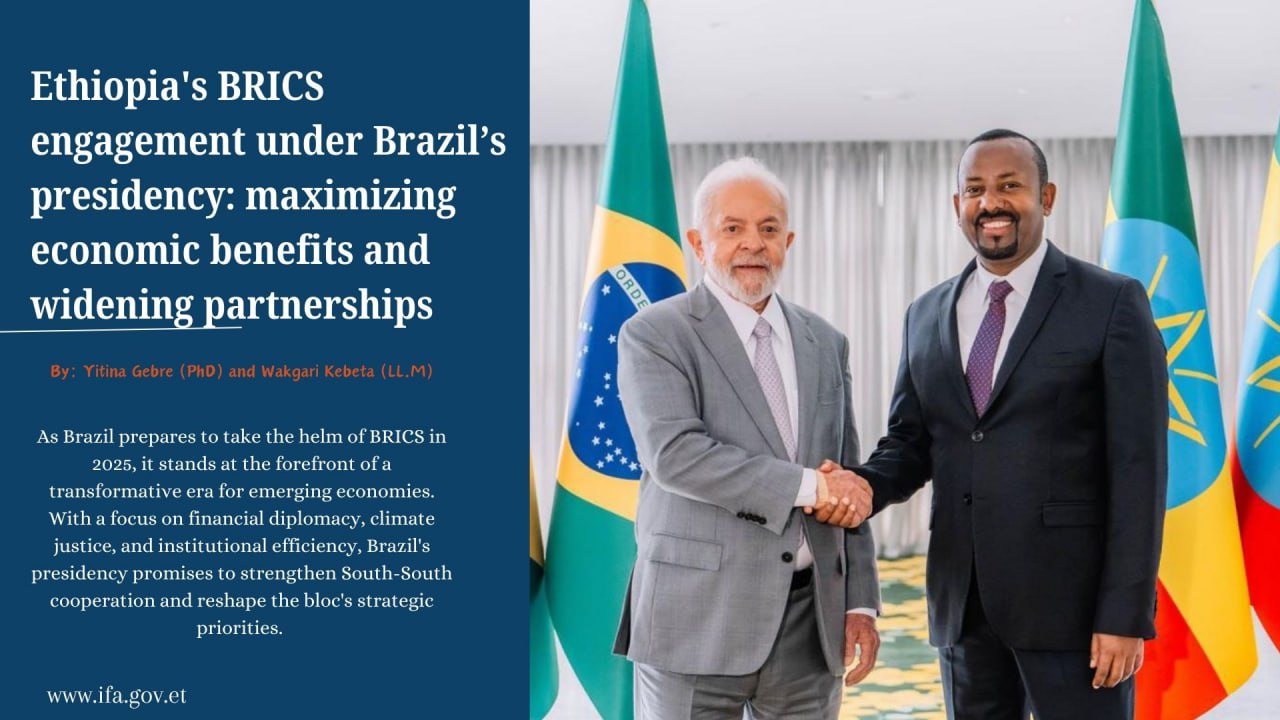
Ethiopia’s engagement in BRICS, particularly in its relationship with Brazil, reflects a comprehensive strategy aimed at strengthening economic ties and fostering international partnerships. A central element of this approach is attracting foreign direct investment (FDI) from BRICS countries, with a specific focus on Brazil, in key sectors such as agriculture, infrastructure, and energy. Alongside FDI, Ethiopia works to bolster trade relations through bilateral agreements that facilitate smoother trade flows and open new markets for Ethiopian goods. Beyond economic cooperation, Ethiopia actively participates in BRICS political dialogues on global governance and development, aligning with other emerging economies to advocate for reforms in international institutions. In addition, Brazil’s development assistance- particularly in agriculture and social programs- has helped Ethiopia leverage Brazilian expertise to enhance its domestic capacities. In the area of regional security, Ethiopia’s involvement in BRICS contributes to initiatives aimed at promoting stability in the Horn of Africa, highlighting the geopolitical importance of its participation.
Through the BRICS framework, Ethiopia’s strategic partnership with Brazil demonstrates both nations’ commitment to economic growth and development cooperation. Ethiopia seeks to capitalize on Brazil’s expertise in agriculture, social programs, and public health, while also attracting Brazilian investment in sectors such as agriculture, infrastructure, and renewable energy. These initiatives align with Ethiopia’s broader BRICS goals of securing FDI, promoting regional stability, and addressing climate challenges. Brazil’s upcoming 2025 BRICS presidency is expected to further advance these multi-dimensional collaborations, underscoring the significance of this bilateral relationship not only for the two countries but also in achieving broader BRICS objectives as a platform for emerging economies.
Though geopolitics is being intensified, Brazil seems to prioritize the economic dimension of the cooperation. Brazil’s BRICS Presidency in 2025 presents an opportunity to cement south-south cooperation. It is expected that Brazil’s priorities and proposals will be enlightened with the continuous discussions to be held at various levels. Brazil’s priorities directly align with Ethiopia’s interests in two ways. First, it prioritizes financial diplomacy. Second, it focuses only on very important meetings and events and this would make it cost effective. As a way forward, Ethiopia should not only claim to host BRICS initiatives but also to think of chairing the group in the coming few years. Given the country’s long years of experience as a center of Africa’s and global diplomacy, and with adequate preparation, the country could chair within the next five years. Nevertheless, the country needs deep institutional reforms in order to lay the groundwork for active engagement and benefit from its membership.
About Authors
Dr.Yitina Gebre Multilateral Affairs Research Director General at the Institute of Foreign Affairs (IFA).
Wakgari Kebeta (LL.M) is a researcher of multilateral affairs at the Institute of Foreign Affairs (IFA).
Declaimer: The opinions stated in this article solely belong to the author and do not reflect the views or positions of the IFA.