

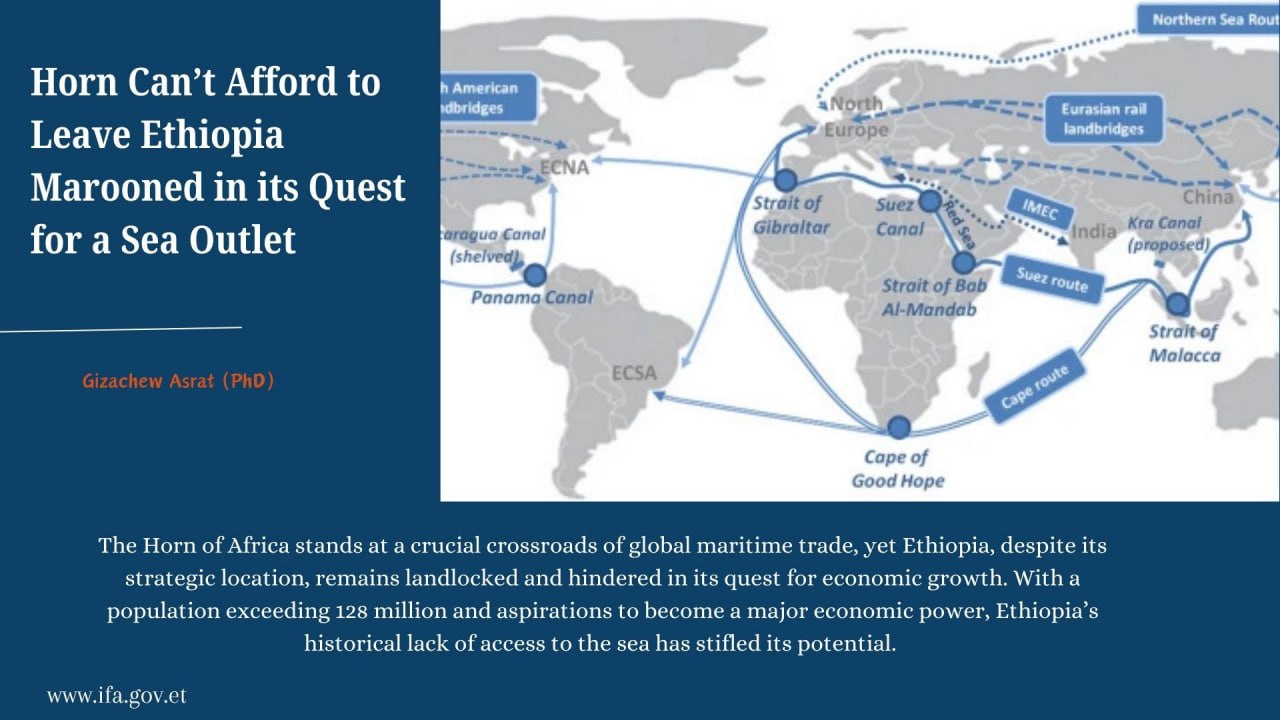
The Horn of Africa, strategically positioned at the crossroads of crucial maritime trade routes, is a region of intense geopolitical competition. Comprising Djibouti, Eritrea, Ethiopia, Somalia, Sudan, and South Sudan, and Kenya the Horn of Africa covers approximately 5 million square kilometers and is home to nearly 250 million people. Its strategic location bordering the Red Sea, Gulf of Aden, and Indian Ocean has made it a focal point for intense geopolitical competition among international and regional powers.
Despite being characterized by volatility and plagued various intra-state and inter-state conflicts, the Horn of Africa remains a major geostrategic region for several reasons. Firstly, its location along critical maritime trade routes connecting Asia, Africa, and Europe grants it significant economic and strategic importance. According to the New Zealand Ministry of Foreign Affairs and Trade (2024) report, the Suez Canal is a major trade route connecting Europe with the Indo-Pacific, servicing around 12–15% of world trade and 30% of containerized shipping. Secondly, it is rich in diverse resources, including fertile land, mineral deposits, and untapped energy potential. Notably, the region contains uranium and gold, as well as Rare Earth Elements (REE), which are essential for batteries in electric cars, cell phones, high-tech weapons, and wind turbines. Additionally, the Horn of Africa boasts abundant mineral resources, including metals, precious metals, coal, and industrial minerals. These resources enhance the region’s strategic value, attracting international players seeking economic opportunities and resource partnerships.
The red sea’s geographic allure extends beyond its immediate littoral states. Distant powers, propelled by strategic interests and commercial ambitions, readily establish naval bases and engage in economic ventures, shaping the region’s power dynamics. This intense competition reflects the strategic importance of the Horn of Africa’s ports. They serve as economic gateways for the region and potential strategic assets, with implications for regional security, trade, and global influence. The influx of foreign actors securing the ports of the Horn has led to foreign geopolitical divisions and shaped intra-horn geopolitics through commercial motivations, proxy wars, transactional diplomacy, and security agreements. However, physical proximity to the Red Sea offers a scant advantage for nations like Ethiopia.
Why the world should care about Ethiopia’s sea access
For most nations, access to the sea is a golden ticket to economic prosperity and security. It unlocks a flourishing economy through cost-effective trade routes, empowers them with naval strength and security, provides recreational havens for their people, and serves as a bountiful source of food and cultural identity. From regulating climate to supporting diverse marine life, the ocean’s significance extends far beyond the shoreline, making it a vital asset for countless nations across the globe. The ten largest economies in the world are all coastal countries, and the global maritime industry employs over 40 million people.
Despite its proximity to the Red Sea, Ethiopia’s landlocked status has historically relegated it to the periphery of maritime activities, hindering its full participation in global trade. This geographic limitation has fueled a persistent desire within Ethiopia to overcome these constraints and secure meaningful access to the sea. Ethiopia’s landlocked status significantly impedes its economic and security aspirations. With a population exceeding 128 million, Ethiopia’s pursuit of alternative sea access has far-reaching implications for its economic development and prosperity of the region. Although Ethiopia has emerged as Africa’s fifth-largest economy and 57th largest world economy, and aspires to become a top economic power by planning to achieve a double-digit annual growth, aiming to reach a GDP of 4.8 trillion dollar within 25, its landlocked status poses significant challenges to this aspiration and vision.
According to the United Nations Conference on Trade and Development (UNCTAD), landlocked countries lag behind their coastal counterparts by an estimated 20% in potential growth. The report further highlights that landlocked countries import and export 20% and 30% less, respectively, compared to coastal nations. These disparities are primarily attributed to higher transportation costs for landlocked states, which rely on overland or air routes. Land transport is significantly more expensive than sea transport, often costing 6-7 times more. Coupled with limited access to global markets, complex border procedures, and increased geopolitical vulnerability, these challenges create significant obstacles to economic prosperity.
By the sheer size of population, one in ten Africans lives in the Horn of Africa region. Of which, 62 percent would come from Ethiopia, whose porous borders are mostly shared with each of these states in the region. For a country like Ethiopia with more than 128 million people currently and projection to be 200 million by 2050 with mass youth generation and working forces dependence on a single port hindering its economic growth and development which in short term will affect the region and international circumstances. Ethiopia, the most populous landlocked nation globally, is strategically positioned in the Horn of Africa, sharing borders with multiple countries with the majority have a connection to the sea.
Ethiopia’s historic deal on maritime access not only holds economic promise but also carries significant security implications for the Horn of Africa region. Given its strategic location and substantial military and diplomatic capabilities, Ethiopia has long been a key player in regional peace and security. As a leading contributor to regional peacekeeping efforts, Ethiopia has deployed thousands of troops to various missions, including the African Union Transition Mission in Somalia (ATMIS), where it currently has a contingent of 4,395 personnel. Additionally, Ethiopia has deployed approximately 7,000 troops on bilateral missions. Over the past two decades, countless Ethiopian peacekeepers have made the ultimate sacrifice in the fight against the Al-Shabaab terrorist group, safeguarding the region and the international community. In addition to Somalia, its contribution in Central Africa, Darfur, Abyei, South Sudan, and Rwanda are a few mentioned successful missions.
Beyond peacekeeping, Ethiopia has actively engaged in mediation efforts to resolve regional conflicts. Notably, the country has facilitated dialogue between Sudan and South Sudan, played a pivotal role in ending the decades-long frozen war with Eritrea, and contributed to efforts to address internal disputes within South Sudan. This proactive approach demonstrates Ethiopia’s commitment to regional stability and its ability to influence peace processes.
Ethiopia, historically, maintained a navy that played a crucial role in securing maritime routes. A renewed focus on naval capabilities could help safeguard the Horn of Africa from piracy and other maritime threats. With improved naval infrastructure, Ethiopia could contribute to regional security, ensuring that trade routes remain open and safe for vessels traversing the region. With the ability to monitor maritime activities, Ethiopia could more effectively combat piracy and strengthen its naval capabilities, there by contributing to reinforce Ethiopia’s position as a regional powerhouse but also enhances its capacity stability in the Horn of Africa.
Following the official declaration of access to the sea, various opinions and voices emerged from the international community. Most notably, narratives dominated from neighboring countries’ experts and politicians who seemed disinterested or even dismissive of Ethiopia’s genuine quest for access to the sea and international trade. This was happen due to high level of mistrust and unhealthy rivalry between states and elites of the region as a result of historical factors and lack of strong regional cooperation. The deal follows Ethiopian Prime Minister Abiy Ahmed breaking the silence on Red Sea access for his nation in October 2023. At the time, his statements had raised concerns in the region. Ethiopia signs the MoU on January 1, 2024, with a self-proclaimed independent Somaliland. Following the MoU, the then Somaliland President Muse Bihi Abdi announced that an agreement had been reached with Ethiopian Prime minister Abiy Ahmed. Somaliland would grant landlocked Ethiopia access to the Gulf of Aden, and in return Ethiopia supports Somaliland.
The maritime access deal has the potential to revolutionize Ethiopia’s global trade landscape. By significantly reducing transportation costs it will enhance the competitiveness of Ethiopian exports, ranging from agricultural products to manufactured goods. Consequently, increased trade opportunities could stimulate economic growth and job creation both domestically and regionally.
Moreover, this strategic move not only benefits Ethiopia but also contributes to the broader stability of the Horn of Africa. By strengthening its maritime presence, Ethiopia can enhance regional security, fostering a more conducive environment for economic development and cooperation among neighboring countries, such as Somalia.
Ethiopia has played a pivotal role in regional stability. Therefore, international and regional partners should view this development as an opportunity to diversify trade routes and contribute to sustainable poverty alleviation and economic development in Ethiopia and the wider region. Particularly, leaders and states of the region should find common interests and work for cooperation to avoid future regret, as the region has consistently missed opportunities in the past
About the Author
Gizachew Asrat (PhD), African Affairs Research Director General at the Institute of Foreign Affairs (IFA).
Disclaimer:-The opinions stated in this article solely Belong to the author and do not reflect the views or Positions of the IFA