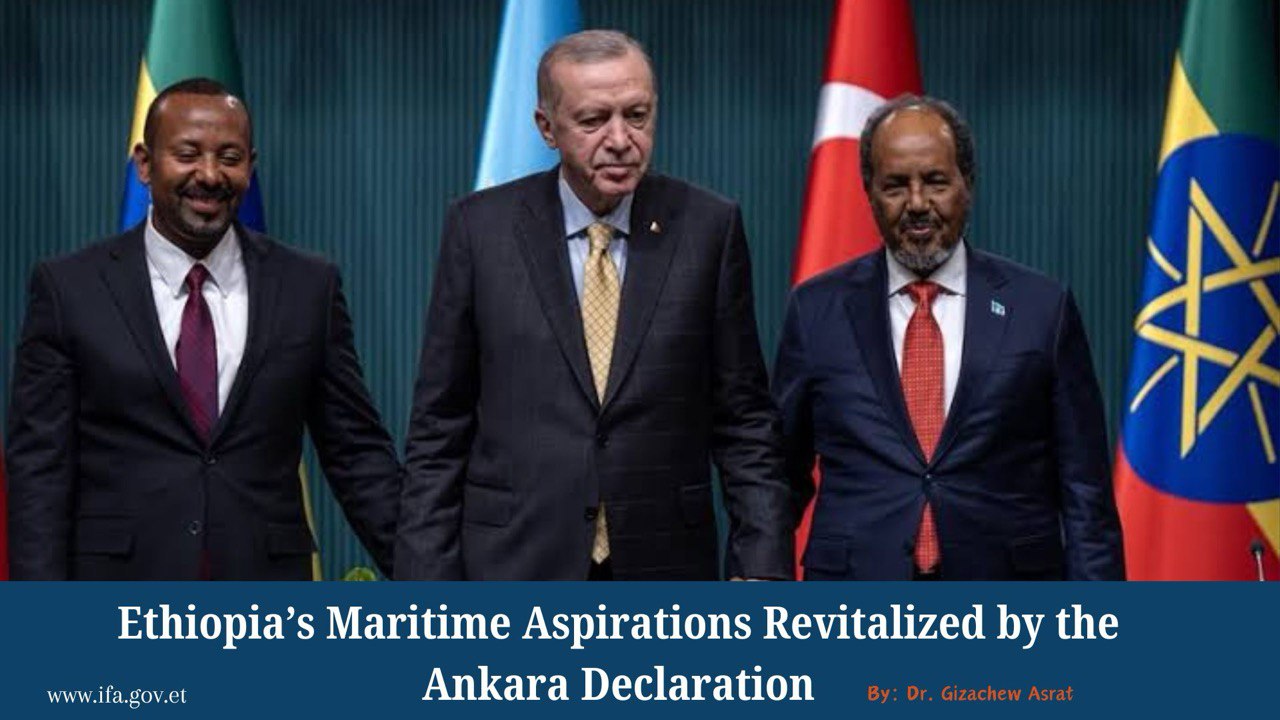
The Ankara Declaration marks a significant milestone in Ethiopia’s diplomatic history and its long-cherished, though often neglected, quest for maritime access. This agreement, recognized by Somalia, Türkiye, and various international organizations, legitimizes Ethiopia’s aspirations, breaking a decades-long taboo on discussing the issue in regional and global forums. It is a transformative step, not just for Ethiopia but for the entire Horn of Africa.
For Ethiopia, the declaration represents a strategic breakthrough in revitalizing a goal that had been deemed unattainable for the last 30 years. The pursuit of maritime access is no longer relegated to the margins of policy debates; it has emerged as a priority of state and regional significance. This shift underscores the pressing need for Ethiopia to diversify its trade corridors and modernize its logistical framework. Maritime access will enable the country to move beyond reliance on traditional landlocked trade routes, ensuring cost-effectiveness and strengthening regional trade integration. Additionally, the economic opportunities associated with sea access—such as attracting foreign direct investment—cannot be overstated.
The declaration’s diplomatic significance lies in its affirmation of Ethiopia’s commitment to peaceful negotiations and collaborative problem-solving. This approach reflects the government’s resolve to achieve maritime access not through confrontation but through dialogue and mutual understanding. As Prime Minister Abiy Ahmed has aptly framed it, this issue is a matter of national survival. The declaration is thus both a diplomatic victory and a reflection of Ethiopia’s broader dedication to regional stability and integration.
Equally noteworthy are the economic and security benefits this agreement holds for Somalia. By acknowledging and respecting Somalia’s sovereignty, Ethiopia has paved the way for strengthened bilateral ties. Somalia stands to gain not only from Ethiopia’s enduring support in security and governance issues but also from the economic dividends of cooperation. Improved infrastructure, enhanced maritime logistics, and the potential to become a regional port hub are just a few of the tangible benefits that Somalia could reap. These developments would support Somalia’s journey toward a more stable and prosperous state, addressing its security and governance challenges.
The Ankara Declaration also highlights Ethiopia’s role as a peace-builder in the Horn of Africa. This acknowledgment comes on the back of Ethiopia’s significant sacrifices in Somalia, including its contributions to peacekeeping and counter-terrorism efforts. The declaration serves as a peace dividend, fostering trust between Ethiopia and Somalia and reducing tensions that have long undermined regional cooperation.
From a global perspective, the declaration has garnered strong endorsements, signaling widespread support for its objectives. The United States, a key player in counter-terrorism efforts in Somalia, has welcomed the agreement, reaffirming its support for Ethiopia and Somalia’s sovereignty and cooperation. Similarly, the European Union, with its history of supporting stability in the Horn of Africa, has also viewed the declaration as a step toward de-escalating tensions and fostering regional integration. Such international backing not only enhances the agreement’s credibility but also ensures its alignment with broader global interests in the region.
As for neighboring countries, while some, like Eritrea and Egypt, may harbor reservations, the declaration offers an opportunity for rapprochement and collaboration in the region. Ethiopia’s approach to the Ankara Declaration exemplifies the importance of trust-building and the identification of shared interests. Without these elements, the Horn of Africa risks remaining trapped in cycles of mistrust and instability. Regional actors need to seize this moment to lay the groundwork for lasting peace and economic prosperity.
The technical challenges of implementing the Ankara Declaration should not be underestimated, but neither should its transformative potential. With Türkiye pledging its support as a guarantor, the agreement is well-positioned for success. It offers a blueprint not only for securing Ethiopia’s maritime access but also for stabilizing the region, fostering economic growth, and addressing the needs of citizens in both Ethiopia and Somalia.
In conclusion, the Ankara Declaration underscores Ethiopia’s geopolitical influence and its role as a stabilizing force in the Horn of Africa. It is more than a diplomatic achievement; it is a testament to the power of peaceful negotiation and a strategic step toward regional stability, economic integration, and the realization of Ethiopia’s historic quest for access to the sea.
About the Author
Gizachew Asrat (PhD), African Affairs Research Director General at the Institute of Foreign Affairs (IFA).
Disclaimer:-The opinions stated in this article solely Belong to the author and do not reflect the views or Positions of the IFA