

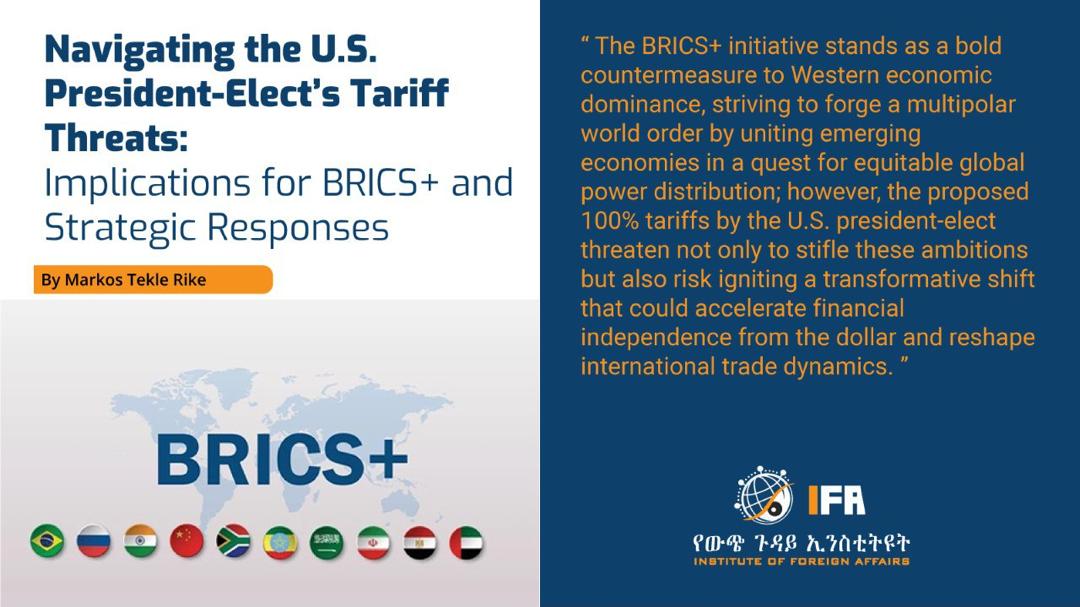
BRICS+
The BRICS+ initiative, an expansion of the original BRICS group, represents a strategic effort by
non-Western nations to establish a more balanced global order by including additional emerging
economies. This expansion offers new members access to investment and financing through the
New Development Bank (NDB), enhanced trade opportunities, and avenues for technology and
knowledge transfer, driving economic growth and innovation (Brookings Institution, 2024).
Politically, BRICS+ strengthens global influence and diplomatic ties among member nations,
fostering coordinated stances on international issues while promoting economic diversification to
reduce dependency on Western markets. Furthermore, by challenging Western dominance and
advocating alternative governance models, BRICS+ aims to contribute to a multipolar world order,
enhancing stability, security, and equitable global power distribution (World Economic Forum,
2024).
The Challenge
BRICS faces challenges to unified action due to its members’ economic dependence on Western
trade, investment, and aid, which complicates adopting collective stances (UNCTAD, 2024).
Geopolitical differences and varying economic policies among members further hinder consensus-building on global issues. Additionally, the group’s institutional capacity is tested by the need for
effective coordination mechanisms to align its members’ diverse priorities and strategies
(Brookings Institution, 2024).
The Threat
The BRICS+ initiative is a strategic effort to challenge the dominance of Western-led global
economic structures and establish a multipolar world order. However, the proposed 100% tariffs
by U.S. President-elect Donald Trump on BRICS nations highlight the significant resistance such
initiatives face. These threats aim to deter BRICS from creating an alternative to the U.S. dollar as
the global reserve currency, representing a broader strategy to maintain the dollar’s supremacy in
international trade (Politico, 2024). In this context, BRICS+ must adopt a cohesive and strategic
approach to navigate this geopolitical challenge.
The Impacts
The proposed 100% tariff on BRICS+ nations by the U.S. president-elect could backfire
economically in the short and long term. While aimed at deterring BRICS+ initiatives, such as
reducing reliance on the U.S. dollar, the tariffs risk inflating consumer prices in the U.S. as critical
suppliers like China, India, and Brazil face higher business costs (Business Insider, 2024).
American companies dependent on global supply chains could see operational costs rise, eroding
competitiveness. Moreover, reciprocal tariffs by BRICS+ nations on U.S. exports could harm
sectors like agriculture, manufacturing, and technology, reducing demand and exacerbating trade
deficits. The interconnected nature of global supply chains further amplifies the risk of disruptions,
potentially driving BRICS+ nations to strengthen partnerships outside the U.S. and undermining
American influence in international trade (The Australian, 2024).
The Repercussion
The U.S. tariff threat may drive BRICS+ and other nations to accelerate financial systems
independent of the dollar, potentially weakening its global dominance. Nations like Russia and
China are already advocating alternatives, while BRICS+ expansion to include emerging
economies like Egypt, UAE, and Iran could boost intra-bloc trade in non-dollar currencies
(Politico, 2024). This shift could deepen BRICS+ cooperation and attract middle powers, eroding
U.S. influence in global trade and finance.
Reciprocal tariffs by BRICS+ nations could harm the U.S. economy by restricting market access
for key exports like agriculture, technology, and energy, exacerbating trade deficits. Such
measures might also drive BRICS+ countries to deepen trade ties with non-U.S. partners, isolating
the U.S. from key growth markets (Business Insider, 2024). Additionally, retaliatory tariffs could
contribute to global economic instability, discouraging investment and slowing economic growth,
with the U.S. also facing repercussions as a significant international market player (The Australian,
2024).
Response by BRICS+
BRICS+ should respond to U.S. tariff threats by strengthening internal economic integration
through enhanced trade agreements and New Development Bank (NDB) financing, reducing
reliance on Western systems (UNCTAD, 2024). Strategic diplomacy with emerging economies
and the Global South can amplify collective bargaining power and attract new members. To ensure
cohesive responses, BRICS+ must align member priorities and develop shared policies while
advancing alternative financial mechanisms, such as a BRICS reserve currency, to reduce dollar
dependence (Brookings Institution, 2024). Public diplomacy, highlighting the benefits of a
multipolar trade system, can garner international support and counter-economic coercion (World
Economic Forum, 2024).
Conclusion
The U.S. president-elect proposed 100% tariffs on BRICS+ nations, posing a significant challenge
to the bloc’s efforts to reduce reliance on the U.S. dollar and advance a multipolar global order.
However, these threats could unify BRICS+ and accelerate its strategic initiatives. The bloc can
reduce Western dependency by enhancing internal economic integration through trade frameworks
and New Development Bank financing, fostering strategic diplomacy with the Global South, and
advancing alternative financial mechanisms like a BRICS reserve currency. Public diplomacy and
cohesive policy alignment further strengthen BRICS+’s resilience, enabling it to counter coercive
measures, promote equitable governance, and challenge Western-led economic dominance.
References
- Politico. “Trump Threatens BRICS Nations with 100 Percent Tariff.” Accessed December 1, 2024. Politico.
- Business Insider. “Trump Is Now Threatening 100% Tariffs on the BRICS Group.” Accessed December 1,
- Business Insider.
- The Australian. “Shock Waves: Markets Hit by Trump’s Tariff Plans.” Accessed December 1, 2024. The
Australian. - Brookings Institution. “Analyzing BRICS+: Strategic Initiatives and Global Impact.” Accessed December 1,
- World Economic Forum. “Emerging Markets and the Multipolar World Order.” Accessed December 1, 2024.
- UNCTAD. “BRICS+: Trade, Development, and Global Governance.” Accessed December 1, 2024.
By: Markos Tekle Rike
Disclaimer:-The opinions stated in this article solely Belong to the author and do not reflect the views or Positions of the IFA