

By: Dr. Gashaw Ayferam and Dr. Gizachew Asrat
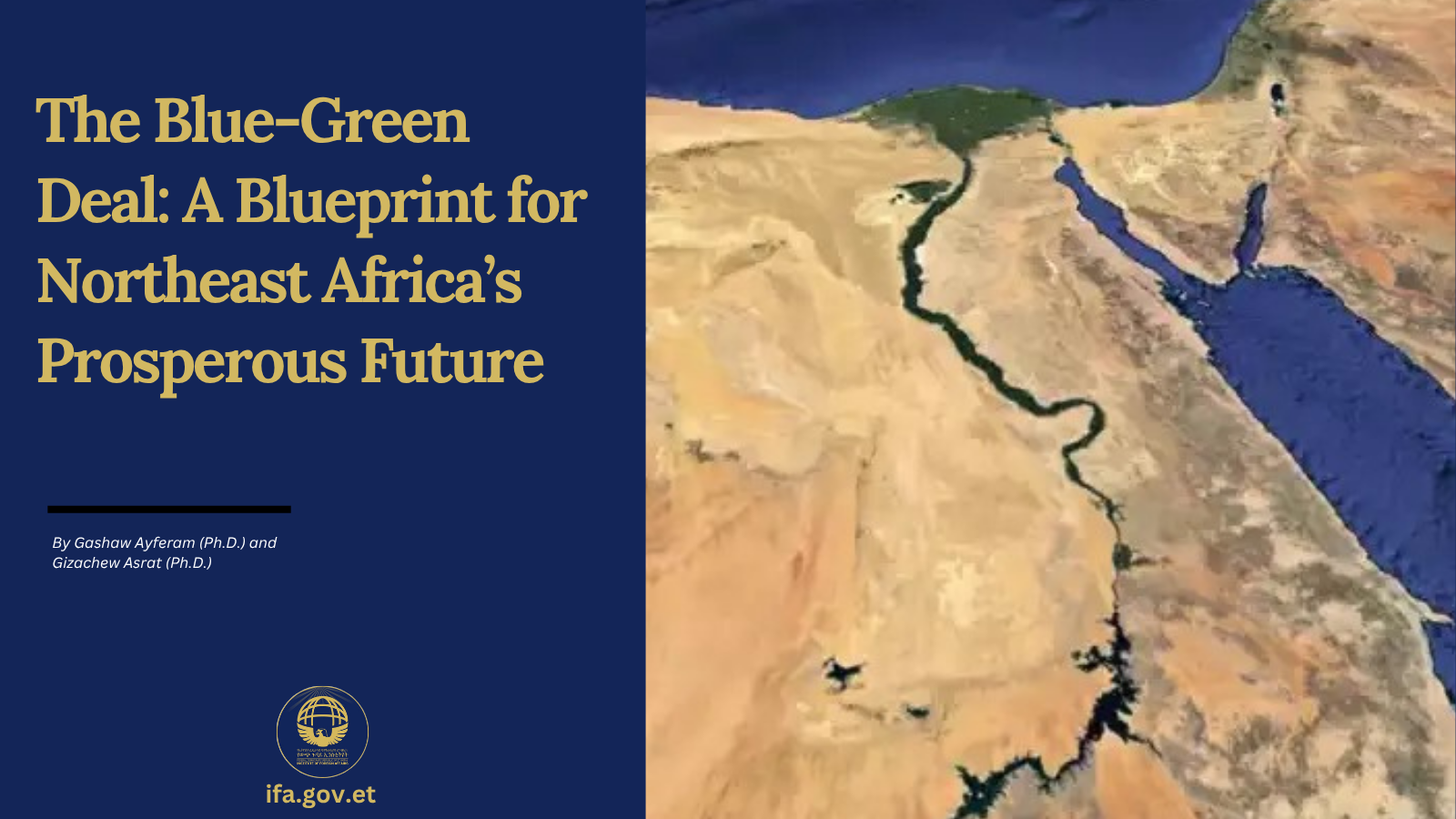
Northeast Africa is home to two vital and strategic resources: fresh water and seawater—sweet and salty, respectively. The region benefits from ocean resources as it shares key strategic waterways, including the Mediterranean Sea, the Suez Canal, the Gulf of Aden, and the Indian Ocean. It is rich not only in seawater resources but also in freshwater resources, such as the Nile River, Genale Dawa, Wabishebele, and Omo-Gibe.
As a result of these water resources, the region has untapped potential for green and blue economies across multiple sectors, such as hydropower, irrigation, fisheries and aquaculture, maritime transport and trade, power trade and connectivity, coastal and marine tourism, port development, offshore oil and gas, and marine renewable energy. The development of these resources could serve as a permanent bridge and catalyst for cooperation rather than breeding grounds for geopolitical tensions. Paradoxically, these resources, instead of fostering cooperation, have become a source of geopolitical conflict, fueled by siloed thinking, conflicting worldviews, and the influence of external powers.
Ethiopia occupies a central geographical position in Northeast Africa, serving as a hub connecting several countries. Rivers originating in Ethiopia, such as the Abbay, Tekezze, Baro-Akkobo, and Merb not only provide freshwater to neighboring countries but also serve as natural bonds. However, the Nile River, a critical resource, has become a source of tension due to Egypt’s monopolistic ambitions and the politicization of water resources within a broader geopolitical context. Other rivers, including the Genale Dawa, Wabishebele, and Omo-Gibe, further exemplify the interconnectedness of the region’s water resources.
Except for South Sudan, all of Ethiopia’s neighbors are littoral states. Somalia and Kenya are littoral states along the Indian Ocean, while Sudan, Eritrea, and Djibouti share the Red Sea. Egypt, Ethiopia’s distant neighbor, also shares the Red Sea. Ethiopia, as the source of the major rivers of the northeast Africa, plays a pivotal role in the freshwater resources of Northeast Africa. While landlocked, Ethiopia’s interdependence with its littoral neighbors is undeniable. This natural interdependence, stemming from shared water resources, presents an opportunity for regional cooperation and a pathway towards peace and stability. A Blue-Green deal framework could capitalize on this interdependence, fostering sustainable development and mitigating potential conflicts.
While the region possesses significant potential in both freshwater and seawater resources, their development remains largely untapped. The legal and institutional frameworks governing these resources are still nascent, particularly in the Red Sea. The existing governance structure, the Red Sea Forum, is exclusive and appears to serve geopolitical interests rather than fostering inclusive regional cooperation. The potential for a green economy, encompassing fisheries, tourism, marine energy, and port development, remains largely unrealized. Furthermore, the Red Sea and Indian Ocean face security challenges, including piracy, further emphasizing the need for regional cooperation to address these issues effectively. In freshwater governance, there are emerging legal and institutional frameworks in the Nile Basin, such as the Cooperative Framework Agreement (CFA) and the Nile Basin Initiative (NBI), as well as the IGAD Transboundary Water Policy. However, there are competing worldviews and visions regarding water governance, especially in the case of the Nile River.
Despite these tensions, hydro-cooperation exists. Ethiopia already engages in power trade with Sudan, Djibouti, and Kenya, supplying green energy from its hydropower plants. Ethiopia also plans to extend its green power trade through two corridors: the North Corridor, linking to North Africa, the Middle East, and Europe, and the South Corridor, extending to South Africa via Kenya and Tanzania.
Recently, Ethiopia has revived its historical claims to access the sea. Historically, Ethiopia has regarded access to the Red Sea as an integral aspect of its national security. In its pursuit of sea access, Ethiopia offers the Grand Ethiopian Renaissance Dam (GERD), Ethio-Telecom, and its successful airline as a concession. The GERD exemplifies how freshwater and seawater can intersect to transform the region into one centered around water-based regional integration. The Blue-Green Deal, therefore, presents itself as the future framework for the region. However, Ethiopia’s neighbors, such as Eritrea and Somalia, have opposed Ethiopia’s sea access aspirations. Egypt, a distant neighbor, has also used Ethiopia’s quest for sea access as a means to mobilize anti-Ethiopia alliances, which has led to the formation of a temporary Egypt-Somalia-Eritrea alliance. Egypt has further sought to create alliances on the Nile River, following the full entry into force of the CFA.
While freshwater and seawater could be sources of cooperation, siloed thinking and the intertwining of these issues with geopolitics and nationalistic aspirations have turned them into sources of tension. This has heightened the vulnerability of the region to external powers that seek to exploit the power vacuum created by these tensions.
The future of Northeast Africa, as we propose, lies in the Blue-Green Deal. This deal recognizes the potential of both freshwater and seawater for regional cooperation and development.
The Green-Blue Deal: A New Framework for Cooperation
The Green-Blue Deal is built around three pillars which is blue development, green development, and the recognition of the interdependence between these two resources. The blue development pillar focuses on harnessing the potential of marine resources, including desalination, fisheries, port development, ocean tourism, renewable energies (such as offshore wind), and maritime security cooperation. The green development pillar, on the other hand, focuses on the development of freshwater resources such as hydropower, agriculture, and water supply. The third pillar, interdependence, is the need to recognize the trade-offs and synergies between freshwater and seawater resources, encouraging cooperation between landlocked and littoral states.
The 5Cs Framework: Key Drivers of the Green-Blue Deal
The 5Cs Framework for the Green-Blue Deal are Cooperation, Connectivity, Conservation, Commerce, and Conflict Prevention:
Cooperation: Cooperation is essential between landlocked and littoral states, as both rely on the other for freshwater and seawater resources. This requires initiating legal and institutional frameworks, including water-sea agreements between Ethiopia and its littoral neighbors.
Connectivity: Developing joint connectivity projects linking freshwater resources with maritime access is crucial. For instance, Ethiopia and Somalia can develop joint projects on the Genale Dawa and Wabishebele rivers, as well as joint port developments and naval cooperation in Somali territorial waters. The same can apply to Ethiopia’s relations with Kenya, Sudan, and Egypt.
Conservation: Sustainable use of shared river basins and marine ecosystems must be prioritized. Cooperation on conservation will ensure the longevity of the region’s freshwater and seawater resources.
Commerce: Economic integration through ports, trade, and power exchanges will drive prosperity. This includes developing infrastructure that enhances regional trade, including energy trade and regional market integration.
Conflict Prevention: Disputes should be resolved through diplomatic means, fostering stability and peace in the region.
Overcoming Siloed Thinking and Embracing Systemic Cooperation
The successful implementation of the Green-Blue Deal necessitates a fundamental shift in approach. Siloed thinking, which isolates individual sectors and actors, must be transcended in favor of a holistic, systems-thinking framework. This necessitates reconciling often-conflicting worldviews and fostering a mindset of interdependence among stakeholders. A new paradigm, one that prioritizes regional cooperation and recognizes the interconnectedness of freshwater and seawater ecosystems, is crucial for the successful realization of this ambitious initiative. In conclusion, the future of Northeast Africa hinges upon the cooperative utilization of both freshwater and seawater resources, and the blue-green deal presents a viable pathway towards achieving this vision.
About the Authors
Gizachew Asrat (PhD), African Affairs Research Director General at the Institute of Foreign Affairs (IFA).
Gashaw Ayferam (PhD), Senior Researcher at the Institute of Foreign Affairs (IFA).
Disclaimer:-
The opinions stated in this article solely belong to the authors and do not reflect the views or positions of the IFA