

Africa needs to be led with homegrown climate solutions guided by the “Development First, Justice Always” principle.It is true that the world continues to move unfairly away from realistic and actionable solutions to climate change. However, the impact of climate change on developing nations is accelerating at an alarming rate, worsening livelihoods and threatening sustainable development as global climate solutions are failing to address the problem. Yet, global climate agreements that were intended to deliver climate justice are weakening due to the divergent and conflicting interests of powerful nations. The recent withdrawal of the United States from the Paris Agreement marked a turning point for many developing countries, forcing them to reconsider reliance on global systems and to pursue self-reliant climate solutions.
Despite contributing the least to the global emissions, African nations continue to be affected by climate change. Due to climate-related disasters such as droughts, desertification, and extreme weather, the continent is losing up to 5% of its economic output, and if we do nothing, we can expect a 30% drop in GDP by 2050. Since governments have diverged on who is most responsible for emission, how to track emissions-reduction goals, and whether to compensate harder-hit countries, climate solution implementation lags behind. To this end the promises of climate finance and fair compensation for damages done have largely gone unfulfilled, while Africa has engaged in and committed to numerous global climate agreements. Particularly climate finance promised to African nations at COP15 and COP29 is not being implemented.
Furthermore, the climate solutions influenced by developed nations are often protectionist in nature that restrict Africa’s ability to use its natural resources for industrialization; and deny the continent the development pathways once taken by industrialized nations – “kicking away the ladder.” Policies and strategies like Carbon Border Adjustment Mechanisms (CBAMs), EU Deforestation Regulation (EUDR) and Carbon Trading are controversial as they could limit Africa’s market opportunities and access to crucial green technologies.
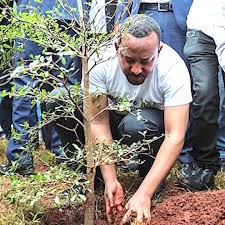
Africa should therefore lead with homegrown climate solutions which enhancing continental development agendas while keeping multilateral commitments.These solutions must be rooted in Africa’s own development needs and natural resource potential, while firmly rejecting externally imposed, protectionist or exploitative frameworks. In this regard, Ethiopia’s Green Legacy Initiative and ongoing renewable energy projects provide concrete examples of how Africa can design and implement sustainable self-driven solutions.
Grand Ethiopian Renaissance Dam (GERD) is an icon representing sovereignty, economic independence and self-sufficient future. At the same time, Africa must unit in one strong voice for climate justice, demanding that developed nations fulfill their obligation to finance Africa’s green transition.
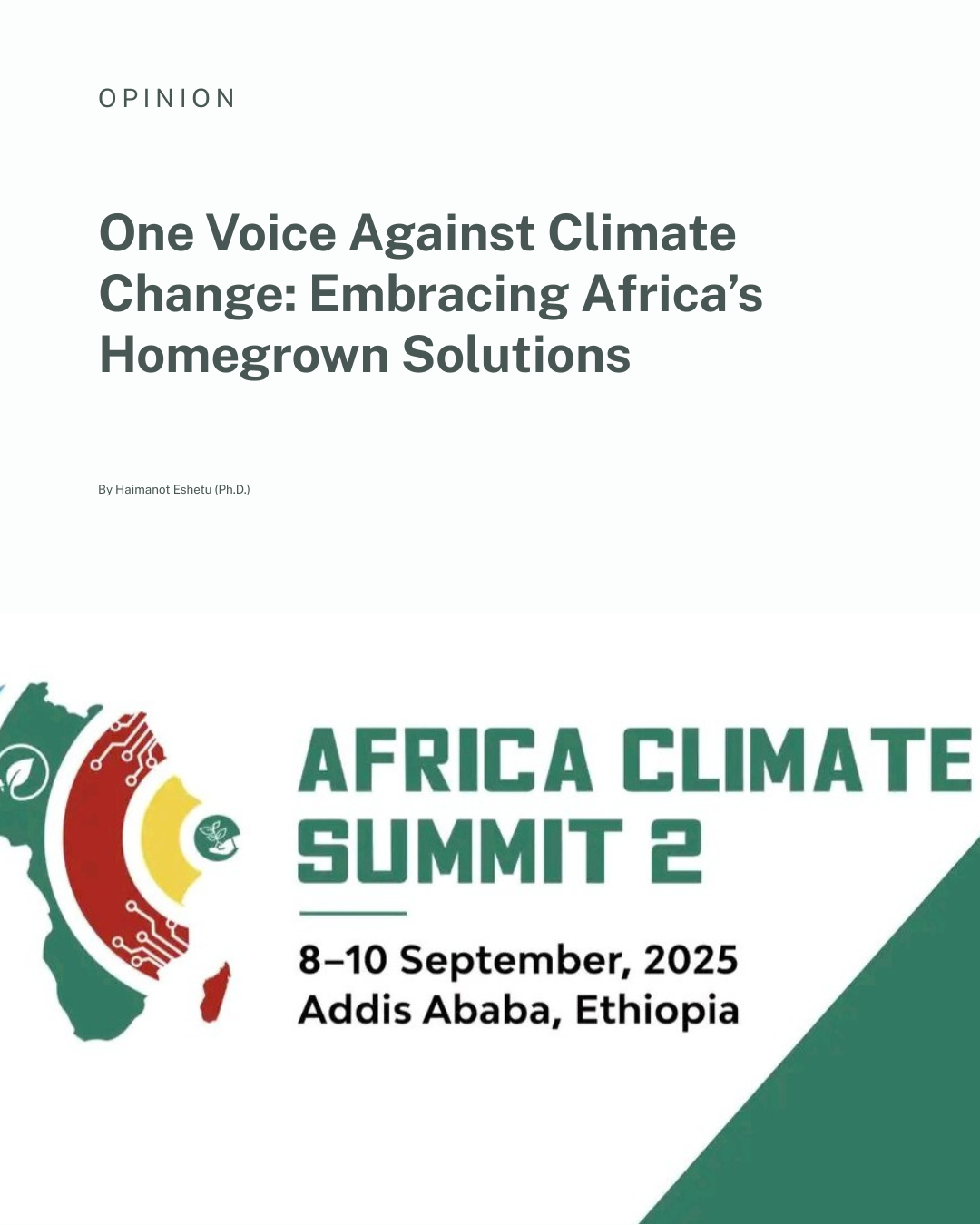
In line with the focus of this article, the press release for the Second Africa Climate Summit (ACS2) which will be held in Addis Ababa, Ethiopia, from September 8-10, 2025, highlighted that the summit seeks to centre Africa’s ambition and homegrown solutions — positioning the continent as a driving force in the global climate response. Most importantly the statement indicated that climate finance at a scale to adequately address adaptation and Africa’s development imperative rooted in green industrialization is one of the core agenda for summit. To this end, the current summit is expected to accelerate climate solutions and financing for Africa’s green development, with a strong emphasis on renewable energy as a transformative force.
Therefore, the most viable approach to designing a climate strategy that ensures sustainable development in Africa is to focus on homegrown solutions. To protect Africa’s interest, the strategy should be built on three pillars: One, “self-determined solutions” that align with Africa’s development agenda and resource base; two, “rejection of protectionist and exploitative policies” that undermine Africa’s sovereignty and industrialization; and three, “demand for fair compensation” from high-emitting nations in line with the principle of common but differentiated responsibilities. This balanced approach enables Africa to protect its climate while safeguarding its right to sustainable development and justice.
References
Africa Energy Portal. (2024, September 20). Africa Loses 5% of GDP to Climate Change. Retrieved from https://africa-energy-portal.org/news/africa-loses-5-gdp-climate-change
Dhafer, S.(2023, October 16).The injustice of climate change: What solutions for Africa? African Business.Retrieved from https://african.business/2023/10/resources/the-injustice-of-climate-change-what-solutions-for-africa
Lindsay M. and Clara F.(2025, January 21) Global Climate Agreements: Successes and Failures. Council on Foreign Relations. Retrieved from https://www.cfr.org/backgrounder/paris-global-climate-change-agreements
Patrick V. (2024). Africa Must Nurture Home-Grown Solutions To Bridge Climate Funding Gap | Opinion. Newsweek. Retrieved from https://www.newsweek.com/africa-must-nurture-home-grown-solutions-bridge-climate-funding-gap-opinion-1917865
Qiang, W., Feng,J. , Rongrong, L. and Xiaowei,W.(2022). Does protectionism improve environment of developing countries? A perspective of environmental efficiency assessment.
Sustainable Production and Consumption. https://doi.org/10.1016/j.spc.2022.01.011
About the author
Haimanot Eshetu (Ph.D.), is a senior researcher at the Institute of Foreign Affairs (IFA)
Disclaimer:
The content disseminated by the Institute of Foreign Affairs (IFA) – including, but not limited to, publications, public statements, events, media appearances, and digital communications – reflects the views of individual contributors and does not necessarily represent the official positions or policies of the Institute, its partners, or any affiliated governmental or non-governmental entities.
While the IFA endeavors to ensure the accuracy, integrity, and timeliness of the information presented, it makes no representations or warranties, express or implied, regarding the completeness, reliability, or suitability of such content for any purpose. The Institute expressly disclaims any liability for errors or omissions, as well as for any actions taken or decisions made based on the information provided.
The inclusion of external links, references, or third-party resources does not constitute an endorsement by the Institute. Additionally, engagement on social media platforms – including, but not limited to, likes, shares, retweets (RTs), or reposts – shall not be interpreted as an endorsement or validation of the views expressed therein.
Readers and audiences are encouraged to exercise critical judgment and seek independent verification when interpreting or relying upon any information disseminated through publications and posts on the Institute’s platforms or representatives.Edit