

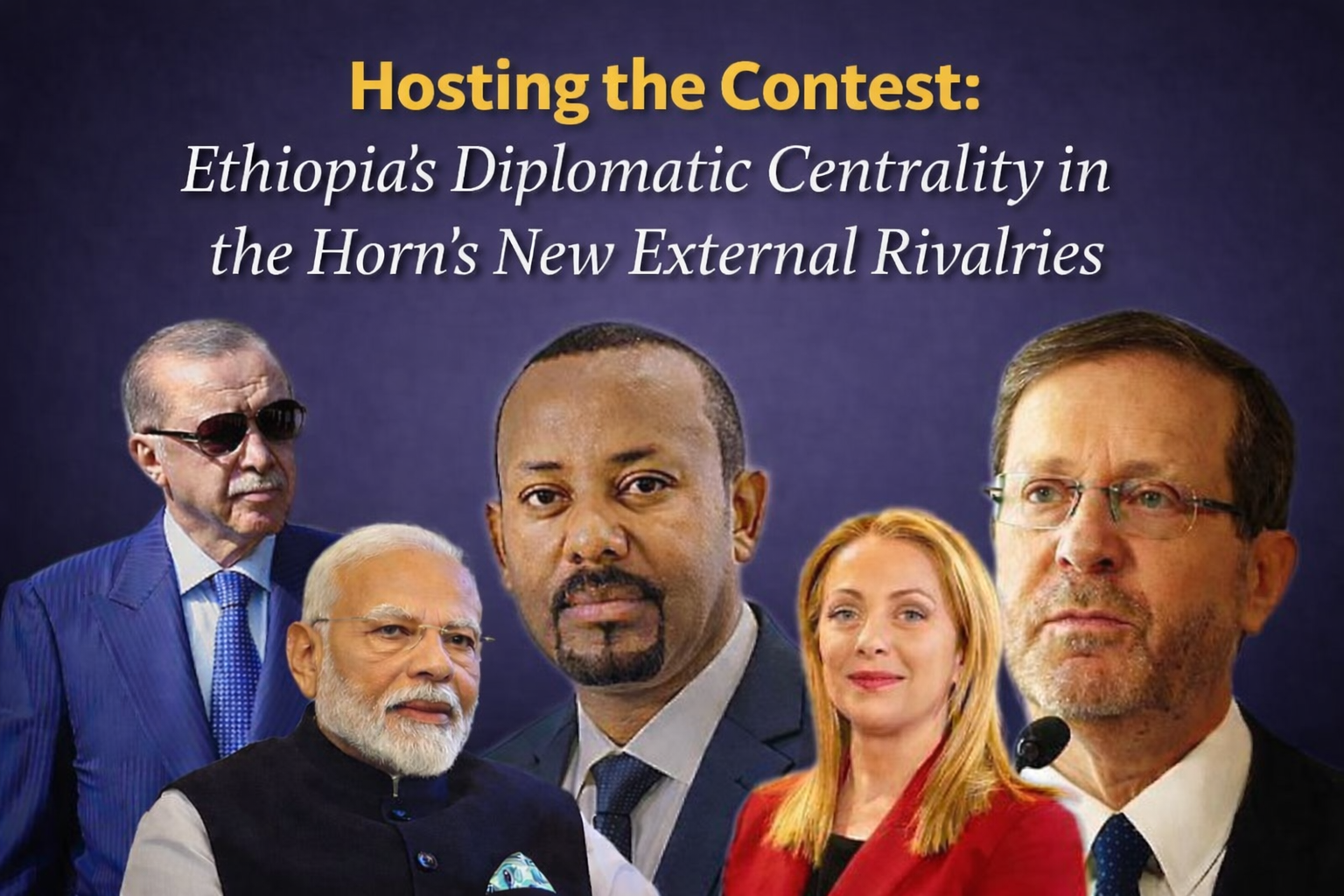
The visit of Israeli President Isaac Herzog to Ethiopia is easy to read as a routine bilateral event: a head of state arrives, meetings are held, diplomatic language is exchanged, and familiar headlines about cooperation follow. But that reading misses the more important development. The significance of the visit lies less in protocol and more in what it reveals about a changing regional pattern: Ethiopia is increasingly functioning as a strategic diplomatic hub where external actors seek legitimacy, access, and political positioning in the Horn of Africa.
This matters because the Horn is no longer a theater of conflict spillovers, maritime anxieties, and external competition in ports and security partnerships. It is also becoming a theater of intensified diplomatic signaling. In that environment, Ethiopia’s value is not only its population size, regional weight, or economic potential. It is also its growing role as a convergence point—an arena where competing powers seek to be seen, heard, and politically absorbed without triggering outright backlash.
The central question, then, is not whether foreign powers are competing in the Horn. That is already established. The real question is whether Ethiopia can convert this diplomatic centrality into durable bargaining leverage—or whether Ethiopia risks becoming a stage for other actors’ rivalries without securing strategic gains of its own.
Beyond the Visit: Diplomatic Centrality as a Strategic Asset
Diplomatic centrality is often misunderstood. It does not mean a state is the strongest military power, the richest economy, or the uncontested regional leader. It means something more specific: a state becomes a repeated site of contact, signaling, and negotiation for multiple actors whose interests overlap, collide, or require mediation. In moments of regional volatility, that position can become a strategic asset.
For Ethiopia, this asset is shaped by a rare combination of factors. Ethiopia is simultaneously the political capital of one of Africa’s most consequential states and the diplomatic seat of continental politics. It is a national decision center, but also a city where messages are often crafted for wider African and regional audiences. A visit to Ethiopia, therefore, is rarely only bilateral. It often carries a second layer of meaning.
In the current Horn-Red Sea environment, that second layer matters more than usual. Sovereignty disputes, recognition politics, maritime competition, and external alignment anxieties are all active at once. In such a setting, actors do not seek only agreements. They seek political framing, reputational cover, and a form of legitimacy that allows them to engage the region without appearing destabilizing. Ethiopia’s diplomatic centrality gives it potential leverage in exactly that space.
Why Ethiopia Is Becoming a Convergence Arena
Ethiopia’s renewed diplomatic traffic is not an accident of protocol calendars. It reflects deeper structural realities in the Horn. First, Ethiopia remains entangled in nearly every major regional file. Whether the issue is Somalia’s security transition, Sudan’s fragmentation and spillover risks, Red Sea strategic competition, Nile diplomacy, corridor politics, or regional infrastructure integration, Ethiopia is rarely a peripheral actor. It may not control outcomes in each theater, but it is frequently an unavoidable interlocutor.
Second, external actors increasingly need African-facing legitimacy, not just transactional partnerships. The era when influence could be built purely through security ties, financing, or commercial deals is under pressure. Public narratives around sovereignty, non-interference, territorial integrity, and African ownership now matter more, especially in the Horn, where external involvement is closely watched and often politically contested. Engagement in Ethiopia allows outside powers to speak not only to Ethiopia, but to a wider diplomatic ecosystem.
Third, the region’s volatility is compressing diplomatic behavior. In periods of rapid change, delay carries costs. Actors fear losing access, misreading political mood, or allowing rivals to define the terms of debate. High-level visits become tools of reassurance, repositioning, and narrative repair—not just ceremonial diplomacy.
Finally, Horn diplomacy is increasingly multi-vector. Bilateral, regional, and continental levels overlap. Ethiopia is one of the few places where an external actor can engage a national government while also projecting a message into regional and continental conversations. That dual function makes the city more than a capital. It makes it a convergence arena.
Re-Centering Ethiopian Agency
A common weakness in analysis of the Horn is proxy-theater thinking: external powers act, local states react. That frame often captures part of the story, but it obscures local agency precisely when it matters most. Ethiopia should not be read only as an object of diplomatic competition. It is also capable of acting as a manager of access.
This distinction is crucial. There is a difference between passive centrality and active centrality. Passive centrality means many actors come to Ethiopia, but Ethiopia gains little beyond symbolic visibility. Active centrality means Ethiopia uses repeated engagement to extract concrete advantages: policy support, diversification opportunities, diplomatic backing, escalatory/ de-escalatory signaling, or better negotiating terms across multiple files.
In practical terms, hosting can become bargaining. Access can be calibrated. Public messaging can be shaped. Issue-linkages can be quietly introduced. Protocol rank, meeting composition, and language emphasis can all communicate priorities. None of this guarantees strategic gain. But it creates opportunities to convert diplomatic traffic into statecraft.
That requires discipline. Diplomatic attention alone does not produce leverage. Leverage emerges when a state has enough internal coordination to know what it wants from each partner, what it will not concede, and how one relationship affects another. Without that, centrality becomes spectacle.
The Current Moment and the Meaning of Diplomatic Clustering
The close timing of high-level visits to Ethiopia should not be reduced to simplistic narratives of a diplomatic race. Yet it would also be a mistake to treat such clustering as analytically empty. In volatile regional moments, repeated high-level engagement is often a signal of perceived importance.
What matters is not merely that leaders are visiting, but why Ethiopia appears increasingly necessary as a venue for diplomatic signaling. The Horn is passing through a phase in which sovereignty language, recognition debates, external partnerships, and regional security calculations are tightly entangled. In such a context, visits serve as instruments of positioning. They can reassure one audience, signal restraint to another, and project influence to a third.
This is especially true when external actors face reputational pressure in the region. A high-level visit can function as a mechanism to sustain political presence, protect relationships, or widen diplomatic room after a controversial move elsewhere. It can also be used by the host state to reaffirm its own relevance and to remind all parties that access to the Horn’s political center requires engagement on Ethiopian terms. Diplomatic traffic is not proof of strategic success. But when visits cluster around contested regional issues, they are best read as indicators of diplomatic centrality under pressure.
What Ethiopia Can Gain from Managing Centrality Well
If Ethiopia manages this moment strategically, diplomatic centrality can produce four forms of leverage.
First, bargaining leverage. When multiple actors seek engagement, Ethiopia gains room to negotiate more selectively. This does not require bloc politics. On the contrary, it can support issue-specific hedging—working with different partners across different domains while preserving autonomy.
Second, narrative leverage. Hosting creates opportunities to shape political language around sovereignty, regional stability, African-led diplomacy, and legitimate partnership. In the Horn, where political framing often affects the absorbability of external engagement, this matters almost as much as material commitments.
Third, diversification leverage. Diplomatic centrality can widen Ethiopia’s options in investment, technical cooperation, diplomatic backing, and external partnerships. The strategic value is not in replacing one relationship with another, but in reducing dependence on any single actor.
Fourth, institutional leverage. Repeated engagement can strengthen state capacity if managed properly. Ministries, diplomatic teams, and policy units can build institutional memory, improve inter-agency coordination, and develop sharper negotiating routines. In this sense, hosting is not just external performance; it can become internal capacity-building.
But none of these gains are automatic. They depend on whether protocol is tied to policy, whether commitments are prioritized, and whether the state can absorb the outputs of intensified diplomacy.
The Risks of Centrality Without Strategy
Diplomatic centrality can also become a liability. One risk is symbolic overhosting: Ethiopia appears central, but repeated visits produce little measurable gain. In this scenario, Ethiopia becomes a venue rather than a strategist. A second risk is policy fragmentation. Different agencies may pursue parallel commitments with different partners without a coherent framework. External actors then navigate institutional silos more effectively than the host state itself. A third risk is reputational spillover. In a sensitive regional environment, hosting competing actors in compressed periods can generate misread signals among neighbors and partners. Even when no alignment shift is intended, diplomatic optics can create friction. A fourth risk is commitment overload. The Horn already faces a broader problem of implementation strain: more frameworks, communiqués, and initiatives than institutions can effectively staff, finance, or execute. Ethiopia is not immune. Diplomatic success at the front end can become administrative stress at the back end. Finally, there is entrapment risk. If competition among external actors is tactically useful but strategically unmanaged, Ethiopia could find itself pulled into disputes that narrow rather than expand its room for maneuver. These risks do not negate the opportunity. They define the conditions under which the opportunity can be used.
The Strategic Test Ahead
The real test for Ethiopia is whether it can institutionalize a form of selective-access diplomacy: not exclusionary, but calibrated; not reactive, but prioritized. The question is not whether Ethiopia should host multiple powers. It will. The question is whether hosting can be governed as a coherent bargaining architecture.
That requires clarity on three fronts. First, issue prioritization: what Ethiopia seeks from which partners, and on what timelines. Second, internal coordination: aligning protocol, diplomacy, and policy follow-through across institutions. Third, signaling discipline: ensuring that public optics and private commitments reinforce rather than contradict one another.
If Ethiopia can manage those tensions, diplomatic centrality may become one of its most useful strategic assets in a reordering Horn. If not, the country may still attract high-level attention—but attention alone is not leverage.
Herzog’s visit, in that sense, is more than a bilateral moment. It is a useful window into a larger regional transformation. Ethiopia is increasingly a site where external actors seek political access, legitimacy, and influence. The deeper question is whether Ethiopia will simply host that contest—or shape it.
By Beminet Alemayehu at IFA
Disclaimer:
The content disseminated by the Institute of Foreign Affairs (IFA) – including, but not limited to, publications, public statements, events, media appearances, and digital communications – reflects the views of individual contributors and does not necessarily represent the official positions or policies of the Institute, its partners, or any affiliated governmental or non-governmental entities.
While the IFA endeavors to ensure the accuracy, integrity, and timeliness of the information presented, it makes no representations or warranties, express or implied, regarding the completeness, reliability, or suitability of such content for any purpose. The Institute expressly disclaims any liability for errors or omissions, as well as for any actions taken or decisions made based on the information provided.
The inclusion of external links, references, or third-party resources does not constitute an endorsement by the Institute. Additionally, engagement on social media platforms – including, but not limited to, likes, shares, retweets (RTs), or reposts – shall not be interpreted as an endorsement or validation of the views expressed therein.
Readers and audiences are encouraged to exercise critical judgment and seek independent verification when interpreting or relying upon any information disseminated through publications and posts on the Institute’s platforms or representatives.