

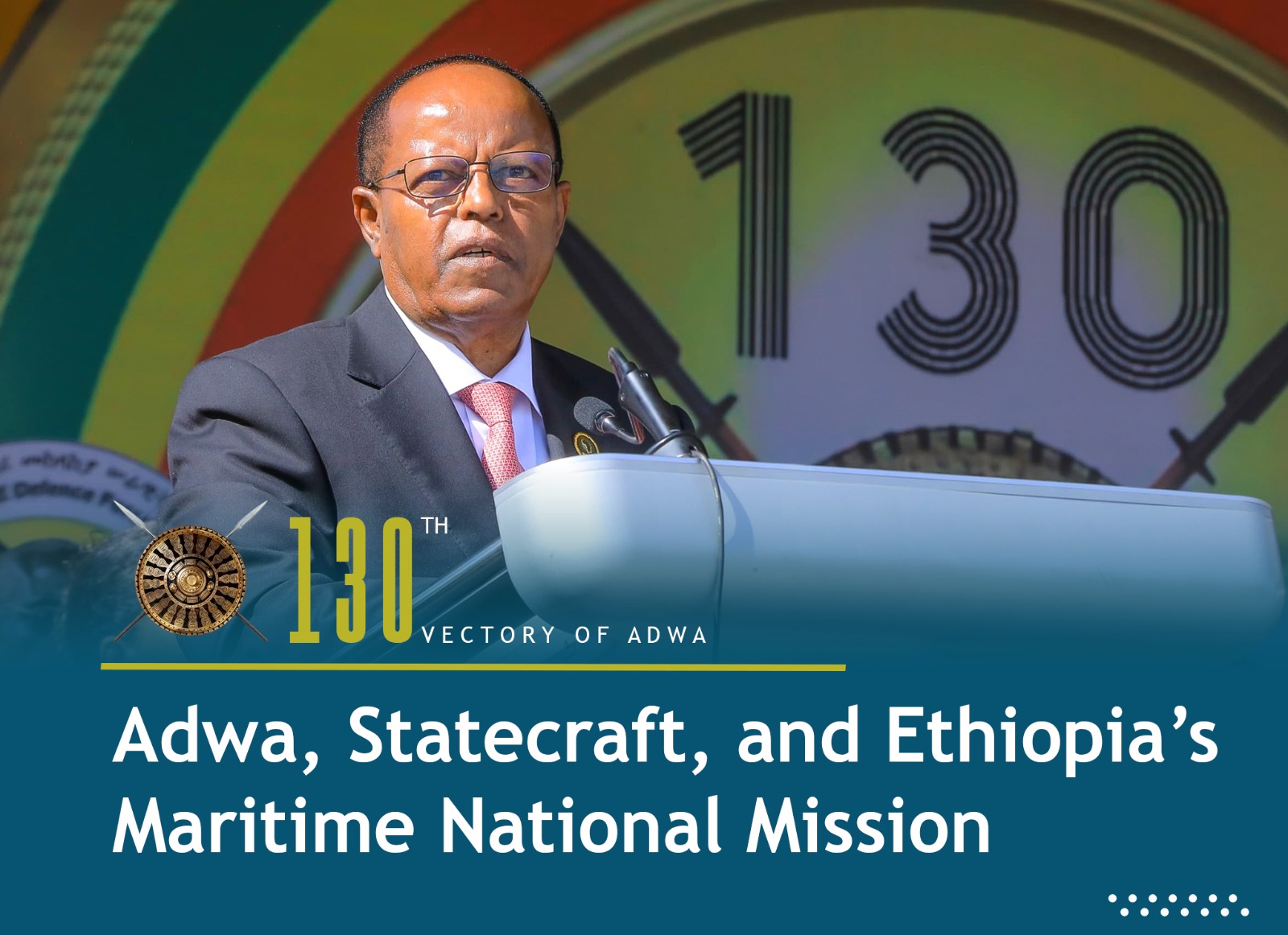
President Taye Atske Selassie’s Adwa anniversary remarks did more than restate Ethiopia’s search for dependable access to the sea. They elevated the issue into national doctrine. By linking maritime access to Adwa—the 1896 victory that preserved Ethiopian sovereignty—the presidency is recoding a logistical constraint as a historical mandate. Ethiopia’s sea-access debate has often been framed through freight costs, port diversification, or bilateral bargaining. Taye’s intervention shifts the frame: access becomes part of the unfinished work of sovereignty, development, and strategic autonomy. That reframing is unfolding amid Somalia’s sovereignty concerns, Djibouti’s corridor centrality, Gulf investment in ports, Turkish mediation, and great-power competition around the Red Sea. The question is whether a nationalized narrative of access can be converted into disciplined diplomacy, institutional adaptation, and regional bargains.
Ethiopia’s sea-access question has returned to the center of Horn politics because the regional order itself is being renegotiated. Across the Red Sea and Gulf of Aden, ports, corridors, bases, and maritime law are now terrain on which sovereignty, leverage, and economic survival are contested. President Taye’s decision to tie the agenda to Adwa carries strategic weight. The presidency is nationalizing maritime access by embedding it in Ethiopia’s historical narrative. In this framing, access to the sea is not a policy preference. It is cast as a national mission rooted in sovereignty, historical justice, and claims of a country of more than 132 million people [2][12].
From Logistical Problem to National Doctrine
Taye’s March 2026 remarks were explicit. He argued that Ethiopia’s search for access to the sea is inseparable from the inheritance of Adwa and should be pursued through peace and cooperation, not confrontation [1][5]. That move matters because it changes the political grammar of the issue. A technocratic problem invites bargaining. A national mission commands institutional attention. By placing sea access inside Adwa’s moral architecture, the presidency widens the constituency behind the agenda and narrows the space for treating it as a negotiable elite talking point.
Ethiopia has done this before. The Grand Ethiopian Renaissance Dam was never only an energy project; it became a vessel for sovereignty, sacrifice, and national dignity. Taye’s intervention suggests that maritime access may be moving along a similar path. Once that happens, the issue stops being measured only in fees or delays. It becomes linked to whether geography should continue to circumscribe the destiny of a major African state [1][5].
The economic rationale is clear. More than 95 percent of Ethiopia’s import-export trade by volume uses the Addis-Djibouti corridor [13]. The World Bank treats that corridor as central to Ethiopia’s trade competitiveness, while African Development Bank financing reflects the same logic [4]. In 2025, Djibouti reportedly handled 9.5 million tons of Ethiopian foreign-trade cargo, underscoring both interdependence and asymmetry [3]. But Taye’s point is that dependence on a single corridor is not just expensive; it is strategically constraining.
Nationalizing the agenda also carries risks. Historical framing can clarify purpose, but it can harden expectations faster than institutions can adapt. The more the issue is embedded in national identity, the greater the pressure on diplomacy to produce visible progress. The presidency is raising the stakes: it is giving the sea-access agenda deeper legitimacy while making execution more urgent.
Adwa’s Afterlife and Historical Continuity
The presidency’s argument rests on a deeper claim: Adwa did not end with military victory, but opened a longer diplomatic struggle over Ethiopia’s place in the regional order. In that reading, sea access belongs to the unfinished afterlife of sovereignty. This is why the remarks insisted that the pursuit is “neither new nor extraordinary” but a continuation of an older trajectory [1]. Ethiopia is not presenting maritime access as a revisionist surprise. It is presenting it as a historically continuous aspiration disrupted by shifting regional settlements.
That framing has force because Ethiopia’s modern political economy has been shaped by changing access regimes, from imperial-era external linkages to post-1993 landlocked dependence after Eritrea’s independence. History here maps path dependency. A state of Ethiopia’s size has long found strategic compression difficult to accept. The problem is that historical legitimacy does not erase the legal and political realities of neighboring sovereignties.
That is where Adwa can function either as a stabilizer or as an accelerant. Somalia’s opposition to the January 2024 memorandum with Somaliland made clear that any Ethiopian path to maritime diversification must reckon with the African Union’s sensitivity to territorial integrity [9]. The Ankara Declaration of December 2024, facilitated by Türkiye, reaffirmed those principles while also acknowledging the mutual benefits of access to and from the sea under Somalia’s sovereign authority [10].
That formula matters. It suggests that the region’s diplomatic center of gravity is not moving toward recognition gambits, but toward negotiated commercial arrangements nested inside recognized sovereignty. Taye’s historical framing can still operate within that logic, but only if the Adwa narrative is used to sustain national purpose rather than shortcut regional law.
The Regional Chessboard
If Ethiopia is nationalizing sea access, the surrounding region is internationalizing it. Djibouti remains the indispensable node of Ethiopia’s trade system; its economy is tied to Ethiopian demand, and lenders still describe the corridor as foundational to connectivity [13][14]. Djibouti’s value also exceeds commerce. Foreign military bases and maritime location place it at the intersection of United States-China competition, French and Japanese security presence, and wider Red Sea volatility [6][8]. That means Ethiopia’s corridor dependence is embedded inside a broader geopolitical theatre rather than a simple bilateral transaction.
Somalia is the second critical arena. Mogadishu’s position is driven by a core interest: defending territorial integrity against precedents it considers existential [9]. That makes any Ethiopian maritime strategy that appears to bypass Somali sovereignty structurally combustible. Yet the Ankara track also showed that Somalia can accept the principle of Ethiopian access when it is articulated through lawful, sovereign, and negotiated channels [10].
The Gulf states add another layer. The United Arab Emirates, through DP World, has built Berbera into a relevant shipping route linked to Jebel Ali, with onward inland connectivity to Ethiopia [7]. Their capital matters because infrastructure often moves faster than diplomacy in the Horn. But Gulf involvement also sharpens distributional questions: who gains leverage, who loses gatekeeping power, and how are local sovereignties recalibrated?
For great powers, the Horn’s ports are about maritime lanes, military reach, supply-chain resilience, and political access. In such an environment, Ethiopia cannot treat sea access as a bilateral dossier. It is negotiating inside a crowded arena where every port can become a diplomatic signal and every corridor a test of alignment.
Strategic Necessity and Institutional Adaptation
The strongest version of Ethiopia’s case is straightforward: a large, fast-growing, landlocked state cannot sustainably anchor more than 95 percent of its external trade in a single corridor without incurring strategic vulnerability [12][13]. Ethiopia also hosts over 1.1 million refugees and asylum-seekers, a reminder that regional instability routinely spills across borders and burdens state systems [11]. When instability metastasizes in Sudan, Somalia, or the Red Sea, logistics, insurance, and political risk travel with it. Sea access, then, is not a prestige agenda. It is national resilience.
But resilience is not secured by rhetoric alone. If the presidency has nationalized the mission, the state must institutionalize it. Ethiopia needs a coherent maritime strategy that integrates foreign policy, trade logistics, customs reform, rail and dry-port capacity, naval ambition, and legal diplomacy. It must diversify access incrementally, using commercial agreements that reduce dependency without manufacturing sovereignty shocks. Addis Ababa should also treat African Union legitimacy as an asset, not an obstacle. In the Horn, durable gains come when strategic necessity is translated into rules-based accommodation rather than symbolic brinkmanship.
This also requires a disciplined public narrative. Adwa can energize the imagination, but institutions must define success in practice: access rights, tariff efficiency, route redundancy, customs harmonization, and long-horizon regional bargains.
Conclusion
President Taye’s intervention has clarified something essential about Ethiopia’s moment. The debate is no longer only about transport economics. By placing the sea-access agenda in the lineage of Adwa, the presidency has elevated it into the domain of state purpose. That move strengthens domestic cohesion, but it also imposes a higher burden of statecraft. National missions cannot be improvised. They require calibrated diplomacy, institutional depth, legal creativity, and patience to pursue gains through layered regional arrangements over dramatic gestures.
For Ethiopia, the path forward is neither retreat from the agenda nor rhetorical escalation. It is diligent institutional adaptation. Addis Ababa must deepen corridor efficiency with Djibouti even as it broadens options elsewhere. It must engage Somalia through sovereignty-conscious frameworks, work with Gulf investors without surrendering strategic autonomy, and use African Union norms as instruments of legitimacy rather than constraints to be evaded. Above all, it must ensure that historical memory disciplines strategy instead of inflaming it. Adwa’s lesson was not only defiance. It was organized national purpose. If Ethiopia’s sea-access mission is to endure, it must now be matched by institutions capable of carrying history without becoming captive to it.
References
[1] Addis Media Network. (2026, March 2). Ethiopia’s pursuit of reliable port access: A historic continuation, not a new ambition—President Taye.
[2] Addis Standard. (2026, March 2). President Taye links Adwa triumph to advancing Ethiopia’s access to the sea agenda.
[3] Addis Standard. (2026, February 27). Ethiopia, Djibouti agree to deepen cooperation at Doraleh Port amid shifting Red Sea geopolitics.
[4] African Development Bank Group. (2026, February 17). Ethiopia–Djibouti Transport Corridor Project Phase II.
[5] Anadolu Agency. (2026, March 2). Ethiopia’s president links right to sea access with Adwa legacy after 1896 victory over colonial power.
[6] Atlantic Council. (2025, July 31). Djibouti is the next arena for US-China competition in the Red Sea.
[7] DP World. (2025). Our locations: Somaliland.
[8] International Monetary Fund. (2025, September 22). Djibouti: 2025 Article IV consultation—Press release; staff report; and statement by the executive director for Djibouti.
[9] Reuters. (2024, April 12). Somalia refuses to accept Ethiopian naval base in breakaway region.
[10] Republic of Türkiye Ministry of Foreign Affairs. (2024, December 11). Ankara Declaration by the Federal Democratic Republic of Ethiopia and the Federal Republic of Somalia.
[11] United Nations High Commissioner for Refugees. (2026, January 27). Ethiopia refugees and asylum-seekers as of December 2025.
[12] World Bank. (2026). Population, total—Ethiopia.
[13] World Bank. (2023, July 20). Addis-Djibouti corridor to get major upgrade that is key to unlocking connectivity and trade for Ethiopia.
[14] World Bank. (2021, November 23). Djibouti Regional Economic Corridor Project.
By Robel Befikadu at IFA
Disclaimer:
The content disseminated by the Institute of Foreign Affairs (IFA) – including, but not limited to, publications, public statements, events, media appearances, and digital communications – reflects the views of individual contributors and does not necessarily represent the official positions or policies of the Institute, its partners, or any affiliated governmental or non-governmental entities.
While the IFA endeavors to ensure the accuracy, integrity, and timeliness of the information presented, it makes no representations or warranties, express or implied, regarding the completeness, reliability, or suitability of such content for any purpose. The Institute expressly disclaims any liability for errors or omissions, as well as for any actions taken or decisions made based on the information provided.
The inclusion of external links, references, or third-party resources does not constitute an endorsement by the Institute. Additionally, engagement on social media platforms – including, but not limited to, likes, shares, retweets (RTs), or reposts – shall not be interpreted as an endorsement or validation of the views expressed therein.Readers and audiences are encouraged to exercise critical judgment and seek independent verification when interpreting or relying upon any information disseminated through publications and posts on the Institute’s platforms or representatives.