

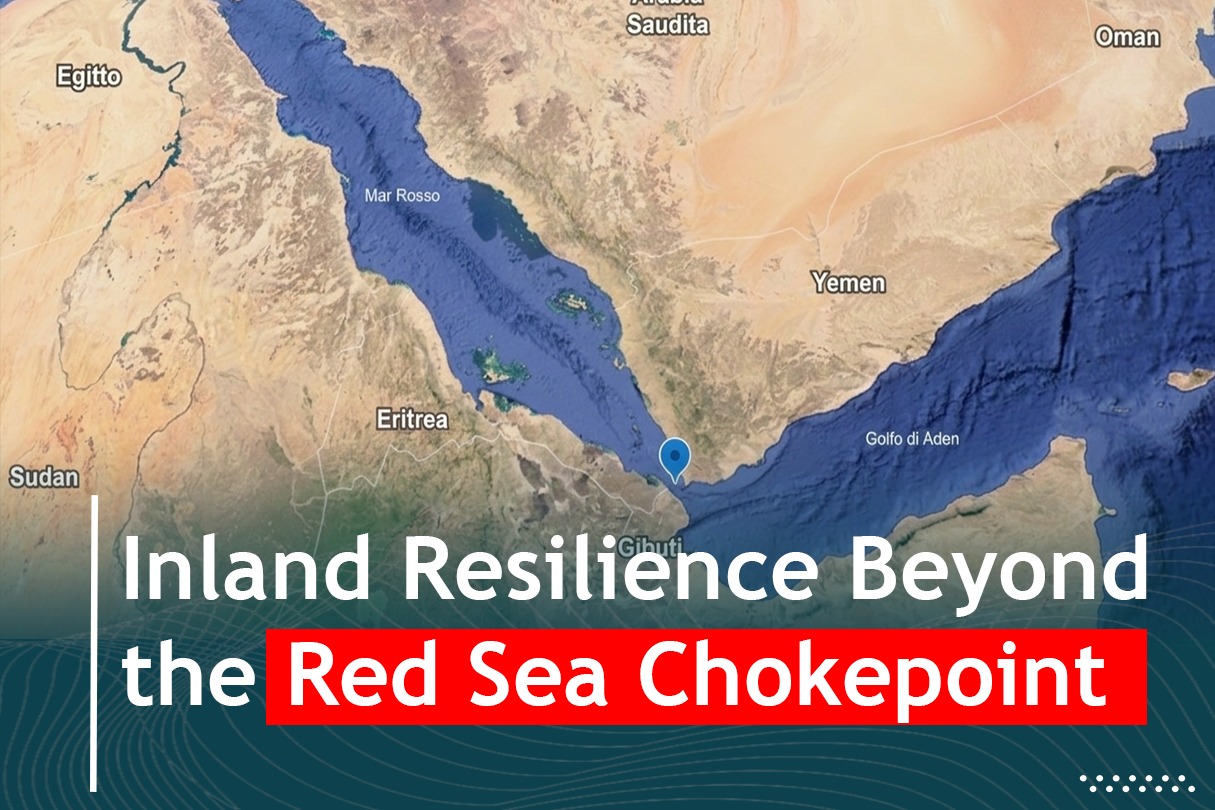
The Red Sea is usually discussed as a maritime theater: a corridor of missiles, naval patrols, insurance spikes, and threatened shipping lanes. Yet for the Horn of Africa, that framing is now too narrow. Recurrent disruption in the Red Sea and Suez system is steadily recoding inland logistics as a core domain of state power. The states that can coordinate ports, rail, roads, dry ports, customs, storage, and corridor governance will be best positioned to absorb external shocks without converting them into domestic crises. This matters because the Horn is not simply exposed to maritime turbulence; it is structurally organized around it. Ethiopia’s overwhelming dependence on the Djibouti corridor, Djibouti’s dependence on Ethiopian traffic, Sudan’s war-driven fragmentation, and the growing strategic interest of Gulf and great powers in port and base infrastructure all reveal the same pattern: resilience is no longer just about access to the sea, but about how inland systems metabolize uncertainty [1][2][3]. This article argues that the political economy of the Horn is shifting from a narrow chokepoint logic toward a broader contest over corridor synchronization. The strategic question is no longer who sits nearest the coast. It is who can turn disruption into delay rather than breakdown, and volatility into governable cost rather than systemic shock. (UN Trade and Development (UNCTAD))
From Maritime Panic to Inland Statecraft
The Red Sea crisis has been read primarily through the lens of global shipping. That is understandable. By early May 2025, ship tonnage transiting the Suez Canal remained about 70 percent below the 2023 average, while rerouting increased ton-miles and freight costs across global supply chains [1]. Yet in the Horn of Africa, instability does not stop at the coastline. It metastasizes inland, where already fragile logistics systems must absorb longer delivery times, higher insurance premiums, customs congestion, warehousing bottlenecks, and foreign-exchange pressure [1][4]. (UN Trade and Development (UNCTAD))
This shift is especially stark in Ethiopia and Djibouti. About 95 percent of Djibouti’s port activity is fueled by Ethiopian trade, making the corridor not simply a commercial route but a shared macroeconomic lifeline [3]. Ethiopia, meanwhile, remains heavily dependent on that corridor even as it searches for diversification and negotiates access politics across the wider Red Sea basin [3][5]. The relationship is therefore paradoxical: maritime insecurity sharpens the value of interdependence, even as it raises the political stakes of dependence. (elibrary.imf.org)
The standard response is to call for naval stabilization. That matters, but it is insufficient. Sea-lane security can reduce the immediate shock, yet it cannot by itself solve inland delay, weak border coordination, poor cargo visibility, limited dry-port capacity, or fragmented corridor management. In that sense, the Horn’s real strategic competition is moving away from the waterline. The decisive arena is increasingly the inland chain that connects port to hinterland: rail scheduling, customs digitization, bonded storage, axle-load enforcement, cross-border standards, and the institutional capacity to coordinate them under stress [4][6][7]. (World Bank)
The implication is broader than logistics. Corridor performance now shapes inflation exposure, industrial continuity, humanitarian response, and diplomatic leverage. In the Horn, inland logistics is becoming a test of sovereignty by other means. States that cannot govern the corridor will struggle to govern the shock. That is why Red Sea uncertainty is no longer merely a maritime security problem. It is an inland state-capacity problem with regional consequences [5][8]. (Rift Valley Institute)
The Corridor as a Strategic Institution
A corridor is often treated as infrastructure. In practice, it functions more like an institution. Roads, rail lines, ports, and dry ports only create resilience when embedded in predictable rules, synchronized agencies, and interoperable systems. The Addis Ababa–Djibouti railway illustrates this clearly. Since commercial operations began in 2018, the line has carried roughly 9.5 million tonnes of goods and helped raise throughput at Djibouti’s ports, but freight volume alone does not guarantee systemic resilience [6]. If rail arrival is not matched by customs clearance, storage space, truck dispatch, and information sharing, the line becomes a pressure conduit rather than a shock absorber. (Africanews)
That is why recent reform efforts matter. The World Bank’s Ethiopia Trade Logistics Project and corridor programs on both the Ethiopian and Djiboutian sides emphasize not only physical upgrades, but also management information systems, terminal operations, electronic gate passes, warehousing expansion, and regulatory coordination [4][7][9]. At Modjo Dry Port, for instance, storage and warehouse capacity have been expanded precisely because resilience depends on whether goods can be buffered inland when maritime schedules become erratic [4]. This is the quiet architecture of strategic adaptation: not dramatic port diplomacy, but the administrative ability to prevent delay from cascading into scarcity. (World Bank)
The same logic is now extending beyond the traditional Ethiopia–Djibouti axis. The African Development Bank’s financing for Phase II of the Djibouti–Ethiopia–South Sudan transport corridor signals an emerging regional understanding that redundancy is not wasteful duplication; it is strategic insurance [10]. A state that relies on a single route is not merely efficient in peacetime. It is vulnerable in crisis. The pursuit of alternative corridors therefore reflects more than commercial ambition. It is a bid to rebalance bargaining power, reduce exposure to single-node failure, and widen the state’s room for maneuver when regional politics tighten [5][10]. (afdb.org)
This is where conventional analyses often miss the point. Port access remains vital, but access alone is not resilience. Resilience is the ability to synchronize inland institutions fast enough that external shock becomes manageable friction rather than national emergency. In the Horn, the corridor has become the true unit of strategic analysis. (afdb.org)
External Powers, Gulf Capital, and the Politics of Leverage
The Horn’s inland turn does not reduce external interest; it reconfigures it. Gulf states, China, the United States, European actors, and multilateral lenders are all implicated in the region’s corridor politics, whether through port investment, military basing, aid, debt, or trade facilitation. Djibouti remains the clearest example of how strategic geography attracts overlapping power projection. China’s military base and its wider interest in ports at the entrance to the Red Sea reflect a view of logistics infrastructure as both commercial platform and geopolitical asset [11]. The United States and its partners view the same geography through security and access calculations of their own. (CSIS)
But external involvement is not neutral. It can widen financing options and accelerate infrastructure delivery, yet it can also fragment priorities and turn corridor development into a field of leverage competition. This is particularly acute in a region where fiscal constraints are severe. Ethiopia’s reform trajectory remains exposed to foreign-exchange pressures and external financing needs, while Djibouti’s medium-term outlook is still tightly linked to the volume and direction of Ethiopian trade [2][3]. That means corridor choices are never just technical. They redistribute dependence. (IMF)
Gulf actors matter here not only because of their Red Sea security interests, but because they increasingly understand ports, free zones, logistics parks, and food corridors as tools of influence. In the Horn, this produces a subtle but consequential shift: the geopolitical contest is no longer confined to who patrols the water or owns the terminal. It extends to who shapes inland standards, financing terms, customs platforms, and route preference. Influence now travels by spreadsheet as much as by warship. (CSIS)
African institutions recognize the stakes, even if their capacity remains uneven. The African Union’s transport agenda and the entry into force of the revised African Maritime Transport Charter underscore a continental push for integrated, secure, and interoperable mobility systems [12][13]. Yet legitimacy without implementation is not enough. The key test is whether regional institutions can help states coordinate corridor governance before external rivalry hardens logistics into another arena of zero-sum politics. (au.int)
Shock Absorption, Displacement, and the Human Geography of Resilience
In the Horn, corridor breakdown is never only an economic event. It quickly becomes social and humanitarian. A region already carrying massive displacement burdens cannot afford logistics failure as a secondary crisis multiplier. By late 2025, Eastern and Southern Africa hosted 25.1 million forcibly displaced people, including 6.3 million refugees and asylum-seekers [14]. Ethiopia itself continues to absorb refugee inflows from neighboring crises, while migration along the eastern route remains active despite escalating risks [15][16]. (UNHCR)
This matters because food, fuel, medicine, and emergency shelter all depend on inland movement. When maritime disruption lengthens delivery schedules, weak inland systems amplify the damage. Delays at dry ports can raise urban prices. Border frictions can slow humanitarian dispatch. Storage shortages can turn temporary disruption into local scarcity. In fragile areas, those pressures can feed public anger, illicit trade, and local conflict. What appears first as a shipping problem can thus reappear inland as a legitimacy problem. (World Bank)
For that reason, inland resilience should be understood as part of national security in the broadest sense. It is what allows states to cushion households, sustain markets, and keep administrative authority credible when regional volatility intensifies. The Horn’s political economy is entering an era in which resilience will be judged less by access claims alone than by the institutional ability to move, store, clear, and distribute under pressure. The future belongs not to the state that merely reaches the sea, but to the one that can govern the corridor from coast to consumer [5][7][10]. (Rift Valley Institute)
Conclusion
The Red Sea will remain a theater of naval rivalry, missile risk, and strategic signaling. But for the Horn of Africa, the more consequential transformation is unfolding inland. Recurrent maritime disruption is teaching a harsh lesson: chokepoints matter, yet the political economy of survival now depends on what happens after cargo lands. The states that will fare best are not necessarily those with the loudest maritime claims, but those that build resilient inland systems—rail that connects to storage, ports that connect to customs, and corridor governance that connects institutions rather than isolating them.
That requires a deeper form of adaptation than emergency response. It demands investment in dry ports, digital customs, bonded warehousing, route redundancy, border coordination, and common operating procedures across agencies and across borders. It also requires diplomatic realism: Gulf capital, great-power interest, and multilateral finance can all help, but only if they reinforce rather than displace regional ownership. The strategic challenge is therefore institutional before it is rhetorical. Without diligent adaptation, Red Sea shocks will continue to ricochet inward as inflation, scarcity, and political strain. With it, the Horn can begin to convert chronic exposure into managed vulnerability—and managed vulnerability into a firmer, more sovereign resilience.
References
[1] United Nations Conference on Trade and Development. (2025). Review of maritime transport 2025.
[2] International Monetary Fund. (2025). The Federal Democratic Republic of Ethiopia: 2025 Article IV consultation.
[3] International Monetary Fund. (2024). Djibouti: 2024 Article IV consultation.
[4] World Bank. (2025). Trade logistics project: Implementation status and results report.
[5] Terrefe, B. (2025). Ethiopia’s Red Sea politics: Corridors, ports and security in the Horn of Africa. Rift Valley Institute.
[6] Africanews. (2024). Chinese-built Ethiopia-Djibouti Railway marks six years of operation.
[7] World Bank. (2026). Regional economic corridor project (Addis-Djibouti Corridor): Implementation status and results report.
[8] African Development Bank. (2014). Developing economic corridors in Africa.
[9] World Bank. (2026). Djibouti regional economic corridor project: Implementation status and results report.
[10] African Development Bank. (2026). Multinational—South Sudan, Ethiopia, Djibouti transport corridor project—Phase II.
[11] Center for Strategic and International Studies. (2024). Responding to China’s growing influence in ports of the Global South.
[12] African Union. (2025). Revised African Maritime Transport Charter enters into force.
[13] African Union. (n.d.). Transport and mobility.
[14] United Nations High Commissioner for Refugees. (2025). Eastern and Southern Africa regional update.
[15] United Nations High Commissioner for Refugees. (2026). South Sudan situation: Country update for Ethiopia.
[16] International Organization for Migration. (2026). Regional migrant response plan: Horn of Africa, Yemen and Southern Africa.
By Amran Gamachu at IFA
Disclaimer:
The content disseminated by the Institute of Foreign Affairs (IFA) – including, but not limited to, publications, public statements, events, media appearances, and digital communications – reflects the views of individual contributors and does not necessarily represent the official positions or policies of the Institute, its partners, or any affiliated governmental or non-governmental entities.
While the IFA endeavors to ensure the accuracy, integrity, and timeliness of the information presented, it makes no representations or warranties, express or implied, regarding the completeness, reliability, or suitability of such content for any purpose. The Institute expressly disclaims any liability for errors or omissions, as well as for any actions taken or decisions made based on the information provided.
The inclusion of external links, references, or third-party resources does not constitute an endorsement by the Institute. Additionally, engagement on social media platforms – including, but not limited to, likes, shares, retweets (RTs), or reposts – shall not be interpreted as an endorsement or validation of the views expressed therein.
Readers and audiences are encouraged to exercise critical judgment and seek independent verification when interpreting or relying upon any information disseminated through publications and posts on the Institute’s platforms or representatives.