

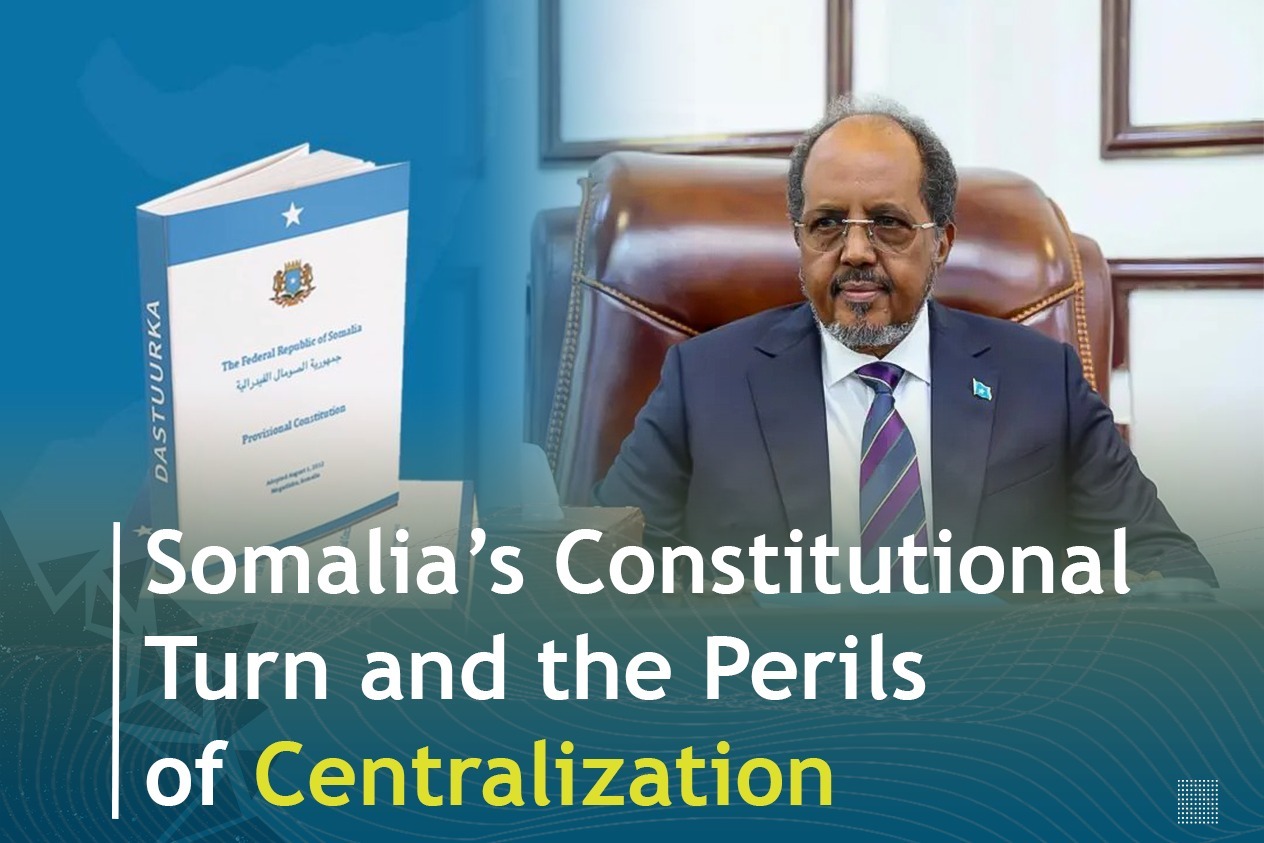
Somalia’s constitutional push is being presented in Mogadishu as the long-delayed completion of state formation. Yet its deeper significance lies elsewhere. The amendments adopted in 2024, the push toward universal suffrage, and the latest parliamentary debates in March 2026 all point to a federal center attempting to consolidate authority before a durable political bargain with the federal member states has been secured. That may appear as institutional progress from the capital. In practice, however, it risks producing a more brittle order: a state that is procedurally stronger at the center but strategically weaker at the edges. Puntland’s withdrawal from cooperation with the federal framework following the 2024 amendments, Jubaland’s later rupture with Mogadishu, and persistent disputes over electoral sequencing reveal that Somalia’s constitutional question is inseparable from its security architecture. Constitutional centralization without federal consensus is therefore a national-security risk [1][2][3][4].
Somalia’s constitutional debate is unfolding at a moment when the Horn of Africa is already saturated with overlapping political transitions. Sudan’s war has reshaped regional threat perceptions. Ethiopia’s search for diversified sea access has sharpened sovereignty politics across the region. The Red Sea has become a corridor of intensified military competition and Gulf commercial ambition. In that context, Somalia is not simply revising a charter. It is attempting to settle the rules of authority while simultaneously fighting an insurgency, renegotiating federal relations, and recalibrating ties with foreign security partners. The central problem is this: Somalia’s constitutional turn is attempting to manufacture state consolidation from the top down, even though the federal consensus required to sustain that consolidation remains contested. When that mismatch hardens, instability can metastasize from political disagreement into structural security vulnerability [1][5].
Amendments as State-Building, Not Mere Legal Reform
The constitutional changes adopted by parliament in March 2024 were defended by the federal government as a necessary step toward a more coherent political order. Supporters argued that Somalia could not remain indefinitely trapped in a provisional framework, an indirect electoral system, and an ambiguous division of powers between the presidency, parliament, and the federal member states. The reforms introduced provisions for direct presidential elections and strengthened the presidency’s authority in relation to the prime minister, while subsequent government initiatives aimed to operationalize one-person, one-vote politics after decades of clan-mediated indirect electoral selection [1][3]. Seen from Mogadishu, the logic is understandable: no state can defeat insurgency, coordinate taxation, or build durable national institutions if its constitutional core remains permanently negotiable.
Yet constitutional reform in Somalia has never been a purely technical exercise. Since the adoption of the 2012 provisional constitution, the federal compact has functioned less as a finalized settlement than as a fragile ceasefire among competing visions of Somali statehood. The text itself anticipated further negotiations with federal member states over the structure of the federation and the distribution of security responsibilities [2]. That historical context matters because the 2024 amendments did not emerge from a fully shared intergovernmental bargain. Rather, they emerged from a federal center increasingly impatient with prolonged constitutional drift. The result is that what Mogadishu presents as institutional consolidation is interpreted by key regional actors as political encroachment. Legal progress without political consent risks hardening constitutional ambiguity rather than resolving it.
Federal Fracture and the Security Geography of Resistance
Puntland’s reaction made this tension unmistakable. One day after the amendments passed, Puntland authorities announced that they would suspend recognition of federal institutions and govern independently until constitutional changes were subjected to a nationwide referendum in which Puntland participated [1]. It represented a direct challenge to the legitimacy of state consolidation without consent from one of Somalia’s most institutionally established regions. Tensions with Jubaland later deepened this pattern. By November 2024, Jubaland had suspended relations and cooperation with Mogadishu following disputes over regional elections, reciprocal arrest warrants, and accusations that the federal center was violating constitutional arrangements and jeopardizing the anti-insurgency campaign [6]. Federal troops and Jubaland forces subsequently clashed around Ras Kamboni in December 2024, forcing a tactical withdrawal by federal forces from parts of Lower Juba [7].
These rifts are dangerous because Somalia’s security map is federal before it is national. Puntland is central to operations against Islamic State affiliates in the northeast; Jubaland sits astride the Kismayo corridor and the Kenyan frontier; South West State and Galmudug remain critical to ongoing campaigns against Al-Shabaab. If constitutional politics convince regional elites that Mogadishu’s state-building project is simultaneously a project of political subordination, then the security bargain underpinning counterinsurgency begins to erode. Militant organizations do not need to win such disputes outright. They only need the Somali state to fragment its political attention. The United Nations has repeatedly warned that Somalia remains vulnerable without agreed political rules, while Al-Shabaab retains the capacity to strike major population centers [4][8].
External Partners Can Support a State, Not Substitute for a Compact
This internal contest is unfolding while Somalia remains deeply embedded in an externalized security architecture. The African Union Transition Mission in Somalia (ATMIS) is gradually giving way to a new African Union Support and Stabilisation Mission in Somalia (AUSSOM), following a Security Council-endorsed framework designed to shift responsibility increasingly to Somali forces while external partners move from substitution to support [9]. Such mission transitions succeed only when domestic political institutions evolve in the same direction as the security transition. Somalia, however, is attempting to manage these processes simultaneously and under conditions of political disagreement.
External actors add another layer of strategic friction. Turkey has emerged as one of Mogadishu’s most important strategic partners, providing military training, maritime security cooperation, and growing economic engagement, while also mediating tensions between Ethiopia and Somalia following Addis Ababa’s memorandum of understanding with Somaliland [10]. The United States continues coordinated strikes against Al-Shabaab and Islamic State targets, including operations conducted in Puntland in early 2026 [11]. Gulf states remain commercially and politically relevant as well: the United Arab Emirates has trained Somali security forces and invested in ports and logistics infrastructure, even as relations with Mogadishu deteriorated sharply in early 2026 amid disputes over sovereignty and port agreements [12]. These partnerships can enhance state capacity. They cannot resolve the underlying constitutional question of who the Somali state represents and which actors regard federal authority as legitimate.
Political Economy, Displacement, and the Costs of an Incomplete Union
Somalia’s constitutional tensions are also inseparable from political-economy dynamics. The country’s trade exposure remains high, and commerce continues to depend heavily on external corridors, livestock exports, remittance-driven consumption, and maritime access to Gulf markets [13]. In 2024, the United Arab Emirates remained among Somalia’s major trading partners, while investment and commercial engagement from Turkey, the UAE, Kenya, and Ethiopia continued to shape Somalia’s emerging economic landscape [12][13]. None of this economic activity can be insulated from constitutional instability. Investors price political cohesion as much as they do legal frameworks.
Human security further compounds the risk. Somalia hosts tens of thousands of refugees and asylum-seekers and an estimated 3.5 million internally displaced persons. Between January and November 2024 alone, roughly 477,000 new internal displacements were recorded due to conflict, climate shocks, and insecurity [4][14]. A state that centralizes authority politically without widening political consensus may achieve legal clarity in Mogadishu while simultaneously losing administrative reach in displacement sites, borderlands, and contested districts where state legitimacy is actually tested. This is the paradox of Somalia’s current constitutional turn: assertiveness at the center can appear as order in the capital while producing greater insecurity in the periphery.
The Real Test Is Institutional Adaptation, Not Central Victory
The latest parliamentary debates in March 2026, which reopened discussion about electoral timelines and presidential tenure, underscore that Somalia’s constitutional question remains unsettled rather than resolved [5]. The federal government is correct in one respect: a permanently provisional state cannot generate durable sovereignty. Yet Puntland and Jubaland are also correct in warning that a federal constitution built without federal consensus risks becoming an instrument of domination rather than a framework of union. Somalia therefore faces not a simple choice between consolidation and fragmentation, but the far more complex challenge of institutional adaptation.
Such adaptation requires more than rhetorical consultation. It requires a sequenced constitutional process anchored in referendum legitimacy, enforceable intergovernmental mechanisms, and security arrangements that reassure regional administrations rather than bypass them. It also requires external partners—the African Union, Turkey, the United States, Gulf states, and European donors—to stop treating constitutional politics as secondary to battlefield metrics. In Somalia, the battlefield is constitutional. Without deliberate institutional adaptation that aligns state-building with federal consent, the country may formally exit the provisional era while effectively reproducing it in practice [1][6][9].
References
- Federal Parliament of Somalia. (2012/2024 note). Provisional Constitution of the Federal Republic of Somalia.
- Human Rights Watch. (2025). World Report 2025: Somalia.
- Reuters. (2024, March 31). Somalia’s Puntland refuses to recognise federal government after disputed constitutional changes.
- Reuters. (2024, August 8). Somalia’s cabinet approves bill for universal suffrage.
- Reuters. (2026, March 5). Somali parliament backs constitutional changes that could extend president’s term.
- Reuters. (2024, November 28). Somalia’s Jubbaland government suspends ties with federal administration.
- Reuters. (2024, December 12). Somalia pulls troops out of Lower Juba after clashes with Jubbaland forces.
- United Nations Security Council. (2024). Briefings on Somalia.
- United Nations Security Council. (2024). Resolution 2767 (2024) on Somalia.
- Reuters. (2024). Turkey-Somalia defence cooperation reports.
- U.S. Africa Command. (2026, March 2). U.S. Forces Conduct Strikes Targeting ISIS-Somalia.
- Reuters. (2026, January 12). Somalia ends port deals and security cooperation with UAE.
- World Bank; OEC; National Economic Council of Somalia. (2024–2026). Somalia economic and trade data.
- UNHCR; OCHA. (2025–2026). Somalia humanitarian and displacement updates.
By Kuchim Sileshe at IFA
Disclaimer:
The content disseminated by the Institute of Foreign Affairs (IFA) – including, but not limited to, publications, public statements, events, media appearances, and digital communications – reflects the views of individual contributors and does not necessarily represent the official positions or policies of the Institute, its partners, or any affiliated governmental or non-governmental entities.
While the IFA endeavors to ensure the accuracy, integrity, and timeliness of the information presented, it makes no representations or warranties, express or implied, regarding the completeness, reliability, or suitability of such content for any purpose. The Institute expressly disclaims any liability for errors or omissions, as well as for any actions taken or decisions made based on the information provided.
The inclusion of external links, references, or third-party resources does not constitute an endorsement by the Institute. Additionally, engagement on social media platforms – including, but not limited to, likes, shares, retweets (RTs), or reposts – shall not be interpreted as an endorsement or validation of the views expressed therein.
Readers and audiences are encouraged to exercise critical judgment and seek independent verification when interpreting or relying upon any information disseminated through publications and posts on the Institute’s platforms or representatives.