

Beyond Diplomatic Housekeeping
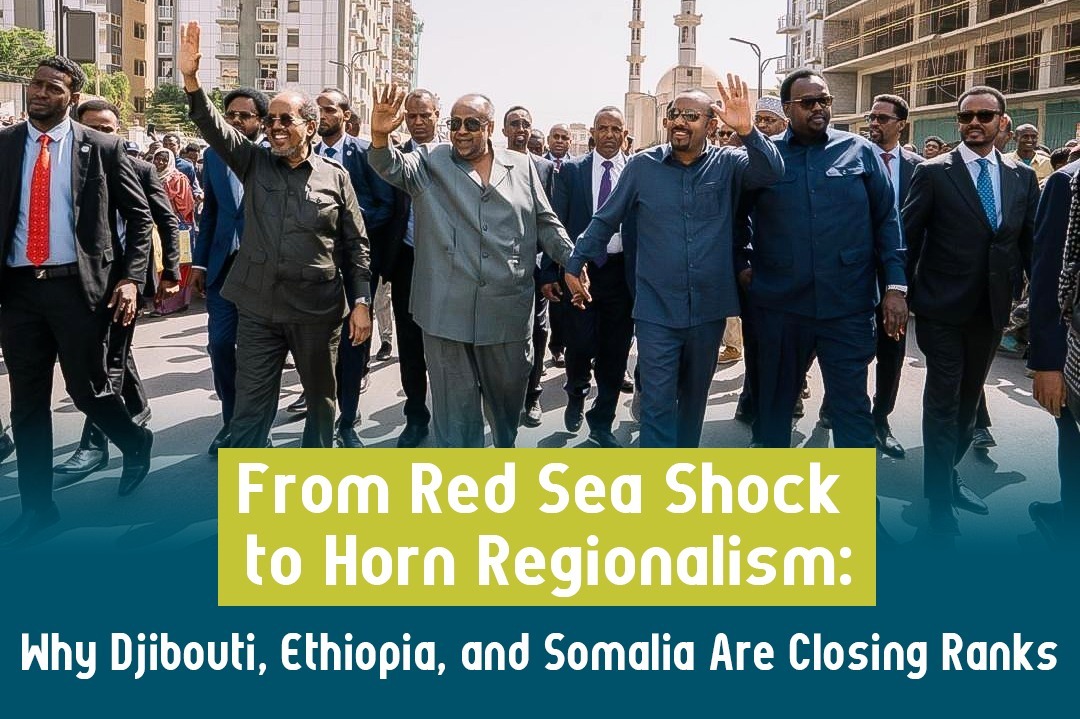
On March 12, Djibouti’s President Ismaïl Omar Guelleh hosted Somalia’s President Hassan Sheikh Mohamud and Ethiopia’s Prime Minister Abiy Ahmed for discussions focused on regional security and the potential spillover effects of the conflict on their economies and stability. A narrow reading of this trilateral meeting in Djibouti would frame it primarily as diplomatic housekeeping—a carefully managed follow-up aimed at sustaining stability between Ethiopia and Somalia after a period of strain. While this interpretation holds some validity, it does not fully capture the broader strategic context. More significantly, Djibouti, Ethiopia, and Somalia appear to be responding to an increasingly complex regional environment in which unresolved disputes are becoming intertwined with economic and geopolitical pressures emanating from the Red Sea and the wider Middle East.
The summit matters, then, not because it settled those disputes, but because it suggested an emerging regional response to external disorder. It pointed to a defensive, crisis-driven Horn regionalism in which states begin to manage shared exposure together rather than through fragmented bilateralism or foreign mediation alone. [1]
Available reporting supports this broader interpretation. Discussions reportedly extended beyond symbolic reconciliation to include peace and security, economic integration, infrastructure, trade, and the regional repercussions of ongoing Middle East tensions. This convergence of issues is analytically significant, as it situates diplomacy, economic connectivity, and external conflict spillovers within a unified framework. While this does not constitute a fully developed regional bloc, it suggests an increasing recognition among regional actors that their vulnerabilities are interconnected. [1]
The Geography of Vulnerability
This evolving perspective becomes clearer when maritime dynamics are placed at the center of analysis. The Red Sea crisis has extended beyond a localized disruption in shipping; it has reshaped trade routes, increased transit times, elevated fuel consumption, and contributed to sustained volatility in freight costs. According to UNCTAD, disruptions in the Red Sea led to rerouting around the Cape of Good Hope, increasing ton-miles and maintaining elevated shipping costs even after the initial phase of the crisis subsided. In its 2025 freight assessment, UNCTAD noted that spot container rates had eased from their midyear peaks by the end of 2024 but still remained well above pre-crisis levels. [2][3]
For countries in the Horn of Africa, these developments are not abstract market fluctuations but immediate strategic concerns. The World Bank underlined that over 95 percent of Ethiopia’s import-export trade by volume passes through the Addis-Djibouti corridor, making maritime stability and corridor efficiency critical to its economic security. Djibouti’s economic model, in turn, is closely tied to its role as a logistics and transit hub, with infrastructure and port services forming the backbone of its national economy. External disruptions therefore affect both countries directly, albeit in different ways: Ethiopia as a landlocked economy dependent on reliable global access, and Djibouti as a transit state whose strategic importance is closely linked to the stability of regional trade flows. Somalia’s position is equally significant, given its extensive coastline and its growing relevance in discussions of maritime governance, port development, and regional security. [4][5]
This is the harder economic bridge that any serious interpretation of the summit must include. The pressure for coordination is not just diplomatic. It is structural. As shipping insecurity stretches from the Gulf to Bab el-Mandeb and the Red Sea, the costs of unmanaged regional rivalry rise. What once looked like separate national concerns increasingly presents itself as a shared question of resilience.
Regionalism Under Duress
It is therefore important to characterize this emerging pattern with precision. What is taking shape is not an idealized form of regional integration, nor does it suggest the immediate emergence of a cohesive regional bloc. Rather, it reflects a pragmatic form of regionalism shaped by shared exposure to external pressures. Historically, the Horn of Africa has articulated ambitions for cooperation more readily than it has implemented them, with initiatives in trade, infrastructure, and security often constrained by political sensitivities and institutional limitations.
The Djibouti meeting did not resolve these longstanding challenges at this point in time. However, the costs of leaving them unaddressed will be detrimental. External pressures—ranging from shipping disruptions to broader geopolitical instability—are narrowing the space for purely competitive approaches; these pressures act as stronger incentives to build mechanisms of self-management, though they remain tentative. In this context, regional coordination is gradually shifting from a matter of political preference to one of strategic necessity. That is why the trilateral agreement among the three leaders is very significant. [2][3]
From De-escalation to Regional Calculation
The significance of the 12 March meeting is also better understood when viewed in sequence. The diplomatic understanding reached between Ethiopia and Somalia in late 2024 helped reestablish a baseline of engagement, reaffirming principles of sovereignty, territorial integrity, and peaceful dispute resolution. Importantly, it also preserved space for dialogue on maritime access within a framework that respects Somali sovereignty. [6][7]
The 12 March meeting also needs to be read in sequence. The diplomatic understanding reached in late 2024 between Ethiopia and Somalia mattered because it restored a minimum political baseline: both sides reaffirmed sovereignty, territorial integrity, and a commitment to address differences through cooperation rather than escalation. Importantly, it also preserved space for dialogue on maritime access within a framework that respects Somali sovereignty while acknowledging mutual benefits. [6][7]
This framework represents a significant shift in the diplomatic landscape between Ethiopia and Somalia, despite some differences. It has undoubtedly paved the way for a workable basis for continued engagement. The Djibouti trilateral appears to build on this foundation by situating bilateral concerns within a broader regional context—linking questions of maritime access, infrastructure, trade, and security to a wider effort to enhance regional stability under conditions of growing external pressure.
Ethiopia’s Access Imperative as a Regional Economic Question
Within this evolving context, Ethiopia’s pursuit of reliable sea access can be more constructively understood as a structural economic requirement rather than a source of inherent instability. As a large and growing landlocked economy, Ethiopia’s long-term development depends on secure, diversified, and sustainable access to global markets. The central issue, therefore, is not the legitimacy of this requirement, but the manner in which it is addressed and the frameworks within which it is accommodated. [4]
Encouragingly, there are indications that this issue is gradually being reframed from a narrowly defined sovereignty concern into a broader regional political economy question. Within that framework, Ethiopia’s push for maritime access is recognized as a legitimate developmental priority, while emphasis is placed on addressing it through negotiated and mutually beneficial arrangements. These may include port access agreements, transit guarantees, infrastructure investments, and long-term commercial partnerships. This approach offers a pathway for aligning Ethiopia’s economic needs with Somalia’s sovereign rights in a cooperative rather than adversarial manner. [6][7]
Viewed in this light, Ethiopia’s access objective has the potential to contribute to regional integration. By embedding access arrangements within agreed legal and institutional frameworks, the issue can evolve into a platform for interdependence and shared economic benefit. The extent to which this potential is realized will depend on the ability of regional actors to move from short-term crisis management toward structured and sustained cooperation.
Caution About Pace and Institutional Depth
At the same time, a more measured interpretation of the Djibouti meeting remains valid. It may be viewed as a constructive yet circumscribed step focused on sustaining dialogue, de-escalating tensions, and preserving diplomatic momentum within a sensitive regional context. However, the absence of formal agreements, institutional mechanisms, or binding commitments suggests that the immediate impact of the meeting may remain modest. The region has previously witnessed high-level engagements where symbolic significance was not consistently matched by enduring outcomes.
Nevertheless, such caution does not negate the broader trajectory of the region, nor is it intended to diminish its significance. In fact, regional shifts often begin incrementally, characterized by evolving patterns of engagement rather than immediate institutional breakthroughs. The Djibouti trilateral is notable in that it brought together discussions of security, economic integration, infrastructure, and external geopolitical pressures within a single forum. While this does not in itself constitute a new regional order, it reflects a growing awareness of the need for more integrated approaches to shared challenges.
A New Logic, Not Yet a New Order
The trilateral agreement is not an announcement of a new regional bloc in the Horn of Africa. Its significance however reveals why such an order is becoming increasingly necessary. Growing maritime insecurity and broader geopolitical uncertainty are rendering fragmented approaches difficult to sustain. Under these conditions, a compelling rationale emerges for cooperative frameworks that effectively balance national sovereignty with practical regional interdependence.
This does not suggest that the region has reached a definitive turning point, nor that it has already overcome its fundamental challenges. Rather, it indicates that a logic of regional self-management is re-emerging under the pressure of external necessity. The critical test remains whether Ethiopia, Djibouti, and Somalia can convert this crisis-driven alignment into a durable framework of consultation and transaction—one that upholds national sovereignty while ensuring that functional interdependence remains politically sustainable. If successful, Ethiopia’s long-standing pursuit of dependable maritime access may be recontextualized not as a source of regional friction, but as the primary catalyst through which a modern Horn of Africa regionalism learns to operate. Conversely, should these efforts falter, the summit risks becoming another entry in the historical archive of engagements that accurately diagnosed structural problems without establishing the institutional mechanisms required to manage them.
The ultimate success of this trilateral engagement depends on the transition from such diplomatic alignment to the creation of robust, treaty-based institutions capable of managing shared economic and security interests.
Sources
[1] Horn of Africa Leaders Warn of Economic Impact From Middle East Conflict, Garowe Online, 12 March 2026. (Garowe Online)
[2] Review of Maritime Transport 2024, UNCTAD, 22 October 2024. (UN Trade and Development (UNCTAD))
[3] Freight Rates and Maritime Transport Costs, UNCTAD, 2025. (UN Trade and Development (UNCTAD))
[4] Addis-Djibouti Corridor to Get Major Upgrade That is Key to Unlocking Connectivity and Trade for Ethiopia, World Bank, 20 July 2023. (World Bank)
[5] Djibouti: Our Commitment and Ongoing Projects, World Bank country materials.
(Referenced in the previous version for Djibouti’s infrastructure and logistics-centered development role.)
[6] Official communiqué issued after the Ethiopia-Somalia understanding in Türkiye, 11 December 2024. (Ministry of Foreign Affairs)
[7] Somalia, Ethiopia Affirm Each Other’s Sovereignty, Unity, Anadolu Agency, 12 December 2024. (Anadolu Ajansı)
By Bona Tolera, IFA
Disclaimer:
The content disseminated by the Institute of Foreign Affairs (IFA) – including, but not limited to, publications, public statements, events, media appearances, and digital communications – reflects the views of individual contributors and does not necessarily represent the official positions or policies of the Institute, its partners, or any affiliated governmental or non-governmental entities.
While the IFA endeavors to ensure the accuracy, integrity, and timeliness of the information presented, it makes no representations or warranties, express or implied, regarding the completeness, reliability, or suitability of such content for any purpose. The Institute expressly disclaims any liability for errors or omissions, as well as for any actions taken or decisions made based on the information provided.
The inclusion of external links, references, or third-party resources does not constitute an endorsement by the Institute. Additionally, engagement on social media platforms – including, but not limited to, likes, shares, retweets (RTs), or reposts – shall not be interpreted as an endorsement or validation of the views expressed therein.Readers and audiences are encouraged to exercise critical judgment and seek independent verification when interpreting or relying upon any information disseminated through publications and posts on the Institute’s platforms or representatives.