

Across Africa, discussions about artificial intelligence are often framed as a competition among the continent’s most visible digital economies. Kenya’s dynamic startup ecosystem, Nigeria’s large digital market, Rwanda’s reputation for agile governance, and South Africa’s strong research infrastructure frequently dominate conversations about Africa’s technological future.
Yet focusing solely on market size or startup density misses another, equally consequential contest unfolding across the continent: the race to shape the governance architecture of African artificial intelligence.
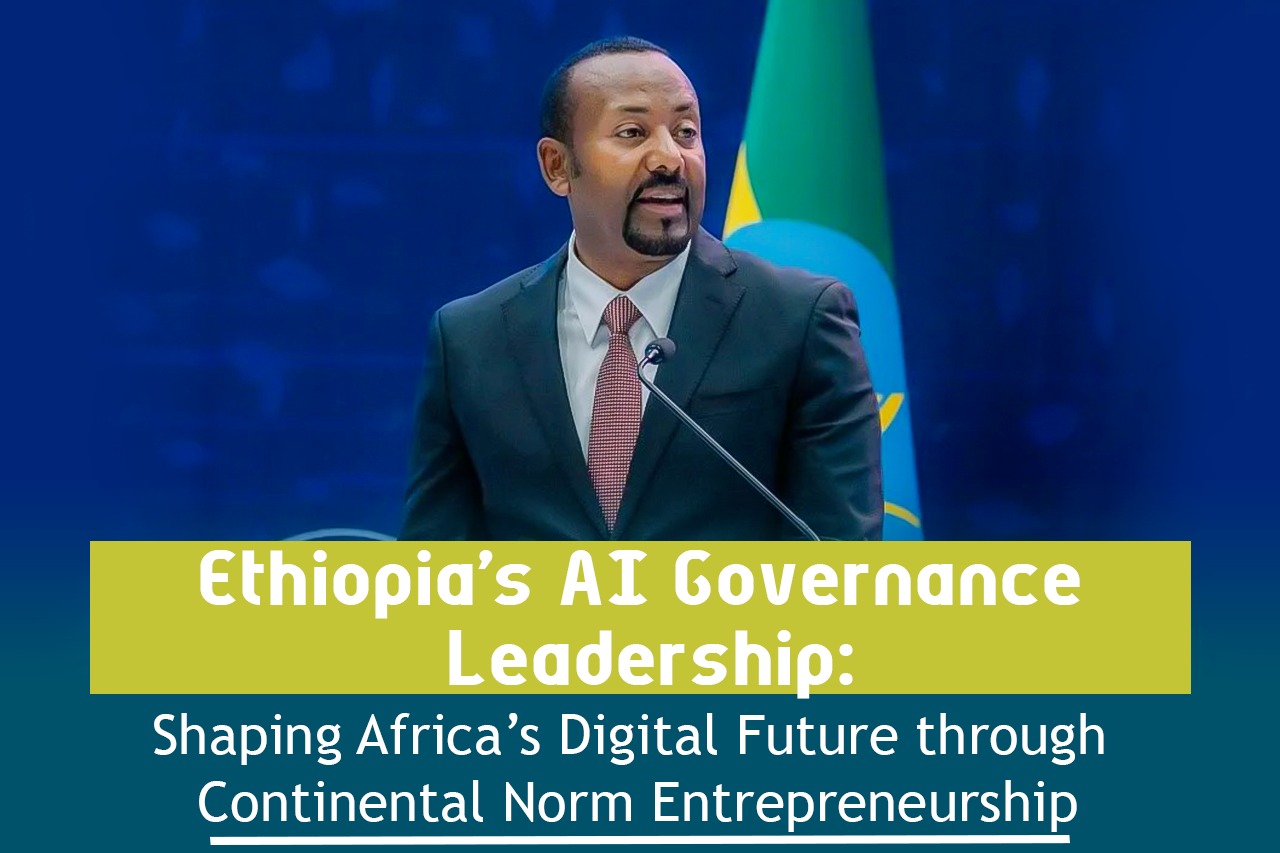
On this question, Ethiopia occupies a uniquely strategic position. The country is not merely another African state seeking to adopt emerging technologies. As host of the African Union and a central hub of continental diplomacy, Addis Ababa sits at the intersection of Africa’s political and institutional networks. Increasingly, Ethiopia is leveraging this position to help shape the emerging norms, policies, and cooperative frameworks that will guide AI governance across the continent.
This ambition was further reinforced when Abiy Ahmed was appointed the African Union’s Champion for Artificial Intelligence and Digital Health, a role supported operationally by the Africa Centres for Disease Control and Prevention (Africa CDC). The appointment signals growing continental recognition of Ethiopia’s capacity to convene stakeholders, facilitate policy dialogue, and promote responsible digital transformation across Africa.
In this context, Ethiopia’s AI strategy represents more than national technological development. It reflects a broader effort to position the country as a continental leader in AI governance and norm entrepreneurship.
Africa’s AI Moment: Governance, Sovereignty, and Development
Artificial intelligence is rapidly becoming one of the most consequential technological transformations of the twenty-first century. Across Africa, governments increasingly view AI not only as an innovation tool but also as a strategic policy domain affecting economic development, public service delivery, and digital sovereignty.
The African Union has recognized this reality in its evolving digital policy agenda. In February 2024, the AU Executive Council endorsed the conceptual framework for a Continental Artificial Intelligence Strategy, instructing the AU Commission to accelerate the development of an implementation roadmap and strengthen regulatory cooperation among member states.
Later that year, the AU formally endorsed the full Continental AI Strategy, presenting it as a framework built around ethical, responsible, and development-oriented artificial intelligence. The strategy emphasizes African ownership of digital innovation, policy coordination among member states, and the protection of African data interests in the global digital economy.
This approach reflects a broader shift in African policy thinking. Rather than treating AI purely as a private-sector technology issue, the AU increasingly frames it as a matter of governance, regulation, and sovereignty.
That perspective creates an important opportunity for countries capable of bridging national innovation initiatives with continental policy coordination. Ethiopia’s diplomatic positioning allows it to play precisely that role.
Addis Ababa as a Continental Policy Hub
The importance of Addis Ababa in African political life extends far beyond symbolism. As the headquarters of the African Union and host to numerous continental institutions, the city functions as a permanent forum where African governments, diplomats, and international partners negotiate the future of regional cooperation.
This institutional geography provides Ethiopia with several structural advantages in emerging policy fields such as artificial intelligence.
First, proximity to AU institutions allows Ethiopian policymakers to engage closely with continental regulatory debates as they unfold. Informal consultations, technical meetings, and diplomatic interactions occur constantly within Addis Ababa’s policy ecosystem.
Second, Ethiopia can convene continental discussions rapidly. Hosting policy forums, technical dialogues, and ministerial meetings enables the country to facilitate the early stages of policy formulation before formal decisions reach AU summits.
Third, Ethiopia benefits from reputational association with continental initiatives. When major African strategies or policy frameworks are discussed in Addis Ababa, the host country naturally becomes linked to the broader continental agenda.
In emerging fields like AI governance—where regulatory norms are still evolving—such advantages can translate into meaningful agenda-setting influence.
The AU Champion Mandate and Ethiopia’s Leadership Role
The appointment of Abiy Ahmed as AU Champion for Artificial Intelligence and Digital Health further strengthens Ethiopia’s continental role in digital governance.
Champion mandates within the African Union often function as political instruments designed to mobilize attention around priority policy areas. They allow individual leaders to advocate for initiatives, facilitate partnerships, and promote policy coordination across member states.
In this case, operational support from the Africa Centres for Disease Control and Prevention adds an additional institutional layer to the mandate. Africa CDC already manages continent-wide initiatives in health data systems, epidemic intelligence, and digital health infrastructure—domains where AI applications are increasingly significant.
The partnership therefore creates a bridge between continental diplomacy and practical implementation, linking Ethiopia’s political leadership role with a technical institution capable of operationalizing digital governance initiatives.
From Strategy to Implementation: The Addis Dialogue
One of the clearest illustrations of Ethiopia’s convening role emerged during the High-Level Policy Dialogue on the Development and Regulation of AI in Africa, held in Addis Ababa in May 2025.
The forum brought together African policymakers, AU officials, development partners, and digital governance experts to discuss the transition from the Continental AI Strategy to practical implementation frameworks.
During the event, AU Deputy Chairperson Selma Malika Haddadi publicly recognized Ethiopia’s leadership in advancing equitable and inclusive AI across Africa. The dialogue emphasized the need for African countries to develop national AI strategies, regulatory frameworks, and cooperative governance mechanisms aligned with the continental strategy.
Importantly, participants also explored the idea of a Continental AI Governance Mechanism, designed to promote ethical standards, data protection principles, and cross-border regulatory coordination.
By hosting and facilitating this dialogue, Ethiopia helped advance the transition from high-level policy commitments toward concrete governance architecture.
Health, AI, and the Africa CDC Connection
Artificial intelligence intersects with numerous sectors, but public health has emerged as one of the most politically viable entry points for AI governance in Africa.
AI technologies can enhance disease surveillance, epidemic forecasting, and healthcare logistics—areas where African governments face urgent capacity challenges. As a result, linking AI policy with health governance offers a practical pathway for continental cooperation.
The Africa Centres for Disease Control and Prevention has emphasized this connection in its support for the AU champion mandate. Initiatives related to digital health infrastructure, data governance frameworks, and real-time epidemic intelligence all rely on advanced data analytics and AI tools.
Ethiopia’s leadership role therefore extends beyond abstract policy discussions. Through Africa CDC partnerships, Addis Ababa can help advance AI-enabled public health systems across the continent, demonstrating how digital innovation can support development outcomes.
Domestic Institutional Foundations
Continental leadership in governance often requires credible domestic institutional foundations. Ethiopia has begun strengthening these foundations through cooperation between national research institutions and emerging technology agencies.
One notable example is the partnership between the Ethiopian Public Health Institute and the Ethiopian Artificial Intelligence Institute. The two organizations signed a memorandum of understanding in 2024 to collaborate on infrastructure development, joint research, and health intelligence systems.
Such initiatives help build the technical and institutional capacity needed to translate policy ambition into practical implementation.
While Ethiopia may not yet rival Africa’s most advanced digital markets, these institutional investments demonstrate a commitment to building the governance frameworks required for responsible AI development.
Complementarity with Africa’s Digital Leaders
Recognizing Ethiopia’s leadership in AI governance does not diminish the contributions of other African digital pioneers.
Countries such as Kenya, Nigeria, Rwanda, and South Africa continue to play essential roles in advancing Africa’s digital economy through innovation ecosystems, regulatory experimentation, and academic research.
Rather than competing directly with these models, Ethiopia’s strategy complements them by focusing on continental coordination and governance leadership.
In this sense, Africa’s AI future may depend on multiple centers of expertise: entrepreneurial hubs that drive technological innovation, research institutions that advance knowledge, and governance platforms that shape policy frameworks.
Ethiopia’s comparative advantage lies in this latter domain.
The Strategic Importance of African Rule-Making
Global debates over artificial intelligence increasingly highlight the importance of regulatory leadership. Jurisdictions capable of shaping governance frameworks often influence global technology practices far beyond their own markets.
The experience of the European Union’s digital regulations demonstrates how governance frameworks can affect international technology standards. For Africa, developing its own AI governance models offers an opportunity to ensure that emerging technologies align with the continent’s development priorities and ethical values.
By hosting continental institutions and facilitating policy dialogue, Ethiopia contributes to this broader effort to ensure that African voices shape the rules governing AI on the continent.
Challenges and Opportunities Ahead
Despite these promising developments, several challenges remain.
First, translating continental strategies into operational governance mechanisms requires sustained institutional coordination and financial resources.
Second, African countries must develop national AI policies capable of aligning with continental frameworks while addressing local priorities.
Third, global technology companies and external regulatory models will inevitably influence Africa’s digital landscape. Ensuring that African governance frameworks remain relevant and effective will require continued collaboration among governments, research institutions, and the private sector.
Yet these challenges also highlight the importance of leadership in digital governance. Countries capable of convening dialogue, coordinating policy development, and facilitating cooperation will play an increasingly significant role in shaping Africa’s digital future.
Conclusion: Addis Ababa and the Future of African AI Governance
Artificial intelligence is transforming economies and societies across the globe. For Africa, the question is not only how to adopt AI technologies but also how to govern them responsibly and inclusively.
Ethiopia’s emerging leadership in AI governance reflects a strategic recognition of this challenge. By leveraging its role as host of the African Union, supporting continental policy dialogue, and building domestic institutional capacity, Ethiopia is helping position Addis Ababa as a hub for African digital governance.
Through initiatives connected to the AU champion mandate and partnerships with institutions such as the Africa Centres for Disease Control and Prevention, Ethiopia is contributing to the development of ethical, inclusive, and development-focused AI frameworks.
In doing so, the country is not merely adopting emerging technologies. It is helping shape the rules that will guide Africa’s digital transformation in the decades ahead.
As the continent navigates the opportunities and challenges of artificial intelligence, Ethiopia’s role as a convening power and governance leader underscores an important reality: Africa’s digital future will be shaped not only by innovation, but also by the institutions that define how innovation serves society.
By Adonyas Eyob, IFA
Disclaimer:
The content disseminated by the Institute of Foreign Affairs (IFA) – including, but not limited to, publications, public statements, events, media appearances, and digital communications – reflects the views of individual contributors and does not necessarily represent the official positions or policies of the Institute, its partners, or any affiliated governmental or non-governmental entities.
While the IFA endeavors to ensure the accuracy, integrity, and timeliness of the information presented, it makes no representations or warranties, express or implied, regarding the completeness, reliability, or suitability of such content for any purpose. The Institute expressly disclaims any liability for errors or omissions, as well as for any actions taken or decisions made based on the information provided.
The inclusion of external links, references, or third-party resources does not constitute an endorsement by the Institute. Additionally, engagement on social media platforms – including, but not limited to, likes, shares, retweets (RTs), or reposts – shall not be interpreted as an endorsement or validation of the views expressed therein.Readers and audiences are encouraged to exercise critical judgment and seek independent verification when interpreting or relying upon any information disseminated through publications and posts on the Institute’s platforms or representatives.