

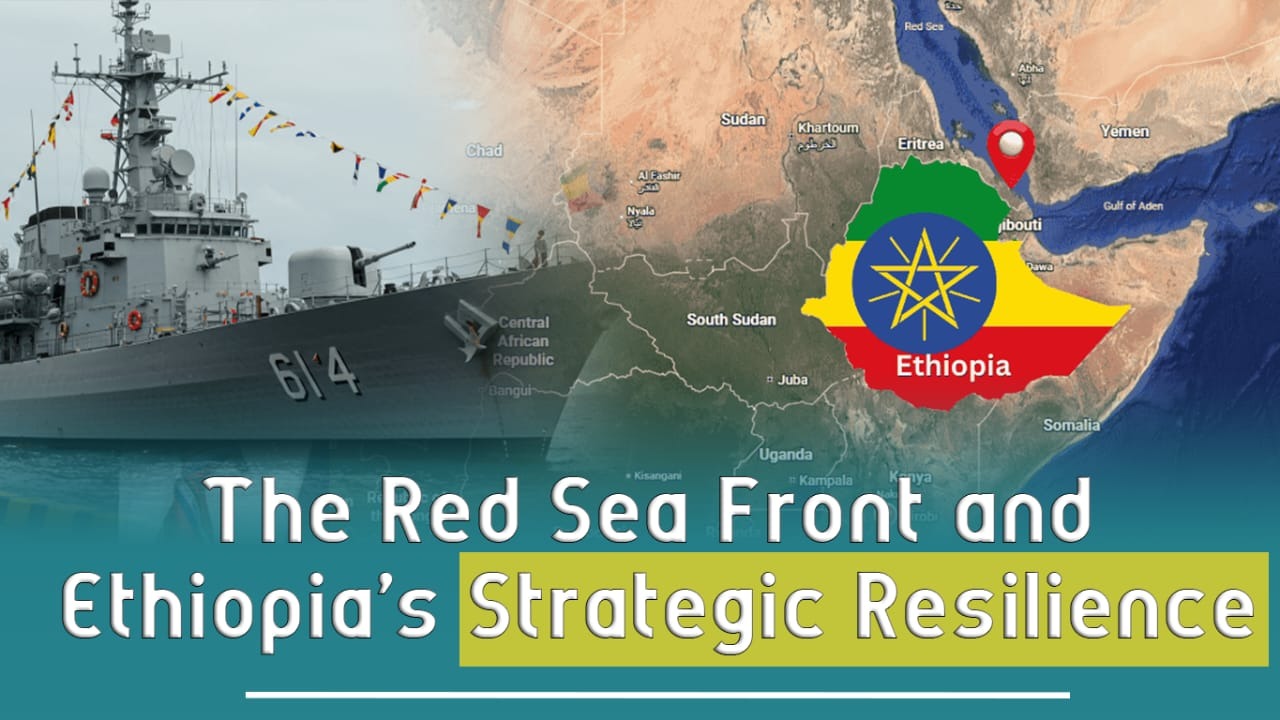
The widening Middle Eastern war is changing the strategic landscape of the Horn of Africa in more immediate ways. Early analysis largely framed the crisis as an external energy shock: conflict in the Gulf would raise oil prices, intensify inflationary pressure, and strain import-dependent economies. That dominant perspective now needs expansion. With the prospect of renewed Houthi action from Yemen, the crisis is no longer only about oil passing through Gulf waters. It is also about the security of the maritime gateway connecting the Red Sea to the Gulf of Aden, the seaborne passage through which much of the Horn’s external commerce is organized.[1][2]
For Ethiopia, the implications are significant. The country is exposed not only to global fuel prices but also to disruption in the trade architecture that links its economy to the sea. More than ninety-five percent of Ethiopia’s import-export trade by volume moves through the Addis-Djibouti route.[3] In stable times, that reliance is costly but manageable. In a period of regional war, it takes on a more strategic character. Pressure on both Gulf energy flows and Red Sea shipping can raise the import bill, lengthen delivery times, increase insurance costs, tighten freight availability, and deepen domestic inflation all at once.
Yet the picture is not defined only by vulnerability. It also highlights a clear national agenda. Ethiopia is already engaged in macroeconomic reform, infrastructure upgrading, and efforts to strengthen external economic management.[3][4] The present crisis therefore presents not only a test but also an opportunity to sharpen a broader resilience strategy. The key question is how Ethiopia can use this moment to strengthen economic security, improve logistical reliability, and reduce repeated exposure to shocks emerging from narrow maritime choke points.
From Oil Shock to Access Risk
A narrow focus on crude prices understates the scale of the current challenge. Energy remains the first and most visible transmission channel, but the Houthi dimension broadens the crisis into a wider problem of access, shipping reliability, and commercial risk.[1][5] The Gulf and the Red Sea are now part of the same stress system. One pressure point lies at Hormuz, where a major share of global energy flows remains vulnerable. The second lies at the Bab el-Mandeb, where shipping can be disrupted by direct attack, by the threat of attack, or by the costly precautions that shipping firms and insurers adopt in response.[1][5]
That shift has direct implications for the Horn. Maritime insecurity in the southern Red Sea does not stop at sea. It moves inland through port operations, freight schedules, trucking costs, warehouse delays, foreign exchange demand, and final consumer prices. In that environment, even without a total interruption of trade, uncertainty itself becomes expensive. Ships take longer routes, insurance premiums rise, emergency surcharges appear, and delivery windows become less predictable.[1]
For Ethiopia, the result is a layered shock rather than a single one. Fuel may cost more, but so too may machinery, industrial inputs, medicines, food items, and containerized consumer goods. The broader issue, then, is not simply whether oil becomes more expensive. It is whether Ethiopia’s external economic circulation can remain predictable under conditions of prolonged Red Sea volatility.
This wider reading offers a stronger analytical frame. The challenge is no longer only energy insecurity. It is access insecurity in an economy whose trade lifeline remains concentrated on one principal maritime outlet.
Ethiopia’s Exposure and Ethiopia’s Leverage
Ethiopia’s dependence on the Djibouti-facing trade system is often described purely as a weakness. A more complete reading shows both exposure and leverage. Exposure, because concentration on one sea access arrangement leaves the economy highly sensitive to disruptions near the southern Red Sea. Leverage, because improvements in logistics efficiency, transport speed, customs coordination, and inland distribution can produce substantial resilience gains even without changing the country’s basic geography.[3]
The World Bank’s support for upgrading the Addis-Djibouti route reflects precisely that point. Investments in transport infrastructure, rail usage, and trade facilitation are not simply development measures. In the current environment, they are part of a wider national resilience agenda.[3] When maritime insecurity rises, the value of every efficiency gain inland becomes greater. Faster cargo handling, smoother customs procedures, and more reliable multimodal transport help offset part of the cost imposed by external instability.
The macroeconomic setting also provides Ethiopia with a stronger starting point than in previous moments of acute external pressure. Recent IMF assessments point to stronger-than-expected growth, improved export performance, rising reserve accumulation, better revenue mobilization, and moderating inflation.[4] These gains do not eliminate the effects of a regional war. They do, however, provide a better platform for policy response.
That policy response will need balance. If fuel and freight costs rise together, Ethiopia must preserve reform credibility while protecting economic stability and social welfare. That calls for disciplined foreign-exchange prioritization, careful inflation management, and targeted measures to shield the most sensitive sectors from abrupt disruption. It also underscores a broader truth: resilience is not only about grand diplomacy or external bargaining. It is also about state capacity, sequencing, and the steady improvement of the systems that connect the domestic economy to the sea.
Energy Security in a More Volatile Maritime Space
Energy will remain the most immediate pressure point. But the mechanism is no longer one-dimensional. In a Gulf-only shock, Ethiopia’s challenge would center mainly on price pass-through from global oil markets. In a Gulf shock combined with renewed Houthi pressure on Red Sea shipping, the landed cost of energy can rise through multiple channels at the same time: higher crude prices, higher insurance costs, longer voyages, tighter vessel availability, and more cautious carrier scheduling.[1][2]
That distinction sharpens the policy challenge. Ethiopia can face a serious fuel shock even if supplies continue to arrive. The risk environment itself is priced into delivery. Commercial caution, rerouting decisions, and conflict-related premiums all shape final import costs before any absolute shortage appears. In such circumstances, energy security is no longer only about procurement. It is also about demand management, efficiency, and the capacity to reduce unnecessary dependence on imported petroleum.
This is where Ethiopia holds an important strategic asset: abundant renewable electricity potential and expanding power generation. The more transport, urban services, and parts of industry can gradually shift toward electrified systems, the more the country can soften future petroleum shocks. The Red Sea crisis therefore reinforces an existing national priority. Energy transition is not only an environmental ambition or a long-term development goal. It is also a buffer against recurring geopolitical disruption.
Short-term measures are equally important. Ethiopia can strengthen fuel resilience by prioritizing essential sectors, improving stock management, reducing avoidable inefficiencies in transport, and linking energy planning more closely to foreign-exchange management. Medium-term action can focus on electric mobility, rail utilization, and industrial energy efficiency. The value of such measures grows in a region where maritime volatility is becoming more regular rather than exceptional.
Food Systems, Fertilizer, and Domestic Stability
The second major transmission channel runs through food systems. International assessments have warned that simultaneous stress in Hormuz and the Red Sea could raise freight costs, tighten fertilizer availability, and increase food prices across vulnerable economies.[5] For Ethiopia, the impact is likely to move through three interlinked pathways.
The first is agricultural input cost. Fertilizer availability and pricing remain central to productivity, output, and rural income. Disruption in supply chains or higher import costs can affect planting decisions and yields, with delayed but important effects on food security. The second pathway is internal transport cost. Even where food is produced domestically, more expensive diesel and less predictable logistics raise the cost of moving goods from surplus-producing regions to urban markets. The third pathway is household purchasing power. When food, transport, and fuel costs rise together, real incomes are compressed and vulnerability spreads beyond the poorest groups.
A more capable response begins by treating these pathways as interconnected rather than separate. Food security planning cannot be isolated from fuel policy, freight management, or import prioritization. Ethiopia can reduce the severity of spillover by improving fertilizer procurement planning, protecting key agricultural supply chains, and strengthening internal market connectivity. Where logistics function more efficiently, inflationary pressures are less likely to cascade as sharply through the system.
There is also a broader developmental implication. Recurrent external shocks are a reminder that national resilience is built not only through emergency response but through everyday state effectiveness. Better storage, better transport, stronger data on food movement, and more coordinated policy across ministries all help reduce the impact of disruptions that originate far beyond Ethiopia’s borders.
The Gulf Link: Remittances and Household Resilience
Another important dimension lies in the relationship between conflict in the wider Middle East and household welfare inside Ethiopia. Ethiopia’s connection to the Gulf is not limited to imported fuel and maritime trade. It also runs through labor migration and remittance flows. Migration and development studies consistently show the significance of labor mobility to Gulf economies for Ethiopian households and local communities, while remittance data confirm the continuing importance of external transfers to economic resilience.[6][7][8]
This channel deserves greater attention. A wider war can affect Ethiopia not only through goods and prices but through income flows. Payment disruptions, labor-market uncertainty in destination countries, or stress on migrant livelihoods can affect Ethiopian families that rely on transfers from abroad. Even where aggregate remittance data remain relatively steady, the local effects can be concentrated and socially significant.
This dimension broadens the policy agenda. National resilience is not only about imports and trade infrastructure. It is also about protecting household-level economic stability. That includes strengthening formal remittance channels, improving financial inclusion for families that depend on external income, and integrating labor mobility considerations into wider economic planning. In a period of geopolitical stress, household resilience becomes part of strategic resilience.
The Horn’s Wider Strategic Adjustment
For the Horn of Africa more broadly, the expanding war increases the strategic weight of the Red Sea and Gulf of Aden. Ports, maritime lanes, foreign military facilities, and commercial infrastructure are concentrated in a narrow and highly consequential geography. Once Houthi activity again raises uncertainty around the southern Red Sea, the region enters a denser security environment whether or not its states are direct participants in the conflict.[1][2]
That regional setting should not be viewed only through the lens of risk. It also encourages practical cooperation. The reliability of Djibouti’s port and logistics functions becomes even more central. The efficiency of inland transport networks across the Horn gains wider significance. Humanitarian access, commercial continuity, and customs coordination all become more valuable when external turbulence grows.
For Ethiopia, this points toward a clear strategic posture. Rather than viewing Red Sea instability only as an external threat, Ethiopia can approach it as a prompt for deeper adaptation: closer operational coordination with Djibouti, better alignment between trade policy and infrastructure policy, greater use of rail where feasible, and a more integrated approach linking economic planning with geopolitical risk assessment. The goal is not immunity from shocks, which few states can achieve, but stronger capacity to absorb and outlast them.
A National Agenda for Resilience
The most useful conclusion is therefore forward-looking. Houthi activation, or even a sustained threat of it, is a reminder that economic security depends not only on what a country imports, but on how reliably it can sustain movement through the systems on which those imports depend. Ethiopia’s exposure is real, but the policy path is also visible.
A practical resilience agenda would include several linked priorities. One is continued improvement of the Addis-Djibouti trade system through infrastructure, trade facilitation, and multimodal efficiency.[3] Another is stronger alignment between fuel planning, foreign-exchange management, and transport efficiency.[4] A third is faster movement toward electrification and reduced petroleum dependence where technically and economically feasible. A fourth is better integration of food security policy with logistics and fertilizer planning.[5] A fifth is greater recognition of remittances and labor mobility as part of the national economic security picture.[6][7][8]
Seen in that light, the Red Sea crisis is not only a source of pressure. It is also a strategic signal. It clarifies where Ethiopia’s vulnerabilities lie and where policy effort can deliver the greatest return. In an era of recurring maritime instability, resilience will come less from reacting to each individual shock than from steadily improving the systems that connect the Ethiopian economy to the outside world.
If the war has moved closer to the Red Sea, Ethiopia’s response can be measured, disciplined, and purposeful. The task is not simply to endure disruption. It is to convert a period of uncertainty into a stronger foundation for economic stability, strategic foresight, and national preparedness.
Notes
[1] Reuters, “Shipping companies divert vessels around Cape of Good Hope after strikes on Iran,” March 1, 2026.
[2] Atlantic Council, “Will the Houthis join the Iran war?” March 2026.
[3] World Bank, “Addis-Djibouti Corridor to Get Major Upgrade That is Key to Unlocking Connectivity and Trade for Ethiopia and the Horn of Africa,” July 20, 2023.
[4] IMF, “IMF Executive Board Completes the Fourth Review under the Extended Credit Facility Arrangement for Ethiopia,” January 16, 2026.
[5] World Food Programme, “WFP warns rising food and fuel prices risk pushing global hunger higher as humanitarian needs grow,” March 2026.
[6] World Bank, Ethiopia Labor Mobility Diagnostic, 2020.
[7] World Bank Data, “Personal remittances, received (% of GDP) – Ethiopia.”
[8] World Bank, Migration and Development Brief 40, 2024.
By Sifan Tadesse, IFA
Disclaimer:
The content disseminated by the Institute of Foreign Affairs (IFA) – including, but not limited to, publications, public statements, events, media appearances, and digital communications – reflects the views of individual contributors and does not necessarily represent the official positions or policies of the Institute, its partners, or any affiliated governmental or non-governmental entities.
While the IFA endeavors to ensure the accuracy, integrity, and timeliness of the information presented, it makes no representations or warranties, express or implied, regarding the completeness, reliability, or suitability of such content for any purpose. The Institute expressly disclaims any liability for errors or omissions, as well as for any actions taken or decisions made based on the information provided.
The inclusion of external links, references, or third-party resources does not constitute an endorsement by the Institute. Additionally, engagement on social media platforms – including, but not limited to, likes, shares, retweets (RTs), or reposts – shall not be interpreted as an endorsement or validation of the views expressed therein.
Readers and audiences are encouraged to exercise critical judgment and seek independent verification when interpreting or relying upon any information disseminated through publications and posts on the Institute’s platforms or representatives.