

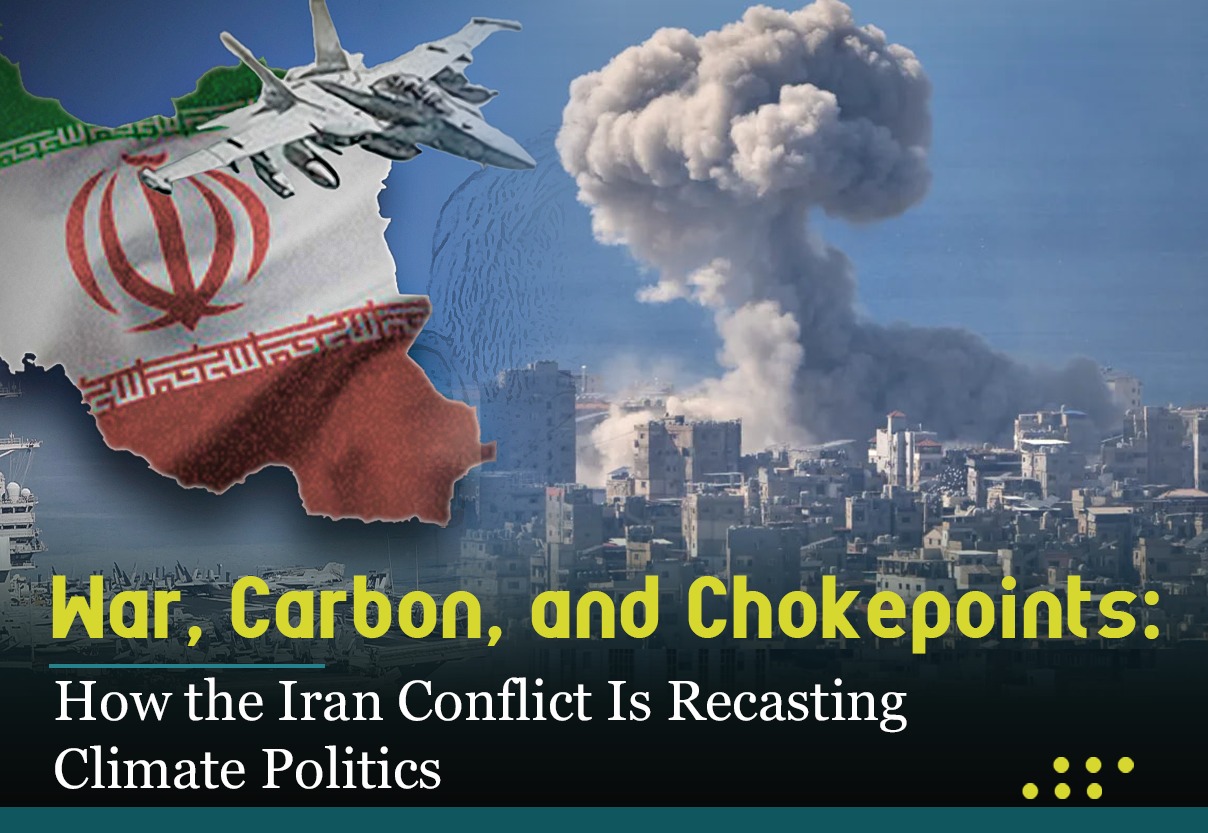
The Iran war is being read, understandably, as a military crisis, an energy shock, and a diplomatic rupture. It is all three. But it is also something else: a test of whether climate politics can survive the return of hard-security thinking. The conflict has pushed governments back toward emergency energy-security measures even as it underscores a point climate strategy has too often treated as secondary. Fossil-fuel dependence is not only environmentally damaging. It is strategically fragile.[1]
That is the article’s central tension. The war can drive states in two opposite directions at once. In the near term, it encourages more stockpiling, more hedging, more fossil contracting, and more political tolerance for expanded oil and gas infrastructure. Yet the same conflict strengthens the strategic rationale for domestic renewables, stronger grids, storage, electrification, and, in some cases, nuclear power. A system dependent on imported hydrocarbons moving through contested maritime corridors looks not only carbon-intensive, but geopolitically exposed.
The real issue, then, is not whether war helps or harms climate action in the abstract. It is which lesson governments draw from disruption. One lesson says insecurity requires a return to fossil insurance. The other says insecurity makes dependence on traded hydrocarbons harder to defend. The Iran war has forced that choice into sharper focus.
War as an Environmental and Carbon Event
Conflict is often treated as a geopolitical problem first and an environmental problem later. That sequencing obscures the scale of damage. War is also an emissions event, a pollution event, and an institutional failure.
The direct environmental effects are immediate. Strikes on fuel depots, ports, industrial facilities, pipelines, and electricity systems release pollutants into air, soil, and water. Fires, leaks, and damaged urban utilities produce consequences that far outlast the period of active combat.[2] In practice, the environmental burden of war extends well beyond the battlefield itself.
The carbon cost is also broader than conventional accounting captures. Military operations consume large quantities of fuel, but emissions do not end there. They continue through weapons production, logistics, emergency diesel generation, and eventual reconstruction. Rebuilding damaged cities and infrastructure is itself carbon-intensive, especially when it depends on cement, steel, transport, and rapid material imports.
A further problem is underreporting. Military emissions remain incompletely disclosed and unevenly measured, leaving a significant gap in global climate accounting.[3] That matters analytically because it allows war to remain peripheral in climate discussion, when in fact conflict produces both direct environmental degradation and long-tail carbon impacts. The Iran war should therefore be understood not simply as a crisis that interrupts climate politics, but as part of the climate problem itself.
The Revival of Fossil-Security Politics
The most immediate political consequence of the war is the return of fossil-security logic. When conflict threatens energy flows through a chokepoint such as the Strait of Hormuz, governments do not first ask how to preserve emissions targets. They ask how to keep fuel moving, prices contained, and domestic disruption manageable.
That response has its own internal rationality. States facing supply shocks or price volatility will seek redundancy: more LNG capacity, longer contracts, expanded reserves, support for domestic production, and naval or diplomatic protection for energy shipping. Each measure can be justified as temporary crisis management. The difficulty is that emergency infrastructure has a habit of becoming permanent.[4]
This is the deeper climate risk. Price spikes matter, but they are not the most enduring consequence. The more consequential outcome is lock-in: new gas terminals, long-lived contracts, and political narratives that recast fossil expansion as prudence rather than delay. Once hydrocarbon dependence is reframed as national resilience, climate commitments become easier to defer without formally abandoning them.
The burden falls unevenly. Wealthier states may absorb higher costs while preserving strategic optionality. Developing import-dependent economies face a harsher trade-off. More public money goes to securing fuel and fertilizer, leaving less fiscal room for adaptation, clean-energy deployment, and industrial transition. In that sense, the war does not only complicate decarbonization. It widens the inequality embedded within it.
There is, however, a serious counterargument. Fossil fuels remain central to industrial systems, electricity generation, transport, and heating. In moments of acute instability, governments cannot simply exit that reality. That is true. But necessity in the short term is not the same as strategic wisdom in the long term. The question is whether fossil reliance is treated as temporary insulation during crisis, or elevated into a renewed doctrine of energy security. The former may be unavoidable. The latter would be a political choice.
Why the Same Shock Strengthens the Case for Clean Energy
The paradox is that the same war pushing states toward fossil hedging also strengthens the strategic case for transition. It does so by clarifying where vulnerability lies.
Imported hydrocarbons depend on exposed shipping lanes, insurable maritime passage, functioning ports, and stable regional politics. Domestic clean-energy systems do not eliminate risk, but they rearrange it. Solar, wind, storage, electrification, grid modernization, and nuclear generation begin to look less like climate preferences and more like resilience assets.[5]
That shift matters. A power system with more domestic renewable generation and storage is less exposed to fuel-price spikes and external supply interruptions. Stronger grids and interconnection improve flexibility under stress. Electrification reduces dependence on imported fuels across transport and heating. Nuclear power, where politically and financially viable, offers another form of domestic supply less vulnerable to maritime chokepoints.
None of this means clean energy escapes geopolitics. Supply chains for minerals, components, and technology remain contested. But the structure of exposure changes. The strategic value of transition lies partly in reducing dependence on combustible commodities moving through politically vulnerable corridors.
This is why the Iran war should not be read only as a setback for climate action. It may also accelerate a different kind of climate politics, one justified less by environmental obligation than by strategic insulation. That is already visible in the way governments increasingly frame domestic energy transition as a question of sovereignty, resilience, and industrial policy. Recent investment patterns support that interpretation: even amid geopolitical tension, global capital continues to flow heavily into clean energy, suggesting that transition technologies are being treated not merely as ethical preferences, but as durable strategic assets.[6]
Militarization and the Narrowing of Climate Diplomacy
The conflict also affects climate politics indirectly by narrowing diplomatic bandwidth. Wars reorder priorities. States preoccupied with deterrence, sanctions, alliance management, and crisis response devote less time and less political capital to climate bargaining.
That diplomatic crowding-out has material consequences. Climate governance depends on negotiation over finance, adaptation, mitigation, and burden-sharing. Those processes already operate with limited trust. In a more militarized international environment, trust becomes scarcer still. States become less willing to rely on rivals, more inclined to securitize supply chains and technology, and more likely to pursue narrower national advantage.
The fiscal consequences are equally important. Rising military expenditure competes directly with the public resources needed for adaptation, resilience, and energy transition.[7] Not every budget line is zero-sum, but at scale the pattern is clear: a world spending more on conflict preparedness is a world with less political room for long-horizon climate cooperation.
The result is not necessarily the collapse of climate diplomacy. It is more likely its fragmentation. Some states will continue to decarbonize through strategic industrial policy. Others will defend fossil expansion as a condition of order and growth. The universal language of climate cooperation may increasingly give way to a harder vocabulary of national resilience.
Conclusion
The Iran war does not settle the future of climate politics. It reveals the terms on which that future will be contested. If governments respond by entrenching long-lived fossil infrastructure, expanding hydrocarbon dependence, and allowing wartime urgency to crowd out climate finance and diplomacy, then the conflict will deepen climate failure. But if they interpret the war as proof that fossil reliance is itself a strategic liability, the same shock could accelerate more resilient low-carbon systems: stronger grids, faster electrification, greater storage, efficiency, and carefully chosen non-fossil generation.
That is the larger significance of the moment. The boundary between climate policy and security policy is eroding. Decarbonization can no longer be treated as an environmental project insulated from geopolitical disorder. It is increasingly bound up with how states think about vulnerability, sovereignty, and economic survival.
The Iran war is therefore not simply disrupting energy markets. It is testing whether governments still see transition as optional in a dangerous world, or whether they begin to understand that danger itself is becoming one of the strongest arguments for it.
References
- Samantha Gross and Caitlin Talmadge, “Why Iran’s disruption of the Strait of Hormuz matters,” Brookings, March 19, 2026.
- United Nations Environment Programme, “UNEP statement on environmental damage arising from the conflict in the Middle East,” March 13, 2026.
[3] Conflict and Environment Observatory (CEOBS) and Scientists for Global Responsibility, Estimating the Military’s Global Greenhouse Gas Emissions, November 2022; see also CEOBS, “New data reveals the Military Emissions Gap is growing wider,” November 6, 2025.
[4] Karim Elgendy, “The Iran war is exacting a heavy toll on Gulf oil and gas exporters – and creating risk and opportunity in North Africa,” Chatham House, March 17, 2026.
[5] International Energy Agency, World Energy Investment 2025: Executive Summary, June 5, 2025.
[6] International Energy Agency, World Energy Investment 2025: Executive Summary, June 5, 2025.
[7] Chatham House, “Climate security should be a bigger priority at the Munich Security Conference,” February 13, 2026.
By Fitsum Abayineh, IFA
Disclaimer:
The content disseminated by the Institute of Foreign Affairs (IFA) – including, but not limited to, publications, public statements, events, media appearances, and digital communications – reflects the views of individual contributors and does not necessarily represent the official positions or policies of the Institute, its partners, or any affiliated governmental or non-governmental entities.
While the IFA endeavors to ensure the accuracy, integrity, and timeliness of the information presented, it makes no representations or warranties, express or implied, regarding the completeness, reliability, or suitability of such content for any purpose. The Institute expressly disclaims any liability for errors or omissions, as well as for any actions taken or decisions made based on the information provided.
The inclusion of external links, references, or third-party resources does not constitute an endorsement by the Institute. Additionally, engagement on social media platforms – including, but not limited to, likes, shares, retweets (RTs), or reposts – shall not be interpreted as an endorsement or validation of the views expressed therein.
Readers and audiences are encouraged to exercise critical judgment and seek independent verification when interpreting or relying upon any information disseminated through publications and posts on the Institute’s platforms or representatives.