

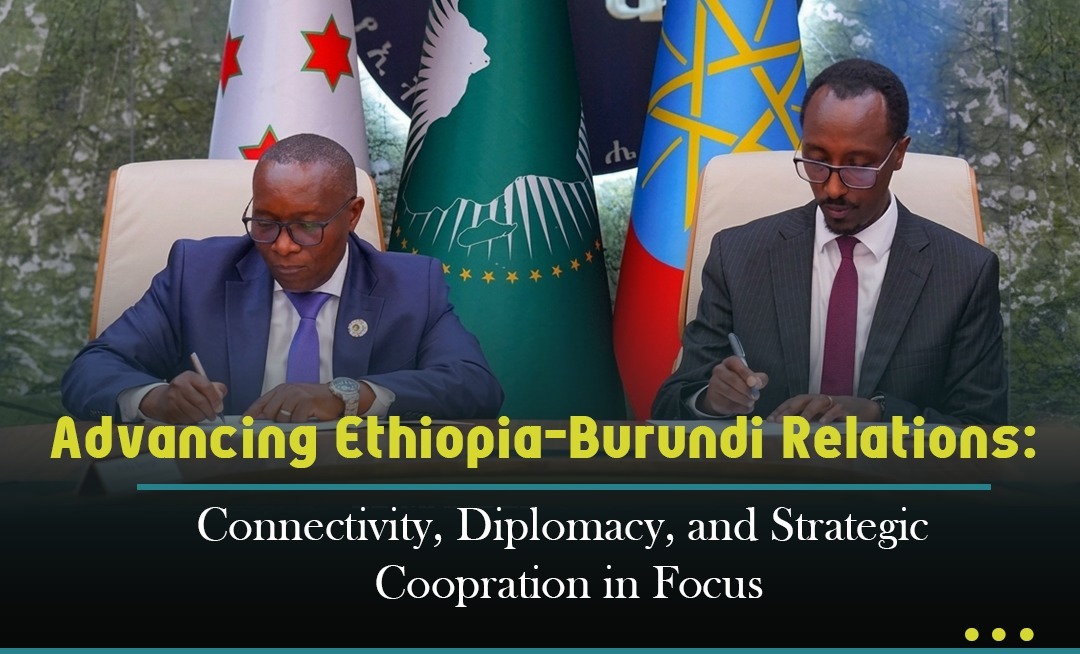
At first glance, Ethiopia–Burundi relations appear firmly anchored in the enduring rhetoric of Pan-African solidarity—a diplomatic language shaped by the founding ethos of the Organization of African Unity in 1963. This narrative, grounded in shared sovereignty, anti-colonial struggle, and collective advancement, remains both symbolically powerful and politically relevant. Ethiopia, as the diplomatic nucleus of the African Union, and Burundi, as a state shaped by post-conflict reconstruction and regional engagement, have long operated within this continental framework.
Yet, this framing, while necessary, is increasingly insufficient. Perhaps most revealing in recent developments is the gradual but unmistakable shift from symbolic solidarity toward pragmatic, sector-driven cooperation. The conclusion of the Second Ethiopia–Burundi Joint Ministerial Commission (JMC) in Addis Ababa, held at the National Bank of Ethiopia and culminating in the signing of agreed minutes, underscores this transition. Bringing together senior officials and technical experts, the two-day engagement extended beyond diplomatic courtesies to address concrete sectors: defense, trade, transport, agriculture, energy, education, digitization, health, and tourism.
This evolution raises a critical analytical question: Are Ethiopia and Burundi redefining the meaning of bilateral cooperation in Africa—not merely as an expression of shared history, but as a deliberate strategy for navigating structural constraints?
Reframing Constraint as Strategic Agency
From a realist perspective, state cooperation is rarely altruistic; it is often born of necessity. For Ethiopia and Burundi, geography has historically imposed a shared structural condition—landlocked-ness. This has translated into dependency on transit states, vulnerability to external shocks, and persistently high trade costs.
Yet, to interpret this condition purely as a constraint is to overlook an emerging strategic recalibration.
Over time, both states have begun to reinterpret landlocked-ness not as a permanent liability, but as a platform for collective bargaining and diplomatic innovation. Participation in regional frameworks such as the Common Market for Eastern and Southern Africa (COMESA) and the African Continental Free Trade Area (AfCFTA) reflects this shift. These are no longer passive mechanisms of economic integration; rather, they are arenas where structurally disadvantaged states seek to renegotiate access, reshape trade corridors, and recalibrate regional power asymmetries.
The recent JMC meeting reinforces this trajectory. By explicitly prioritizing trade, transport, and economic cooperation, both governments signaled an intention to move beyond rhetorical alignment toward coordinated policy action. As Ethiopia’s Foreign Minister H.E. Dr. Gedion Timotheos noted in his closing remarks, the Commission represents “an important step toward building a stronger and more resilient partnership”—a statement that reflects not only diplomatic optimism but strategic intent.
In this context, sovereignty is neither eroded nor diluted. Instead, it is reconfigured, exercised through interdependence, institutional engagement, and negotiated connectivity.
Logistics and Transport as Instruments of Diplomacy
If there is a single domain where this strategic recalibration becomes most visible, it is in logistics and transport.
Ethiopia’s infrastructural trajectory, anchored in projects such as the Addis Ababa–Djibouti railway, the expansion of dry ports, and broader logistics modernization, positions it as an emerging gateway economy within the Horn of Africa. Burundi, for its part, remains integrated into the Central Corridor linking it to Tanzanian ports, a route that has historically underpinned its external trade.
These corridors might seem to appear geographically and institutionally distinct. Yet, a deeper analysis suggests the potential for convergence within a broader continental framework of interconnected trade routes.
The JMC discussions, which emphasized transport and trade facilitation, indicate a growing recognition of this possibility. Rather than pursuing isolated national strategies, Ethiopia and Burundi are increasingly positioned to align their approaches in areas such as:
- corridor development planning
- customs harmonization and regulatory alignment
- cross-border logistics and trade facilitation mechanisms
Such coordination carries profound implications. It not only reduces transit inefficiencies and trade costs but also enhances collective bargaining power vis-à-vis transit states and external partners. In this sense, infrastructure evolves from a technical domain into a geopolitical instrument, one that enables states to shape, rather than merely navigate, regional economic systems.
Strategic Complementarity in an Asymmetrical Partnership
A superficial reading of Ethiopia–Burundi relations might emphasize asymmetry, differences in economic scale, infrastructural capacity, and diplomatic influence. Ethiopia’s population size, economic ambitions, and continental diplomatic role contrast sharply with Burundi’s more constrained capacities.
Yet, this asymmetry does not necessarily translate into imbalance. On the contrary, it reveals a form of strategic complementarity.
Ethiopia’s infrastructural momentum and energy potential—particularly its expanding hydropower capacity—offer tangible opportunities for regional integration. Burundi, facing energy deficits, stands to benefit directly from such developments, particularly in supporting industrialization and improving socio-economic resilience.
Conversely, Burundi’s experience in post-conflict governance and regional coalition-building provides institutional insights that are often underappreciated. Its engagement in peacebuilding processes offers a stabilizing dimension that is essential for long-term infrastructure investment—an often overlooked but critical component of regional development.
The JMC’s inclusion of sectors such as defense, education, health, and digitization further broadens this complementarity. Cooperation in these areas suggests an understanding that connectivity is not limited to physical infrastructure but extends to institutional, technological, and human capital linkages.
Regional Integration: Between Aspiration and Practice
Regional integration in Africa is frequently critiqued for its uneven implementation. Persistent infrastructure deficits, regulatory fragmentation, and high transaction costs continue to constrain intra-African trade. While frameworks such as AfCFTA and COMESA offer ambitious blueprints, their effectiveness ultimately depends on state-level coordination and political will.
In this regard, Ethiopia–Burundi cooperation offers a microcosm of both the challenges and possibilities of regional integration.
The outcomes of the recent JMC, particularly the emphasis on trade, transport, and institutional collaboration, suggest a shift from declaratory commitments toward operational engagement. The signing of agreed minutes, following technical presentations by senior officials, reflects an effort to institutionalize cooperation and translate diplomatic intent into actionable frameworks.
More importantly, the scope of the discussions—spanning sectors from agriculture to digitization—indicates a holistic approach to integration. It recognizes that economic connectivity must be supported by complementary investments in human capital, innovation, and governance systems.
Yet, significant challenges remain. The alignment of regulatory frameworks, the financing of cross-border infrastructure, and the management of political risks all require sustained commitment.
Perhaps the most critical test of Ethiopia–Burundi relations lies not in the articulation of shared goals, but in their implementation. Diplomatic engagements, including Joint Ministerial Commissions, often produce comprehensive agendas. However, the translation of these agendas into tangible outcomes is frequently constrained by institutional capacity, resource limitations, and shifting political priorities. The recent JMC, while significant, should therefore be understood as a starting point rather than an endpoint.
The inclusion of diverse sectors—defense, energy, education, digitization—reflects ambition. But it also raises questions regarding prioritization and sequencing. Which sectors will receive immediate attention? How will progress be monitored? What mechanisms will ensure continuity beyond the political cycle?
Addressing these questions requires more than diplomatic goodwill. It necessitates robust institutional frameworks, clear implementation timelines, and mechanisms for accountability—elements that have historically been uneven across regional initiatives.
Conclusion: From Landlocked-ness to Strategic Connectivity
Ethiopia–Burundi relations appear to be at a critical juncture. While rooted in a shared history of Pan-African solidarity, they are increasingly being reshaped by pragmatic considerations of connectivity, economic resilience, and strategic coordination.
The recent Joint Ministerial Commission meeting in Addis Ababa underscores this transformation. It reflects a growing recognition that cooperation should move beyond rhetoric toward structured, sector-specific engagement capable of delivering tangible outcomes.
Yet, the broader significance of this relationship lies in its conceptual evolution.
“Landlocked solidarity,” once understood primarily as a shared constraint, is being reimagined as a platform for strategic collaboration. It represents a shift from dependency to agency, from isolation to integration, and from structural vulnerability to negotiated resilience.
The future of Ethiopia–Burundi relations will depend on their ability to sustain this momentum—to institutionalize cooperation, prioritize implementation, and navigate the complex interplay of regional dynamics.
To arrange these references chronologically for your policy brief, they should be ordered from the oldest year to the most recent. Within the same year (as seen in 2013), they are then alphabetized by the author’s name.
References
African Union. (2002). Constitutive Act of the African Union. Addis Ababa.
Nile Basin Initiative. (2012). State of the Nile River Basin Report. Entebbe.
Curtis, D. (2013). The international peacebuilding paradox: Burundi case study. African Affairs, 112(446), 72–91.
Salman, S. M. A. (2013). The Nile Basin Cooperative Framework Agreement. Water International, 38(1), 17–30.
Gebreluel, G. (2014). Ethiopia’s role in African politics. Journal of Eastern African Studies, 8(3), 1–15.
Common Market for Eastern and Southern Africa (COMESA). (2020). Regional Integration Report. Lusaka.
African Development Bank. (2021). African Economic Outlook: Regional Integration and Trade. Abidjan.
By Kuchim Silesh, IFA
Disclaimer:
The content disseminated by the Institute of Foreign Affairs (IFA) – including, but not limited to, publications, public statements, events, media appearances, and digital communications – reflects the views of individual contributors and does not necessarily represent the official positions or policies of the Institute, its partners, or any affiliated governmental or non-governmental entities.
While the IFA endeavors to ensure the accuracy, integrity, and timeliness of the information presented, it makes no representations or warranties, express or implied, regarding the completeness, reliability, or suitability of such content for any purpose. The Institute expressly disclaims any liability for errors or omissions, as well as for any actions taken or decisions made based on the information provided.
The inclusion of external links, references, or third-party resources does not constitute an endorsement by the Institute. Additionally, engagement on social media platforms – including, but not limited to, likes, shares, retweets (RTs), or reposts – shall not be interpreted as an endorsement or validation of the views expressed therein.
Readers and audiences are encouraged to exercise critical judgment and seek independent verification when interpreting or relying upon any information disseminated through publications and posts on the Institute’s platforms or representatives.