

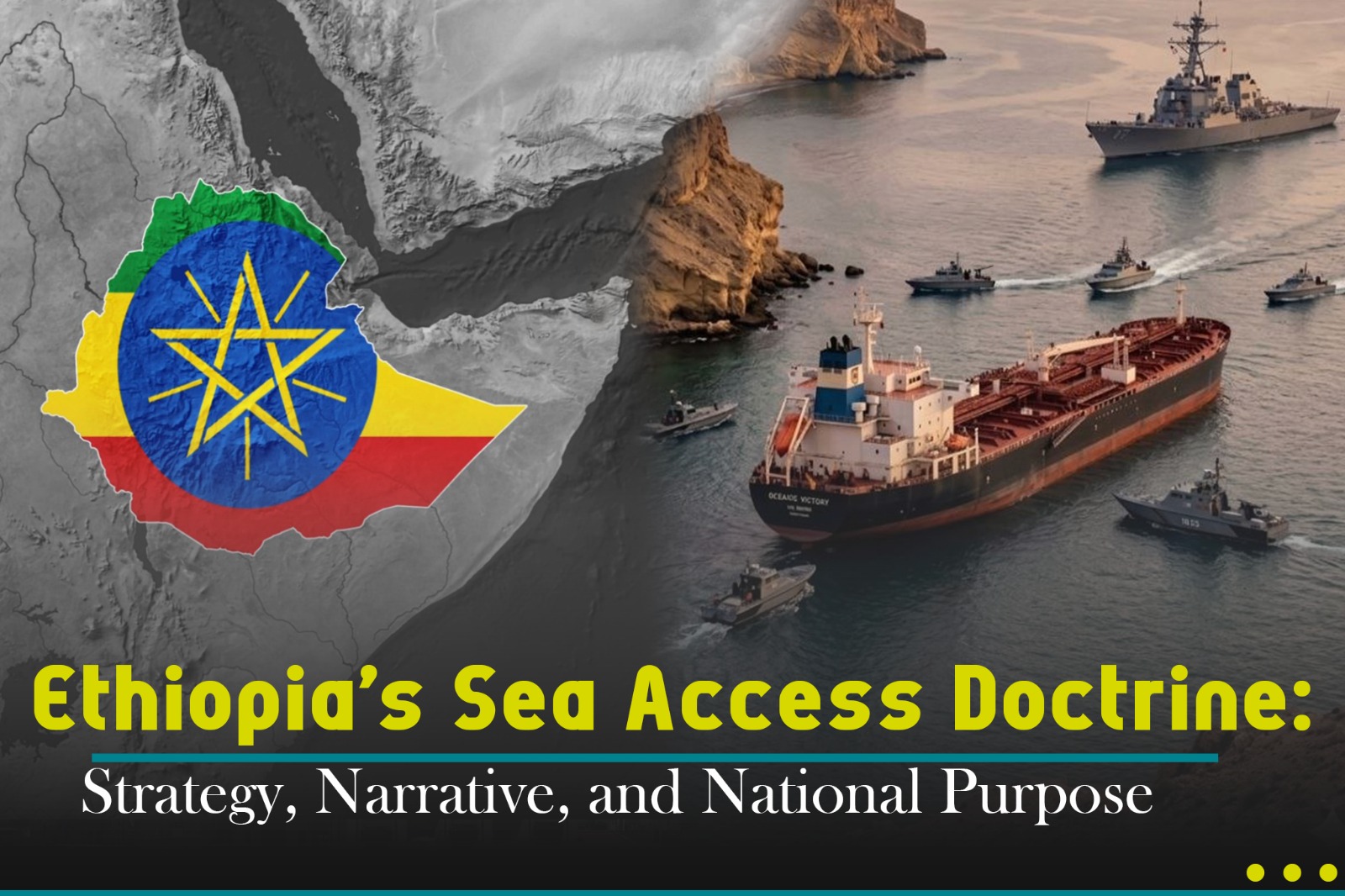
A maritime question that has become a national idea
The most revealing feature of Ethiopia’s sea-access campaign is not that Addis Ababa has already secured a decisive maritime settlement. The revealing feature is the persistence of the theme itself. Sea access continues to appear in Ethiopian official discourse as a matter of national future, economic resilience, and regional connectivity, even when no singular diplomatic breakthrough defines the moment.¹ That persistence suggests the issue now serves two purposes at once. It remains a real strategic objective, but it has also become a unifying national narrative through which the state can speak about Ethiopia’s future in terms larger than internal crisis.
This is why the issue deserves a more careful reading than it often receives. Ethiopia’s maritime question is not simply symbolic. It rests on a structural economic reality. More than 95 percent of Ethiopia’s trade by volume moves through the Addis–Djibouti corridor, making that route the country’s principal commercial lifeline.² For a country of Ethiopia’s scale, sea access is tied to logistics costs, export competitiveness, industrial policy, and long-term strategic autonomy. It is not a luxury of nationalist rhetoric. It is a question of national survival. .
The hard economic logic behind the campaign
A country as large and commercially ambitious as Ethiopia cannot indefinitely treat maritime dependence as a secondary matter. When one corridor carries the overwhelming share of external trade, every disruption becomes a national vulnerability. The World Bank continues to describe the Addis–Djibouti route as the key artery connecting Ethiopia to regional and international markets.³ That observation is not merely technical. It has strategic consequences. Dependence on a single outlet narrows policy flexibility, raises exposure to shocks, and places long-term economic viability at the mercy of a single point of faulure.
Independent analysts reinforce this structural reading. Biruk Terrefe’s study for the Rift Valley Institute argues that the Horn is defined by complex infrastructural interdependencies in which ports, corridors, and security systems shape both economic and political outcomes.⁴ Read through that lens, Ethiopia’s maritime posture is not an aberration. It is the behavior of a major inland state trying to reduce exposure within a region where infrastructure and power are tightly entangled.
That is the first point often missed in outside commentary. Ethiopia is not pursuing sea access because the idea is emotionally resonant, though it is. It is pursuing it because a country with its demographic weight, economic ambition, and regional centrality cannot remain indefinitely boxed into a single trade geography without eventually trying to widen its options.
Why the message is aimed inward as well as outward
Yet the most interesting development is domestic. Ethiopian messaging on sea access has recently moved across several registers at once: state media, youth mobilization platforms, and scholars presenting the issue as a generational national agenda.⁵ This breadth matters. It indicates that sea access is being normalized not merely as a policy demand, but as a civic and political theme capable of carrying national meaning.
In a more settled political environment, such a campaign might look routine. Ethiopia, however, is not operating in a settled environment. The postwar order in the north remains fragile, and tensions surrounding political transition have not fully disappeared.⁶ Electoral administration, too, continues to unfold under the shadow of security assessment and risk management.⁷ In such an environment, sea access offers Addis Ababa something politically valuable: a language of common national purpose that is future-oriented, developmental, and difficult to confine to one partisan constituency.
That domestic role should not be mistaken for insincerity. National projects are often politically useful precisely because they are real. Sea access works as an integrative narrative because Ethiopians can plausibly understand it as a genuine strategic and economic necessity rather than a manufactured slogan. It supplies a vocabulary of destiny at a moment when much of the country’s political conversation remains organized around trauma, insecurity, and incomplete transition.
Strategic realism, not strategic drift
Some critics worry that a sea-access campaign can unsettle neighboring states or encourage expansive interpretations of Ethiopian ambition. Addis Ababa has reason to watch its language carefully. But the public record also shows that Ethiopia’s leadership has repeatedly tried to frame the issue as one for peaceful dialogue rather than force. In March 2025, Prime Minister Abiy Ahmed explicitly ruled out war with Eritrea over Red Sea access and said Ethiopia would pursue the matter peacefully.⁸ Earlier statements similarly sought to lower regional anxieties by presenting the issue as a matter for negotiation, not coercion.⁹
Those statements matter because they place the campaign within a diplomatic rather than military grammar. Ethiopia is asserting that landlocked dependence on one principal outlet is a legitimate strategic problem. That is a difficult argument, but not an unreasonable one. Seen this way, Ethiopia’s posture is better understood as strategic realism than revisionism: an effort to convert structural vulnerability into negotiated regional integration. Ethiopian official rhetoric increasingly presents access as compatible with regional interdependence and African development, not as a repudiation of them.¹⁰
Here another independent analytical voice is useful. A recent CSIS assessment argues that Ethiopia remains central to the Horn by virtue of its size, location, and historical influence, even as domestic challenges have complicated its external role.¹¹ That observation clarifies the wider point. Ethiopia does not approach sea access as a marginal state seeking symbolic prestige. It approaches it as a pivotal regional actor trying to recover room for maneuver in a crowded and unstable strategic environment.
Sea access as a nation-organizing narrative
What gives the campaign its force, then, is not only economic logic. It is the way economic logic has been elevated into a national idea. Sea access now allows the Ethiopian state to tell a broader story about where the country is heading. It links trade, sovereignty, youth, development, and regional stature into a single frame. That is politically useful because it creates coherence across otherwise fragmented debates. It is strategically consequential because it signals that the issue will remain durable regardless of short-term diplomatic rhythm.
The practical implication is clear. Ethiopia’s sea-access campaign should not be read as a temporary rhetorical cycle. It is becoming part of the country’s medium-term strategic identity. For neighboring states and regional institutions, that means the question is unlikely to disappear through delay alone. It will return until it is addressed through legal, commercial, and political arrangements that reduce dependence and distribute gains more broadly.⁴
The more constructive regional response is therefore not to dismiss Ethiopia’s logic, but to channel it. A durable framework would not have to treat Ethiopian access and regional sovereignty as mutually exclusive principles. It would instead have to recognize that the Horn’s future depends on turning structural interdependence into negotiated advantage rather than managed suspicion.
More than access
In the end, Ethiopia’s sea-access campaign is about more than reaching the coast. It is about how a state under internal strain tries to recover strategic coherence. Addis Ababa has chosen to transform a logistical vulnerability into a national project, and in doing so it has found a theme that speaks simultaneously to economics, dignity, sovereignty, and regional relevance. That is why the campaign has endured even without a defining diplomatic climax. Its value is no longer exhausted by any single negotiation. It now helps organize how Ethiopia imagines its future.
That is the deeper significance of the moment. Sea access is no longer just an external objective. It is becoming part of Ethiopia’s internal political architecture: a way of binding strategic necessity to national narrative. And for a country still navigating the aftershocks of conflict and transition, that is not a minor development. It is a sign that the Ethiopian state is trying to replace the language of crisis with the language of purpose.
Footnotes
- Ethiopian News Agency, “Ethiopia Presses Red Sea Access as ‘Win-Win’ Solution at Strategic Maritime Dialogue,” April 7, 2026.
- World Bank, “Addis-Djibouti Corridor to Get Major Upgrade That is Key to Unlocking Connectivity and Trade for Ethiopia,” July 20, 2023.
- World Bank, Regional Economic Corridor Project documents on the Addis–Djibouti corridor, 2023–2026.
- Biruk Terrefe, Ethiopia’s Red Sea Politics: Corridors, Ports and Security in the Horn of Africa (Rift Valley Institute, 2025).
- Ethiopian News Agency, “Federation Urges the Youth to Lead Ethiopia’s Sea Access Agenda,” April 10, 2026; Ethiopian News Agency, “Scholars Call for Legal and Diplomatic Solutions to Generational Agenda,” April 8, 2026.
- Reuters, “Tigray Party to Restore Pre-War Administration, Jeopardising Northern Ethiopia Peace,” April 20, 2026.
- National Election Board of Ethiopia, “NEBE Consults Political Parties on Security Issues for the 7th General Election,” March 2026; The Reporter Ethiopia, “Election Board to Deploy Team to Assess Security Situations Ahead of June Election,” April 7, 2026.
- Reuters, “Ethiopia’s Abiy Rules Out War with Eritrea Over Red Sea Access,” March 20, 2025.
- Associated Press, “Ethiopia’s Leader Plays Down Fears of Conflict as He Pursues Sea Access,” January 2024.
- Ethiopian News Agency, “Ethiopia Presses Red Sea Access as ‘Win-Win’ Solution at Strategic Maritime Dialogue,” April 7, 2026.
- CSIS, “Vying for Regional Leadership in the Horn of Africa,” February 24, 2025.
By Hawi Wondimu, IFA
Disclaimer:
The content disseminated by the Institute of Foreign Affairs (IFA) – including, but not limited to, publications, public statements, events, media appearances, and digital communications – reflects the views of individual contributors and does not necessarily represent the official positions or policies of the Institute, its partners, or any affiliated governmental or non-governmental entities.
While the IFA endeavors to ensure the accuracy, integrity, and timeliness of the information presented, it makes no representations or warranties, express or implied, regarding the completeness, reliability, or suitability of such content for any purpose. The Institute expressly disclaims any liability for errors or omissions, as well as for any actions taken or decisions made based on the information provided.
The inclusion of external links, references, or third-party resources does not constitute an endorsement by the Institute. Additionally, engagement on social media platforms – including, but not limited to, likes, shares, retweets (RTs), or reposts – shall not be interpreted as an endorsement or validation of the views expressed therein.
Readers and audiences are encouraged to exercise critical judgment and seek independent verification when interpreting or relying upon any information disseminated through publications and posts on the Institute’s platforms or representatives.