

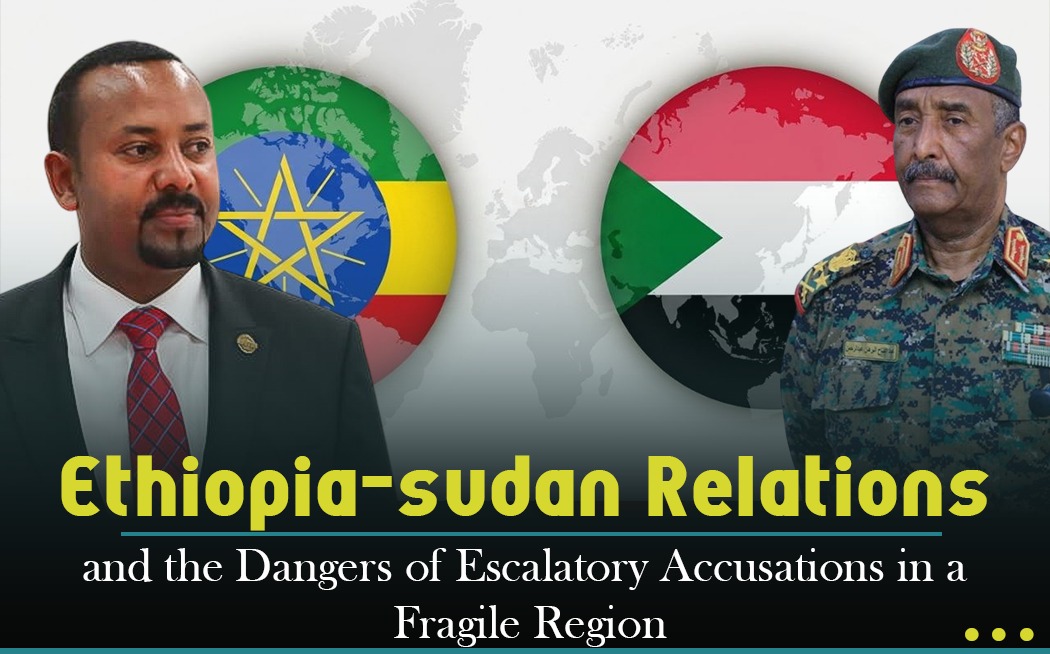
Regional Stability, Escalatory Narratives, and the Risks of Geopolitical Spillover
The latest accusations by Sudanese officials alleging Ethiopian involvement in drone strikes targeting Khartoum International Airport arrive at a moment when Sudan itself is facing one of the gravest state collapses in modern African history. Beyond the immediate diplomatic friction, the allegations reveal a far deeper regional problem: the growing tendency to externalize Sudan’s internal crisis and frame neighboring states through the lens of militarized suspicion rather than cooperative security.
On 5 May 2026, Sudanese Foreign Minister Mohieddin Salem and Sudanese Armed Forces (SAF) spokesperson Brigadier General Asim Awad Abdelwahab publicly accused Ethiopia of participating in drone operations against strategic sites in Khartoum. Sudan subsequently recalled its ambassador from Addis Ababa for consultations. Ethiopia’s Ministry of Foreign Affairs firmly rejected the allegations, describing them as baseless and reiterating Ethiopia’s long-standing support for peace, dialogue, and Sudanese-led political resolution.
The significance of these accusations lies not only in the diplomatic exchange itself, but in the wider geopolitical environment in which they emerge. Sudan’s civil war has increasingly evolved beyond a domestic power struggle into a regionalized conflict shaped by competing narratives, proxy calculations, external influence, and strategic contestation over the Red Sea corridor.
Sudan’s Civil War: A Crisis Decades in the Making
Sudan’s current conflict did not begin in April 2023. The war represents the culmination of decades of militarization, institutional fragmentation, uneven state formation, and unresolved struggles over political authority.
At the center of the conflict are two rival military forces: the Sudanese Armed Forces (SAF), led by General Abdel Fattah al-Burhan, and the Rapid Support Forces (RSF), commanded by Mohamed Hamdan Dagalo, widely known as Hemedti. The RSF traces its roots to the Janjaweed militias that emerged during the Darfur conflict in the early 2000s under the government of former President Omar al-Bashir.
Those militias were initially mobilized as counterinsurgency forces in Darfur and later evolved into a heavily armed paramilitary structure with significant economic and political influence. Over time, the RSF transformed into one of Sudan’s most powerful military actors, operating parallel to the national army while developing independent financial and regional networks.
Following the removal of al-Bashir in 2019, Sudan entered a fragile transitional process marked by tensions between civilian political forces and the military establishment. Although the SAF and RSF initially cooperated within the transitional arrangement, disputes over military integration, political control, and access to strategic resources steadily intensified.
The immediate trigger for war came in April 2023 when disagreements surrounding the integration of the RSF into the national army escalated into open confrontation. What many initially expected to be a short-lived military clash rapidly transformed into a devastating nationwide conflict affecting Khartoum, Darfur, Gezira, and large parts of Sudan’s economic and administrative infrastructure.
The humanitarian consequences have been catastrophic. Tens of thousands have reportedly been killed, millions displaced internally and externally, and vital infrastructure severely damaged. International organizations and the United Nations have repeatedly warned of famine, institutional collapse, and the growing regionalization of the conflict.
The Regionalization of Sudan’s Conflict
Sudan’s strategic geography ensures that its instability cannot remain confined within its borders. Positioned between the Horn of Africa, the Sahel, the Nile Basin, and the Red Sea, Sudan occupies one of Africa’s most geopolitically sensitive corridors.
As the war intensified, regional and international actors increasingly became entangled in Sudan’s crisis through diplomatic competition, security calculations, economic interests, and rival strategic alignments. Allegations of foreign backing for competing factions have become a recurring feature of the conflict environment.
It is within this broader context that the accusations against Ethiopia should be understood.
The claims emerge amid a rapidly militarizing regional atmosphere where political narratives are increasingly weaponized. Yet despite the seriousness of the allegations, no independently verified international evidence has publicly established Ethiopian involvement in the alleged drone attacks.
That distinction matters.
In contemporary conflicts, accusations themselves often become instruments of political messaging, diplomatic pressure, and perception management. In highly polarized environments, narratives can escalate faster than verifiable facts.
Responsible diplomacy therefore requires credible investigation mechanisms, transparency, and restraint rather than public escalation unsupported by independently corroborated evidence.
Ethiopia’s Strategic Interest Lies in a Stable Sudan
From a strategic standpoint, Ethiopia has little to gain from a prolonged and regionalized Sudanese civil war.
Sudan’s instability directly affects Ethiopia through refugee flows, cross-border insecurity, illicit arms movement, disrupted trade routes, and wider regional economic uncertainty. A fragmented Sudan increases security vulnerabilities across Ethiopia’s western frontier while simultaneously threatening broader Horn of Africa stability.
Since the outbreak of the war in 2023, Ethiopia has hosted large numbers of Sudanese refugees despite facing its own post-conflict reconstruction pressures and economic constraints. Addis Ababa has repeatedly supported diplomatic efforts led by the African Union (AU) and the Intergovernmental Authority on Development (IGAD), emphasizing ceasefire negotiations, humanitarian access, and Sudanese-led political dialogue.
Ethiopia’s official position has consistently maintained that there is no military solution to Sudan’s crisis. The Ethiopian Ministry of Foreign Affairs recently reiterated support for “an immediate humanitarian truce, followed by a sustained ceasefire and an independent, inclusive and transparent civilian-led dialogue and transition process.”
This position aligns with Ethiopia’s broader regional strategy.
Ethiopia’s long-term geopolitical priorities — including economic integration, regional connectivity, access to the Red Sea, energy cooperation, and cross-border infrastructure development — fundamentally depend on regional stability rather than prolonged interstate confrontation.
A collapsing Sudan does not strengthen Ethiopia’s strategic position; it weakens the entire Horn of Africa.
Ethiopia and Sudan: Geography Beyond Political Cycles
Despite current tensions, Ethiopia and Sudan share one of the most historically interconnected relationships in Northeast Africa.
The two countries are linked not only by geography, but by centuries of religious interaction, trade, migration, and social exchange. Border communities have long maintained economic and familial ties that transcend modern political boundaries.
Historically, Sudan hosted Ethiopian refugees during periods of civil conflict and political instability in Ethiopia. Ethiopia, likewise, has provided refuge to Sudanese civilians fleeing violence and instability.
These humanitarian traditions remain an important reminder that the relationship between the two societies extends far beyond contemporary diplomatic disagreements.
At the same time, bilateral tensions have periodically surfaced over issues such as the al-Fashaga border dispute, regional security alignments, and disagreements surrounding the Grand Ethiopian Renaissance Dam (GERD).
Yet even amid these disputes, both states remain strategically interdependent.
Neither Ethiopia nor Sudan can sustainably pursue long-term regional security through confrontation, proxy rivalry, or mutual destabilization.
The Danger of Escalatory Narratives
One of the most dangerous consequences of Sudan’s current crisis is the growing risk of geopolitical spillover.
Public accusations against neighboring countries — especially in the absence of transparent investigation — risk widening Sudan’s internal war into a broader regional confrontation.
The Horn of Africa has historically suffered from proxy conflicts in which domestic crises become entangled with wider geopolitical rivalries involving external powers, maritime competition, security alliances, and strategic access to the Red Sea.
As global and regional competition intensifies around the Red Sea corridor, local conflicts increasingly attract external influence and geopolitical manipulation. In such environments, narratives themselves become strategic instruments.
Ethiopia’s Ministry of Foreign Affairs recently warned that some accusations may be encouraged by “external patrons seeking to advance their own nefarious agenda.” While such language reflects diplomatic positioning, the broader concern is analytically significant.
Fragile regional environments are especially vulnerable to perception warfare, narrative escalation, and political polarization.
The danger is not merely rhetorical.
Escalatory accusations can inflame nationalist sentiment, narrow diplomatic space, encourage retaliatory posturing, and deepen mistrust among neighboring states already operating within an unstable security environment.
In conflict-prone regions, perception itself can become a destabilizing force.
Why African-Led Diplomacy Matters
The current tensions reinforce the urgent need for credible African-led diplomatic frameworks capable of addressing both Sudan’s internal conflict and the wider regional tensions emerging around it.
The African Union and IGAD remain essential institutional mechanisms for de-escalation, mediation, humanitarian coordination, and regional dialogue.
While these institutions have faced criticism over effectiveness and enforcement limitations, they nonetheless provide indispensable diplomatic platforms through which neighboring states can avoid direct confrontation.
Ultimately, Sudan’s crisis cannot be sustainably resolved through military victory alone.
Neither the SAF nor the RSF appears capable of securing decisive national stability through prolonged warfare. Instead, continued conflict risks accelerating state fragmentation, humanitarian collapse, economic destruction, and regional destabilization.
For neighboring states such as Ethiopia, the strategic priority is therefore clear: conflict containment, diplomatic engagement, and regional stabilization.
Conclusion
The recent accusations against Ethiopia should be understood within the broader realities of Sudan’s devastating civil war, the militarization of regional politics, and intensifying geopolitical competition across the Horn of Africa and the Red Sea corridor.
In the absence of independently verified evidence, public allegations risk aggravating an already fragile regional environment and narrowing the space for diplomacy at a moment when de-escalation is urgently needed.
More fundamentally, Sudan’s crisis demonstrates how quickly internal conflicts can generate wider geopolitical repercussions when combined with fragile interstate relations, competing narratives, and external strategic interests.
Neither Ethiopia nor Sudan benefits from prolonged hostility.
The peoples of both countries remain connected by geography, history, economic interdependence, and shared security concerns. Their futures are inseparable from the broader stability of the Horn of Africa.
For that reason, restraint, dialogue, and African-led diplomacy remain far more strategically valuable than mutual accusations, regional polarization, and narrative escalation.
A stable Sudan is not simply a Sudanese interest.
It is a strategic necessity for the future stability of the entire Horn of Africa.
By Kuchim Sileshe, IFA
Disclaimer:
The content disseminated by the Institute of Foreign Affairs (IFA) – including, but not limited to, publications, public statements, events, media appearances, and digital communications – reflects the views of individual contributors and does not necessarily represent the official positions or policies of the Institute, its partners, or any affiliated governmental or non-governmental entities.
While the IFA endeavors to ensure the accuracy, integrity, and timeliness of the information presented, it makes no representations or warranties, express or implied, regarding the completeness, reliability, or suitability of such content for any purpose. The Institute expressly disclaims any liability for errors or omissions, as well as for any actions taken or decisions made based on the information provided.
The inclusion of external links, references, or third-party resources does not constitute an endorsement by the Institute. Additionally, engagement on social media platforms – including, but not limited to, likes, shares, retweets (RTs), or reposts – shall not be interpreted as an endorsement or validation of the views expressed therein.
Readers and audiences are encouraged to exercise critical judgment and seek independent verification when interpreting or relying upon any information disseminated through publications and posts on the Institute’s platforms or representatives.