

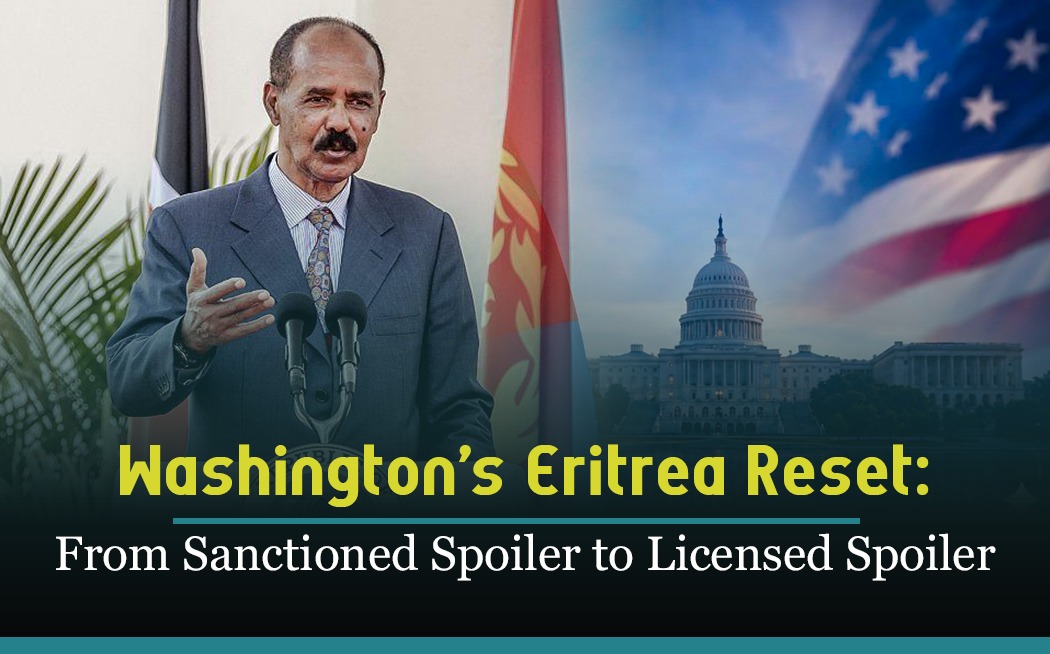
Washington’s reported plan to remove sanctions on Eritrea marks a significant moment in the evolving security architecture of the Horn of Africa and the Red Sea. On the surface, the logic appears pragmatic: Eritrea controls a long Red Sea coastline, sits opposite Saudi Arabia, and occupies a decisive position in the corridor linking the Horn, the Gulf, and the wider maritime-security ecosystem. Yet the strategic paradox is difficult to avoid. A policy designed to stabilize a volatile frontier may end up rewarding a state whose regional posture has repeatedly complicated the very stability Washington seeks to preserve.[1]
According to a Reuters report published in May 2026, the United States is preparing to remove sanctions on Eritrea, with analysts linking the move to Asmara’s strategic location along the Red Sea shipping route and Washington’s interest in easing regional tensions.[1] This is not merely a bilateral diplomatic adjustment. It reflects a broader strategic recalibration in which the Horn is no longer treated as a secondary African theater, but as part of a transregional continuum connecting Red Sea security, Gulf politics, maritime trade, and African institutional order.
That recalibration is understandable. Eritrea’s geography gives Asmara leverage that few regional actors can ignore. Its ports, coastline, and proximity to Yemen and Saudi Arabia make it relevant to shipping security and crisis management. Its relationship with Ethiopia, the Horn’s demographic and diplomatic center of gravity, also gives Eritrea outsized importance in any regional de-escalation framework. For Washington, engaging Asmara may appear to offer a channel through which Red Sea security, Ethiopia-Eritrea confidence-building, and wider geopolitical competition can be managed at once.
Historically, however, Eritrea’s strategic relevance has not translated into constructive regional integration. The United States imposed sanctions in 2021 on Eritrean entities and individuals under Executive Order 14046, citing their contribution to the crisis then affecting Ethiopia and the wider Horn.[2] Those measures were not incidental. They formed part of a pressure architecture aimed at constraining destabilizing behavior, encouraging withdrawal from contested spaces, and protecting the stability and integrity of regional states.
The current concern is therefore not whether Eritrea matters. It clearly does. The concern is whether Washington is converting Eritrea’s strategic geography into diplomatic impunity. Ethiopia has pursued a consistent regional interest in secure, negotiated, and economically viable access to the sea, a question rooted in its landlocked status and long-term development requirements. At the same time, Addis Ababa has formally communicated concerns regarding Eritrean troop presence near contested areas and alleged support for armed groups, while also signaling willingness to engage peacefully on maritime access and related issues.[3] This combination of principled sovereignty and negotiated access should be treated as an opening for regional diplomacy, not as a justification for empowering unilateral disruption.
At the same time, Asmara has weakened the very institutional channels that could help manage these tensions. In December 2025, Eritrea withdrew from the Intergovernmental Authority on Development, only two years after rejoining the regional bloc.[4] IGAD noted that Eritrea had not participated in the organization’s meetings, programmes, or activities since June 2023, while expressing continued openness to constructive engagement.[5] IGAD is one of the few African-led arenas through which Ethiopia-Eritrea tensions, Red Sea insecurity, Sudan’s war, and Somalia’s security transition can be discussed within a regional framework. Eritrea’s exit reinforces a familiar pattern: maximum sovereignty claim, minimum institutional constraint.
What we are witnessing is the possible emergence of a “licensed spoiler” model. Under this model, an actor with a record of disruption is not rehabilitated because its conduct has clearly changed, but because external powers decide that its geography has become too valuable to ignore. The spoiler is not transformed. It is repackaged as a necessary partner. Its leverage rises precisely because the surrounding security environment deteriorates.
Seen from that angle, Washington’s calculation is not irrational, but it is incomplete. The United States may believe that engagement can moderate Asmara, create channels for de-escalation, strengthen Red Sea coordination, and limit the space available to rival powers. This is the strongest argument for a reset. Isolation has not liberalized Eritrea, reduced its domestic militarization, or integrated it into regional institutions. A managed opening could, in theory, create incentives that pressure alone has failed to produce.
Yet that argument depends entirely on conditionality. Without clear benchmarks, sanctions relief risks becoming a unilateral concession rather than a calibrated instrument. Eritrea’s operating model links domestic militarization with external maneuvering. Indefinite national service sustains a highly securitized state structure; political closure reduces internal accountability; and regional disruption then becomes a mechanism for projecting strength outward while insulating the regime at home. In this sense, Eritrea’s foreign policy cannot be separated from its domestic architecture. The same state that organizes society around permanent mobilization also benefits from a neighborhood kept under strategic pressure.
In practical terms, Washington’s reset should not be judged by whether it opens a channel to Asmara. It should be judged by what that channel requires. Any serious framework would need to tie sanctions relief and diplomatic upgrading to verifiable security de-escalation, non-interference in neighboring states, renewed cooperation with IGAD and AU mechanisms, humanitarian access where relevant, and measurable reform of Eritrea’s national-service system. These conditions would not resolve the Eritrean question in full. They would, however, prevent engagement from becoming a reward for coercive leverage.
That framework would also serve Ethiopia’s constructive regional agenda. Addis Ababa’s long-term interest lies in negotiated maritime access, corridor diversification, regional economic integration, and predictable security relations with its neighbors. A stable Red Sea order cannot be built by isolating Ethiopia’s legitimate development requirements from the wider architecture of ports, trade corridors, and African-led diplomacy. Nor can it be built by allowing Asmara to convert its coastline into a veto point over regional integration. The sustainable path is one in which Ethiopia’s search for access is addressed through lawful negotiation and mutual economic benefit, while Eritrea is encouraged to re-enter regional mechanisms under clear rules of conduct.
The better approach, therefore, is conditional engagement anchored in regional architecture. Washington can speak to Asmara without laundering its behavior. It can recognize Eritrea’s Red Sea significance without converting geography into exemption. It can support Ethiopia-Eritrea de-escalation while strengthening, rather than bypassing, African institutional channels. The key test is whether the United States uses engagement to pull Eritrea into a rules-based regional framework or simply accepts Asmara’s role as a hard-edged gatekeeper on the Red Sea.
The Horn’s emerging security order is already marked by corridor competition, port politics, external military positioning, and fragile institutions. In such an environment, great powers often privilege access over accountability and short-term deterrence over long-term order. If Washington removes sanctions without enforceable conditions, it may not be stabilizing the Horn’s Red Sea frontier. It may be turning Eritrea from a sanctioned spoiler into a licensed one.
References
[1] Reuters reported in May 2026 that the United States was set to remove sanctions on Eritrea, linking the move to Eritrea’s Red Sea location and shifting regional alignments. (Reuters)
[2] The U.S. Treasury announced November 2021 sanctions on Eritrean entities and individuals under Executive Order 14046. (U.S. Department of the Treasury)
[3] Reuters reported in February 2026 that Ethiopia formally communicated concerns regarding Eritrean troop presence and support for armed groups, while noting Ethiopia’s stated openness to peaceful negotiations on maritime access. (Reuters)
[4] AP reported Eritrea’s December 2025 withdrawal from IGAD. (AP News)
[5] IGAD said Eritrea had not participated in IGAD meetings, programmes, or activities since June 2023 and stated that it remained open to constructive engagement. (igad.int)
By Dinaol Ibraahim, IFA
Disclaimer:
The content disseminated by the Institute of Foreign Affairs (IFA) – including, but not limited to, publications, public statements, events, media appearances, and digital communications – reflects the views of individual contributors and does not necessarily represent the official positions or policies of the Institute, its partners, or any affiliated governmental or non-governmental entities.
While the IFA endeavors to ensure the accuracy, integrity, and timeliness of the information presented, it makes no representations or warranties, express or implied, regarding the completeness, reliability, or suitability of such content for any purpose. The Institute expressly disclaims any liability for errors or omissions, as well as for any actions taken or decisions made based on the information provided.
The inclusion of external links, references, or third-party resources does not constitute an endorsement by the Institute. Additionally, engagement on social media platforms – including, but not limited to, likes, shares, retweets (RTs), or reposts – shall not be interpreted as an endorsement or validation of the views expressed therein.
Readers and audiences are encouraged to exercise critical judgment and seek independent verification when interpreting or relying upon any information disseminated through publications and posts on the Institute’s platforms or representatives.