

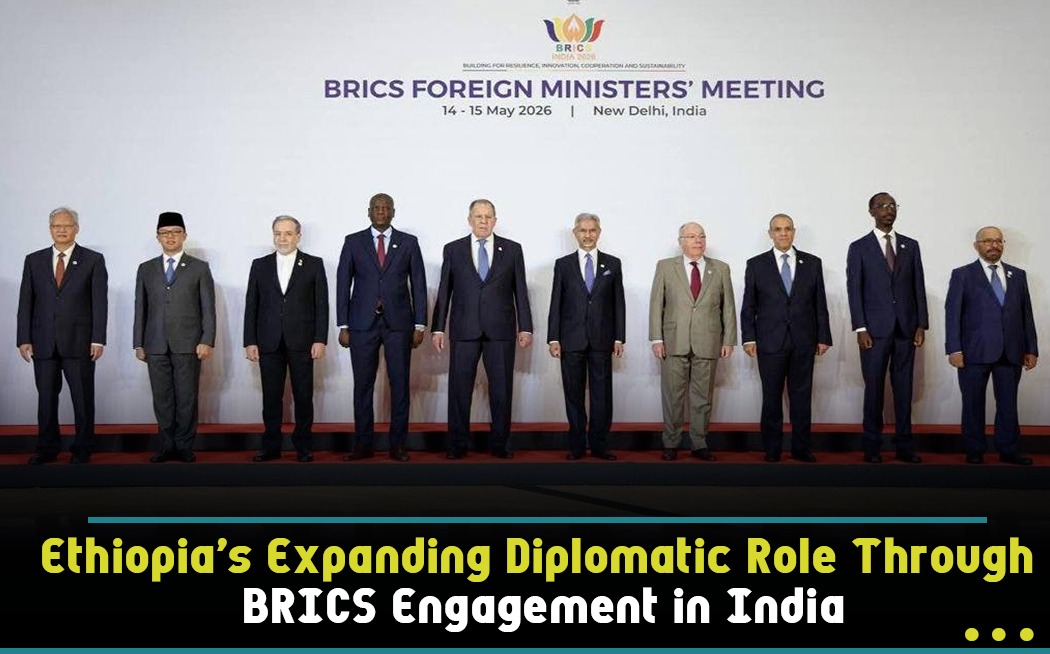
Ethiopia’s Minister of Foreign Affairs, Gedion Timothewos, is participating in the BRICS Ministers of Foreign Affairs Meeting taking place in New Delhi, India, from May 14–15, 2026. Convened under India’s BRICS Chairship, the meeting is being held under the theme: “Building for Resilience, Innovation, Cooperation, and Sustainability.” The gathering brings together foreign ministers and senior officials from BRICS member states to deliberate on pressing international political, economic, and security issues shaping the contemporary global order.
Ethiopia and BRICS: A New Chapter in Foreign Policy
Ethiopia officially joined BRICS in January 2024, becoming one of the new members admitted during its historic expansion process announced at the 15th BRICS Summit in Johannesburg, South Africa, in 2023. Ethiopia’s accession marked a major turning point in the country’s diplomatic and economic trajectory, positioning Addis Ababa within one of the most influential coalitions of emerging economies in the world.
Originally formed by Brazil, Russia, India, China, and South Africa, BRICS has evolved into a major geopolitical and economic platform representing a significant share of the world’s population, global GDP, energy production, and emerging markets. The expansion of it reflects a broader transformation in global politics, where developing countries increasingly seek stronger representation, alternative financial mechanisms, and a more balanced international system.
For Ethiopia, joining BRICS was not merely symbolic; it represented a strategic foreign policy achievement with long-term diplomatic, economic, and geopolitical implications.
Ethiopia’s participation in BRICS carries several important implications for the country and the broader African continent.
1. Economic Opportunities and Alternative Partnerships
Membership provides Ethiopia with expanded access to emerging markets, investment
opportunities, infrastructure financing, and development cooperation. As Ethiopia continues its economic reform agenda and post-conflict recovery efforts, BRICS offers an alternative avenue for economic engagement beyond traditional Western-led financial institutions.
BRICS’ emphasis on South-South cooperation aligns closely with Ethiopia’s long-standing foreign policy orientation of diversifying partnerships and strengthening ties with emerging economies. Increased collaboration with countries such as India, China, Brazil, and the Gulf- connected BRICS economies could contribute to industrial development, technology transfer, energy cooperation, and trade expansion.
BRICS membership offers Ethiopia four distinct strategic benefits: access to infrastructure financing devoid of strict policy conditionalities, local currency financing that mitigates vulnerability to the US dollar, opportunities for South-South technology transfer partnerships, and heightened diplomatic leverage within emerging economy coalitions that command over 40% of global GDP (BRICS, 2024). Consequently, Ethiopia stands to continually benefit from this platform while effectively maintaining its balanced relationships with Western and other international partners.
Additionally, Ethiopia will benefit from future cooperation with the New Development Bank
(NDB)—the financial institution established by BRICS to support infrastructure and sustainable development projects across member states and developing economies.
2. Geopolitical and Diplomatic Significance
Ethiopia’s inclusion in BRICS elevates its diplomatic visibility and strategic relevance within the Global South. As the seat of the African Union and a historically influential African state, Ethiopia’s membership reinforces Africa’s growing voice within global governance discussions. The move also reflects a wider global shift toward multipolarity, where emerging powers are increasingly challenging traditional Western dominance in international institutions. Through BRICS, Ethiopia gains a platform to advocate for reforms in international finance, trade systems, debt governance, and representation within global decision-making bodies such as the United Nations Security Council and international financial institutions.
For Addis Ababa, BRICS membership strengthens its ambition to position itself as a diplomatic bridge between Africa, Asia, and the broader developing world.
3. Regional and Continental Implications
Ethiopia’s entry into BRICS has implications beyond national borders.
As one of Africa’s fastest-growing economies and a central political actor in the Horn of Africa, Ethiopia’s participation could help channel greater investment and political attention toward the region.
The membership also reinforces Africa’s importance within emerging global alliances and highlights the continent’s increasing strategic value in areas such as energy, trade corridors, population growth, and critical resources.
Ethiopia–India Relations in a Broader Strategic Context
The BRICS meeting comes at a time of intensified Ethiopia–India diplomatic engagement.
President Taye Atske Selassie has recently been in India on an official visit, signaling the strengthening relationship between Addis Ababa and New Delhi.
India and Ethiopia share longstanding historical and diplomatic ties spanning education, trade, pharmaceuticals, agriculture, and development cooperation. India has emerged as one of Ethiopia’s key investment partners, particularly in manufacturing, healthcare, and agricultural sectors.
The simultaneous presence of Ethiopia’s President and Foreign Minister in India underscores the strategic importance Ethiopia places on its relationship with New Delhi and its broader engagement with Asian emerging powers. It also reflects Ethiopia’s efforts to leverage BRICS membership to deepen bilateral and multilateral partnerships that support national development priorities.
Ethiopia’s Position at the BRICS Meeting
Addressing the high-level gathering, Foreign Minister Gedion Timothewos emphasized the urgent need for coordinated multilateral efforts to confront the growing global political and economic crises affecting both developed and developing nations.
He warned that unresolved global instability could result in severe economic disruptions, financial insecurity, and social instability transcending national borders. The Minister further stressed the importance of equitable global governance and the need for international systems that better reflect the realities and interests of developing countries.
His remarks align with broader BRICS calls for reforming global governance structures and strengthening international cooperation based on mutual respect, inclusivity, and sustainable development.
Conclusion
Ethiopia’s active participation in the BRICS Foreign Ministers’ Meeting in New Delhi reflects the country’s evolving foreign policy posture and growing role within emerging global institutions. Since officially joining BRICS in 2024, Ethiopia has sought to position itself as a key African voice within the Global South while pursuing diversified economic and diplomatic partnerships.
As global power dynamics continue to shift toward a more multipolar order, Ethiopia’s engagement within BRICS may increasingly shape its economic opportunities, diplomatic influence, and strategic positioning both regionally and internationally.
By 𝐁𝐞𝐦𝐧𝐞𝐭 𝐀𝐥𝐞𝐦𝐚𝐲𝐞𝐡𝐮 @IFA
Disclaimer:
The content disseminated by the Institute of Foreign Affairs (IFA) – including, but not limited to, publications, public statements, events, media appearances, and digital communications – reflects the views of individual contributors and does not necessarily represent the official positions or policies of the Institute, its partners, or any affiliated governmental or non-governmental entities.
While the IFA endeavors to ensure the accuracy, integrity, and timeliness of the information presented, it makes no representations or warranties, express or implied, regarding the completeness, reliability, or suitability of such content for any purpose. The Institute expressly disclaims any liability for errors or omissions, as well as for any actions taken or decisions made based on the information provided.
The inclusion of external links, references, or third-party resources does not constitute an endorsement by the Institute. Additionally, engagement on social media platforms – including, but not limited to, likes, shares, retweets (RTs), or reposts – shall not be interpreted as an endorsement or validation of the views expressed therein.
Readers and audiences are encouraged to exercise critical judgment and seek independent verification when interpreting or relying upon any information disseminated through publications and posts on the Institute’s platforms or representatives.