

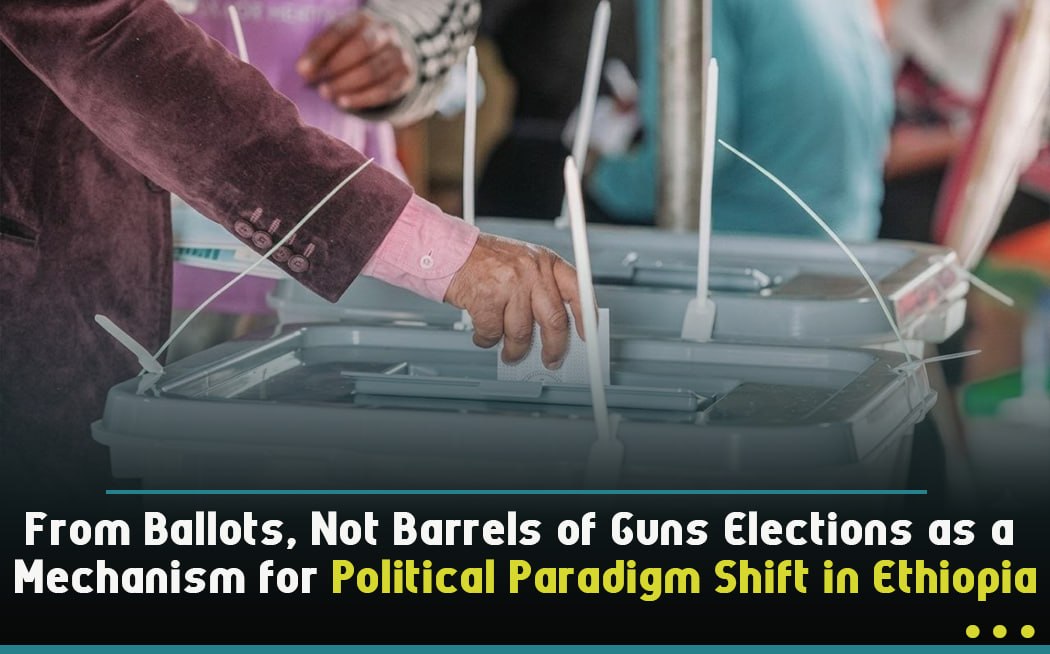
Elections as a Mechanism for Political Paradigm Shift in Ethiopia
Executive Summary
Ethiopia’s modern political history has been characterized by recurrent cycles of armed struggle, attempted coups, mass protest, and abrupt regime changes. While these mechanisms have periodically succeeded in dislodging incumbent authorities, they have not produced the end goals and aspirations of the Ethiopian people, such as sustainable peace, a democratic political system, a stable political culture, and development. Rather, the long-period trends of violent political changes in Ethiopia have entrenched militarized political behaviors, authoritarian political rules of thumb, weakened institutions, and normalized violence as legitimate means of political contestation and change. In this policy brief, I argued that repeated and continuous electoral practices can change political norms and playing fields from coercion to consent, from the bush to meeting hall dialogues, from confrontation to dialogue, from enmity to loyal opposition, and from militarized competition to civic engagement. Therefore, exercising credible, inclusive, and institutionalized elections is the only viable pathway toward long-term democratic transformation, sustainable peace, and development in Ethiopia.
Historical Contexts: Armed Struggle and Protest in Ethiopia
Over the last 120 years, the modern Ethiopian state’s journey has been marked by persistent political struggle to establish a democratic political system, sustain peace, and achieve development, through reliance on force and mass protests (Bahru, 2002; Clapham, 2018; Young, 1997). These efforts have taken many forms, including peasant rebellions (the Bale peasant rebellion, the Gojjam peasant uprising, and the First Woyane movement), organized armed struggles (the TPLF, ONLF, OLA, etc.) (Young, 1997), and mass popular movements (Ethiopian Student Movements and Youth Protests). In modern Ethiopia, from imperial regimes to the contemporary period, these movements and struggles have reflected a deep and enduring demand for political changes.
Throughout these periods, several uprisings and political actions succeeded in removing leaders or overturning regimes. For instance, the 1916 palace coup, supported by the Battle of Segale, and the Anchim War facilitated the coronation of Haile Selassie I as regent in 1916 and Emperor in 1930; the 1960 attempted coup shaken the imperial legitimacy; the Ethiopian Student Movements (ESM) played a crucial role in the revolutionary changes of the imperial regime in Ethiopia in 1974; coordinated armed struggles led to the fall of Derg regime in 1991 and the 2018 popular protest aka (youth protest:-Qerro, fano, ejeto, zerma, etc) realized the end of the EPRDF dominance or authoritarian rule. Each of these violent, protest, and militant forms of political change marked a turning point in the country’s political trajectory. For instance, the 1974 Ethiopian revolution and resultant downfall of the imperial regime addressed land issues through land reform policy (by addressing the question of land to the tiller), the downfall of the Derg regime in 1991 brought the legal and institutional recognition of diversity (addressing the question of nationality), and the 2018 protest brought the current political reform.
However, these changes have two limitations. First, these periodical violent regime changes are realized at the immense cost of human life, widespread destruction of materials, and erosion of institutional legacy. Second, the political changes brought regime change without structural transformation, which continued to serve as structural constraints on the establishment of a democratic political system, sustainable peace, and development. Despite their success in changing governments and addressing some national questions, these movements have largely fallen short of achieving their ultimate national goals, namely, establishing a stable democratic political system, lasting peace, and sustainable development. It has been more than 60 years since Ethiopian Students streamlined triple questions in the Ethiopian state: peace, democracy, and development. After all these years, the issues of development, peace, and democracy are still at their initial and fresh stages. Therefore, the modern Ethiopians’ repeated cycle of upheaval and regime change has not translated into an enduring democratic political system and sustainable peace; rather, this long history of struggles has contributed to the development of a political culture characterized by militancy, coercion, protest-oriented hierarchy, and zero-sum game competition where power is often perceived as something to be seized by force and held exclusively. Such political culture stands in contrast to the foundational principles of democratic political culture, which emphasize compromise, tolerance, negotiation, accountable governance, and civic engagement.
Why are armed struggle and protest politics do not Sustain Democracy?
In the context of 60 years of violent and mass movements, Ethiopia’s experience of political change indicates that leadership or regime changes are not a sufficient condition for establishing a genuine democratic political system. Regime change or political turnover is not a guarantee for the birth of democracy, rather democratization is rooted in the cultivation and exercise of democratic political culture. Without building and fostering the political values and practices that support inclusivity, mutual respect, tolerance, dialogue, loyal opposition, and institutional integrity, the struggle for democracy remains a mere wish and paper values. Therefore, undemocratic political norms, practices, and behaviors never give birth to a democratic political system. While mass political protests and armed struggle are key in deposing authoritarian regimes and bringing political changes, the nature of the new political system, either the rebirth of authoritarianism or a democratic political system, is determined by the political tools employed in the transitional process. No democracy is born from an undemocratic political process; armed struggle and mass political protests do not pave the way to democracy. This is because;
First, these political mechanisms often produce short-term victories but undermine enduring institutional stability and legitimacy. Governance systems established through violence always lack legitimacy and rely mainly on coercion, making inclusive governance difficult to establish. Second, dependence on violence as the rule of the game has gradually led to the militarization of political culture. For instance, in Ethiopian political narratives, sociological discourses, music, heroic ideas, and inter-party relations are heavily militarized and shaped by violent traditions. Also, leadership that develops in the context of conflict and violent political conditions tends to emphasize discipline, hierarchy, commands, and controls, often at the expense of deliberation and inclusivity. These all panniers the realization of democratic political principles, values, and practices such as compromise, negotiation, dialogue, and tolerance for political dissent (Lyons, 2019).
Third, the culture of armed struggle tends to reproduce itself. When the source of power is perceived as a force or from the barrel of a gun, opposition political forces are indirectly incentivized to adopt similar coercive or forceful strategies to achieve political power. Because such political culture perpetuates a cycle of political instability and undermines the legitimacy of peaceful political processes (Tilly, 2003). Similarly, massive protests, although less violent and destructive than armed struggle, also have negative consequences on the democratization process. Though they mobilize large segments of the population and pressure the government to change policy or the government itself, they always lack the organizational structure and peaceful political culture necessary to sustain democratic political transitions. Without institutions and a peaceful political culture, protest-driven change risks devolving into fragmentation or renewed conflict.
Election as a Transformative Political Culture: Elites, Citizens and Institutions
On the contrary, elections as a source of political power fundamentally alter governance and the political system by shifting political culture and practices from a zero-sum power struggle to an electoral contest for public support. Elections, by nature, introduce uncertainty, meaning the outcomes are not predetermined by existing power/force accumulation but are decided through the willing voting of citizens, which encourages politicians to focus on persuasion, negotiation, and dialogue rather than coercion (Przeworski, 1992). The real transformative power of an election comes from its repeated occurrence over time. Electoral cycles can gradually build trust in institutions, foster cultural transformation, normalize political competition, and promote accountability and responsibility. As Lindberg (2006) rightly argued, even flawed elections can help transform political culture if they are conducted incrementally and integrated into broader political reforms. Since establishing democratic political cultures among elites, citizens, and institutions depends on repeated practices, the true impacts of elections lie in these ongoing processes. Democratic political institutions and cultures develop through persistence, repetitive practices, and civic education.
In Ethiopia, the concept of elections was formally incorporated into the legal system through the 1955 Revised Imperial Constitution. Since then, the country has experienced several electoral processes, marked by both progress and setbacks, until the adoption of the 1995 FDRE Constitution. The 1995 Constitution introduced a modern electoral framework grounded in political pluralism, universal suffrage, periodic elections, and multiparty participation. Since its adoption, Ethiopia has held six rounds of periodic general elections and is now approaching its seventh term.
Although the six consecutive elections held since 1995 have frequently been criticized for their restricted political space, limited civil society participation, constraints on media freedom, and political repression by the ruling party, the country’s three decades of electoral experience have nevertheless produced important democratic gains and institutional lessons (Aalen & Tronvoll, 2009). First, despite its limitations, the National Election Board of Ethiopia (NEBE) has endured as a key democratic institution. Particularly since 2018, relatively more independent and professionally competent electoral boards have begun to emerge. The continuity and survival of the electoral board represent an important institutional memory and democratic milestone necessary for the development of a stable democratic political system.
Second, some elections have been regarded as meaningful democratic milestones that demonstrated the potential of elections to address Ethiopia’s political challenges peacefully and at relatively low cost. For example, according to Aalen and Tronvoll (2009), the first two Ethiopian elections were generally viewed as an important initial step toward democratic practice in Ethiopia. More significantly, the 2005 general election became a major test of Ethiopia’s political process, demonstrating the possibility that democratic elections could address the country’s political problems (Samatar, 2005). The public debates, campaign activities, political issues raised, growing voter awareness, and the preparedness of opposition political parties all indicated the potential for democratization in Ethiopia. However, the momentum of democratization was undermined by weak democratic political culture and the lack of political tolerance and resilience among political elites (Aalen & Tronvoll, 2009; Samatar, 2005). Similarly, the 2021 sixth general election was conducted through a relatively smoother process under a comparatively independent electoral board, and it became one of the few Ethiopian elections in which participating opposition parties broadly accepted the democratic legitimacy of the process and election results.
Thus, the six consecutive rounds of periodic elections in Ethiopia have generated valuable democratic experiences and practical lessons for the country’s democratization process. These include the development of a culture of political campaigns, public debates, party politics, policy-based political programs, and political pluralism. Overall, the balance sheet of Ethiopia’s electoral experience suggests that democratization has the potential to address many of the country’s political challenges. However, achieving this requires persistence, stronger democratic institutions, and a genuine transformation in political culture.
To initiate the politics of persistence and bring about a genuine political culture shift from coercion to peaceful dialogue, changes are necessary across three interconnected levels: elites, citizens, and institutions. First, there must be an elite political culture transformation from a dominance/zero-sum game/enemy political mindset to a loyal opposition/compromise/dialogue/negotiation political mindset. This means elites accepting electoral uncertainty, respecting results, and engaging in dialogue and negotiation with opponents. Significantly, elites need to understand that losing an election isn’t political extinction, nor is winning a permanent seizure of power; instead, it is part of an ongoing, legitimate power cycle within a fixed period. Second, citizens are the backbone, owners, and guardians of electoral democracy. A democratic political system demands active citizens who tolerate diverse views and reject violence as a strategy to seize political power. Therefore, citizens’ civic education and engagement are vital in enhancing democratic political culture. Third, elite political exercise and citizens’ engagement are realized through institutions. Thus, a democratic institution is the third pillar of the democratization process. For democracy to flourish, it requires impartial courts, independent electoral management bodies, a strong civil society, and a strong and free media. In the absence of strong and impartial institutions, elections tend to reinforce existing power structures rather than transform them (Diamond, 1999). On the contrary, all these changes do not come overnight. It requires gradual institutional and behavioral changes, as well as construction. Therefore, building a democratic political system is essential but time-consuming and requires commitment. Once realized, the three drivers of electoral democracy reinforce each other: credible institutions encourage or force elites to follow the rules and increase citizens’ trust in the system. This gradually shifts political culture from violence and protest-oriented unrest to democratic consolidation.
Conclusions and implications
In developing countries with a long history of armed struggle and regime changes through barrels of guns, democratic elections are a challenging culture. It needs elites, citizens, and institutions to make gradual behavioral changes and commitments. Because it is not a one-shot activity, it is a comprehensive, long-term political culture paradigm shift project. Global experiences have shown that elections offer a pathway toward a more stable and inclusive political order. While not a panacea for all problems, elections provide a relatively effective mechanism for gradually transforming political culture, shifting power source from coercion to consent, from imposition to dialogue, and from zero-sum game politics to win-win solutions. Above all, it brings the political transition from barrels of guns to ballots. Therefore, to transform Ethiopian political culture from polarization, zero-sum games, militancy, and coercion to dialogue, negotiation, loyal opposition, and win-win political discourse, all Ethiopians must prioritize:
- Credible and inclusive electoral systems.
- Strengthen independent and impartial electoral bodies
- Ensuring a level playing field for political parties, which includes protecting the rights and freedoms of opposition political parties
- Investing in and promoting democratic values and discouraging the normalization of violence as a means of playing politics
- Expanding civil education
- Expanding and investing in inter-party and inter-group dialogues
References
Aalen, L. and Tronvoll, K. (2009). The End of Democracy? Curtailing Political and Civil Rights in Ethiopia. Review of African Political Economy, 36(120), pp.193–207.
Bahru Zewde. (2002). A History of Modern Ethiopia, 1855–1991. Addis Ababa: Addis Ababa University Press.
Clapham, C. (2018). The Horn of Africa: State Formation and Decay. Oxford: Oxford University Press.
Diamond, L. (1999). Developing Democracy: Toward Consolidation. Johns Hopkins University Press.
Lindberg, S. I. (2006). Democracy and Elections in Africa. Baltimore: Johns Hopkins University Press.
Lyons, T. (2019). The puzzle of Ethiopian politics. Boulder, Colorado Lynne Rienner Publisher.
Przeworski, A. (2003). Democracy and the market: political and economic reforms in Eastern Europe and Latin America. Cambridge: Cambridge University Press.
Samatar, A.I. (2005). The Ethiopian Election of 2005: A Bombshell & Turning Point? Review of African Political Economy, [online] 32(104/105), pp.466–473.
Tilly, C. (2003). The Politics of Collective Violence. Cambridge: Cambridge University Press.
Young, J. (1997). Peasant Revolution in Ethiopia: The Tigray People’s Liberation Front, 1975–1991. Cambridge: Cambridge University Press.
About the author
Shimellis Hailu Dessie is director general of Europe and America Affairs Department at the Institute of Foreign Affairs.
Disclaimer:
The content disseminated by the Institute of Foreign Affairs (IFA) – including, but not limited to, publications, public statements, events, media appearances, and digital communications – reflects the views of individual contributors and does not necessarily represent the official positions or policies of the Institute, its partners, or any affiliated governmental or non-governmental entities.
While the IFA endeavors to ensure the accuracy, integrity, and timeliness of the information presented, it makes no representations or warranties, express or implied, regarding the completeness, reliability, or suitability of such content for any purpose. The Institute expressly disclaims any liability for errors or omissions, as well as for any actions taken or decisions made based on the information provided.
The inclusion of external links, references, or third-party resources does not constitute an endorsement by the Institute. Additionally, engagement on social media platforms – including, but not limited to, likes, shares, retweets (RTs), or reposts – shall not be interpreted as an endorsement or validation of the views expressed therein.
Readers and audiences are encouraged to exercise critical judgment and seek independent verification when interpreting or relying upon any information disseminated through publications and posts on the Institute’s platforms or representatives.