

A Method, Not a Mood
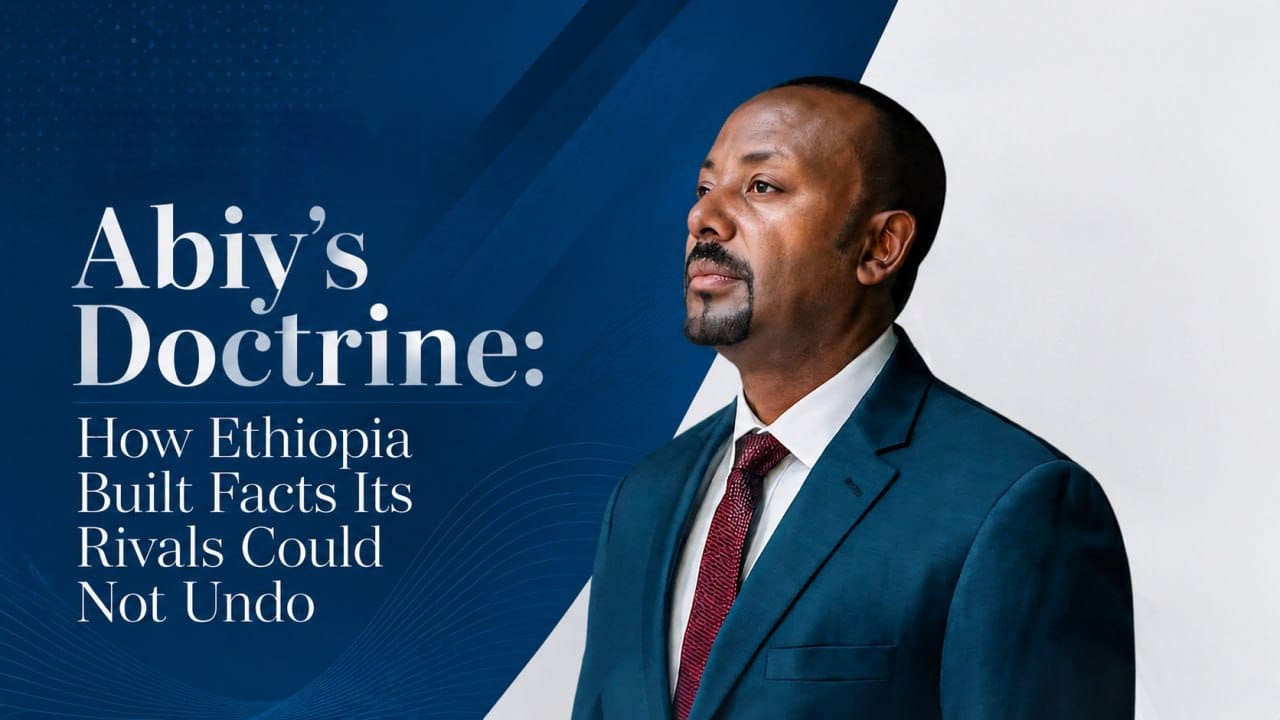
Ethiopia’s transformation since 2018 is usually scored as a ledger of intentions: a liberal opening that soured, a Nobel laureate who went to war, a reformer who centralised. That accounting misses the organising logic of the period. The defining feature of Abiy Ahmed’s statecraft is not ideology but method — the conversion of structural weakness into settled fact, executed so that rivals are left contesting a reality rather than vetoing a plan. A landlocked economy, a contested river, and an encircling coalition were each treated not as constraints to be negotiated indefinitely but as conditions to be altered on the ground. The wager is that facts, once built, outlast the objections to them. Three theatres show the method working; a fourth, the election, illustrates how the same logic is increasingly being applied to the slower and more demanding work of institutional continuity and political maturation.
Reform Under Fire
The most counter-intuitive achievement is economic. A government prosecuting a civil war, absorbing pandemic and commodity shocks, and carrying distressed external debt is not supposed to simultaneously dismantle a half-century-old statist model. Ethiopia attempted both at once. It floated the birr, opened banking and telecommunications to foreign capital, and restructured its external debt under the G20 Common Framework, anchored by a four-year Extended Credit Facility agreed with the International Monetary Fund in 2024.[^1] The payoff is now measurable. The Fund’s April 2026 outlook projects 9.2 percent growth — the fastest on the continent and more than double the sub-Saharan average — and its January 2026 review judged the outcomes better than anticipated, citing accumulating reserves, falling inflation and stronger revenue.[^2]
The strategically significant detail is composition rather than headline. Unlike peers whose expansion rides a single commodity cycle, Ethiopian growth draws on manufacturing, construction, mining and agriculture together, a breadth that makes the trajectory harder to reverse and less hostage to any one price.[^3] Reform did not pause for the war; it advanced inside it, which is why the result now functions as an accomplished fact rather than a pledge.
The Nile, Redrawn
The Grand Ethiopian Renaissance Dam is the method in its purest form. Inaugurated on 9 September 2025 as Africa’s largest hydroelectric project, generating above 5,000 megawatts and financed domestically through bonds and citizen subscription rather than external lending, it closed a fifteen-year contest not with a signature but with a switch.[^4] Egypt had abandoned negotiations in late 2023 and carried its objection to the United Nations Security Council; by the inauguration its protest had narrowed to a letter, while the presidents of Kenya, Somalia and Djibouti attended the ceremony.[^5]
The deeper shift is structural and legal. For a century the river was governed by the 1929 and 1959 treaties that reserved its flow to the two downstream states and assigned the upstream sources nothing. By completing the dam without a binding tripartite accord, and through the parallel ratification of the Cooperative Framework Agreement among upstream riparian states while the downstream pair stayed outside it, Ethiopia did not win the argument about the colonial water order so much as retire that order’s enforceability.[^6] The objection persists; the fact persists more durably.
Unmaking an Encirclement
The regional theatre is where the method is least understood and most consequential. Through 2024 Egypt assembled a counter-Ethiopian alignment with Eritrea and Somalia, formalised in an October tripartite pledge and reinforced by an Egyptian bid to place troops in Somalia under the African Union mission — an encirclement designed to pressure Ethiopia over the river.[^7] Ethiopia answered not with force but by removing the coalition’s keystone. The Türkiye-mediated Ankara Declaration of December 2024 reconciled Ethiopia and Somalia, affirming Somali sovereignty while acknowledging Ethiopia’s pursuit of negotiated sea access under Somali authority, and broke the momentum of the tripartite axis within weeks.[^8]
Material reality reinforced the diplomacy. Within the African Union mission, Ethiopia contributes roughly 2,500 troops against Egypt’s 1,091, and remains the operationally indispensable force against a resurgent al-Shabaab, whereas the Egyptian posture sits distant from the ground it claims to secure.[^9] An encirclement that looked formidable on a map proved hollow in execution, because Ethiopia held the asset the region actually needed — security depth — and its rival did not.
The Democratic Dividend of Continuity
If the economy, the Nile, and regional diplomacy demonstrate Ethiopia’s capacity to reshape its external realities, the 1 June 2026 election highlights a different dimension of statecraft: the gradual consolidation of political institutions capable of sustaining national continuity through periods of profound change. Elections are often judged solely by the competitiveness of the immediate contest. Yet in states navigating post-conflict recovery, economic transformation, and major institutional reforms simultaneously, the more consequential question is whether political processes continue to function, adapt, and endure. By that measure, the 2026 vote represents an important stage in Ethiopia’s broader process of political development.
The significance of the election lies not merely in who wins, but in what the exercise itself demonstrates. Less than four years after the Pretoria Agreement ended one of Africa’s most devastating conflicts, Ethiopia has maintained its constitutional electoral calendar and preserved the institutional mechanisms through which political authority is renewed. In many post-conflict environments, elections are postponed, transitional arrangements extended, or political uncertainty allowed to linger. Ethiopia instead has chosen continuity. That decision reflects a growing confidence in the state’s ability to manage competition through institutions rather than exceptional measures.
The process also reflects a political arena that continues to widen and evolve. Recent electoral reforms lowered the parliamentary threshold for representation, dozens of opposition parties secured accreditation, and the contest has drawn participation from political actors representing a broad range of ideological and regional constituencies.[^11] These developments do not suggest the completion of democratic consolidation; no political system emerging from conflict reaches that point quickly. They do, however, point toward a gradual process of institutional maturation in which participation, representation, and electoral administration become more deeply embedded with each successive cycle.
Viewed through this lens, the election is best understood not as a verdict on Ethiopia’s democratic destination but as evidence of an ongoing democratic trajectory. The strategic significance of the vote lies in its contribution to continuity, predictability, and institutional legitimacy. Just as economic reforms and infrastructure projects seek to build durable foundations for national development, repeated electoral cycles help establish the habits, expectations, and political norms upon which a more mature democratic order ultimately rests.
The Doctrine’s Enduring Legacy
Judged as a morality tale, the Abiy era resists a clean verdict. Judged as statecraft, its signature is unmistakable: a landlocked, river-dependent, encircled state altered the facts that defined its vulnerability faster than its rivals could codify objections to them. The economy grows fastest on the continent; the dam stands and generates; the encircling coalition is broken; the maritime question has moved from rhetoric to negotiation. Equally important, Ethiopia has maintained a process of political institutionalization through a period of extraordinary national strain. The 2026 election is therefore not merely another political event but part of a broader effort to anchor continuity, legitimacy, and orderly political succession within durable institutions. The country has demonstrated an ability to transform strategic constraints into lasting realities. The gradual strengthening of its political institutions may prove to be the most consequential irreversibility of all.
Notes
[^1]: Background on the macroeconomic reform programme — exchange-rate liberalisation, the opening of banking and telecommunications, debt treatment under the G20 Common Framework, and the four-year Extended Credit Facility of approximately US$3.4 billion approved by the International Monetary Fund in 2024. Birr Metrics, citing IMF, April 2026.
[^2]: International Monetary Fund, World Economic Outlook (April 2026) and Regional Economic Outlook for sub-Saharan Africa; fourth ECF review completed 16 January 2026, disbursing about US$261 million and bringing total disbursements to roughly US$2.18 billion. Finance in Africa; The African Mirror, January–April 2026.
[^3]: On the diversified composition of growth across manufacturing, construction, mining and agriculture. Africa Business Communities; Serrari Group analysis, April 2026.
[^4]: On the Grand Ethiopian Renaissance Dam: inaugurated 9 September 2025, installed capacity above 5,000 megawatts, financed domestically through bond sales and citizen contributions. Fanack Water, March 2026; The Reporter (Ethiopia), July 2025.
[^5]: On Egypt’s termination of negotiations in late 2023, its recourse to the UN Security Council, and the attendance of the presidents of Kenya, Somalia and Djibouti at the inauguration. African Press Agency, January 2026; Ethiopia Insight, October 2025.
[^6]: On the 1929 and 1959 Nile treaties and the ratification of the Cooperative Framework Agreement among upstream riparian states while Egypt and Sudan remained outside it. The Reporter (Ethiopia), July 2025; Progress Center for Policies brief, September 2025.
[^7]: On the October 2024 Egypt–Eritrea–Somalia tripartite pledge and Egypt’s contribution of troops to the African Union mission in Somalia. Georgetown Journal of International Affairs, April 2025; African Arguments, January 2025.
[^8]: On the Türkiye-mediated Ankara Declaration of 12 December 2024 reconciling Ethiopia and Somalia. Al Jazeera, December 2024; institutional foreign-affairs analysis, October 2025.
[^9]: On the composition of the African Union mission (approximately 2,500 Ethiopian and 1,091 Egyptian troops) and the 2025 resurgence of al-Shabaab. Critical Threats Project; contemporary Horn of Africa security analysis, April 2026.
[^10]: On the 1 June 2026 election: the Prosperity Party’s 96.8 percent of seats in 2021, opposition fragmentation, narrowed civic and press space, and the absence of polling in much of Tigray. Al Jazeera, May 2026; The Conversation, May 2026; Africa Center for Strategic Studies, January 2026.
[^11]: On the July 2025 electoral law revision lowering the parliamentary threshold from fifteen to ten percent, the accreditation of roughly forty-eight opposition parties, and the ruling party’s decision not to contest several opposition-leaning localities. Africa Center for Strategic Studies, January 2026.
By IFA Staff writer
Disclaimer:
The content disseminated by the Institute of Foreign Affairs (IFA) – including, but not limited to, publications, public statements, events, media appearances, and digital communications – reflects the views of individual contributors and does not necessarily represent the official positions or policies of the Institute, its partners, or any affiliated governmental or non-governmental entities.
While the IFA endeavors to ensure the accuracy, integrity, and timeliness of the information presented, it makes no representations or warranties, express or implied, regarding the completeness, reliability, or suitability of such content for any purpose. The Institute expressly disclaims any liability for errors or omissions, as well as for any actions taken or decisions made based on the information provided.
The inclusion of external links, references, or third-party resources does not constitute an endorsement by the Institute. Additionally, engagement on social media platforms – including, but not limited to, likes, shares, retweets (RTs), or reposts – shall not be interpreted as an endorsement or validation of the views expressed therein.Readers and audiences are encouraged to exercise critical judgment and seek independent verification when interpreting or relying upon any information disseminated through publications and posts on the Institute’s platforms or representatives.