

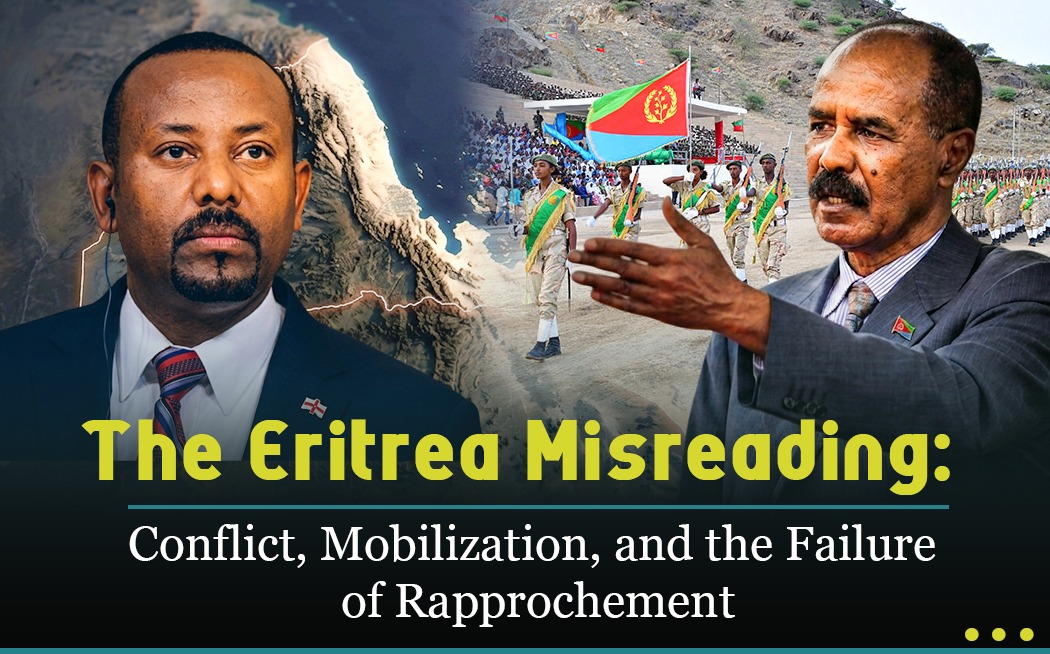
Recent signs of renewed American engagement with Eritrea reflect a familiar assumption in Horn of Africa diplomacy: that diplomatic normalization and reduced external pressure can gradually incentivize political moderation. Similar expectations shaped the optimism surrounding the 2018 Ethiopia–Eritrea rapprochement, when regional reintegration was expected to soften Eritrea’s confrontational posture and open pathways toward normalization.
That assumption proved deeply flawed.
The central problem was not simply that engagement failed to change Eritrea’s behavior. It was that external actors consistently misread the governing logic of the Eritrean state itself. Eritrea was approached as a conventionally isolated actor seeking reintegration into regional and international systems. Yet the political structure that emerged after independence appears fundamentally different. Its internal cohesion has long depended on indefinite militarization, centralized security control, and the reproduction of external threat narratives.
Eritrea’s external confrontation is not merely a foreign policy preference that can be moderated through diplomatic incentives. It is embedded within a broader model of conflict-dependent sovereignty in which domestic political control, permanent mobilization, and regional tension reinforce one another.
This is the structural reality the United States risks misunderstanding once again. The post-2018 rapprochement between Ethiopia and Eritrea generated enormous regional optimism. Ethiopia moved rapidly to restore diplomatic relations and facilitate Eritrea’s reintegration after two decades of hostility. The lifting of international sanctions reinforced the expectation that Eritrea would gradually transition from isolation toward cooperative regional engagement.
The logic behind this approach appeared straightforward. Regional integration was expected to reduce insecurity, unlock economic opportunities, and weaken the rationale for prolonged militarization. Diplomatic normalization, in effect, was treated as a mechanism of behavioral transformation.
Yet the years that followed revealed little evidence of meaningful internal political change. Indefinite national service remained intact. Independent political institutions did not emerge. Civic space remained closed. Successive reports by the United Nations Special Rapporteur on the situation of human rights in Eritrea continued documenting arbitrary detention, forced conscription, and severe restrictions on political freedoms years after normalization began.[1]
That continuity mattered because it demonstrates that external normalization was never accompanied by internal political restructuring. Eritrea accepted diplomatic rehabilitation without altering the underlying mechanisms through which the regime sustains domestic authority.
The concept of conflict-dependent sovereignty helps explain why. Conflict-dependent sovereignty describes a political order in which domestic authority depends on sustaining an environment of external threat and indefinite mobilization. Under such a system, militarization is not simply a response to insecurity; it becomes an organizing principle of governance itself. External confrontation legitimizes centralized authority, while centralized authority depends on the continuation of militarized political life.
In practical terms, permanent mobilization requires enduring threat narratives. Those narratives are reinforced through highly securitized external relationships and recurring confrontation. The cycle then reproduces itself.
Thus, the failure of behavioral normalization after 2018 becomes less surprising. International actors assumed that reintegration would moderate Eritrea’s conduct because confrontation was treated as a product of isolation. But confrontation appears more deeply embedded than that. It functions as part of the regime’s internal survival architecture.
Eritrean military involvement in northern Ethiopia demonstrated the persistence of a confrontation-centered regional posture even after normalization and sanctions relief. Multiple investigations by Human Rights Watch, Amnesty International, and The Sentry documented allegations of massacres, widespread looting, systematic destruction, and sexual violence linked to Eritrean forces operating in Tigray.[2]
More structurally significant, however, was what the war revealed about the political utility of militarized confrontation for the Eritrean state itself. The conflict revived longstanding threat narratives centered on Tigrayan political actors historically perceived by Eritrea’s leadership as existential adversaries. It reinforced indefinite mobilization and prolonged the security-centered orientation of governance.
Even after the Pretoria Agreement formally ended large-scale hostilities, international observers and United Nations reporting continued expressing concern regarding the presence of Eritrean forces inside parts of northern Ethiopia.[3] The persistence of that posture suggested that de-escalation itself carried political limits.
Recent efforts by the United States to explore renewed engagement with Eritrea appear driven partly by broader geopolitical calculations in the Horn of Africa and the Red Sea corridor. Yet the underlying policy logic still reflects a familiar belief: that diplomatic rehabilitation can gradually encourage strategic moderation. The problem is that this framework risks confusing tactical flexibility with structural transformation.
Eritrea’s leadership has historically demonstrated a willingness to engage diplomatically when such engagement reduces pressure or expands strategic maneuverability. But tactical engagement has not translated into sustained moderation of the regime’s security posture. The post-2018 experience illustrated precisely this dynamic. Diplomatic normalization altered Eritrea’s external environment without changing the political architecture through which the regime maintains internal control.
What American policymakers appear to underestimate is that peaceful regional integration may itself create internal pressures for political normalization inside Eritrea. Economic opening, reduced militarization, and freer regional interaction would gradually weaken the justification for indefinite emergency governance. For a system built around prolonged mobilization and centralized authority, that transition carries political risks.
The central lesson of the post-2018 period is therefore not simply that normalization failed. It is that external actors repeatedly misdiagnosed the nature of the Eritrean state itself. The United States now risks repeating that same analytical error. The assumption that diplomatic access and reduced pressure can moderate Eritrea’s external behavior overlooks the deeper structural reality that confrontation remains intertwined with the regime’s internal political continuity. As long as indefinite mobilization and external threat narratives remain central to governance, rapprochement alone is unlikely to alter Eritrea’s strategic posture in any durable way.
The failure of behavioral normalization after 2018 was not an accidental policy setback. It was the predictable outcome of engaging Eritrea without fully understanding the strategic logic sustaining the regime.
Footnotes
[1] United Nations Human Rights Council, Report of the Special Rapporteur on the Situation of Human Rights in Eritrea, A/HRC/56/24, May 2025.
[2] The Sentry, Power and Plunder: The Eritrean Defense Forces Intervention in Tigray, June 2025; Human Rights Watch, Ethiopia: Eritrean Forces Massacre Tigray Civilians, 2021; Amnesty International, Ethiopia: Troops and Militia Rape, Abduct Women and Girls in Tigray Conflict, 2021.
[3] United Nations Human Rights Council, Report of the Special Rapporteur on the Situation of Human Rights in Eritrea, A/HRC/56/24, May 2025.
By Hanan Hassen, IFA
Disclaimer:
The content disseminated by the Institute of Foreign Affairs (IFA) – including, but not limited to, publications, public statements, events, media appearances, and digital communications – reflects the views of individual contributors and does not necessarily represent the official positions or policies of the Institute, its partners, or any affiliated governmental or non-governmental entities.
While the IFA endeavors to ensure the accuracy, integrity, and timeliness of the information presented, it makes no representations or warranties, express or implied, regarding the completeness, reliability, or suitability of such content for any purpose. The Institute expressly disclaims any liability for errors or omissions, as well as for any actions taken or decisions made based on the information provided.
The inclusion of external links, references, or third-party resources does not constitute an endorsement by the Institute. Additionally, engagement on social media platforms – including, but not limited to, likes, shares, retweets (RTs), or reposts – shall not be interpreted as an endorsement or validation of the views expressed therein.
Readers and audiences are encouraged to exercise critical judgment and seek independent verification when interpreting or relying upon any information disseminated through publications and posts on the Institute’s platforms or representatives.