

Structural Decay, Resource Wars, and the Path to Civilian Rule
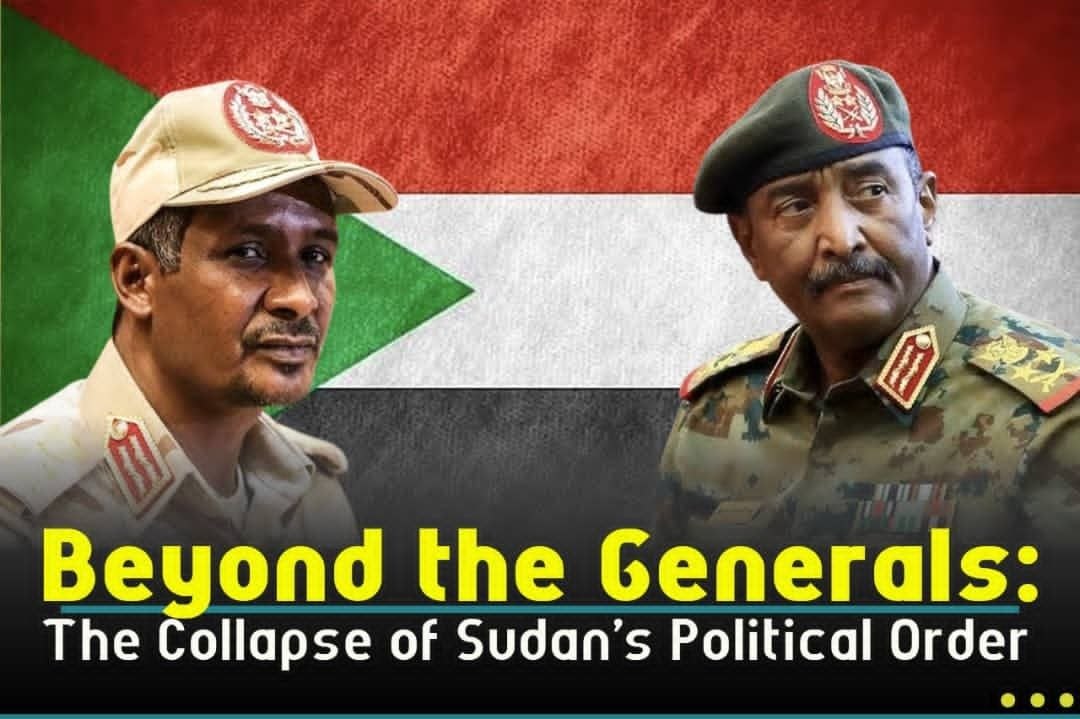
Sudan’s war is not a contest between two generals; it is the armed collapse of an extractive military-commercial order. The fighting between the Sudanese Armed Forces and the Rapid Support Forces is often narrated through Burhan and Hemedti, but the deeper unit of analysis is the architecture that produced both men: a security system that converted coercion, commercial control, and external patronage into rival claims of sovereignty. The collapse of the post-Bashir transition confirmed the structure. Civilian rule threatened not only military prestige, but the commercial autonomy of armed institutions that had learned to treat the state as a revenue base.2
The organizing logic is extractive military capitalism: armed institutions built to capture revenue rather than to govern, and to defend that capture against any civilian order that would constrain it. This concept clarifies the causal chain. Military-commercial autonomy made civilian transition threatening; the failed transition hardened armed rivalry; armed rivalry became sustainable through gold and commercial holdings; those revenue streams created leverage for external patrons; and that patronage now converts Sudan’s internal war economy into a Red Sea and Horn security problem.
Tamkeen and the Origins of Military-Commercial Rule
The first layer of this architecture was tamkeen, the Bashir-era policy of “empowerment” through which regime loyalists penetrated the judiciary, civil service, security institutions, and economy. Academic and policy research has described tamkeen as a system that weakened the judiciary, replaced professional administrators with loyalists, monopolized economic sectors, and expanded paramilitary power.4 Civil society research has also shown how military and security elites used this order to capture state assets and entrench loyalist control over banks, companies, and strategic commercial sectors.
This was not simply authoritarianism. It was state design. By fusing command authority with corporate access, the old regime made the security sector both guardian and beneficiary of the state. When the civilian transition attempted to expose that economy to public authority, reform ceased to be administrative. It became existential for the armed institutions that had grown inside the state.
Two Factions, One Machine
The distinction between the SAF and the RSF is essential for accountability, but insufficient for diagnosis. The SAF is the formal army, with institutional inheritance, uniforms, barracks, and a claim to state continuity. The RSF is the deniable instrument that evolved from the Janjaweed counterinsurgency in Darfur into a paramilitary-commercial formation. The distinction matters. It does not alter the shared logic: both emerged from the same system of coercive accumulation.
The SAF’s formal status masks an expansive economic footprint. Investigative and civil society reporting has shown that Sudan’s military-security network used control of banks, import-export companies, processing plants, and corporate structures to preserve power after the coup against the civilian transition. One major reporting project identified hundreds of entities controlled by security elites and highlighted a major military-linked financial institution as a central node in the armed economy. This is why civilian demands to remove the military from non-military commercial activity struck at the economic base of the armed order.
The RSF followed the same logic through a different institutional route. Rights-focused investigative reporting linked Hemedti’s network to a major gold company and documented RSF control over a key mining area in Darfur. Later media reporting showed the RSF and allied groups moving toward a parallel political project, including a transitional charter designed to claim administrative legitimacy against the army-led authority. The relevant question is therefore no longer which commander wins. The question is who is positioned to govern the aftermath, and the answer increasingly points toward two extractive sovereignties rather than one Sudanese state.
Gold and the Leverage Architecture
Gold is the conversion belt between battlefield control and political endurance. After the loss of much oil revenue following South Sudan’s secession, gold became Sudan’s substitute hard-currency artery. Policy research has shown that both the SAF and the RSF competed for natural resources before the war, and that control of gold assets became one driver of the conflict.12 Later media reporting, citing official figures and expert assessments, showed that gold continued to flow even under wartime conditions, while much of the trade moved outside formal channels.
The leverage question follows directly. Whoever controls the revenue architecture — gold fields, commercial holdings, border routes, banking channels, and foreign access bargains — holds bargaining power beyond the next battlefield line. Media reporting on Russian efforts to secure a Red Sea naval facility showed how Sudan’s internal military economy can become a corridor asset for external actors seeking strategic positioning. This does not make any external actor the master variable of Sudan’s war. It shows how domestic coercive accumulation becomes transregional leverage.
Why Mediation Fails When It Mediates a Battle
Traditional mediation keeps failing because it treats a structural problem as a procedural one. Early diplomatic commitments focused on civilian protection, humanitarian access, ceasefires, and confidence-building measures. These were necessary instruments, but they did not target the revenue architecture that allowed both factions to absorb diplomatic pressure. A ceasefire that leaves the two military-commercial systems intact does not end the war. It suspends it.
Later civilian-centered consultations corrected part of the misdiagnosis by creating space for political and social actors outside the armed camps. Policy analysis of that process recorded a joint civilian call structured around ceasefire, democratic governance, humanitarian access, justice, and a Sudanese-owned political process. Yet the contradiction remains. Civilian consensus can articulate a political horizon, but it cannot by itself dismantle the armed economies that finance the war.
Civilian Capacity Under Fire
None of this means that personalities are irrelevant, or that an immediate ceasefire is not worth pursuing. A halt to the killing is its own imperative. The narrower argument is that a pause which leaves the two military-commercial empires standing does not end the war; it banks it for the next round. Humanitarian assessments already describe a catastrophe in which most Sudanese require aid and millions face acute food insecurity.
The strongest civilian counter-architecture is already operating under fire. Civil society documentation of the Emergency Response Rooms describes a nationwide network of local volunteer structures providing healthcare, food, education, civilian protection, evacuations, and psychosocial support across Sudan. This is not civil society as symbolism. It is governance capacity in conditions where the formal state has fractured.
The Horn’s Security Exposure
For Ethiopia, IGAD, and the wider Horn, Sudan’s war is becoming more than a neighboring crisis. It is the possible formation of a partitioned security architecture on the western side of the Red Sea, with gold revenue, foreign basing bargains, and rival administrative projects hardening into durable political geography. Recent diplomatic principles on Sudan included African, Gulf, Middle Eastern, European, and multilateral actors, confirming that the war is already treated as a regional-order question rather than a contained domestic conflict.
The structural implication is therefore clear. If mediation continues to referee the generals without targeting extractive military capitalism, Sudan’s partition will deepen even where no formal partition is signed. If, instead, Ethiopia, IGAD, and the African Union anchor a civilian-centered process that follows the money as seriously as it follows the guns, the region can begin shifting leverage away from armed extraction and toward civilian authority. Sudan’s war may not end at the next negotiating table. It may end only when the revenue architecture that keeps the war alive is made politically unusable.
References
- Council on Foreign Relations, “Civil War in Sudan,” Global Conflict Tracker, updated 8 May 2026, https://www.cfr.org/global-conflict-tracker/conflict/power-struggle-sudan.
- Council on Foreign Relations, “Civil War in Sudan,” Global Conflict Tracker, updated 8 May 2026, https://www.cfr.org/global-conflict-tracker/conflict/power-struggle-sudan; Sudan Tribune, “Sudanese stakeholders sign Political Framework Agreement,” 5 December 2022, https://sudantribune.com/article266523/.
- Catherine Cartier, Eva Kahan and Isaac Zukin, “Breaking the Bank: How Military Control of the Economy Obstructs Democracy in Sudan,” C4ADS, 29 June 2022, https://c4ads.org/reports/breaking-the-bank/.
- Center for Contemporary Arab Studies, “Authoritarian Legacies and the War in Sudan,” Georgetown University, 2025, https://ccas.georgetown.edu/ccas-newsmagazine/authoritarian-legacies-and-the-war-in-sudan/.
- Suliman Baldo, “Gold and the War in Sudan: The Securitization of Sudan’s Gold Sector,” Chatham House, 26 March 2025, updated 24 March 2026, https://www.chathamhouse.org/2025/03/gold-and-war-sudan/02-securitization-sudans-gold-sector.
- Center for Contemporary Arab Studies, “Authoritarian Legacies and the War in Sudan,” Georgetown University, 2025, https://ccas.georgetown.edu/ccas-newsmagazine/authoritarian-legacies-and-the-war-in-sudan/.
- Catherine Cartier, Eva Kahan and Isaac Zukin, “Breaking the Bank: How Military Control of the Economy Obstructs Democracy in Sudan,” C4ADS, 29 June 2022, https://c4ads.org/reports/breaking-the-bank/.
- Mat Nashed, “Sudan’s Economy Dominated by Military Interests: Report,” Al Jazeera, 29 June 2022, https://www.aljazeera.com/news/2022/6/29/sudan-economy-dominated-by-military-interests-report.
- “Framework Agreement — Final English Text,” 5 December 2022, https://redress.org/storage/2022/12/Framework-Agreement-Final-ENG-05122022.pdf.
- Global Witness, “Exposing the Financial Network Behind Hemedti’s RSF in Sudan,” 9 December 2019, https://globalwitness.org/en/campaigns/conflict-resources/exposing-rsfs-secret-financial-network/.
- Reuters, “Sudan’s RSF and Allies Formalise Vision for Parallel Government,” 5 March 2025, https://www.reuters.com/world/africa/sudans-rsf-allies-formalise-vision-parallel-government-2025-03-04/.
- Suliman Baldo, “Gold and the War in Sudan,” Chatham House, 26 March 2025, updated 24 March 2026, https://www.chathamhouse.org/2025/03/gold-and-war-sudan/03-gold-production-and-trade-during-war.
- Associated Press, “In Sudan’s War Economy, Gold Keeps Flowing as Miners Risk Mercury and Collapse,” 25 May 2026, https://apnews.com/article/426486b65041026256e6efa84dec6fdd.
- Reuters, “Russian Red Sea Base Deal Still on the Table, Sudanese FM Says,” 12 February 2025, https://www.reuters.com/world/russia-sudan-agree-red-sea-naval-base-sudanese-foreign-minister-says-2025-02-12/.
- U.S. Department of State, “Jeddah Declaration of Commitment to Protect the Civilians of Sudan,” 11 May 2023, https://2021-2025.state.gov/jeddah-declaration-of-commitment-to-protect-the-civilians-of-sudan/; Peace Agreements Database, “Joint Statement of Commitments from Jeddah Talks,” 7 November 2023, https://www.peaceagreements.org/viewmasterdocument/2533.
- Zekarias Beshah, “The Third International Conference on Sudan Opens a New Opportunity for a Civilian-Centred Peace Process,” Amani Africa, 24 April 2026, https://amaniafrica-et.org/the-third-international-conference-on-sudan-opens-a-new-opportunity-for-a-civilian-centred-peace-process/.
- International Rescue Committee, “Crisis in Sudan: What Is Happening and How to Help,” updated 14 April 2026, https://www.rescue.org/article/crisis-sudan-what-happening-and-how-help.
- Right Livelihood, “Sudan’s Emergency Response Rooms Receive Right Livelihood Award for Life-Saving, Community-Led Humanitarian Response,” 1 October 2025, https://rightlivelihood.org/news/sudans-emergency-response-rooms-receive-right-livelihood-award-for-life-saving-community-led-humanitarian-response/.
- Foreign, Commonwealth & Development Office, “Third International Sudan Conference 2026: Berlin Principles for Sudan,” 30 April 2026, https://www.gov.uk/government/publications/third-international-sudan-conference-april-2026-co-hosts-statement/third-international-sudan-conference-2026-berlin-principles-for-sudan.
By Beminet Alemayehu , IFA
Disclaimer:
The content disseminated by the Institute of Foreign Affairs (IFA) – including, but not limited to, publications, public statements, events, media appearances, and digital communications – reflects the views of individual contributors and does not necessarily represent the official positions or policies of the Institute, its partners, or any affiliated governmental or non-governmental entities.
While the IFA endeavors to ensure the accuracy, integrity, and timeliness of the information presented, it makes no representations or warranties, express or implied, regarding the completeness, reliability, or suitability of such content for any purpose. The Institute expressly disclaims any liability for errors or omissions, as well as for any actions taken or decisions made based on the information provided.
The inclusion of external links, references, or third-party resources does not constitute an endorsement by the Institute. Additionally, engagement on social media platforms – including, but not limited to, likes, shares, retweets (RTs), or reposts – shall not be interpreted as an endorsement or validation of the views expressed therein.Readers and audiences are encouraged to exercise critical judgment and seek independent verification when interpreting or relying upon any information disseminated through publications and posts on the Institute’s platforms or representatives.