

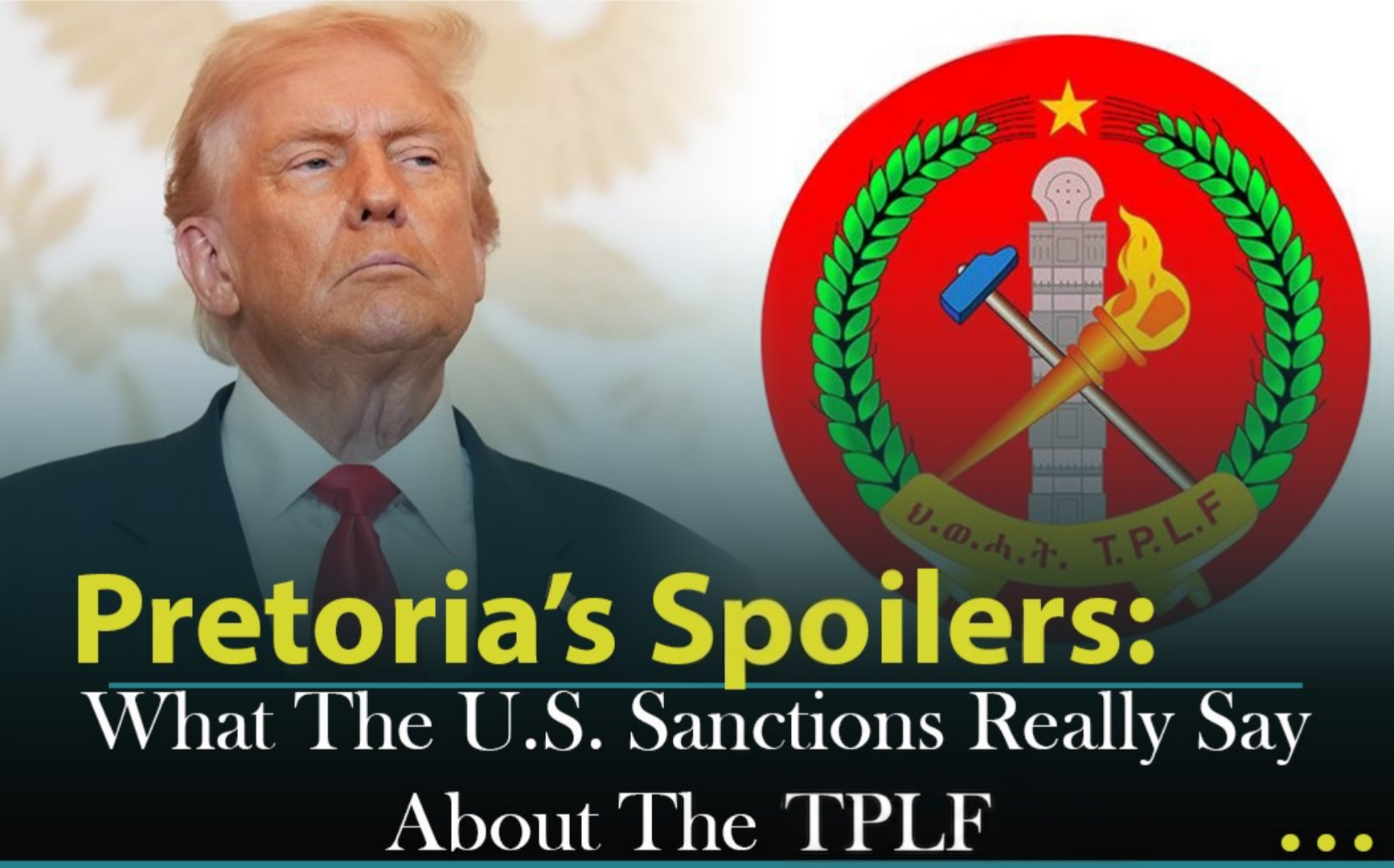
The United States’ decision to impose visa restrictions on hardline members of the Tigray People’s Liberation Front (TPLF) will not significantly alter the balance of power in northern Ethiopia. The sanctions do not freeze assets, disrupt financial networks, or meaningfully constrain the group’s political or organizational capabilities. Measured by conventional standards of coercive diplomacy, their material impact is limited. Yet that is precisely why their political significance deserves greater attention.
The importance of the sanctions lies less in what they do than in what they communicate. Washington has effectively made a judgment about responsibility for the deteriorating post-war political environment in Tigray. In doing so, it has moved beyond generic calls for restraint and assigned a specific political label: spoiler
This is the central significance of the measure. The sanctions do not impose a high cost on the TPLF, but they do impose a reputational and diplomatic cost by identifying hardline elements within the movement as actors undermining the implementation of the Pretoria Agreement.
Pretoria and the Politics of Legitimacy
The Pretoria Agreement was never simply a ceasefire. Signed under African Union mediation in November 2022, it established the framework through which post-war political competition in Tigray would be managed. Its success depends not only on security arrangements but also on broad acceptance of its legitimacy as the primary mechanism for resolving disputes. That legitimacy has increasingly come under strain.
Recent political tensions within Tigray have exposed growing disagreements over authority, transitional governance, and the future direction of the region. While these disputes are often presented as internal political disagreements, they have broader implications. They raise a more fundamental question: whether political actors remain committed to pursuing their objectives through the institutions and procedures established under Pretoria.
Peace agreements rarely collapse because of a single violation. They erode when influential actors begin treating the agreement as optional rather than binding. Once alternative sources of authority emerge, the contest shifts from implementing the settlement to redefining it. That is the context in which the U.S. sanctions should be understood.
The Real Function of the Sanctions
The sanctions are best viewed as an act of political classification rather than coercion. Modern diplomacy increasingly relies on instruments that shape legitimacy rather than directly alter behavior. States and international actors often lack the willingness or leverage to impose sweeping punitive measures. Instead, they seek to influence political outcomes by determining who is recognized as a constructive stakeholder and who is viewed as an obstacle. The visa restrictions fit this pattern.
By targeting specific TPLF hardliners rather than TPLF as a whole, Washington is making a distinction between political representation and political obstruction. The message is not that Tigrayan interests lack legitimacy. Rather, it is that certain actors are being held responsible for undermining the framework through which those interests are meant to be pursued.
In practical terms, the sanctions intervene in what might be called the recognition economy of peace processes. Political actors derive influence not only from military capabilities but also from diplomatic acceptance. Access to foreign governments, international organizations, donor networks, and mediation platforms constitutes a form of political capital. The sanctions do not remove the TPLF from the political arena, but they weaken the standing of those increasingly perceived as challenging Pretoria’s implementation.The result is a subtle but important shift in international positioning. Washington is no longer merely supporting the Pretoria Agreement; it is signaling who it believes is placing that agreement at risk.
Why Washington Is Acting Now
The timing is not accidental.The United States invested considerable diplomatic capital in supporting the Pretoria process and continues to view it as one of the few successful examples of African-led conflict resolution in recent years. Renewed instability in Tigray would not only threaten Ethiopia’s fragile post-war recovery but would also undermine confidence in the broader model of negotiated conflict settlement that Pretoria represents. There are wider regional considerations as well.
The Horn of Africa is already confronting overlapping crises, including the war in Sudan, Red Sea insecurity, and intensifying geopolitical competition among regional and external powers. A renewed conflict in northern Ethiopia would introduce another major source of instability into an already volatile strategic environment.
From Washington’s perspective, preserving Pretoria is therefore not simply about Ethiopia. It is about preventing a broader regional deterioration. The sanctions should be viewed as part of that effort. They are designed to reinforce the political architecture of the peace agreement by increasing the reputational costs of challenging it.
The Spoiler Designation Matters
Critics may argue that visa restrictions are largely symbolic and therefore unlikely to influence events on the ground.That criticism is partly correct. The sanctions alone are unlikely to change the calculations of determined hardliners. Nor are they capable of resolving the underlying political disputes that continue to shape post-war Tigray. However, dismissing the measure as merely symbolic misunderstands how contemporary peace enforcement often works.
Peace agreements survive not only because they are enforced through coercion but because they are reinforced through recognition. External actors constantly signal which institutions they support, which leaders they engage, and which political strategies they consider legitimate. These judgments shape the incentives facing local actors, particularly in post-conflict environments where international legitimacy remains an important source of political influence.
Seen from this perspective, the sanctions matter precisely because they formalize a judgment that many international actors had previously implied but not explicitly stated. Hardline elements within the TPLF are increasingly being viewed not as guardians of Pretoria but as impediments to its implementation.
That does not mean the designation is universally accepted. Nor does it mean the targeted actors will lose their domestic influence. Legitimacy cannot be imposed from abroad, and international classifications do not automatically determine local political realities. But they do shape the diplomatic environment in which those realities evolve.
Beyond Punishment
The broader lesson is that the sanctions reveal a changing approach to peace enforcement.Traditional tools of coercion are often politically costly, difficult to sustain, and of uncertain effectiveness. As a result, external actors increasingly rely on measures that shape legitimacy rather than directly impose force. Recognition, access, engagement, and reputational standing have become important instruments of statecraft.The sanctions on TPLF hardliners illustrate this shift. Their immediate material impact may be limited. Their political meaning is not.
By imposing the restrictions, Washington has effectively entered the contest over who owns the Pretoria Agreement and who threatens it. The measure does not materially weaken the TPLF. It does something potentially more consequential: it identifies elements within the movement as major spoilers of the post-war settlement.
Whether that judgment ultimately strengthens Pretoria remains uncertain. What is already clear, however, is that the sanctions are not primarily about travel. They are about legitimacy. And in contemporary peace processes, legitimacy is often the first battlefield on which political futures are decided.
References
[1] U.S. Department of State. Announcement of Targeted Visa Restrictions for Individuals Involved in Undermining Peace in Ethiopia. 18 June 2026.
Official State Department release:
Bureau of African Affairs Release
[2] Reuters. US announces targeted visa restrictions for some Ethiopians. 18 June 2026.
Reuters Report
[3] African Union. Cessation of Hostilities Agreement Between the Government of the Federal Democratic Republic of Ethiopia and the Tigray People’s Liberation Front. 2 November 2022.
African Union Peace Agreement Page
[4] IGAD. Agreement for Lasting Peace Through a Permanent Cessation of Hostilities Between the FDRE and the TPLF. 3 November 2022.
Signed Pretoria Agreement PDF
[5] United Nations Peacemaker Database. Agreement for Lasting Peace Through a Permanent Cessation of Hostilities Between the Government of Ethiopia and the TPLF.
UN Peacemaker Entry
[6] African Union Commission. Statement of the Chairperson on the First Strategic Reflection on the Implementation of the Pretoria Agreement. 11 March 2024.
AUC Strategic Reflection Statement
[7] Fana Media Corporation. Getachew Reda Says U.S. Visa Restrictions Signal Blame on Debretsion Camp for Rising Tensions in Northern Ethiopia. 19 June 2026.
Fana Report
[8] Addis Standard. Breaking: U.S. Imposes Visa Restrictions on ‘Hardline’ Members of TPLF and Their Immediate Family Members. 19 June 2026.
Addis Standard Report
By Beminet Alemayehu, IFA
Disclaimer:
The content disseminated by the Institute of Foreign Affairs (IFA) – including, but not limited to, publications, public statements, events, media appearances, and digital communications – reflects the views of individual contributors and does not necessarily represent the official positions or policies of the Institute, its partners, or any affiliated governmental or non-governmental entities.
While the IFA endeavors to ensure the accuracy, integrity, and timeliness of the information presented, it makes no representations or warranties, express or implied, regarding the completeness, reliability, or suitability of such content for any purpose. The Institute expressly disclaims any liability for errors or omissions, as well as for any actions taken or decisions made based on the information provided.
The inclusion of external links, references, or third-party resources does not constitute an endorsement by the Institute. Additionally, engagement on social media platforms – including, but not limited to, likes, shares, retweets (RTs), or reposts – shall not be interpreted as an endorsement or validation of the views expressed therein.
Readers and audiences are encouraged to exercise critical judgment and seek independent verification when interpreting or relying upon any information disseminated through publications and posts on the Institute’s platforms or representative