

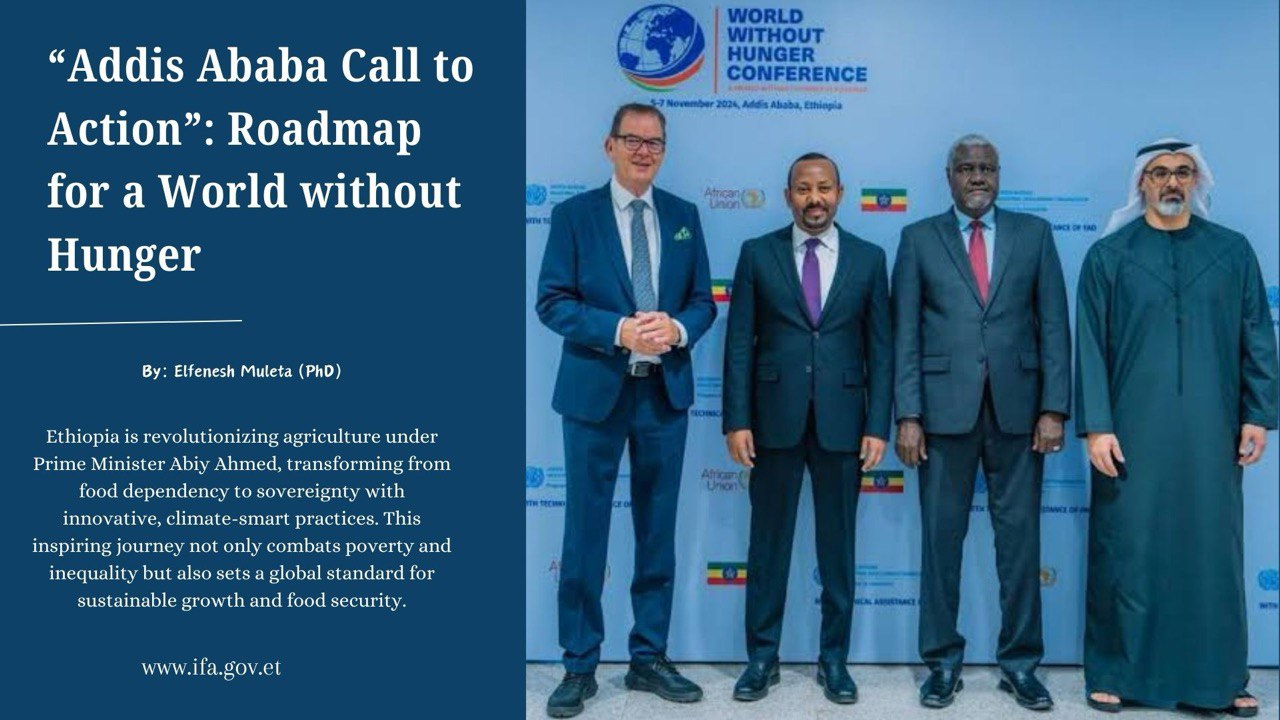
The World without Hunger initiative embodies the global commitment to eradicating hunger, ensuring food security, and improving nutrition for all by 2030 (SDG 2). However, hunger and food insecurity persist, impacting significant populations worldwide and aggravated by climate change, conflict and inequality. Addressing these requires concerted international action, sustainable agriculture, and policies targeting the root causes of hunger while building resilient, inclusive and accessible food systems.
Since 2018, Ethiopia has implemented over 80 policy reforms to improve its investment climate, focusing on sector liberalization, regulatory adjustments, and legal frameworks. These efforts are designed to position Ethiopia as a strategic destination for partnerships and investments that support sustainable agriculture, climate resilience, and economic growth. By fostering an environment conducive to innovation and collaboration, Ethiopia underscores its dedication to achieving Zero Hunger by 2030, aligning its proactive policy framework with global food security goals. Through its Homegrown Economic Reform Agenda, Ethiopia has identified agriculture, manufacturing, tourism, mining, and ICT as key pillars of economic growth. Prime Minister Dr. Abiy Ahmed has emphasized that while all five pillars hold immense untapped potential, agricultural productivity remains the critical, driving force of our economy. This focus on agriculture not only supports food security but also creates jobs, stabilizes rural communities, and establishes a robust foundation for sustainable economic development.
Ethiopia’s agricultural transformation is a multifaceted initiative that not only expands land for crop production but also significantly boosts productivity across key sectors, including dairy, meat, poultry, fish, and honey. This holistic approach prioritizes nutrition-sensitive agricultural practices designed to enhance dietary diversity and elevate the nutritional quality of food. Programs such as “Yelimate Turufat” are pivotal in this endeavor, actively promoting the cultivation of nutrient-rich crops that contribute to better health outcomes and food security for all Ethiopians. At the heart of this strategy lies the government’s commitment to climate-smart agricultural practices, which incorporate drought-tolerant crops, efficient irrigation systems, and sustainable land management techniques to build resilience against climate impacts and ensure reliable food production. As part of the Green Legacy Initiative, the government has also expanded the cultivation of perennial crops and fruits, strategically diversifying agricultural sectors vulnerable to climate change. Together, these interconnected efforts position Ethiopia to establish a sustainable food system capable of effectively tackling the dual challenges of hunger and malnutrition, ensuring a prosperous and food-secure future for its citizens.
Ethiopia has strategically focused on high-value industrial crops, achieving remarkable results through the cultivation of drought-tolerant, water-efficient crops such as wheat, teff, maize, and sorghum. Prime Minister Dr. Abiy Ahmed emphasized that wheat production, in particular, has been a cornerstone of this effort:
“Through innovation, technology, and climate-smart irrigation, we have transformed our agricultural landscape from a wheat deficit to a surplus, increasing production by an impressive 300%. This shift not only liberates us from the grips of poverty but also harnesses our human potential to drive enhanced productivity. To nurture a truly productive workforce and population, we must make critical investments in nutrition...”
Ethiopia’s food security strategy prioritizes wheat production, investing in improved farming practices, drought-resistant varieties, and climate-smart irrigation to boost domestic output. This focus on agricultural productivity, within a diversified economy leveraging natural resources, favorable climate, and a youthful population, aims to foster resilience and long-term economic growth. The Green Legacy Initiative, with its focus on environmental restoration and agroforestry, further promotes sustainable agriculture with impacts extending beyond Ethiopia’s borders, as highlighted by Prime Minister Abiy Ahmed:
“Through homegrown solutions, we have been implementing strategies aimed at fostering growth and prosperity, reducing emissions, and building climate resilience...” This commitment to sustainability underscores Ethiopia’s dedication to achieving long-term resilience and prosperity.
Furthermore, Ethiopia’s food system transformation strategy strengthens the entire value chain, from production to consumption, focusing on market access for farmers and investment in food processing. This includes promoting agricultural technology (digital tools, improved seeds, research) and collaborating with international partners. However, recent setbacks linked to economic slowdowns, climate change, and conflict necessitate urgent action, according to Industry Minister Melaku Alebel, who advocates for sustainable investment in agribusiness, infrastructure, digital innovation, climate resilience, and fair trade. UNIDO’s Director of Agribusiness and Infrastructure, Dejene Tezera similarly stresses the need for agro-industrialization to build sustainable and resilient food systems to prevent hunger beyond 2030.
Ethiopia’s post-2018 reforms under Prime Minister Abiy Ahmed have yielded significant progress toward achieving food self-sufficiency, establishing it as a potential model. This impactful work was recognized with the Agricola Medal awarded to Prime Minister Abiy Ahmed for his vision and commitment to food security and nutrition. At the ceremony, Prime Minister Abiy Ahmed stated:
“As I accept this prestigious award, I would like to emphasize my government’s commitment not only to meeting Zero Hunger goals but also to achieving food sovereignty and national prosperity.” At COP28 in the UAE, he reinforced this vision, adding, “Through homegrown solutions, we have been implementing strategies aimed at fostering growth and prosperity, reducing emissions, building climate resilience, and achieving sustainable development...”
These statements reflect Ethiopia’s comprehensive approach to addressing hunger, underscoring the importance of food security, sustainability, and national self-reliance. By prioritizing both food sovereignty and climate-resilient practices, Prime Minister Abiy’s(Dr.) administration is working toward a future where hunger is eradicated and local food systems are strengthened, contributing to the global goal of a world without hunger. His emphasis on sustainable, locally driven strategies highlights Ethiopia’s potential to be a model for other nations striving to meet Zero Hunger and create resilient, self-sufficient economies.
Following Ethiopia’s progress towards food security, the successful World without Hunger Conference was held in Addis Ababa on November 7, 2024. Organized by UNIDO, the Ethiopian government, the African Union Commission, and the FAO, the conference marked a significant intensification of global efforts to eradicate hunger. Innovative solutions were showcased, new partnerships formed, and investments secured. The conference culminated in the Addis Ababa Call to Action, a roadmap for collaborative investment to end hunger, and the launch of a UNIDO-FAO study outlining actionable solutions and investment opportunities.
Prime Minister Abiy Ahmed’s closing remarks at the World without Hunger Conference emphasized the urgent need for innovative solutions to combat rapid population growth and global crises. He pointed out that sustainable practices, modern farming techniques, and improved access to agricultural inputs are essential for boosting productivity. Highlighting Ethiopia’s agricultural transformation, he noted that the country has successfully doubled its cultivated land and achieved promising results from high-value crops. This progress serves as a model for others, showcasing the potential of collective efforts through global collaboration. In his address, Abiy Ahmed stated, “Our focus on agricultural transformation has doubled our cultivated land, with promising results from high-value industrial crops. This conference unites global leaders to discuss innovative solutions and partnerships, and I am hopeful our collective efforts will bear fruit.”
He underscored Ethiopia’s holistic approach, which addresses systemic challenges such as poverty, inequality, and the impacts of climate change. These interconnected strategies aim not only to enhance agricultural productivity but also to build resilience and foster inclusive economic growth, ultimately contributing to a sustainable future.
In conclusion, Ethiopia’s path toward achieving Zero Hunger demonstrates a powerful model of resilience, sustainability, and innovation under the leadership of Prime Minister Dr. Abiy Ahmed. Through initiatives like the Green Legacy and the Homegrown Economic Reform Agenda, Ethiopia has transformed its food systems by emphasizing climate-smart practices, technology-driven agriculture, and substantial investments in drought-resistant and high-yield crops. By transitioning from dependency to food sovereignty and implementing over 80 investment climate reforms since 2018, Ethiopia has created a conducive environment for partnerships and sustainable growth. As Prime Minister Abiy stated, “Through innovation, technology, and climate-smart irrigation, we have transformed our agricultural landscape from a wheat deficit to a surplus.” Ethiopia’s commitment to homegrown solutions and collaborative global efforts exemplifies how dedicated, sustainable practices can tackle hunger, bolster national prosperity, and contribute meaningfully to global food security.
About the Authors
Dr. Elfenesh Muleta Senior Researcher of Multilateral Affairs at the Institute of Foreign Affairs (IFA).
Declaimer: The opinions stated in this article solely belong to the author and do not reflect the views or positions of the IFA