

The Organization of Islamic Cooperation (OIC), known in Arabic as Munaẓẓamat at-Taʿāwun al-ʾIslāmī (منظمة التعاون الإسلامي), was established in 1969 following a conference held in Morocco. The conference was a response to an arson attack on the Al-Aqsa Mosque in East Jerusalem (Awawdeh, 2020). Chronologically, the formation of the organization coincided with the Cold War era, a time when the Middle East and North Africa regions were divided into three conflicting ideological camps: pro-US, pro-Soviet, and non-aligned (Awawdeh, 2020). Though the nomenclature of the organization is explicitly associated with the religion of Islam, it should be noted that the national interests of member states, rather than Islam, have often been a critical factor for the formation of the group, as evidenced by the inclusion of several non-Muslim countries. Therefore, the activities of member states do not necessarily reflect the theological divisions of its members (WAGI, 2018).
The OIC consists of 57 member States stretching into four continents: Asia, Africa, Europe and South America (OIC, 2024; UN, 2024). This makes OIC the second largest Intergovernmental Organization next to the United Nations. Nearly half of its members are African countries (27 of them), viewing the organization as a forum for promoting good governance, cultural exchanges, moderation and dialogue (Hakala & Kettis, 2013). The Middle East is the home to several powerful members of the OIC and also hosts its headquarters.
In his recent parliamentary speech, Prime Minister Abiy Ahmed (PhD), highlighted the importance of assessing Ethiopia’s engagement with the Middle East. He stated, “Everything Ethiopia has previously pursued regarding the Middle East has been completely misguided.”[1] This marks a paradigm shift, as Ethiopia had maintained a “closed foreign policy” towards Middle Eastern Arab countries for centuries. Enhancing engagement with Middle Eastern states and multilateral organizations might help redress past foreign policy mistakes. In this regard, Ethiopia’s membership in the OIC could fill one of the diplomatic lacunas with the Middle East. Beyond this, Ethiopia’s bid (potential) to join the OIC may help the country strengthen its global alliances based on the organization’s working principles. Yet, as few countries may object Ethiopia’s noble quest for OIC membership, devising careful strategies is crucial to tackle any potential objections before applying. Against this background, this policy brief posed the central questions: Has the time come for Ethiopia to join OIC?
Ethiopia’s Legitimate Quest for Membership
Ethiopia’s interest in joining the OIC likely stems from a recent invitation extended by the organization itself (APA, 2024). This can be cited as a golden opportunity for the Ethiopian government to express its interest and initiate an application process to become the 58th member. The discussion that follows assesses the enabling factors that makes Ethiopia’s legitimate quest for possible membership.
Strong Historical Ties with OIC Member Countries
Ethiopia has close historical, cultural, religious and diplomatic ties with the Islamic world, dating back to the early days of Islam (Pankhurst, 2002). When the companions of Prophet Muhammed were persecuted by the Quraiysh tribe, they sought refuge in Ethiopia twice. This marked the commencement of religious diplomacy between Ethiopia and the Muslim world, and consequently adorned Ethiopia with a name, ‘Darul Hijreteyni’- the place of two pilgrimages. Notably, Ethiopia’s role in protecting the early Muslims and providing security to them has cemented its place as a symbol of peace and protection in the Islamic world. In this context, those existing engagements between Ethiopia and the various Islamic organizations, if any, are hardly surprising, seeing in the lens of history.
Solid Demographic Foundations in Ethiopia
Demographically, most OIC member countries constitute Muslim majority population despite some countries do not exhibit this characteristic. Hence, the commonly held misconception: ‘A country must be a Muslim-majority to join OIC’ does not hold water. Of course, the OIC charter[2] stipulates that ‘any Muslim majority country’ can join the OIC on the basis of agreed criteria”. This doesn’t mean that the organization is exclusionary from its inception based on religion. Practically speaking, the organization is inclusive, consists of member countries from a wide-range of religious backgrounds. For example, of the 57 member states, countries such as Cameroon (18.3%), Guyana (6.4%), Gabon (11.2%), Mozambique (18.0%), Togo (14.0%) and Uganda (11.5%) are non-Muslim majority.
Another important indicator of its inclusiveness is the provision of observer status[3] conferred by the organization. Accordingly, there are 5 Observer Countries that are not Muslim majority, including Central African Republic, Russian Federation and Thailand. This suggested that becoming a member of OIC requires sole adherence to the organization’s objectives and principles instead of religious majority (Hakala & Kettis, 2013; OIC, 2024).
Although the place of religion as a defining criterion of membership is not explicitly implicated in the Charter, still one can argue Islam holds a key position. Therefore, Ethiopia having more than one-third of Muslim population (CSA, 2007) has a solid demographic foundation that cannot be ignored by the Council of foreign Ministers of OIC if it decides to apply for membership.
Shared Goal between Ethiopia and OIC Members
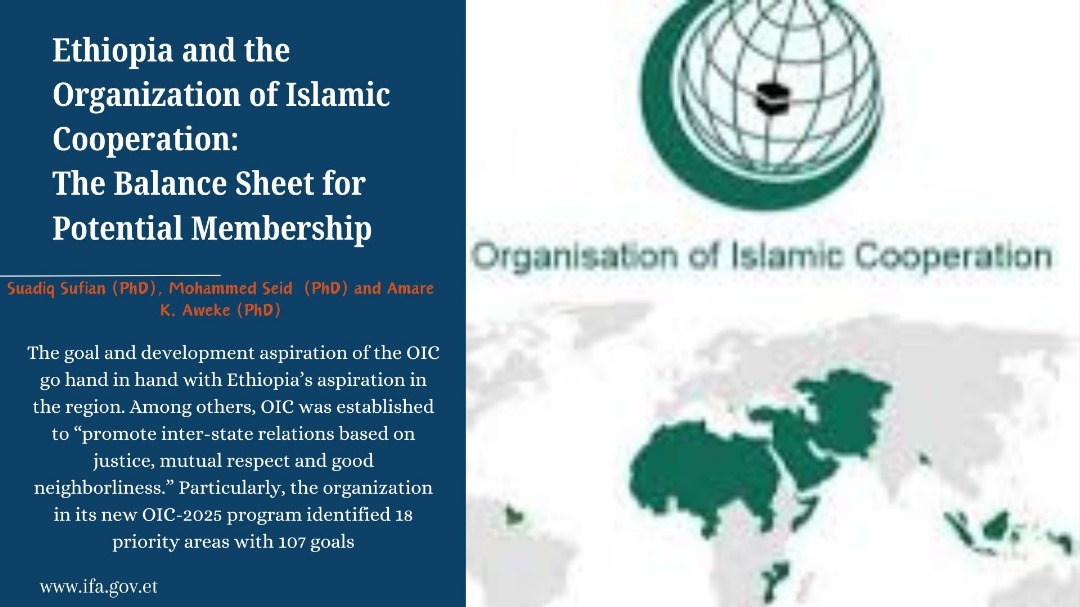
The goal and development aspiration of the OIC go hand in hand with Ethiopia’s aspiration in the region. Among others, OIC was established to “promote inter-state relations based on justice, mutual respect and good neighborliness.” Particularly, the organization in its new OIC-2025 program[4] identified 18 priority areas with 107 goals. Some of the priority areas are issues of Peace and Security, Poverty Alleviation, Counter-terrorism, Investment and Finance, Food Security, Science and Technology, Climate Change and Sustainability, Moderation, Culture and Interfaith Harmony, Empowerment of Women, Human Rights and Good Governance. Without exaggeration, these focus areas align with Ethiopia’s road map for development under the current government.
Keen Interest among the OIC Member States
Following Prime Minister, Abiy’s doctrine of “neighborhood first” foreign policy, Ethiopia could establish strong diplomatic relation with neighboring Islamic countries (Allo, 2018). Meanwhile, some Islamic countries demonstrated their keen interest in working with Ethiopia even at difficult times. A case in point is UAE’s unwavering support to Ethiopia during the Post – 2018 political transition. Therefore, any current (potential) Ethiopia’s bid for membership in the OIC may garner a great deal of support from influential Muslim countries such as Saudi Arabia, Turkey, and the United Arab Emirates. Indeed, quite on the contrary, going on the wrong side of history, few countries may object Ethiopia’s quest for membership – inclusion in the OIC.
However, the consensus-based approach of OIC’s decision making[5] may pose a significant obstacle for Ethiopia’s bid for membership, given the presence of long-standing adversarial countries within the group. These countries may actively work to block Ethiopia’s legitimate quest for OIC membership. Accordingly, winning the heart of 57 countries will be difficult for Ethiopia, underscoring the importance of mechanisms such as strengthening Afrabia framework and bilateral diplomacy.
Prospects and Challenges of Joining OIC
Joining the OIC represents Ethiopia’s strategic move to enhance its global image, strengthen its economic prospects and play a major role in regional and global security. More importantly, it helps the country to counter malign influence of adversarial actors in the Islamic world pertaining to Ethiopia’s national interest. More to the detail, Ethiopia’s membership in the OIC could offer the following advantages:
Economic Cooperation
Over the years, the OIC successfully functioned as a common platform in enhancing economic cooperation among member countries. The organization established various institutions to enhance economic cooperation. Ihsanoglu (2009) identified three multilateral financial schemes that promote intra-OIC trade. The first one is the ‘Longer Term Trade Financing Scheme’, aiming to promote exports of non-conventional goods by providing funds. The second is ‘Islamic Corporation for the Insurance of Investment and Export Credit’ (ICIEC). The last but not the least is ‘Agreement on the Multilateral Islamic Clearing Union’. In this context, Ethiopia’s potential membership could serve as a catalyst to enhance economic cooperation with OIC member countries by using these platforms.
Neutralizing Regional Tension on Hydro Politics
Several countries in the OIC share Transboundary Rivers such as the Nile, Euphrates and Ganges. Though sharing these waters is seen as a source of cooperation between neighboring countries; sometimes they may also constitute a challenge when it comes to their management. In this connection, the OIC Water Vision of “working together for a water secure future” is a powerful and important call for member countries[6]. Accordingly, working for this vision would create a healthy cooperative environment among OIC countries, suggesting that Ethiopia’s potential membership in the OIC would play a crucial role in solving disputes over the equitable utilization of the Nile River.
Promoting Islamic Tourism
The OIC adopted the “Strategic Roadmap for Development of Islamic Tourism” during the 10th Islamic Conference of Tourism Ministers (ICTM) in February 2018[7]. This strategic roadmap aimed at enhancing Islamic tourism by promoting OIC countries as preferred destinations for Muslim tourists. Special historical ties with Islam might position Ethiopia as one of the best destinations for Islamic tourism in the world. It is worth mentioning that Ethiopia was the first country to recognize Islam, provided protection to Muslim immigrants, and served as the first land of experimentation for Muslim-Christian tolerance. Ethiopia is also the origin of important Islamic figures such as Bilal (the first Muezzin of Islam, who summons Muslims to prayer) and Umm Ayman Barakah (Prophet Mohammed’s stepmother). Beyond these, it is the land of great Muslim scholars, ancient mosques and shrines, and Islamic manuscripts. Given all these historical assets, Ethiopia’s potential membership in the OIC would enhance the development of its Islamic tourism sector.
Encouraging Interreligious Dialogue
Ethiopia is a multi-cultural state composed of a federation of various ethnic, linguistic, religious, and regional groups. Given the prevalence of identity-based conflicts, interreligious and intercultural dialogue holds significant place in the country. Hence, Ethiopia’s membership in the OIC could potentially enhance its ability to resolve such conflicts. This is partly due to the fact that OIC’s efforts to promote interreligious and intercultural dialogue, which can serve as a valuable model. For example, the OIC has initiated effective dialogue with Western countries and gained recognition for these efforts as per resolution.
Although joining OIC has the aforementioned potential opportunities, it may also pose challenges that need to be considered while initiating or applying for membership.
Increasing Vulnerability to Conflict
OIC is the one of the most conflict-ridden blocks. More than 60 percent of all conflicts in the world occur in OIC countries (SESRIC, 2024). The consequences of the raging violence in OIC countries have been devastating. Beyond that 80 percent of global conflict fatalities have taken place in OIC countries. Moreover, two-thirds of world refugees originate from OIC countries (OIC SESRIC, 2018). Given such position of OIC, Ethiopia’s quest for membership may become a source of great concern as it exposes the country to new regional conflicts and rivalries.
Less efficient in taking Action
Although OIC is the collective representative body of the Islamic world, it is not strong as its name implies, at least. It lacks adequate institutional structure to implement its decision. Its discussions and decisions are often limited to diplomatic declarations with limited capacity to enforce them. It often fails to take collective measures on critical matters for regional and international peace and security.
Difficulty of Balancing National and Collective Interests
OIC as a multilateral organization has its own vision and collective goals. Meanwhile, Ethiopia has its own national interest with specific goals. Ethiopia’s potential membership in OIC may put the country in a difficult situation while attempting to balance its national interest with the collective goals of the Bloc.
Conclusion
Ethiopia’s potential membership in the OIC presents both challenges and opportunities. The country’s historical ties to Islam, its substantial Muslim population, and the inclusive nature of the OIC provide a strong foundation for engagement. Membership could enhance Ethiopia’s influence in regional and international affairs, promote interreligious dialogue, and improve its political, economic, and cultural relations globally. However, the consensus-based decision-making process within the OIC may create obstacles, especially given Ethiopia’s diplomatic disputes with Egypt and Somalia. Additionally, Ethiopia’s susceptibility to regional conflict, the OIC’s internal inefficiencies, and potential misalignments between Ethiopia’s interests and the collective goals of the OIC could hinder its membership aspirations. Therefore, Ethiopia should approach the OIC from a non-theological perspective, acknowledging its diverse religious and demographic landscape. As the OIC is a platform for representing sovereign states, the Ethiopian government should take the lead in pursuing membership in order advance its stated foreign policy objectives.
Reference
Allo, A. (2018). The Abiy Doctrine: One year of Ethiopia’s new foreign policy – African Arguments. African Arguments. https://africanarguments.org/2019/04/the-abiy-doctrine-one-year-of-ethiopia-new-foreign-policy/
APA. (2024). Ethiopia hints joining Organization of Islamic Cooperation | APAnews – African Press Agency. APA News. https://apanews.net/ethiopia-hints-joining-organization-of-islamic-cooperation/
Awawdeh, S. (2020). An Introduction to the Organization of Islamic Cooperation. New York University. https://www.nyulawglobal.org/globalex/oic.html
CSA. (2007). The 2007 People and Housing Census Statistical Result Official Report.
Hakala, P., & Kettis, A. (2013). The Organisation of Islamic Cooperation : Defined – for Better and Worse – by Its Religious Dimension. DG EXPO. https://www.europarl.europa.eu/thinktank/en/document/EXPO-AFET_SP(2013)491520
Ihsanoglu, E. (2009). Enhancing Economic Cooperation Among Muslim Countries-The Role of OIC. International Journal of Economics, Management and Accounting, 17(1), 13–30.
OIC. (2024). Organization of Islamic Cooperation – Member States. Organization of Islamic Cooperation. https://new.oic-oci.org/SitePages/LandingpageEN.aspx?lan=en
OIC SESRIC. (2018). Achieving peace and security: challenges for the OIC. In Sesric.org (Vol. 7). https://www.sesric.org/publications-detail.php?id=472
Pankhurst, R. (2002). Across the Red Sea and Gulf of Aden: Ethiopia’s Historic Ties with Yaman. Africa: Rivista Trimestrale Di Studi e Documentazione Dell’Istituto Italiano per l’Africa e l’Oriente, 57(3), 393–419. https://www.jstor.org/stable/40761637?searchText=&searchUri=&ab_segments=&searchKey=&refreqid=fastly-default%3Ab0752815780113aa64823be162c36048&initiator=recommender
SESRIC. (2024). Resilience Building Studies » Conflicts, Peace and Security. SESRIC Research. https://www.sesric.org/conflicts-peace-security.php
UN. (2024). Organization of Islamic Cooperation. In Permanent Missions to the United Nations (pp. 374–374). https://doi.org/10.18356/9789213585009c218
WAGI. (2018). Regionalism – World Atlas of Global Issues. World Atlas of Global Issues. https://espace-mondial-atlas.sciencespo.fr/en/topic-strategies-of-transnational-actors/focus-3F07-EN-religious-multilateralism.html
About the Authors
Suadiq Sufian (PhD) and Mohammed Seid (PhD), Senior Researcher of Middle East Affairs at the Institute of Foreign Affairs (IFA)
Amare K. Aweke (PhD), Middle East Affairs Researcher Director General at the Institute of Foreign Affairs (IFA).
Declaimer:-
The opinions stated in this article solely Belong to the authors and do not reflect the views or position of the IFA