

Introduction
The fall of Bashar al-Assad on 8 December 2024 and the subsequent establishment of an Islamist HTS[1]-dominated government in Syria elicited divergent reactions from the two powerful neighboring countries, Turkey and Israel. Alarmed by the presence of Islamist militants near its border, Israel crossed the UN-protected buffer zone and seized control of territories in southern Syria. Although the interim government led by Ahmed Al-Shara repeatedly stated, ‘We do not want conflict with Israel,’ the Israel Defense Forces (IDF) conducted hundreds of airstrikes on Syrian military assets. Syria’s Ambassador to the UN, Koussay Aldahhak, accused Israel of destabilizing the country in a recent Security Council meeting held on 11 April 2025[2] and formally demanded an end to Israeli aggression. In response, Israeli Deputy UN Ambassador Jonathan Miller asserted, ‘Israel does not seek territorial gains in Syria.’ Despite these exchanges, the UN Security Council failed to halt the alleged Israeli incursions into Syria.[3]
Turkey has supported Syrian rebels throughout the civil war and is widely believed to have orchestrated the fall of the Assad regime in December 2024. While Turkish military involvement in Syria dates back to 2016 through its backing of the Syrian National Army (SNA), a recent diplomatic visit by Syria’s interim president to Ankara has paved the way for unprecedented military cooperation between the two nations. Turkey’s influence in Syria continues to grow as both states prepare to sign a joint defense pact that could authorize Turkish air and ground force deployments in Syrian territory. Israel has accused Turkey of establishing a de facto protectorate in Syria and conducted preemptive airstrikes in Hama and the Tiyas(T4) Airbases. Furthermore, Israel has explicitly warned that any foreign military presence—including Turkey’s—constitutes a direct threat to its national security. The two nations’ competing interests in Syria have escalated tensions to the brink of potential military confrontation. Amid these developments, the U.S. President Donald Trump offered to mediate between the two American allies. Most recently, however, Turkey and Israel have made deconfliction talks in Azerbaijan to prevent armed clashes.[4] This policy brief, therefore, scrutinizes the needs, interests and positions of Turkey and Israel regarding Syria and explores possible future scenarios.
Historical Context to Turkey-Israel Diplomatic Relations
Although many Muslim states had been at odd with Israel during the Cold War, Turkey was the first Muslim majority country that recognized the state of Israel in 1949. To this effect, the Turkish government opened a legation in Israel and the Israeli government reciprocated by establishing an embassy in Ankara. However, following the Suez Canal Crisis in 1956, Turkey downgraded its diplomatic representation to the level of “charge d’Affaires“. Turkey pursued a balanced foreign policy towards Israel and the Arab world, driven by shared strategic interests with Israel and common cultural heritage with the Arabs. In 1958, Israeli Prime Minister David Ben-Gurion and Turkish Prime Minister Adnan Menderes signed the “Peripheral Pact” which formalized military and intelligence cooperation between the two countries. In 1967, however, the Turkish government joined the Arabs in condemning Israel’s invasion of Arab lands without referring Israel as an “aggressor state” unlike its Arab counterparts. The Turkish lenient position to the Arab cause helped to improve bilateral relations, eventually leading to the restoration of full diplomatic ties including ambassadorial diplomatic representation as of January 1980(Sekulow, 2015; Kosebalaban, 2010).
Since post-cold war period, the Turkish –Israel diplomatic relations has been consistently affected by the Israeli-Palestinian Peace Process. It often becomes a common trend for Ankara to reduce diplomatic representation whenever the Arab /Palestinian cause were presumed to be affected. .Upon the Annexation of East Jerusalem as the capital of Israel on 30 November 1980, Ankara downgraded its diplomatic relations with Israel. In this regard, Ankara’s diplomatic representation with Tel-Aviv from Ambassador to “Second Secretary”[5] until 1992 was a case in point. In January 2000, the two countries signed a remarkable water agreement which permitted Israel to purchase water from Turkey. Following the victory of AKP party in Turkey in 2002, the two countries upgraded their diplomatic relations. The high level diplomatic visit of Israel by Prime Minister Recepe Tayyib Erdogan in 2005 and a reciprocal visit by Prime Minister Shemon Peres in 2006 and Israeli Prime Minister Ehud Olmert’s three-day visit to Ankara in 2008 signaled the peaks of their diplomatic relations (Efron, 2018).
Turkey-Israel diplomatic relations began to decline after the assassination of Hamas leader Sheikh Ahmed Yassin. In response, Erdogan condemned Israel’s action as an act of terror, though Turkey did not sever diplomatic ties. Relations were further strained by the unexpected military operation led by Ehud Olmert against Gaza—a population with whom Erdogan had strong emotional ties—culminating in Turkey cutting diplomatic relations in 2008. The most notorious Turkish-Israeli confrontation turned violent in 2010 when the Turkish ship Mavi Marmara, carrying humanitarian aid to Gaza, was raided by the Israeli navy, resulting in the deaths of ten Turkish activists. In response, Turkey withdrew its ambassador from Tel Aviv and downgraded diplomatic relations to the level of second secretary. This rupture lasted six years until normalization was restored in 2016 under a reconciliation agreement. Israel formally apologized for the Mavi Marmara incident, paid $20 million in compensation to the victims’ families, and permitted Turkey to carry out humanitarian projects in Gaza under Israeli security oversight. However, another diplomatic crisis erupted in 2018 after the IDF killed over 2000 Palestinians during protests in Gaza. Tensions continued to deteriorate, reaching a new low after the October 2023 crisis and the ensuing humanitarian catastrophe, which has claimed the lives of more than 60,000 Palestinians (Efron, 2018).
Turkey and Israel: Needs, Interests and Position over Syria
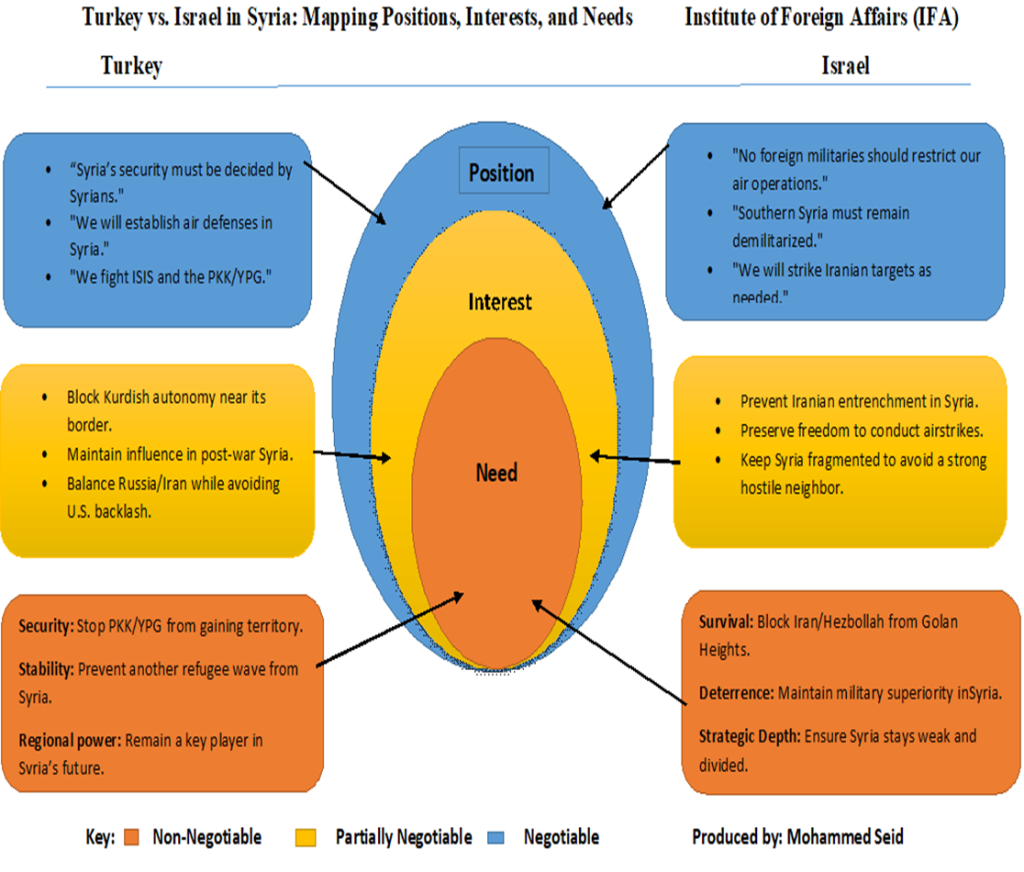
Analyzing the needs, interests and positions of conflict parties can provide valuable insights for conflict intervention. To examine Turkey’s stance on Syria, Fisher et al.’s (2007:27) Onion Model of Analysis serves as a useful framework. This model is structured around the analogy of an onion and its layers. The outermost layer (position) reflects the publicly stated demands of the involved actors. Beneath this lies the interest layer, which represents the underlying strategic objectives the parties seek to achieve through the conflict. At the core are the needs—fundamental, non-negotiable concerns that drive the parties’ actions. Applying this framework helps uncover the deeper motivations behind the conflict, moving beyond surface-level demands to understand the interplay of needs, interests, and positions. Below is an analysis of Turkey and Israel’s policies toward Syria using this model.
Turkey’s Needs, Interests and Positions over Syria
The Onion Model provides a structured framework for examining the complex dynamics of the conflict. Turkey could navigate in Syria by categorizing its stance into three distinct layers: position, interest and need. Turkey’s public positions (outer layer) asserts its right to establish defense systems in Syria, framing its military presence as part of counterterrorism efforts against ISIS and the PKK/YPG. This positioning serves strategic purposes – by emphasizing its counter-ISIS role, Turkey aims to persuade the U.S. that its presence could reduce America’s counterterrorism burden, potentially facilitating a U.S. withdrawal from the region. Given that combating ISIS remains a key precondition for any U.S. withdrawal, Turkey has proactively sought to establish a regional security platform involving Syria, Jordan, Lebanon, and Iraq to coordinate ongoing counter-ISIS operations. This multilayered approach reflects how Turkey’s public positions connect to its deeper strategic interests in regional security architecture and burden-sharing with Western allies.[6]
Beneath its public positions, Turkey pursues deeper strategic interests in Syria. Foremost among these is preventing Kurdish autonomy along its border—a concern underscored by President Erdoğan’s direct appeal to Syria’s interim president during a recent visit, urging decisive action against ISIS and Kurdish militants to secure their shared border. Turkey also seeks to shape Syria’s political future by promoting a unified, Sunni-led government aligned with its interests. Additionally, Ankara views its military presence in Syria as crucial for geopolitical balancing, countering what it perceives as excessive superpower influence (particularly from the U.S. and Russia) in its immediate neighborhood. This strategic calculus reflects Turkey’s determination to safeguard its regional security while maintaining autonomy in its foreign policy decisions.[7]
Turkey’s non-negotiable core interests include securing its borders from Kurdish militias, preventing another destabilizing refugee influx from Syria, and maintaining its status as a regional power. Alarmed by the territorial expansion of Kurdish separatist groups, Turkey has deployed its armed forces to northern Syria since August 2016, supporting the Syrian National Army (SNA) and establishing a military presence in the region (Efron, 2018). The country currently hosts over two million[8] Syrian refugees, a situation that has strained its domestic politics and raised security concerns among European neighbors. While some refugees have begun returning following the demise of the Assad regime, Turkey views its military presence in Syria as essential to stabilizing the region and mitigating further refugee flows. Beyond security concerns, Turkey has sought to expand its economic, diplomatic, and military influence in the Middle East using Syria as a spring board. Its stabilizing role in regional conflicts, growing involvement in multilateral cooperation, and strategic balancing between great powers reinforce its position as a regional power (Üstün, n.d.). Consequently, any challenge to these core interests constitutes a red line for Ankara, leaving no room for compromise.
Israel’s Need, Interest and Position over Syria
A similar model of analysis (Fisher et al, 2007) unpacking Israel’s multifaceted Syria policy through three concentric layers of engagement: surface-level positions, underlying strategic interests, and fundamental security needs. The surface (position) level analysis revealed that the Israeli government insists the absence of foreign military presence in Syria including Turkey and demilitarized border area. This is with the motive to sustain Israeli military supremacy and freedom of air operation over Syria. One of the rationales for air supremacy over Syria `given by Israeli politicians is that “We will strike Iranian targets as needed”[9] Hence, Israel construes the deployment of Turkish air defense assets in Syria as a threat to Israeli jets of conducting air operations over Syrian airspace. In a recent joint press statement with Donald Trump, Prime Minister Netanyahu uttered, “the presence of any foreign military in Syria is a red-line”[10] Opposing the view of Israel, Turkish foreign Minister Hakan Fidan stated, “Syria’s security must be decided by Syrians”[11] Although the public position of Israel could be negotiable, it links the deeper strategic interest over the future of Syrian security and military architecture.[12]
The deeper strategic interests of Israel in Syria lie in preventing Iranian and Hezbollah forces from gaining footholds near the Golan Heights, maintaining military deterrence, and keeping Syria weak to eliminate any potential threat to its security. The Syrian government under Bashar al-Assad has long been a staunch adversary of Israel and a key supporter of Hezbollah and other anti-Israeli militant groups. Although Israel’s goal of preventing the revival of the “Axis of Resistance” in the region aligns with the interests of both the Syrian interim government and Turkey, Israel continues to oppose Turkey’s military presence due to a deep-seated trust deficit. This reflects Israel’s perception that a unified, Sunni-dominated Syria would pose a significant security threat. To counter this, Israel advocates for an inclusive federal structure in Syria, ensuring the country remains fragmented and weak—unable to present a unified threat.
At the core of Israel’s security calculus lie three fundamental imperatives: preventing Iranian and Hezbollah entrenchment near the Golan Heights, preserving military deterrence, and ensuring Syria remains too fragmented and weakened to pose a credible threat. While Israeli operations have significantly degraded the so-called “Axis of Resistance” as of October 2023, Tehran and its proxies continue attempts to establish footholds in Syria—a security concern that equally threatens Syria’s interim government. Israel maintains its military dominance through preemptive strikes targeting enemy capabilities, a doctrine consistently applied in Syria for decades. This reflects a long-term strategic objective: to perpetuate a weak, divided Syrian state incapable of coordinating threats against Israel.[13]
Possible Scenarios for Turkish Israel Conflict over Syria
Given the escalating tensions between Turkey and Israel over Syria—and their ongoing deconfliction talks in Azerbaijan—several possible scenarios could unfold, ranging from diplomatic de-escalation to direct military confrontation.
- Negotiated De-escalation through adopting Russia-Israel Security Model.
Turkey and Israel might de-escalate their tension over Syria through adopting Russia-Israel Security Model. This model might help Syria, Israel and Turkey as it will target common threats like ISIS, Iran and its proxies. This scenario will most likely to occur because the following factors: Firstly, Turkey and Israel through the US brokered talks in Azerbajan come to some level of understanding. Secondly, both nations did not want military confrontation in Syria. Thirdly, both states tacitly recognize there sphere of influence in Syria (Turkey northern Syria while Israel aspires to maintain its buffer zone in Southern Syria). Lastly, Syrian interim government prioritize internal instability over confrontation with Israel.
- Escalation of Proxy War
Turkey and Israel could intensify proxy war in Syria. Turkey boosts military aid to Syrian rebel factions while Israel expands support for anti-HTS forces like reminants of Assad force and the Druze militia. Israel is also conducting a series of air strikes against Islamist rebels moving south ward. This scenario will likely to occur because of two factors: Firstly, the Turkish-Syrian defense pact allows Ankara’s military presence in Syria, which Israel construed as a direct threat. Secondly, attack by HTS-affiliated militia on Israeli positions in the Golan.
- Direct Military Confrontation
Israeli air strikes reportedly targeted Turkish military convoys and installations in Syria. Turkey might retaliate by striking Israeli positions. This scenario is unlikely to occur unless there is accidental clash between the two states and major attack by Turkish-back militants on the Israeli forces in southern Syria.
Conclusion
The evolving tensions between Turkey and Israel over Syria stem from their competing strategic interests, security concerns, and regional ambitions. While Turkey seeks to consolidate influence in northern Syria, counter Kurdish autonomy, and stabilize the region to prevent further refugee flows, Israel prioritizes neutralizing Iranian and Hezbollah threats, maintaining military supremacy, and preventing a strong Islamist-led Syria. The risk of escalation—whether through proxy warfare or direct confrontation—remains high, though negotiated de-escalation, possibly through a Russia-Israel-style security arrangement, offers a viable path to avoid open conflict. The outcome hinges on diplomatic efforts, mutual recognition of red lines, and external mediation, particularly from the U.S. As both nations navigate this precarious standoff, the future of Syria’s stability hangs in the balance.
Reference
Efron, S. (2018). The future of Israeli-Turkish relations. Santa Monica, CA: Rand Corporation. https://www.rand.org/content/dam/rand/pubs/research_reports/RR2400/RR2445/RAND_RR2445.pdf.
Fisher, S et al (2000). Working with Conflict: Skills and Strategies for Action. London: Zed
Books.
Kosebalaban, Hassen (2010) The Crisis in Turkish-Israeli relations: What is its strategic significance? Middle East Policy, Vol. XVii, No. 3. https://www.academia.edu/56225701/The_Crisis_in_Turkish_Israeli_Relations_What_Is_Its_Strategic_Significance
Sekulow, J. (2016). Turkey-Israel Relations. M.G. Robertson Global Centre for Law & Public Policy, Research Paper No. 15-3. Vol.1,1. https://papers.ssrn.com/sol3/papers.cfm?abstract_id=271994.
Üstün, Çiğdem( nd ) ,Theoretical Analysis of Turkey as a Regional Power” Department of Political Science and Public Administration, Gediz University – İzmir. Draft Conference Paper.http://web.isanet.org/Web/Conferences/FLACSO-ISA%20BuenosAires%202014/Archive/3bae0df8-d05d-4837-9811-73216a2a95bf.pdf
[1] HTS refers Hay’at Tahrir al-Sham, the incumbent Islamist group in Syria
[2] https://www.rudaw.net/english/middleeast/syria/110420252
[3] https://www.timesofisrael.com/israel-and-turkey-hold-syria-deconfliction-talks-to-avoid-military-clash/ ; https://www.youtube.com/watch?v=ihBf4RZa_Ec
[4] https://www.aljazeera.com/news/2025/4/10/turkiye-and-israel-hold-talks-to-avoid-clashes-in-syria ; https://www.middleeasteye.net/news/turkey-and-israel-deconfliction-line-syria
[5] Second Secretary refers a mid-level diplomatic rank, typically positioned fourth in the hierarchy below an Ambassador, after the Minister/Deputy Chief of Mission, Counselor, and First Secretary.
[6] https://www.middleeasteye.net/news/turkey-and-israel-deconfliction-line-syria ; https://www.timesofisrael.com/israel-and-turkey-hold-syria-deconfliction-talks-to-avoid-military-clash/
[7] Ibid.
[8] https://www.worldbank.org/en/country/turkey/publication/turkeys-response-to-the-syrian-refugee-crisis-and-the-road-ahead
[9] https://www.middleeasteye.net/news/turkey-and-israel-deconfliction-line-syria
[10] https://www.youtube.com/watch?v=ihBf4RZa_Ec
[11] https://www.middleeasteye.net/news/turkey-and-israel-deconfliction-line-syria
[12] https://apnews.com/article/israel-turkey-syria-conflict-talks-447f81a8eff6e1bb81b85dca0b7c6034 ; https://www.timesofisrael.com/israel-and-turkey-hold-syria-deconfliction-talks-to-avoid-military-clash/ ;
[13] Ibid
About the authors
Amare K. Aweke (PhD) is the Middle East Affairs Research Director General at the Institute of Foreign Affairs (IFA).
Mohammed Seid (PhD) and Suadiq Sufiyan (PhD), Senior Researchers of Middle East Affairs at the Institute of Foreign Affairs (IFA)
Disclaimer : the opinions stated in this article solely Belong to the authors and do not reflect the views or Positions of the IFA