

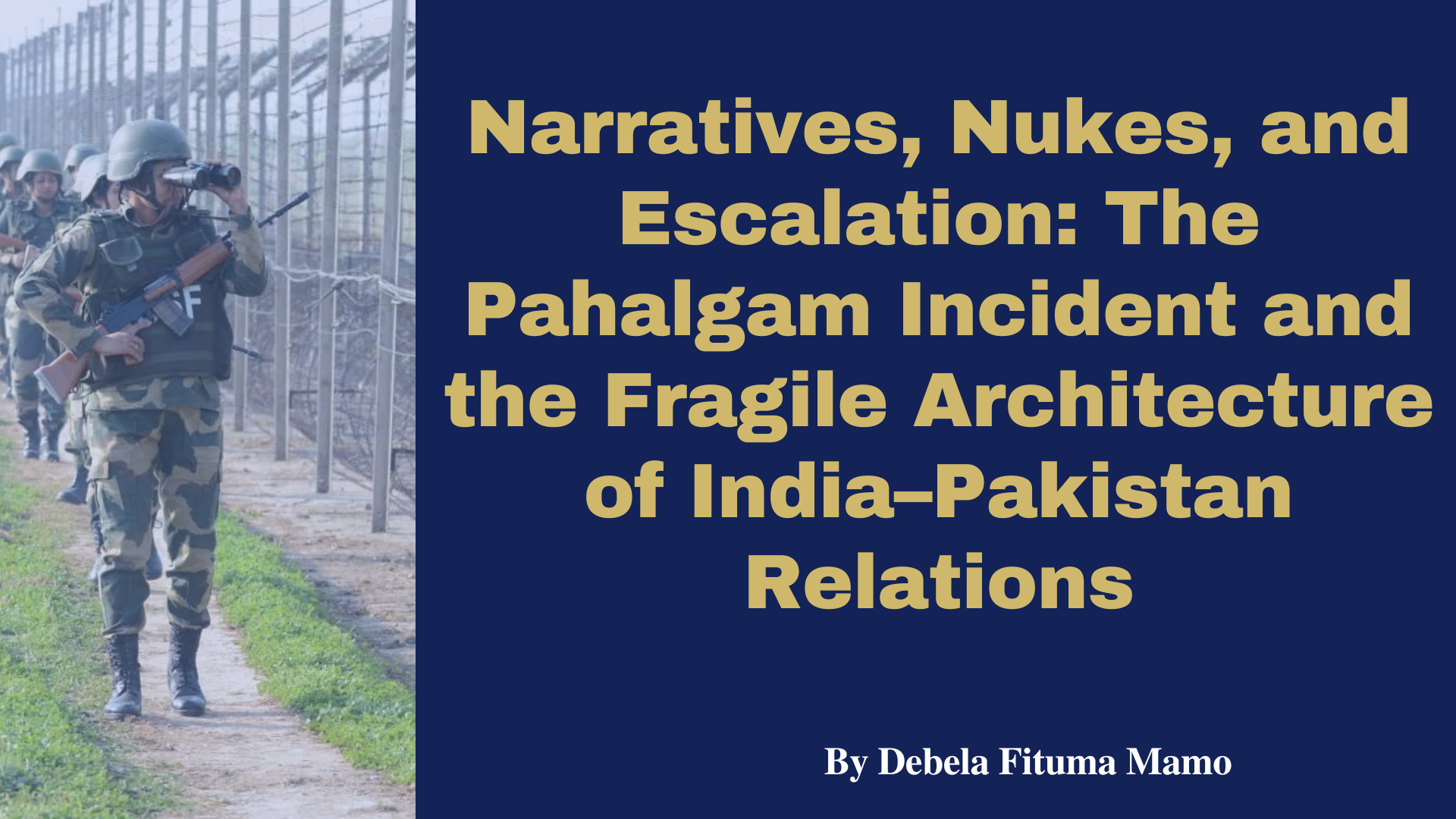
On April 22, 2025, India endured its most lethal attack on civilians since the 2008 Mumbai assaults. The carefully targeted ambush in Baisaran Valley, near the tourist hub of Pahalgam, resulted in the deaths of twenty-five Indian nationals and one Nepalese citizen and left over twenty others injured (Center for Preventive Action 2025). This singular episode reignited tensions between India and Pakistan, rapidly deteriorating an already precarious diplomatic landscape. In an era defined by nuclear deterrence, asymmetric warfare, and accelerating digital instability, such incidents no longer remain local tragedies, they risk cascading into regional or even global crises (Altaf & Javed 2025).
The antagonism between India and Pakistan remains one of the most enduring legacies of the 1947 partition of British India. The status of Jammu and Kashmir, contested on grounds both strategic and symbolic, continues to fuel confrontation. The post-colonial history of South Asia is marked by multiple full-scale wars, in 1947–48, 1965, and 1971, as well as the 1999 Kargil conflict and a sustained pattern of cross-border skirmishes that intensified between 2016 and 2018 and persisted into 2023 (Center for Preventive Action 2025). These hostilities have been punctuated by intermittent diplomatic overtures and trade agreements, yet these moments of promise have consistently given way to breakdowns marked by mistrust, unresolved grievances, and mutual recrimination (Center for Preventive Action 2025).
The Pahalgam incident represents not merely another chapter in this long and contentious history, but a potential inflection point. In its immediate aftermath, India adopted a series of retaliatory and deterrent measures with far-reaching implications. These included the reduction of High Commission personnel in both countries, the expulsion of Pakistani diplomats, heightened military alertness along the Line of Control (LoC), and the withdrawal of visa-free travel arrangements. Additionally, India suspended bilateral trade at the Attari crossing and unilaterally halted participation in the Indus Waters Treaty, a foundational agreement that regulates water-sharing between the two nations and critically affects Pakistan’s agricultural lifeline (Singh 2025; Center for Preventive Action 2025).
Pakistan, while swiftly condemning the attack and denying any state involvement, issued a reciprocal suite of policy countermeasures. It closed the Wagah border, suspended trade and air routes, rejected India’s suspension of the water treaty, and unilaterally withdrew from the Simla Agreement, the long-standing accord that governs the LoC. Moreover, it warned that any disruption to the flow of the Indus River would be interpreted as an act of war (Altaf & Javed 2025; India’s World 2025). These actions collectively underscore how limited the margin for diplomatic error has become, and how entrenched the culture of brinkmanship now is.
At the core of this conflict lies the persistent deployment of proxy actors, which continues to undermine efforts toward stabilization. The Resistance Front (TRF), initially assumed to be responsible for the attack, is widely understood as a proxy for the Pakistan-based Lashkar-e-Taiba, though it later issued a denial of involvement (India’s World 2025). Such groups allow Islamabad plausible deniability while continuing to erode India’s control in the Kashmir Valley. In contrast, India has emphasized direct, overt countermeasures including surgical strikes and intelligence-driven military operations (Singh 2025). The asymmetric nature of these tactics renders the conflict particularly volatile, with a high risk of escalation through either miscalculation or intentional provocation (India’s World 2025).
The regional reverberations of the incident were immediate and conspicuous. Expressions of solidarity with India poured in from across South Asia, Afghanistan, Bangladesh, Bhutan, Nepal, and Sri Lanka, as well as from key Indo-Pacific partners including Japan, South Korea, Taiwan, Indonesia, Singapore, Thailand, and Vietnam. West Asian powers such as Bahrain, Saudi Arabia, the UAE, Israel, Iran, Iraq, Jordan, Kuwait, Oman, and Qatar also denounced the attack and voiced support for New Delhi (India’s World 2025). This concerted regional response illustrates a growing consensus around the threat posed by cross-border terrorism and underscores the increasingly interconnected nature of South Asian security.
International condemnation followed swiftly, with over sixty countries and multilateral organizations issuing statements of concern (India’s World 2025). The United States categorically denounced the attack. Vice President DJ Vance remarked that “nothing can justify such a heinous act of killing tourists and civilians,” urging both India and Pakistan to act with restraint and prioritize regional stability (Center for Preventive Action 2025; Newsweek 2025). The U.S. position reflects its dual strategic calculus: deepening defense cooperation with India as part of its Indo-Pacific strategy, while maintaining a limited yet functional relationship with Pakistan focused on counterterrorism and nonproliferation.
China, as expected, adopted a more ambivalent tone. It extended condolences and condemned the violence without assigning culpability, instead calling for calm and an impartial investigation into the perpetrators (Center for Preventive Action 2025). Beijing’s stance reflects its enduring strategic alliance with Islamabad, reinforced by the China-Pakistan Economic Corridor (CPEC) and historical territorial alignments. The 1963 Sino-Pak border agreement, which granted China control over the Shaksgam Valley, a move unrecognized by India, continues to undergird China’s geopolitical calculus (Newsweek 2025). Chinese Foreign Ministry spokesperson Guo Jiakun stated that “China hopes that India and Pakistan will exercise restraint, work in the same direction, manage relevant differences properly through dialogue and consultation, and jointly uphold peace and stability in the region” (India’s World 2025).
Beyond conventional and diplomatic realms, the Pahalgam incident has illuminated the increasingly consequential role of digital warfare and emerging technologies in conflict escalation. New military capabilities, especially artificial intelligence and automated surveillance systems, have compressed decision-making timelines, leaving little room for strategic reflection (Altaf & Javed 2025). In this fifth wave of warfare, the battlefront has shifted into the digital domain where perception, narrative, and algorithmic influence shape national and international responses (Zia 2025).
Narrative manipulation and disinformation, deliberately seeded and virally propagated, have become tools of modern statecraft. In this environment, where cyberwarfare intersects with public opinion, facts are contested, trust is eroded, and national security decisions are increasingly influenced by the digital ecosystem. Artificial intelligence has already begun to influence early-stage targeting systems and threat assessment protocols, thereby reducing human control at critical junctures (Altaf & Javed 2025). This convergence of technological acceleration and strategic ambiguity heightens the probability of misjudgments, misfires, and potentially catastrophic spirals.
The Pahalgam incident, therefore, must be seen not as an isolated act of terror but as a manifestation of deeper, overlapping fault lines, historical animosity, strategic rivalry, regional polarization, and the weaponization of information. The conflict between India and Pakistan has evolved beyond physical borders and is now shaped by a convergence of cyber capability, nuclear deterrence, and the manipulation of global perception. In such a scenario, traditional instruments of diplomacy are no longer adequate.
If a pathway toward de-escalation is to be forged, it must involve more than the mere resumption of stalled dialogues. What is urgently needed is a reimagining of regional security architecture, one that incorporates not only conventional military safeguards but also mechanisms for managing digital warfare, narrative control, and AI-driven escalation. In the absence of such innovation, the India-Pakistan conflict risks becoming the first flashpoint of a new era of warfare, one defined less by borders than by bandwidth and less by armies than by algorithms.
References
Center for Preventive Action. 2025. Conflict Between India and Pakistan. Global Conflict Tracker.
Newsweek. 2025. Kashmir Map Shows Who Controls Territory in Contested Himalayan Region.
Singh, Ashish. 2025. India-Pakistan Conflict: Proxy Wars and the Crisis of Global Stability in a Nuclear Age. Countercurrents.org.
India’s World. 2025. Global Response to the Pahalgam Attack: From Sympathy to Strategy.
Zia, Ameena. 2025. Faultlines and Frontlines: Reframing the India-Pakistan Conflict in the Age of Narrative Warfare. The Friday Times.
Zohaib Altaf and Nimra Javed. 2025. One Small Mistake Could Trigger an Uncontrollable Escalation Between India and Pakistan. The Diplomat.
Photo credit (@nationalherald)
About the author
Mr. Debela Fituma Mamo is a researcher in the Institute of Foreign Affairs’ Asia and Pacific Affairs Department. He is reachable at debela.f.mamo@ifa.gove.et
Disclaimer:
The opinions stated in this article solely belong to the author and do not reflect the views or positions of the IFA