

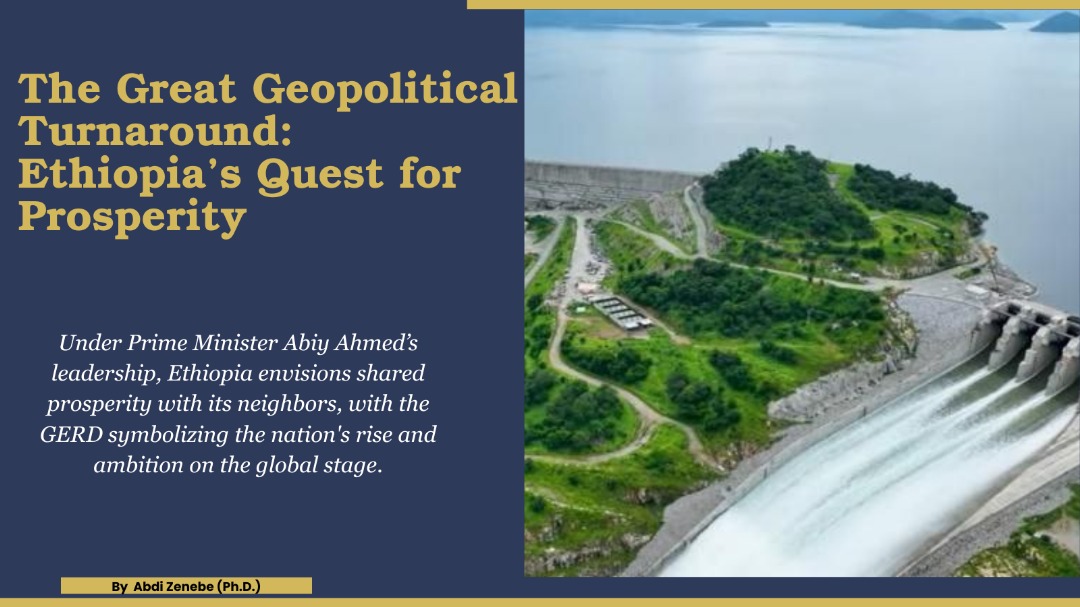
In the heart of Northeast Africa, Ethiopia is scripting a remarkable story of resilience, ambition, and transformation. Under Prime Minister Abiy Ahmed’s leadership, the nation has embarked on a journey to secure its future through strategic autonomy, energy independence, and a bold vision for regional cooperation. Food security is another pillar of Ethiopia’s quest for autonomy. By investing in agriculture and irrigation the government is reducing reliance on imported food and shielding the nation from global supply shocks. This focus on self-sufficiency complements Ethiopia’s broader strategy of building resilience against external pressures.
At the center of this transformation is the Grand Ethiopian Renaissance Dam (GERD), a project that has not only reshaped Ethiopia’s domestic landscape but also redefined its role in the region. This article explores how Ethiopia’s pursuit of prosperity through the GERD, food security, and a renewed quest for sea access is turning the tides of geopolitics in Northeast Africa.
The GERD: A Symbol of National Revival
Before 2018, the GERD was a dream teetering on the edge of collapse. Stalled by mismanagement and political inertia under the previous Ethiopian People’s Revolutionary Democratic Front (EPRDF) regime, the dam seemed destined to join the long list of unfulfilled projects that plagued Ethiopia’s past. Yet, under Abiy’s administration, the GERD roared to life, becoming a beacon of national pride and a testament to what Ethiopia could achieve when united.
The dam’s completion has brought far more than electricity. It has sparked a cultural and moral awakening among Ethiopians. For a nation accustomed to delays and failures in public projects, the GERD’s rapid progress set a new standard for excellence. It showed that Ethiopia could dream big and deliver. This shift in mindset is revolutionary, especially when contrasted with the EPRDF era, where even studying project failures could lead to disappearances or worse. Engineers, economists, and ordinary citizens lived in fear of questioning the status quo. The GERD changed that, fostering a culture of ambition and accountability.
Beyond its domestic impact, the GERD has been a game-changer for Ethiopia’s energy security. With a capacity to generate over 6,000 megawatts of electricity, the dam is powering homes, industries, and dreams across the country. It has reduced Ethiopia’s energy shortages and laid the foundation for economic growth. But its true significance lies in how it has emboldened Ethiopia to confront its geopolitical challenges head-on.
Breaking the Chains of Geopolitical Suffocation
For decades, Ethiopia faced a silent but suffocating crisis, what classical geopolitics calls the anaconda strategy: the lack of sovereign access to the sea. Landlocked since Eritrea’s independence in 1993, Ethiopia’s reliance on foreign ports for trade left it vulnerable to external pressures. Under the EPRDF, discussions about sea access were taboo, suppressed by a regime that treated the issue as a commercial inconvenience rather than an existential threat. This reluctance played into the hands of external actors who sought to keep Ethiopia weak and dependent.
The GERD changed the equation. This newfound energy wasn’t just felt at home. The completion of the GERD sent ripples across the entire region. Ethiopia, once struggling with “strategic exhaustion,” suddenly found its footing. Where before, discussions about gaining access to the sea were treated as a purely commercial matter, or worse, suppressed, they are now seen as a matter of vital strategic importance – an existential need, even. It’s like waking up from a long dream and realizing you’ve been missing something crucial all along.
By securing energy independence, Ethiopia gained the confidence to address its loss of “rimland”, coastal access, as a matter of survival. The dam provided the economic and moral leverage needed to elevate this issue on the regional stage. Today, Ethiopia is openly demanding sovereign access to the sea through peaceful means, a move that has stunned both friends and foes. The timing of this demand, during a period of national transition, may seem surprising, but it reflects a universal truth: nations seize moments of change to correct historical injustices and chart new paths.
Ethiopia’s quest for sea access is not about dominance but survival. With a population exceeding 130 million, the country cannot thrive without reliable trade routes. The GERD has given Ethiopia the credibility to make this case forcefully, showing the world that it can deliver on ambitious goals. Yet, the response from some regional actors, like Egypt, has been dismissive, with claims over the Red Sea that border on geopolitical overreach.
In other words, the GERD has given Ethiopia the leverage to demand serious consideration for its maritime aspirations. While some react with surprise or even hostility, few can deny the legitimacy of a 130-million-strong landlocked nation seeking direct access to global trade routes. Egypt’s hypocritical stance, lecturing others on maritime rights while monopolizing the Nile’s waters, only underscores the geopolitical double standards at play.
Meanwhile, global powers and the UN Security Council have focused on the GERD’s implications for Nile water sharing but sidestepped Ethiopia’s legitimate concerns about sea access. This double standard is fading, however, as Ethiopia’s persistence forces the world to acknowledge its long-denied rights.
The testament is already coming, several countries of the world have openly supporting the Ethiopia’s legal rights to have access to the sea.
A Vision for Collective Prosperity
Many wonder why Ethiopia is pressing this issue now, amid internal transitions and regional instability. The answer lies in the nature of transitions themselves, nations often recalibrate their ambitions during periods of change. Ethiopia is no exception.
Ethiopia’s transformation under Abiy’s leadership is not rooted in confrontation but in cooperation. The government has outlined peaceful options for securing sea access, all based on the principle of mutual benefit. In his recent address to the Ethiopian Parliament Abiy stipulated three different options that include political bargaining, shared values or commercial arrangements with an open call to attain other options from the brothers across the region and beyond.
Ethiopia envisions a region where prosperity is shared, not hoarded. This vision, encapsulated in Abiy’s philosophy of Medemer, rejects the zero-sum games of traditional geopolitics painted both in the form of realism and neorealism. Instead, it seeks strategic partnerships with neighbors like Somalia, Djibouti, Kenya, South Sudan, Sudan and Eritrea to foster collective growth.
The GERD has been a catalyst for this regional reawakening. By demonstrating Ethiopia’s commitment to self-reliance, it has positioned the country as a stabilizing force in the Horn of Africa. Ethiopia’s neighbors are beginning to see it not as a threat but as a partner capable of driving regional integration. Those who have sown fear and division in the region are losing ground as Medemer gains traction, quietly reshaping the Horn’s political landscape.The goal is to forge not just transactional relationships, where one side benefits at the expense of another, but deep, strategic partnerships with all its neighbors.
The Road Ahead
Ethiopia’s journey is far from complete. The country faces internal challenges and economic strains. Externally, resistance to its sea access ambitions persists, driven by actors who fear a strong Ethiopia. Yet, the GERD has shown that Ethiopia can overcome seemingly insurmountable obstacles. Its success has inspired a generation to believe in the nation’s potential, and its ripple effects are reshaping Northeast Africa.
The question is no longer whether Ethiopia deserves sea access or not rather it is the question of “how and when” Ethiopia will secure sea access remains open, but the government’s commitment to peaceful, cooperative solutions offers hope. By tying its prosperity to that of its neighbors, Ethiopia is charting a path that could transform the Horn of Africa into a region of shared growth and stability. The GERD, once a distant dream, is now a symbol of what is possible when a nation dares to reimagine its future. For the time, Ethiopia states clearly it is ‘better today than tomorrow’ for the good of our people and states alike.
Conclusion
Ethiopia has outlined peaceful, mutually beneficial solutions, ranging from port leases to shared infrastructure investments. Unlike past regimes that operated under rigid realist frameworks, Abiy’s administration embraces a vision of collective regional development. Ethiopia sees its future as intertwined with its neighbors, advocating for strategic partnerships over transactional deals.
Ethiopia’s quest for prosperity is a story of courage, vision, and transformation. The GERD has not only powered the nation’s homes but also ignited its spirit, proving that Ethiopia can rise above its challenges to claim its rightful place in the world. By securing energy and food independence and boldly addressing its need for sea access, Ethiopia is rewriting the geopolitics of Northeast Africa and the driving force has been nothing but a legitimate quest for prosperity.
About the Author:
Abdi Zenebe (Ph.D.) is a Deputy Executive Director of the Institute of Foreign Affairs.
Disclaimer:
The content disseminated by the Institute of Foreign Affairs (IFA) – including, but not limited to, publications, public statements, events, media appearances, and digital communications – reflects the views of individual contributors and does not necessarily represent the official positions or policies of the Institute, its partners, or any affiliated governmental or non-governmental entities.
While the IFA endeavors to ensure the accuracy, integrity, and timeliness of the information presented, it makes no representations or warranties, express or implied, regarding the completeness, reliability, or suitability of such content for any purpose. The Institute expressly disclaims any liability for errors or omissions, as well as for any actions taken or decisions made based on the information provided.
The inclusion of external links, references, or third-party resources does not constitute an endorsement by the Institute. Additionally, engagement on social media platforms – including, but not limited to, likes, shares, retweets (RTs), or reposts – shall not be interpreted as an endorsement or validation of the views expressed therein.
Readers and audiences are encouraged to exercise critical judgment and seek independent verification when interpreting or relying upon any information disseminated through publications and posts on the Institute’s platforms or representatives.