

Executive Summary
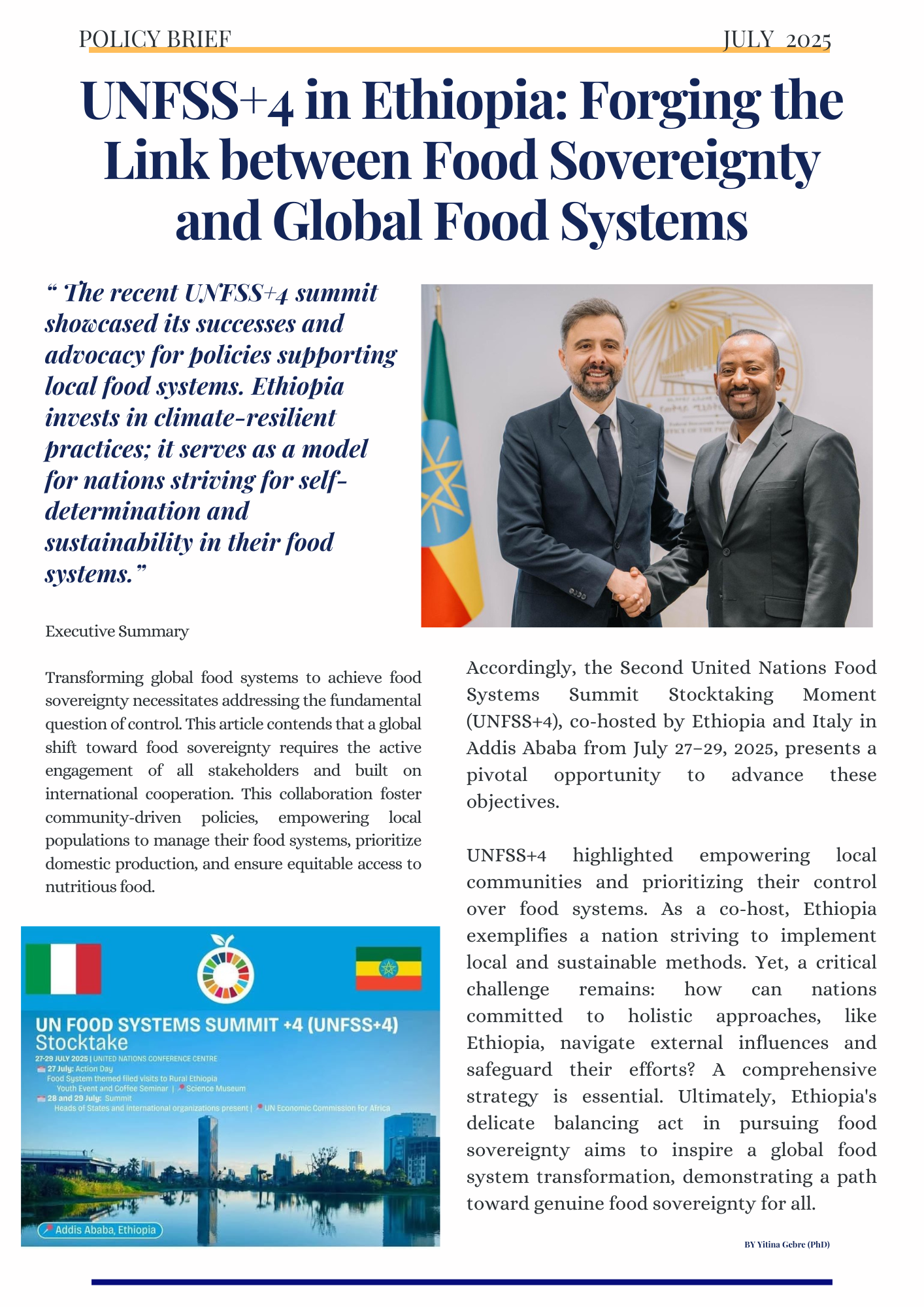
Transforming global food systems to achieve food sovereignty necessitates addressing the fundamental question of control. This article contends that a global shift toward food sovereignty requires the active engagement of all stakeholders and built on international cooperation. This collaboration foster community-driven policies, empowering local populations to manage their food systems, prioritize domestic production, and ensure equitable access to nutritious food. Accordingly, the Second United Nations Food Systems Summit Stocktaking Moment (UNFSS+4), co-hosted by Ethiopia and Italy in Addis Ababa from July 27–29, 2025, presents a pivotal opportunity to advance these objectives.
UNFSS+4 highlighted empowering local communities and prioritizing their control over food systems. As a co-host, Ethiopia exemplifies a nation striving to implement local and sustainable methods. Yet, a critical challenge remains: how can nations committed to holistic approaches, like Ethiopia, navigate external influences and safeguard their efforts? A comprehensive strategy is essential. Ultimately, Ethiopia’s delicate balancing act in pursuing food sovereignty aims to inspire a global food system transformation, demonstrating a path toward genuine food sovereignty for all
Introduction
Ethiopia’s pursuit of food sovereignty involves a delicate balancing act. While embracing modern agricultural technologies and foreign investment, the country also strives to maintain control over its food systems through inclusive resource management[1]. However, Ethiopia’s agricultural sector remains highly susceptible to climate change, environmental challenges, and economic dependencies, including reliance on donor funding and competition from subsidized imports. Addressing these interconnected challenges requires an integrated approach that secures land rights, promotes ecological farming, and encourages sustainable and locally relevant innovation[2].
Food sovereignty asserts the right of peoples to healthy, culturally appropriate food produced sustainably, and the right to define their own food and agriculture systems[3]. This puts the needs of food producers and consumers at the heart of food policies, prioritizing them over market demands and corporate interests. Emerging from grassroots movements of farmers, fishers, indigenous peoples, and landless workers, food sovereignty seeks to reclaim control over the food system by rebuilding connections between people, land, and food providers[4]. Rooted in struggles for control of food, land, water, and livelihoods[5], food sovereignty empowers communities to define their own food systems, strengthening local economies, supporting producers, and establishing fair trade practices. It shifts food governance away from corporations and global markets, prioritizing localized, sustainable practices, knowledge sharing, and social movements dedicated to justice and equity in agriculture[6].
Recognizing the urgent need for local solutions to persistent food insecurity, climate instability, and systemic vulnerabilities in the global food system[7] the United Nations organized the Food Systems Summit in 2021[8]. As UNFSS+4 approaches, Ethiopia’s decision to co-host this key event underscores its growing leadership in global food governance. The summit reflects Ethiopia’s commitment to building food systems that are safe, nutritious, and rooted in community values, allowing it to advocate for self-determination, sustainable agriculture, and culturally relevant food systems as a leading voice in Africa.[9]
Ethiopia’s Unwavering Commitment to Food Sovereignty
For Ethiopia, food sovereignty extends beyond simple food security, representing a fundamental right that empowers its citizens, particularly individuals, smallholder farmers, and pastoral communities. This right guarantees control over essential resources—land, water, seeds, and livestock—protecting them from external exploitation through community-based management and prioritized local access. In shaping its food policies[10], Ethiopia asserts its autonomy, reflecting its unique context and remaining independent of global trade pressures and donor impositions while embracing both traditional and modern agricultural practices[11]. These principles guide numerous initiatives that are significantly contributing to both national food sovereignty and a broader global transformation of food systems.
Ethiopia’s transformation from a major wheat importer, spending nearly $1 billion annually, to a net exporter and Africa’s leading wheat producer represents a significant stride toward food sovereignty. Spearheaded by Prime Minister Abiy Ahmed, large-scale dry-season wheat irrigation projects have not only enhanced the nation’s food resilience but have, for the first time, enabled it to export more wheat than it imports. The era of relying on millions of quintals of imported wheat to meet basic needs has ended.
Ethiopia’s success has been recognized by international organizations like the FAO, which acknowledges the country’s focus on wheat production as central to achieving food self-sufficiency[12]. Through strategies like expanding irrigated farming, utilizing improved seed varieties, and adopting modern farming techniques, Ethiopia has significantly increased its wheat yield and marketable surplus. This initiative has driven annual wheat production to an impressive 231 million quintals, not only eliminating wheat imports but also strengthening food and nutrition security, demonstrating Ethiopia’s tenacity in addressing global agricultural challenges[13].
Prime Minister Abiy Ahmed recently confirmed Ethiopia’s remarkable achievement in a televised interview, stating that the country has surpassed Egypt to become Africa’s largest wheat producer, tripling Egypt’s output. While this claim has faced some skepticism, it stands as a testament to the nation’s strategic agricultural policies and unwavering commitment to economic development. Furthermore, prominent global figures, including Bill Gates and African Development Bank President Akinwumi Adesina[14], have lauded Ethiopia’s agricultural progress, particularly its success in boosting wheat productivity, highlighting it as a potential model for sustainable development in Africa.
In 2024, Ethiopian Prime Minister Abiy Ahmed received the Agricola Medal from the Food and Agriculture Organization (FAO) of the United Nations, recognizing his leadership, vision, and dedication to nutrition and food security, particularly his pursuit of wheat self-sufficiency. This honor, bestowed in Rome, Italy, acknowledges both Ethiopia’s efforts to achieve food self-sufficiency and Prime Minister Ahmed’s inspiration to his people to pursue food security through resilience and sustainable development. The success of Ethiopia’s food sovereignty efforts is evident in its increasing wheat production, directly attributable to local initiatives like abandoning fragmented agricultural systems and adopting year-round cultivation. These homegrown solutions are further complemented by the Green Legacy Initiative (GLI), which focuses on soil health and water conservation.
Ethiopia’s commitment to food sovereignty is powerfully demonstrated through the Green Legacy Initiative (GLI), launched in 2019. This ambitious program has significantly increased the country’s planted areas, transforming coverage from 3% to 24%. As Harari Region’s Chief Administrator, Ordin Bedri, emphasized, the GLI is integral to Ethiopia’s national food sovereignty agenda, improving soil health through erosion prevention and enhanced nutrient cycling, directly benefitting agricultural productivity.
The primary goals of the Green Legacy Initiative are ambitious. As minister of agriculture Girma Amentie stated planting 50 billion trees by 2030, restoring 22 million hectares of deforested land, and increasing the country’s forest coverage from 15% to 30%[15]
Continuing this momentum, Prime Minister Dr. Abiy Ahmed launched the 2025 planting season under the theme “Renewal through Planting,” aiming to plant an unprecedented 7.5 billion seedlings nationwide. This initiative is more than just planting trees; it’s a foundational strategy for securing Ethiopia’s future by directly addressing food and water security, strengthening livelihoods, and enhancing overall climate change resilience. Restoring degraded lands and improving soil and water conservation directly boost agricultural productivity and ensure a sustainable resource supply. The focus on fruit and fodder trees directly invests in the nutritional well-being and economic stability of Ethiopian families, furthering food self-sufficiency[16].
The Ethiopian government’s call to action highlights the collective responsibility central to the initiative’s success and Ethiopia’s commitment to sustainable development and climate leadership. By participating, Ethiopians cultivate environmental stewardship and resilience, planting the seeds of hope for a secure, prosperous, and self-sufficient future. This key national program fundamentally enhances climate resilience, promotes sustainable agriculture, and builds robust food systems capable of withstanding environmental shocks. Combating desertification, promoting biodiversity, and enriching soil health, the Green Legacy Initiative directly contributes to Ethiopia’s food sovereignty, serving as a model for global food system transformation.
Launched in November 2022, Ethiopia’s ‘Yelemat Tirufat’ (Bounty of the Basket) program demonstrates the nation’s commitment to food sovereignty by directly tackling micronutrient malnutrition and building more resilient food systems[17]. Recognizing that micronutrient deficiencies – stemming from inadequate diets, limited access to fortified foods, and underlying socioeconomic factors – have severe consequences on growth, immunity, and cognitive development, ‘Yelemat Tirufat’ employs a multi-faceted approach centered on: (1) developing climate-smart household-level food production systems, (2) promoting nutritious food consumption, (3) strengthening institutional capacity for food security, and (4) ensuring effective project management, including responsible food utilization and sharing[18].
By prioritizing increased access to vitamin-rich foods, particularly dairy, eggs, chicken, and honey, the program directly addresses nutritional challenges often exacerbated by climate-induced drought. ‘Yelemat Tirufat’ also boosts the production of diverse food crops, improving nutrition security, empowering smallholder farmers, and strengthening local food systems. With over 20,000 villages engaged, ‘Yelemat Tirufat’ has significantly increased milk and egg production and created approximately 259,000 jobs annually, contributing to a food-sovereign Ethiopia. Sustained success in addressing micronutrient malnutrition requires a collaborative, multi-sectoral approach involving government, NGOs, civil society, and the private sector to overcome challenges like limited access to fortified foods and healthcare services, and insufficient public awareness.
Furthermore, Ethiopia has taken bold measures to transform its food systems since 2019. This commitment stems from a recognition of the urgent need for reform in global food systems, a need powerfully highlighted by the United Nations Food Systems Summit (UNFSS) announced in October 2019[19]. Following this call to action, Ethiopia actively engaged in the UNFSS process, joining over 150 other nations in this endeavor[20]. This engagement was prompted by the persistent global hunger crisis [Cite: FAO report on the state of global food security] and driven by Ethiopia’s deep commitment to food security, food sovereignty, the well-being of its citizens, and environmental sustainability[21]. In this context, Ethiopia embraced the UNFSS principles as a guiding framework for its own ambitious food system transformation agenda[22]
As a starting point, Ethiopia subscribed to the UNFSS Action Tracks and, in 2020, initiated a series of dialogue forums. These forums engaged diverse stakeholders to gather insights and perspectives on the challenges facing Ethiopia’s food system, facilitating discussions on key issues such as food production, distribution, consumption patterns, nutrition, and environmental sustainability. The culmination of these efforts was the National launch of the Ethiopian Food System Transformation and Nutrition (EFSTN) on 15 July 2021. The EFSTN is a comprehensive plan designed to address the multifaceted challenges of Ethiopia’s food system and promote sustainable and nutritious food production and consumption practices. It envisions a future where all Ethiopians have access to safe, affordable, and nutritious food, while ensuring the preservation of the country’s natural resources and biodiversity.
The EFSTN pathway is aligned with Ethiopia’s Homegrown Economic Reform Agenda, which aims to transform the country into an industrialized lower-middle-income country by 2025. It also aligns with and builds upon Ethiopia’s existing food systems policy ecosystem and key national programs, incorporating lessons learned from previous initiatives. The EFSTN Technical Synthesis summarizes the current state of Ethiopian food systems and introduces the game-changing solutions that form the basis of the EFSTN. Endorsing the technical synthesis, Ethiopia’s position statement guides implementation arrangements, timelines, roles, responsibilities, accountabilities, and resource requirements, as outlined in the EFSTN roadmap. The Agricultural Transformation Institute (ATI) provides technical expertise and assistance for the EFSTN, leading resource mobilization, partnership development, and communication efforts across the initiative[23].
Ethiopia’s commitment to self-determination is evident in its progress towards food sovereignty, notably reducing its dependence on foreign food aid through strategic investments in domestic production. This proactive, multi-pronged approach empowers Ethiopians to meet their own needs with dignity and autonomy, providing a potential blueprint for other nations. By prioritizing self-reliance, sustainable agricultural practices, and national policies that boost productivity while promoting environmentally sound farming, Ethiopia demonstrates global leadership in reshaping its food systems. This commitment is further exemplified by its “home-grown policy,” which embraces international expertise to strengthen localized food systems, moving beyond a rigid interpretation of food sovereignty to contribute to global food system transformation.
Unlike a purely control-oriented approach, Ethiopia’s resource management and technology adoption strategy is characterized by pragmatism and collaboration. Recognizing the widespread integration of modern techniques and genetic products, Ethiopia doesn’t pursue absolute control over its natural resources or reject all foreign technologies. Instead, it champions collaborative resource management, both domestically and internationally. This is reflected in its initiatives to encourage collaborative farming among neighboring farmers with fragmented landholdings and in its willingness to attract foreign investment in its rivers and land, while upholding a commitment to equitable water resource sharing with both regional and distant communities.
Ethiopia views food sovereignty not as a simple objective, but as a comprehensive endeavor realized through targeted programs and policies that address intertwined environmental, economic, and global challenges. The “Green Legacy” initiative mitigates climate change impacts on agriculture, improving environmental health and productivity[24] [25]. The ‘Yelemat Tirufat’ program addresses economic hurdles faced by smallholder farmers by enhancing their access to essential services and infrastructure[26] . Concurrently, efforts to maximize wheat and cereal production aim to reduce dependence on external actors and counteract the effects of subsidized imports[27]. While navigating biotechnology adoption, Ethiopia champions natural fertilizers and localized innovation to safeguard traditional farming knowledge[28]. Finally, addressing land tenure insecurity, particularly for women[29], is a key priority. Collectively, these initiatives illustrate Ethiopia’s holistic strategy to empower farmers, strengthen rights, promote self-reliance, and encourage sustainable technological progress.
In contrast to Ethiopia’s model, which integrates global food systems with localized practices and aspects of food sovereignty, the concept of food sovereignty fundamentally challenges the dominant neoliberal framework. This prevailing system, often characterized by corporate control and profit-driven efficiency, frequently disadvantages small-scale farmers, agricultural workers, and developing countries. Food sovereignty, conversely, champion’s agro ecological methods that prioritize local empowerment, ecological sustainability, and social resilience. Framed as a fundamental human right, it emphasizes cultural identity, self-determination, and democratic participation in food and agricultural policy. Achieving widespread food sovereignty necessitates collaborative efforts among governments, international bodies, and civil society. These interwoven perspectives highlight the need for a multidisciplinary understanding of the complex global food system.
Ethiopia Hosting UNFSS+4: A Significant Milestone
Ethiopia’s hosting of the UNFSS+4 event marks its growing global leadership in food systems transformation and food sovereignty. This leadership is underscored by three key factors: its successful localization of global food transformation systems while moving beyond traditional interpretations of food sovereignty; the event’s showcase of innovative homegrown solutions and unwavering political commitment to tackling complex food security challenges; and the firm establishment of Addis Ababa as a central and influential diplomatic hub, particularly for amplifying the voices and experiences of the Global South.
The significance of Ethiopia hosting UNFSS+4 lies in the multiple opportunities it presents for advancing both its national agenda and contributing to global food systems transformation. Strategically located, the conference offers an invaluable platform for sharing best practices, allowing Ethiopia to disseminate its valuable lessons learned and successful strategies to the international community. Moreover, it provides a crucial platform to advocate for policies that prioritize local food systems, empower smallholder farmers, and promote agroecology on a global stage. The event also facilitates attracting essential partnerships and investments for further agricultural development and food system strengthening. Ultimately, this enables Ethiopia to significantly shape global discussions towards a food sovereignty-aligned agenda, fostering greater self-determination in food policies worldwide. Finally, the conference is expected to boost tourism and the economy.
Policy Recommendations for Maximizing Impact
To effectively navigate the complex interplay between global food systems and national food sovereignty, Ethiopia should prioritize the following actions:
- Sustain Investment in Local Resilience: Continue robust investment in smallholder farmers and climate-resilient agriculture, recognizing them as the cornerstone of food sovereignty.
- Strategic Value Chain Development: Focus strategically on developing domestic value chains to enhance local production and significantly reduce dependency on imports, empowering local economies.
- Capitalize on Global Momentum: Leverage the energy, insights, and commitments generated from UNFSS+4 to drive concrete policy reforms and accelerate the implementation of national food system strategies.
- Uphold Fair Trade Principles: Promote trade regulations that respect and protect national food sovereignty and local markets, drawing inspiration from Ethiopia’s emphasis on self-reliance.
- Ensure Inclusive Stakeholder Participation: Facilitate broad and meaningful participation from various stakeholders, including farmers, civil society, and the private sector, in the post-summit follow-up process to ensure diverse perspectives are included and sustained.
- Advocate for Global Integration of Food Sovereignty: Advocate for the deeper and more systematic integration of food sovereignty principles into global food policy frameworks to ensure sustainable, equitable, and autonomous food systems worldwide.
[1] Jayne, T.S., Chamberlin, J., Headey, D.D., & Sitko, N.J. (2019). How can Africa transform its agriculture? IFPRI Research Report 173. International Food Policy Research Institute (IFPRI).
[2] Friis, H., & Keil, A. (2020). Rethinking agricultural policy in Ethiopia: Towards a more inclusive and sustainable approach. Development Policy Review, 38 (6), 764-781.
[3] Declaration of Nyéléni. (2007). Declaration of Nyéléni: First Global Forum on Food Sovereignty. Retrieved [Insert date you accessed the website] from https://nyeleni.org/spip.php?article290
[4] Desmarais, A. A. (2007). La Vía Campesina: The Globalization of Food and Farming. Pluto Press.
[5] Declaration of Nyéléni, (2007). U.S. Food Sovereignty Alliance: https://usfoodsovereigntyalliance.org/what-is-food-sovereignty/
[6] Dercon, S., & Gollin, D. (2019). Agriculture in African development: Theories and strategies. Annual Review of Resource Economics, 11(1), 313–335.
[7] IPCC. (2022). Sixth Assessment Report: Climate Change 2022 – Impacts, Adaptation and Vulnerability. Intergovernmental Panel on Climate Change.
[8] United Nations. (2019). Secretary-General Announces Bold Steps to Transform Food Systems
[9] UN Food System submit+4.2025, Second United Nations Food Systems Summit Stocktake (UNFSS+4) Addis Ababa, Ethiopia | 28 to 29 July 2025
[10] Rahmato, D. (2011). *Land and agrarian issues in Ethiopia*. Forum for Social Studies.
[11] Jayne, T.S., Chamberlin, J., Headey, D.D., & Sitko, N.J. (2019). How can Africa transform its agriculture? IFPRI Research Report 173. International Food Policy Research Institute (IFPRI). (This report discusses general challenges, and how African nations try to balance modern needs with local control.)
[12] FAO. (2021). The State of Food and Agriculture 2021. Food and Agriculture Organization.
[13]Ethiopia News Agency.2025: Ethiopian Soof Security’s in the New Era
https://www.ena.et/web/eng/w/eng_6743987
[14] President Akinwumi Adesina Speech; https://www.youtube.com/watch?v=LkcfoojS4wk
[15] United Nations Environment Programme (UNEP). (2021). The Green Legacy Initiative: A pathway to sustainable ecosystem restoration in Ethiopia. https://www.unep.org/ethiopia-green-legacy-report-2021
[16]Abiy Ahmed (PhD) speech,2025.June https://www.youtube.com/watch?v=ipUlMgSXS10
[17] Abiy Ahmed speech. 2024. https://www.youtube.com/watch?v=m2t7MDY-VvQ
[18] Ethiopia News Agency.2025: Ethiopian Soof Security’s in the New Era
https://www.ena.et/web/eng/w/eng_6743987
[19] United Nations. (2019). Secretary-General Announces Bold Steps to Transform Food Systems
[21] FAO (Food and Agriculture Organization). The State of Food and Agriculture website: [www.fao.org] (www.fao.org)
[22] HLPE (High Level Panel of Experts on Food Security and Nutrition). (2017). *Sustainable food systems for nutrition*. [http://www.fao.org/hlpe/en/](http://www.fao.org/hlpe/en/)
[23] Ethiopia agricultural Transformation Institute. https://ati.gov.et/food-systems/?cid=mc_mini_widget-6&mcat=1
[24] FAO. (2021). The State of Food and Agriculture 2021. Food and Agriculture Organization.
[25] World Bank. (2020). Ethiopia Country Environmental Analysis. World Bank Group.
[26] Dercon, S., & Gollin, D. (2019). Agriculture in African development: Theories and strategies. Annual Review of Resource Economics, 11(1), 313–335.
[27] Oxfam. (2014). trading away our rights: Women working in global supply chains. Oxfam International.
[28] Scoones, I. (2015). Sustainable agriculture and the politics of knowledge: Genetically modified crops in developing countries. Routledge.
[29] Holden, S. T., & Ghebru, H. (2016). Land tenure reforms, tenure security and food security in poor agrarian economies: Causal linkages and research gaps. Global Food Security, 10, 21–28.
About the Author
Yitina Gebre (Ph.D.), Multilateral Research Affairs Director General, Institute of Foreign Affairs
Disclaimer:
The content disseminated by the Institute of Foreign Affairs (IFA) – including, but not limited to, publications, public statements, events, media appearances, and digital communications – reflects the views of individual contributors and does not necessarily represent the official positions or policies of the Institute, its partners, or any affiliated governmental or non-governmental entities.
While the IFA endeavors to ensure the accuracy, integrity, and timeliness of the information presented, it makes no representations or warranties, express or implied, regarding the completeness, reliability, or suitability of such content for any purpose. The Institute expressly disclaims any liability for errors or omissions, as well as for any actions taken or decisions made based on the information provided.
The inclusion of external links, references, or third-party resources does not constitute an endorsement by the Institute. Additionally, engagement on social media platforms – including, but not limited to, likes, shares, retweets (RTs), or reposts – shall not be interpreted as an endorsement or validation of the views expressed therein.
Readers and audiences are encouraged to exercise critical judgment and seek independent verification when interpreting or relying upon any information disseminated through publications and posts on the Institute’s platforms or representatives.