

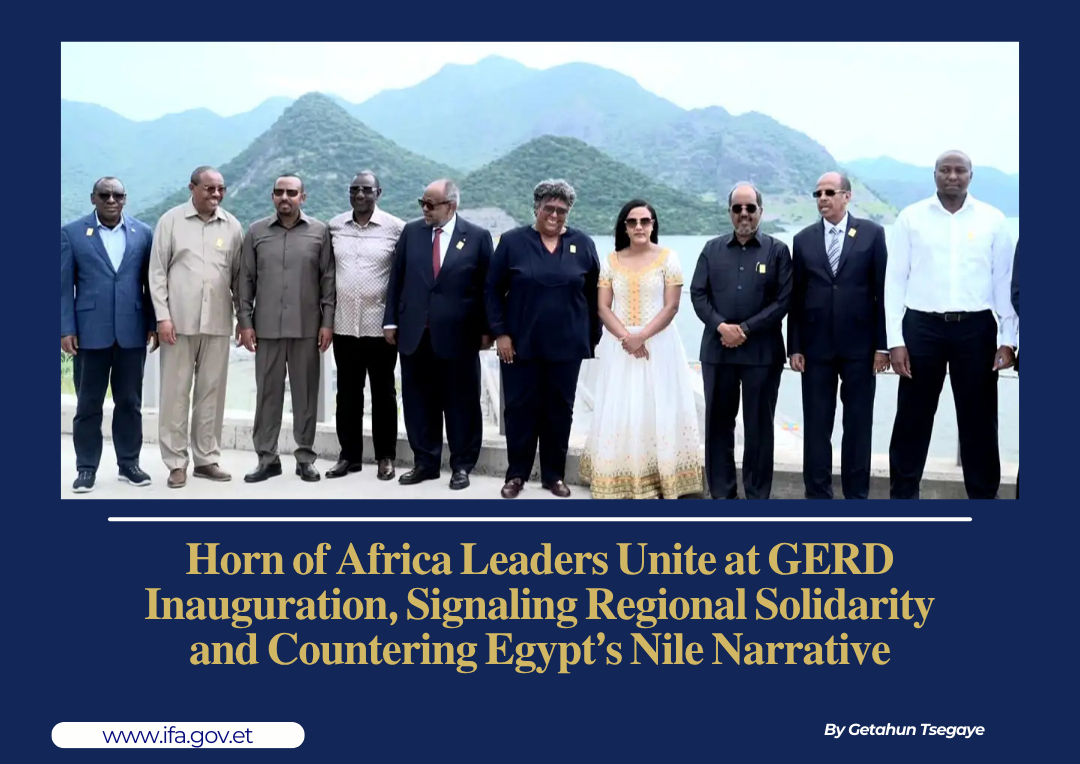
The attendance of neighboring heads of state during the inauguration of the Grand Ethiopian Renaissance Dam (GERD) demonstrates a moment of Horn of Africa solidarity, countering narratives that GERD is solely Ethiopia’s concern.
Since its inception in 2011, Ethiopia has consistently called on the lower riparian countries, Sudan and Egypt, for fair and equitable utilization of the Abbay River [Nile]. However, Egypt has persistently cast doubt on Ethiopia’s legitimate call, clinging to colonial-era treaties that completely excluded Ethiopia, the source of more than 85% of the Nile’s waters.
Egypt has attempted to frame the GERD as a source of tension, instigating Sudan and using proxy measures against Ethiopia through neighboring countries. The presence of the heads of state of Somalia, Djibouti, and Kenya—all from the Horn of Africa—during the GERD inauguration marks a landmark diplomatic shift in favor of Ethiopia and the wider Horn, projecting GERD not only as a national project but also as a regional one benefiting the entire region.
Despite Somalia’s growing alignment with Egypt (particularly regarding Red Sea and Nile politics), President Hassan Sheikh Mohamud’s presence at the inauguration is significant. During his remarks, he acknowledged the GERD’s importance as an anchor symbolizing the common wealth of the Horn of Africa. He emphasized Somalia’s commitment to unwavering regional peace and integration, recognizing that GERD benefits not only Ethiopia but also Somalia and the region at large. His presence signals a diplomatic gesture that could bolster the Ankara Declaration with Ethiopia—an agreement granting Ethiopia sea access via Somalia. It may also represent a balancing act: supporting Somalia’s historically, socially, and economically tied neighbor Ethiopia, while maintaining strategic ties with Egypt.
Djibouti, another strategic Horn of Africa state, also endorsed the GERD through its president, Ismaïl Omar Guelleh, who called the inauguration a historic day and described the GERD as an African project. Djibouti, host to multiple foreign military bases—including those of the U.S., China, France, and Gulf States—sent a message of neutrality and interest in regional stability by attending the event. President Guelleh’s framing of the GERD as an African project, rather than merely an Ethiopian one, reinforces this stance. Ethiopia has already begun exporting electricity to Djibouti, and President Guelleh’s speech suggests Djibouti’s interest in strengthening electricity interconnections and economic cooperation.
President William Ruto’s presence further reflects Kenya’s support for Ethiopia’s development sovereignty and its role in promoting cooperative regional infrastructure. In his keynote speech, he described the day as a moment of monumental historical significance—both a feat of engineering and a bold affirmation of Africa’s capacity to shape its own destiny. Kenya, which has positioned itself as a diplomatic hub in the Horn through efforts such as the Nairobi Process, Somalia peace talks, and regional mediation, views the GERD as a building block of trust and regional integration. Since Kenya has already begun accessing GERD electricity, the dam serves as a foundation for cooperation and shared destiny in the Horn.
The GERD’s inauguration is also a diplomatic asset showcasing African leadership. The attendance of regional leaders strengthens Ethiopia’s stance against Egypt’s claims of “historical rights” based on colonial-era treaties that excluded Ethiopia. While Egypt has consistently countered Ethiopia’s position by aligning with Sudan, Gulf States, and occasionally Horn states, Ethiopia has stood firm, asserting its legitimate right to use the Nile while calling for cooperation guided by the principle of Limited Territorial Sovereignty—ensuring equitable utilization of trans-boundary rivers. The GERD inauguration can be read as Ethiopia consolidating neighborly support to counter Egyptian influence.
Moreover, the GERD inauguration marks a cornerstone in energy diplomacy and regional integration. The presence of Horn leaders reflects the project’s practical benefits. Kenya, Djibouti, and Somalia all face energy shortages—Ethiopia already exports electricity to Djibouti and Kenya, and Somalia could also benefit. This positions the GERD as an economic driver of regional integration, reducing dependence on external powers.
Ultimately, the attendance of Horn leaders underscores that the GERD is an African matter. Ethiopia has consistently adhered to the principle of “African solutions to African problems,” framing the dam as a matter of African cooperation rather than external intervention. The event highlights Ethiopia’s unwavering commitment to regional integration and demonstrates that Egypt must reconsider its refusal to embrace Ethiopia’s call for shared development.
About the Author
Getahun Tsegaye is a dedicated and versatile professional with extensive experience in education, healthcare, journalism, and non-profit leadership. He possesses a strong skill set in teaching, curriculum development, medical assistance, patient care, and freelance writing. As the founder and executive committee member of a youth-focused NGO, Getahun actively promotes peace, security, and regional cooperation.
He holds advanced degrees in Global Studies and International Relations, as well as a Master’s in Peace and Security.
Getahun is committed to fostering collaboration and understanding within the Horn of Africa, striving to enhance regional stability and development through his work and advocacy.
You can reach him at getishgift@gmail.com.
Disclaimer:
The content disseminated by the Institute of Foreign Affairs (IFA) – including, but not limited to, publications, public statements, events, media appearances, and digital communications – reflects the views of individual contributors and does not necessarily represent the official positions or policies of the Institute, its partners, or any affiliated governmental or non-governmental entities.
While the IFA endeavors to ensure the accuracy, integrity, and timeliness of the information presented, it makes no representations or warranties, express or implied, regarding the completeness, reliability, or suitability of such content for any purpose. The Institute expressly disclaims any liability for errors or omissions, as well as for any actions taken or decisions made based on the information provided.
The inclusion of external links, references, or third-party resources does not constitute an endorsement by the Institute. Additionally, engagement on social media platforms – including, but not limited to, likes, shares, retweets (RTs), or reposts – shall not be interpreted as an endorsement or validation of the views expressed therein.
Readers and audiences are encouraged to exercise critical judgment and seek independent verification when interpreting or relying upon any information disseminated through publications and posts on the Institute’s platforms or representatives.